Friday, 5 June 2015

The Rhinoceros That Died in Nottinghamshire in 1754

Each issue of Archives of Natural History produced by the Society for the History of Natural History usually contains much that is interesting and informative. The current issue is no exception. As I was leafing through it, my eye fell on the account a rhinoceros in Nottingham in the 1700s.  A rhinoceros in Nottingham—and Derby—and even Edinburgh—in the 1700s? I was soon reading the whole article.

By searching in digitised newspaper archives Caroline Grigson of the Institute of Archaeology at University College London has added to what was already known of the import and display of Indian rhinoceroses in Britain in the 18th Century1. The first, a female, arrived from Calcutta on 1 October 1737 (a male had died en route); the second, a male, in 1739; the third, a female, probably in 1756.

There is a long tradition of curiosities being taken around the country to be exhibited at fairs and at inns and public houses by showmen, either as individual animals or in the larger menageries seen at fairs, wakes and circuses. But the toting of an adult rhinoceros around Britain must have presented a considerable logistical challenge. Grigson, shows that the first animal was in London in 1740 and 1741 when she was “upwards of five foot high” and “twelve feet two inches from the nose to the rump”, Derby in 1742 (112 miles from London) then Burton-on-Trent and Lichfield before returning to Derby. She is recorded in Norwich in 1744 and then in 1747 in Edinburgh (over 400 miles from London). In 1749 she was back in England, at Nottingham. By the end of 1751 the female rhino was in London, housed in several inns in succession (one presumes in the stables); at this time she weighed 80 cwt or, whatever the definition of hundredweight being used, 4 tonnes or so. Somebody else can do the calculation of how many horses were needed to pull such a load along the turnpikes.

The paragraph which caught my eye initially was on the demise of the rhinoceros:

     The noble rhinoceros took to the road again and died shortly before 8 March 1754 when it was reported in the Derby Mercury that
The famous rhinoceros which was about four Years ago shewn in the White-Hart in this Town…was taken ill upon the Road from Mansfield to Nottingham, and died upon the Forest, near Red-Hill, on Thursday, to the great Loss of the Proprietor, Mr Pinchbeck. Who purchased it of Mrs Parsons some time since…
Redhill is four miles north of Nottingham on the road (now the A60) to Mansfield. In the 1700s and beyond a guide could be hired to ensure that the traveller did not get lost in Sherwood Forest, the southern limit of which was Redhill.

So, there is a conversation stopper for the pubs of Nottingham tonight. If you are tired of the endless discussion of the performance of County and Forest on the football field or the less than perfect start to the cricket season for the county side at Trent Bridge, just ask the question: Did you know an Indian rhino died at Redhill in 1754? You could also muse on what happened to the beast after it died and whether its skin and skeleton were preserved somewhere in the hope of making a profit after its loss as a live exhibit to the proprietor. Finally, as your friends’ eyes glaze over you could point out that the first rhino to reach Nottingham was not the first rhino to reach London. That one arrived in 1684 on the East Indiaman Herbert under a Captain Udall2.

A very much alive Indian Rhinoceros
Kaziranga National Park, Assam, 2007


1Grigson C. 2015. New information on Indian rhinoceroses (Rhinoceros unicornis) in Britain in the mid-eighteenth century. Archives of Natural History 42, 76-84.

2Rookmaaker LC, Jones ML, Klös H-G, Reynolds RJ. 1998. The Rhinoceros in Captivity. A list of 2439 Rhinoceroses Kept from Roman Times to 1994. The Hague: Kluger.


Tuesday, 2 June 2015

Aquarists and Fish-keeping in the 20th Century. Part 6: Charles Schiller and the Hispaniola at Scarborough

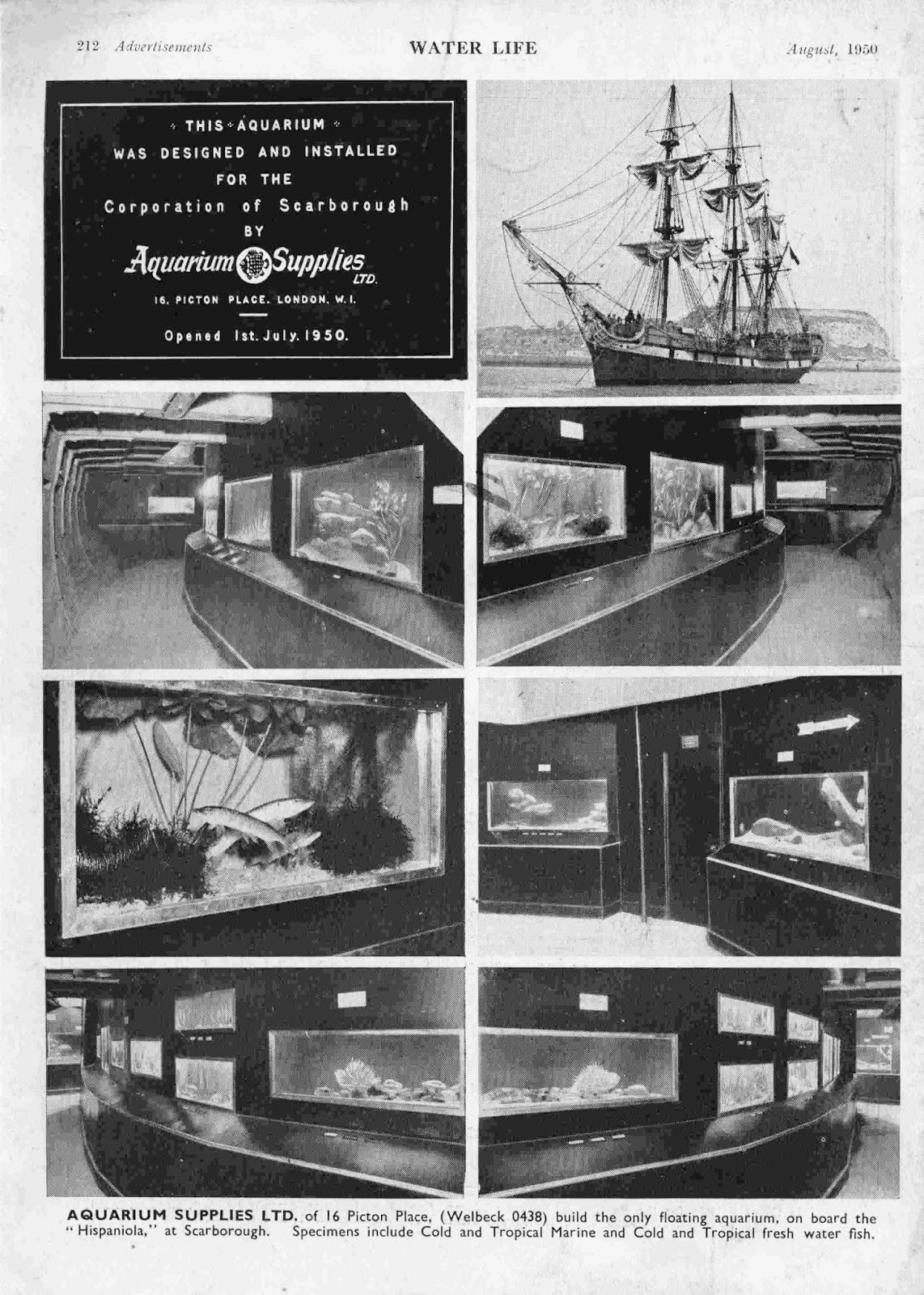
British seaside towns in the 1950s were in the business of attracting holidaymakers and animal exhibits of one kind or another often filled the bill. Aquariums were (and still are popular) especially on wet days in towns where boarding house landladies turfed their inmates out after breakfast and locked the door until 'tea' time, sometime after 5 pm. Scarborough, a Yorkshire town on the east coast of England, always competed hard to attract the holiday pound. In 1949, the town corporation had built a boat with a pirate crew to sail across the freshwater mere to an islet covered in sand from the beach. Once there the children carried with their parents could dig for buried treasure. How do I know this? Well, I was one of the children but I apparently refused to dig for treasure; I was not going to be shouted at by some piratical slavedriver and join a bunch of thugs throwing sand everywhere. So, with the full dignity of a five-year old I withdrew my labour. The whole venture was an enormous success for Scarborough, if not for me, and ran in the holiday season for many years. The pirate 'ship' was called the Hispaniola. However, Scarborough then acquired another Hispaniola, an ocean-going vessel built in the 1880s and named Ryelands that had starred in the 1950 Disney film Treasure Island. This one was moored in the harbour and this is where Charles Schiller appears in the story.

Charles Schiller's company, Aquarium Supplies, built a public aquarium in this second Scarborough Hispaniola in 1950. This is from Water Life and Aquaria World of August-September 1950:

...Internally, the ship's structure has been considerably altered to accommodate the large tanks in which fish from all parts can be seen in surroundings made to represent as near as is possible their natural haunts.
     Largely responsible for the co-ordination of the work of setting up the tanks is Miss Joyce Noble who comes from Durban, South Africa and who, with the advice given by technologists from laboratories and research stations, took steps to ensure that the correct effect was achieved in each separate section. The photograph below shows her on the deck of the vessel where only a short while ago fierce mock fights and walking the plank episodes were undertaken. Miss Noble was carrying out the more peaceful task of selecting samples of rockwork and is seen holding a particularly fine piece of pure white coral from the Great Barrier Reef, presented by the local museum. The other picture shows that Miss Noble herself gets into appropriate dress to seek out suitable material from stretches of the coast.
     From what I hear of the project, I think that the Scarborough authorities are to be congratulated on the venture and Aquarium Supplies, Ltd, on the way they have made a first-class job of the conversion and setting-up. I have no doubt that aquarist's [sic] societies from all over the country will be keen to arrange day outings to this well-known Yorkshire seaside resort and to make a visit to the Hispaniola the chief event of the day.
     For those unable to make a trip there for the time being, I am hoping to be able to give a description of the aquarium in a later issue, detailing the construction of the tanks and listing the creatures to be seen.
     Incidentally, whilst mentioning Aquarium Supplies, Ltd. it was this firm which set up the aquarium in the Ideal Homes Exhibition, Berg House illustrated in the last issue.
     Mr. Schiller, assisted by Miss Joyce Noble, was responsible for designing the layout of aquariums in the homes of a number of well-known people, including Lord Rothermere, Miss Gracie Fields, and the Western Brothers. Another achievement of the firm was to secure the commission to install a tank in Buckingham Palace.

It is not surprising that Charles Schiller had a full-page back-cover advertisement in the same issue:


The floating aquarium was called the Hispanioquarium. The ship then apparently soon moved to appear as Moby Dick to Morecambe, another town trying to attract holidaymakers, but was destroyed by fire in 1970. There is no mention of the aquarium still being present.

Saturday, 30 May 2015

Rovinj Marine Biological Laboratory in 1964. Part One

A SECOND PART has been added on 11 August 2020. It can be found HERE.
----------------

A marine biology field trip was part of every zoology degree in the 1960s. For those of us in second year at Sheffield in 1964 we were not to enjoy the delights of the Robin Hood’s Bay Marine Laboratory—the usual venue—and the temperatures of the North Sea in March. Instead we were going Yugoslavia and the Marine Station at Rovinj on the Istrian coast. The Adriatic seemed much more appealing than the North Sea.

How the trip to Rovinj came about was, we recall, down to a former Sheffield student married to a Yugoslav who had become manager of the new hotel a short walk from Rovinj. Visiting Sheffield she persuaded John Ebling (1918-1992) of Rovinj’s possibilities not only for the marine life but also for side visits including the nearby Limski ‘fiord’, the Roman amphitheatre at Pula and, just within reach for a day, Venice.

When I scanned all my old slides a few years ago I came across the photographs I had taken on the Rovinj trip. I also realised that I knew nothing of the history of the Rovinj marine laboratory, or indeed whether it had survived to the present century. I do recall that the Sheffield staff (faculty for American readers) found it difficult to make contact with the inhabitants of the laboratory, of which I remember seeing only two, both dressed in those immense white labcoats that nearly reached the floor and favoured by Central and East European scientists of the time. We were asked not to wander from the large laboratory into the nether reaches of the building but one day John Ebling did venture back there to make some degree of contact with the locals and on his way seen a very large glass tank containing a shoal of cuttlefish. He managed to persuade those in charge that we lesser mortals should see that sight and it was one not to be missed. The shoal moved as if joined by invisible thread with the individuals changing colour and pattern in a display that was not only bewildering but also in unison.

Here is my photograph of the Rovinj Marine Biological Station taken in late March 1964 (my old passport shows entry to Yugoslavia on 17 March and exit on 1 April):

Rovinj Marine Biological Station. March 1964

I now find that the Rovinj laboratory is a constituent of Croatia’s Rudjer Boskovic Institute and still operating as a marine biological laboratory. I then found papers on its history. It was founded in 1891 as a field station of the Berlin Aquarium Unter den Linden (1869-1910), a commercial operation that also displayed non-aquatic animals including the first gorilla in Germany. Rovinj as a town in Istria was then part of the Austro-Hungarian empire. After the First World War Istria was under Italian rule and the laboratory came to fall under the aegis of an Italian-German consortium with a co-director appointed from each side by the Royal Italian Oceanographic Committee and the Kaiser Wilhelm Gesselschaft. At the end of the Second World War, the laboratory was closed for three years. Istria became part of Yugoslavia and the national academy took charge. That was obviously the state when we were there in 1964. With the breakup of Yugoslavia, Rovinj became part of Croatia in 1991. With such upheavals it is hardly surprising that the laboratory, its library and its reference collections suffered. The books, papers and specimens were moved to Italy in 1943 and it would appear that the building was wrecked.

The original purpose of the Rovinj marine station was to supply living organisms to the Berlin Aquarium. It also came to supply living and preserved materials throughout Europe. The histories shown below explain how it came to acquire a research function through the activities of Rudolf Virchow (1821-1902) famous as the ‘father of modern pathology’ and for cell theory but infamous for his opposition to Darwin.

In 1964 the laboratory had a small boat, Bios, shown here at Rovinj. She took us on a cruise up the Limski ‘kanal’, a ria where oysters and mussels were grown in large numbers. On a cold, damp day light relief was provided by the exploration of the set of the not-worth-watching movie, The Long Ships, which had recently been filmed there.

Bios, the laboratory's boat. March 1964

We all stayed at the Hotel Jadran. It had been built before the First World War to attract tourists to the town. Much Prošek (a name now banned by the EU) was consumed after dinner. On Easter Sunday (29 March) we were given boiled eggs for breakfast that had been died a deep, virulent purple. The lurid eggs put some of the ladies who may have consumed too much Prošek the evening before off consuming them but a male student who obviously loved eggs worked his way through them; I lost count after he got to six.

Rovinj with Hotel Jadran (centre). Photographs were Agfacolor
slides now notorious for deteriorating with time
The pace of marine biology was not taxing and we had an afternoon trips to Pula with its Roman amphitheatre as well as a whole day by bus to Venice. The countryside was alive with lizards warming themselves in the spring sunshine and breeding amphibians. The chorus of hundreds of tree frogs in the bushes surrounding a pond was unforgettable. The reptiles and amphibians of Istria were little known in the English-speaking world at that time and we published a note* on what we had found.

One of the lizards, Algyroides nigropunctatus; a male

Other photographs I took can be seen on Flickr.

PART TWO was added on 11 August 2020. It can be found HERE.


----------------------------


These two papers describe the history of the Rovinj marine laboratory and include references to earlier descriptions:

Lucu, Č & Marsoni, SS. 2013. Tribute to Professor Massimo Sella - former scientist and Director of the Marine Biological Station in Rovinj - on the occasion of the 120th anniversary of marine research in Rovinj (1891-2011). Periodicum Biologorum 115, 105-108.

Zavodnik, D, Zavodnik, N & Iveša, L. 2001. The 110th anniversary of the marine research station at Rovinj (Adriatic Sea, Croatia). Reference collections. Nat. Croat. 10, 53–60.

*Peaker, M & Peaker, SJ. 1968. Spring herpetofauna of the Rovinj area (Istria, Yugoslavia). British Journal of Herpetology 4, 36‑37

Thursday, 7 May 2015

Asiatic Lions: A Conservation Success Story

If, like me, you were under the impression that the Asiatic or Indian Lion was confined to overgrazed degraded habitat with its only stronghold the Gir Forest in Gujarat then you would be wrong. The Asiatic Lion is a conservation success story, as we found when in Gir in April. The population is now spread well beyond the old hunting park of the Nawab of Junagadh, as young animals have left ranges occupied by established prides. Details of the 2010 Census (411 animals in all) are shown on the local wildlife conservations trust's Asiatic Lion website.

Early morning in Gir

At a population level, the only threat to their remaining a viable wild population would appear to be the outbreak of an infectious disease. At an individual level, lions living outside the protected areas get killed by trains and road traffic, and seem, judging by reports in local newspapers, prone to falling down wells; some are killed by farmers but we were told that a rapid compensation scheme for cattle and buffaloes taken by lions now keeps the nomadic herders, the Maldhari people, onside.

Young lioness in the late afternoon

Lions need food and a marked feature of management of the Gir complex of parks and sanctuaries has been the increase in the number of wild ungulates, from 10,000 in 1974 to 50,000 in 2005 (54 per lion in 1974; 139 in 2005). Water troughs, cleaned and filled by water tanker during the dry season, and a reduction in the number of domestic ungulates as Maldharis have been resettled, appear to have been important in improving the habitat across Gir.

Traditionally, the view was taken that the lions of Gujarat had been through a severe population bottleneck in the early years of the 20th Century when the population was thought to be under twenty.  Whether this information was correct and whether more recent studies on genetic variation are reliable (some suggesting inbreeding depression, others showing heterozygosity) are open to question. From my quick reading of the literature, the research effort on Indian lions should be aimed urgently at determining the amount of genetic variation because management strategies in situ and ex situ depend on that knowledge.

Since the lion's original range extended as far east as Bengal, the establishment of viable populations in the wild far enough away from Gir to prevent the spread of disease would seem an obvious move. Attempts to reintroduce lions outwith Gujarat seem mired in politics, with the state government opposing plans to establish a population in Madhya Pradesh. State pride in conserving the lions does not, it appear, extend to letting anybody else in on the act. I have been unable to determine the current state of play in this silly squabble.

In terms of ex-situ conservation, there are captive populations in India and Europe. The sorry tale of cross-bred African and Indian lions in zoos need not concern us here. A breeding programme started at Sakkarbaug Zoo in Junagadh but now including other zoos in India has produced nearly 200 offspring. It is these animals that have been exported to European zoos.

Our visit to Gir coincided more or less with the Zoological Society of London's announcement on building a new enclosure for Asiatic Lions and collaborating with the state of Gujarat to 'save the sub-species'. British newspapers report that the population is 'now down to 400' and that London Zoo is, in so many words, stepping in to prevent the further decline. Such arrant nonsense does ZSL's reputation no good, providing the anti-zoo lobby with ammunition that the zoo world is more concerned with keeping large mammals in zoos to attract visitors than with real conservation efforts in the wild. Yes, zoos in Europe can ensure that a population of Asiatic Lions is maintained should a disastrous disease strike but surely there are far more urgent and severe threats of extinction in the world than the well-managed habitat and booming lions in Gujarat.

Gujarat really does take its lions very seriously. The Ahmedabad edition of the Sunday Times of India for 5 April, for example, shows in the British journalese of the 1930s still in use in India, the draconian measures being taken to limit the tourist industry around Gir. To quote from the first:

People making plans to go lion spotting in Gir sanctuary this summer vacation should prepare to face a severe shortage of rooms and inflated tariffs. The majority of hospitality units will be shut following the Gujarat high court crackdown on illegal hotels and farmhouses in an around the sanctuary.
     The HC ordered action against the illegal encroachment s after it took suo motu cognizance of an anonymous letter complaining that forest management in Gir has become subordinate to the tourism industry. The government immediately identified 128 such "encroachers", who run hospitality units in the buffer zone around the sanctuary...the authorities first targeted farmhouses and 72 such places have been sealed...authorities sealed nearly 70% of rooms in small farmhouses.
     ...There are 34 big hotels around the sanctuary with permission to operate 390 rooms all put together. The committee is tasked to seal the remaining rooms and disconnect power supply to them.

A few days later we read that a 'luxury' hotel belonging to the Taj group had been ordered by the High Court to close down two days later. Such press cutting are shown on on the Asiatic Lion website.

Before going to Gir, we should I seen (and I do not remember watching it when it was first shown) the BBC programme made by Icon Films in 2006 in the Natural World series. That gives a much more realistic view on the recovery of the lion population up to about 2005. It can be seen on YouTube here.

The Nawab of Junagadh
The man responsible for preserving the Gir Forest and the Indian Lion was the Nawab of the princely state of Junagadh, Muhammad Mahabat Khanji III Rasul Khanji (1900-1959)—a man about as popular in India as cholera. On partition of India in 1947 he declared Junagadh to be part of Pakistan. The overwhelmingly Hindu population of the state, which would have been an isolated enclave in India, objected. After a series of events that could have formed the story of a work by W.S. Gilbert he fled to Pakistan with money from the state treasury, most of his wives and some of his hundreds of dogs. Junagadh was then invaded by the Indian army and became part of India. His dogs, which were costing India a fortune to feed, were shot. The whole story is here.

We called in while driving through Junagadh from Gir to Rajkot to look at the Mahabat Maqbara, a mausoleum built over the tomb of a previous Nawab at the end of the 19th Century. Sadly, this magnificent edifice is in a state of decay, surrounded by litter. The paved area was being used for an informal cricket match to the great delight of the male Brits who watched ball after ball being sent over walls and buildings by a batsman who delighted in punishing the full toss (every ball bowled) while the fielders had to try to recover the ball from the various buildings and busy road.

For his work in saving the lions, we felt like raising a glass to the memory of the Nawab. Unfortunately, we could not do so. Gujarat is a 'dry' state.

Monday, 4 May 2015

Parakeets vs Rat Snake: A Remarkable Encounter in the Gir Forest of Gujarat

The first of a short series on our trip around the national parks and sanctuaries of Gujarat with Naturetrek. We came across this remarkable battle between Rose-ringed Parakeets aka Ring-necked Parakeet (Psittacula krameri) and a Rat Snake (Ptyas mucosus now sillily feminised to P. mucosa apparently). The noise from the tree, where the parakeets had a nest hole, drew everybody’s attention as we were driven along the track in the Gir Forest. The defence by the parakeets was a collective display of aggression that involved a great deal of fluttering, feinting and biting the tip of the snake’s tail. Reinforcements flew in, and the question was then: how related are members of the defending flock—previous offspring or siblings maybe—and which family members looked after the dangerous end of the snake? You will see the outcome if you watch the video to the end (better viewed at full size in YouTube), suffice it to say that there was an eventual and then hasty downward retreat.


Where the parakeets who were living dangerously in attacking the snake following J.B.S. Haldane’s famous dictum on kin selection: I would lay down my life for two brothers or eight cousins?

Sunday, 26 April 2015

Tropical Fish Transport in 1951 Avro York

Interest in fish-keeping has waxed and waned since the middle of the 19th Century. The trade in livestock and supplies this century is enormous at around US$M500 per annum. In Britain, all accounts stress the boom of the early 1950s. In those days air travel was extremely expensive and so I was surprised by what I read in this letter written to the Aquarist magazine in 1976 by C.D. Roe of Shirley Aquatics (a company founded in the 1930s that is still in existence). In discussing the development of artificial seawater, he wrote:

…In 1951 I used to charter every three months a York freighter from B.O.A.C. to bring fishes from Singapore to London. This was before the days of oxygen-filled bags and insulated containers, and we used to have to carry out our heating and apparatus at enormous cost, and the four or five day journey back, as it used to be, was spent in keeping the fish well aerated and at the right temperature. The bringing back of freshwater tropical fish in those days was very simple and successful and quite profitable…


The Avro York was developed from the Lancaster bomber. The British Overseas Airways Corporation (merged with British European Airways to form British Airways in 1974) operated all long-haul flights. Those of us who flew with BOAC still miss it while those of us of a certain age will also remember the Dinky diecast toy Avro York, made only between 1952 and 1954. Mine, a much-prized birthday present, had many take-offs and landings from an airfield drawn on a sheet of cardboard—none though with fish from Singapore.

BOAC Avro York
(from the British Airways Heritage Collection)


Thursday, 23 April 2015

Aquarists and Fish-keeping in the 20th Century. Part 5: Charles Schiller

This article from the Golden Jubilee (October 1974) edition of The Aquarist and Pondkeeper by Paul William Charles de Zille Schiller (1906-1980) covers his activities in the tropical fish trade in the early to middle decades of the 20th Century. The Editor, Laurence E. Perkins, added the note on Charles Schiller which is also reproduced below. I have already covered Charles Schiller in my post of 17 February 2015.

Charles Schiller's knowledge of the Aquatic trade spans a period of almost sixty years. Below he recalls the growth of his own business, and some of the fascinating characters it has brought him into contact with.

For me it all started before the First World War, when I was only eight years old. My father was the Court Florist and held the Royal Appointment for Edward VII and George V and his very exclusive establishment was situated in Wigmore Street, London W.l. My interest grew with the years and in 1926 I built, what I believe to be, the first chromium-plated steel-frame aquarium, which I proudly installed in the shop near the cash desk. This created tremendous interest, and before long I was inundated with requests from people who wanted a similar tank of their own. And so it was that by the beginning of the Second World War I had a staff of 26 who did nothing but service aquaria all over the West End of London and beyond. As far as I know, at that time ours was the only concern selling or devoting our attentions exclusively to tropical fish—we had nothing to do with goldfish, although I believe there was much more money to be made out of them at the time. Our clients included many doctors, dentists and consultants in the district, and eventually our fame spread further afield. I remember one noble Earl who had an estate in Leicestershire. We installed a very beautiful tank there, but unfortunately they were in the habit of giving wild parties, as a result of which—usually on the Monday morning—we had to send staff all the way to Melton Mowbray to re-instal the tank, which might contain the contents of a bottle of whisky which had been given to the fish for fun!
     My parents became so interested in my hobby that they allowed me to use the first floor of the Wigmore Street premises as a showroom—in fact it was there that we held the first meeting of the Guild of British Aquarists, which was a society formed by people in the trade—in those days mostly goldfish purveyors. Eventually the property next-door also became available, and it was decided that, as my aquatic business was expanding fast, I should take these premises also.
     The first immersion heaters were made in my father's cellar in Wigmore Street. When Pyrex glass was invented in the late 1920s, we started using it as a cover for our immersion heaters, which previously had been enveloped in a mica wrapping and then sealed in a brass tube and nickel-plated. We made all our own aquaria, and when a local wrought-iron manufacturer decided to give up business we took the firm over together with a number of the staff. This gave us our first real entry into the manufacture of aquariums on a large scale. All aquariums were turned-out with polished slate bottoms—these were much sought-after because it was considered that the plants grew very much better. Eventually bi-metal (which originated in the U.S.A.) became available in this country and we began manufacturing thermostats, which were very accurate, considering the crude way in which we originally made them.
     In those days the Germans knew so much more than us about the hobby, and we constantly turned to them for supplies. Apart from a few fishes brought over here by amateur enthusiasts, Germany was the main source of new specimens. Two young men in Hamburg started a business known as 'Aquarium Hamburg', and subsequently we became their English agents. Being situated in such a busy port, they used to send students all over the world to collect fish. It was quite usual for them to book space on a ship—perhaps two or three cabins, which they had specially heated, and air laid on. There were no plastic bags in those days, and the fish used to come over either in aquaria or in large tanks. When my own stocks became really low, I used to book a cabin on one of the tramp steamers going out from London Docks, go over to Hamburg and bring back specimens—perhaps 5,000 or 6,000 at a time. In those days the journey used to take about 48 hours. There was no radio, and once you were away from London nobody knew where you were until you arrived in Hamburg. 48 hours in one cabin in a rough sea was no fun, I can tell you!
     Aquarium Hamburg soon built up a fine reputation throughout the world. Between the wars the company decided to teach America the hobby, and opened-up a depot along the Hudson River some 35 miles or so from New York. The two partners used to do turn-and-turn-about: one would remain at the parent company in Hamburg whilst the other would be in the States. I re-visited Germany in 1949 to see if I could re-establish business connections. As you know, Hamburg was in a state of almost complete ruin, and I was more than surprised to find that their buildings were still standing together with those of the Women's Clinic in the next block.
     Another regular source of supply over the years has been a certain well-known Chinaman in Singapore. At one time he built-up a very thriving business supplying the Germans, and occasionally there was enough to spare for us. We used to ship them in the care of the ship's baker on the P. & O. boats— the old 'Rajputana' and the 'Rawlpindi', unfortunately both sunk during the War. A large number of Rasbora and similar fish were brought over by Japanese crews who kept them in the kitchens. I once called at the Docks to inspect some fish which had arrived for me and found that in the large kitchen on one of the Japanese boats, the kitchen ranges had been closed down, and a number of the ovens lined with zinc trays in which the various fish had been put. On one occasion a ship had to put into Marseilles on the way home because the crew had used all the available fresh water on board. The small tropicals used to come over in large earthenware crocks in which the travelling Chinese are reputed to put the remains of their families who die en route.
     Development of the hobby was very steady between the wars but when hostilities broke out in 1939, all imports ceased and very many of us were called-up. My connections were completely severed until 1946 when I returned home and opened my own retail aquarist shop. Sometimes on Saturday afternoon I would close the shop, dash off to London Airport, and get a flight over to Hamburg or Brussels. I was looking for Neons, which I discovered could be purchased either in Hamburg or Liege for the same price. It was a complete mystery to me where these fish originated, although it was rumoured that they were bred in East Germany and smuggled over the border to the Western Zone. Incidentally, I imported the first Neons ever to be seen in this country—I think it was about 1936. In those days I used to travel by Hillman's Airways, which was a line run by a London taxi owner who specialised in cut-price fares to the continent. He had a fleet of De Havillands, and this could be quite a lot of fun. I used to bring back 100 Neons at a time, and if I remember correctly we paid £1.00 each for them.
     During the past twenty-five years I have spent a great deal of time travelling all over the world, and the aquatic trade has seen many changes. Until about two years ago, anyone wanting to heat an aquarium in the home generally used what we call 'separates'— that is a separate heater connected to a thermostat. Although a number of firms developed an automatic heater with a thermostat in the same tube, it was a long while before these caught on. Now it appears that nobody really wants the separates except those few hobbyists who have more than two or three tanks. Combined heater/thermostats are so sophisticated nowadays, and the results so regular, that to mess about connecting wires from one small instrument to another no longer makes any kind of sense.
     Now that I am fast approaching seventy, looking back I can recall many interesting and a few almost eccentric characters, most of whom are sadly no longer with us. One of the latter was poor old Freeman of Waterloo Goldfishery who met a rather untimely end. It was his habit to collect a few water plants before breakfast, and one day he failed to return. We believe that he must have suffered a heart attack, because his unfortunate wife eventually found him in the pond with his head well and truly stuck in the river mud.
     Mr. Walter Woolland of Woolland's of Knightsbridge provided us with one of our most interesting commissions. He became a real tropical fish enthusiast and decided that he wanted to breed Mollies. It was arranged that one of my suppliers in Florida would put on the steamship 'Washington' in New York, 80 cans, each with a trio of Mollies. In those days they were worth about £7 10s a trio, and I shall always remember going down to Plymouth to meet the ship and bringing the 80 cans up to London. A special first-class coach had been reserved, and the engine put on two hours in advance in order to heat up the carriages. Subsequently Mr. Woolland became so interested in breeding this fish that he asked us to build several 16 ft. long aquariums on the first floor of his building.
     A French Count came into my shop one day and purchased out of hand a 24 in. aquarium with chromium-plated edges. He also bought all the trimmings—heater, thermostat, sand, rock plants, a selection of fish, and when I asked him where he'd like it delivered, he said: "Oh, I have a flat on the Champs Elysees in Paris, here is the address." So the next day I had to go over and instal the tank. Fortunately I was able to get back by teatime—Hillman's Airways again! The French now have exquisite taste in aquaria and accessories. I find it difficult to imagine a similar incident taking place today.


     I recall another occasion just before Christmas 1934. I was closing my shop somewhat late when I observed a large black face trying to look through the window which was covered in mist. I answered the door and invited him in. He was a very large gentleman indeed and exquisitely dressed for the City—bowler hat, rolled umbrella and a beautiful overcoat. He apologised profusely, but eventually entered the shop and asked the price of nearly everything on show. As he was about to depart, he turned to quite a nice outfit I had there and said: "How much is that?" "£25," I said, hoping desperately to get rid of him. "Wrap it up," he replied. Well, of course, you can't wrap up a thing like that, but I suggested that if he liked to send transport for it (it was obvious that he wanted it in a hurry) I would arrange to instal it free of charge. In those days we normally charged about five guineas to go to someone's house and instal a really nice outfit. A car duly arrived, and when my staff returned, having completed the assignment, they reported one very satisfied customer. The following day was Saturday —early-closing day—and having nothing to do until meeting my fiancee in the evening, I decided to go round and inspect the job for myself. The house in Camden Town was a large Georgian mansion, but the district itself had been allowed to run down and was rapidly deteriorating into a slum. The door was opened by a rather sleazy looking Irish maid who invited me in. From inside the house there suddenly appeared an apparition dressed in a pair of old, very soiled flannel bags and an athletic vest. With a sense of shock, I recognised my immaculate customer of the previous night. He was extremely cordial, said how pleased he was with the aquarium and invited me to look over the house. Well, I have never seen anything else quite like it. There were the most beautiful antique furniture and objets d'art. The man obviously had exquisite taste. Apparently he had made a great deal of money and decided to invest in beautiful things. Having looked over the house—which left me almost breathless—we went into the huge dining room. Running down the centre of the room was a large refectory table, beautifully set, with lace mats and silver. A great dish sat in the middle containing fruits out of season, and in the corner was a very large hot-plate. On the other side was a 3-manual electrically blown organ! My host insisted that I stayed to lunch, in spite of my statement that I had already lunched some two hours earlier. We were shortly joined by three gentlemen who looked suspiciously like thugs, and whom I supposed were his bodyguards. They looked and behaved in a manner reminiscent of all Hollywood gangster films you ever saw. We all sat down, and the maid entered carrying a large covered dish which she put on the hot-plate. I wondered what exotic feast lay beneath, and was much surprised to find that all the ceremony was due to a plate of sausages and mash.
     Before leaving I received a further invitation for my fiancee and myself to attend dinner on the following Tuesday evening, and a polite request was made that we should dress for the occasion. We turned-up at the appointed time, and were introduced to a number of guests, all of whom were in formal dress, like ourselves. However, there was no sign of our host who, it transpired, was down in the underground kitchens preparing the meal. He later explained that when he gave a dinner party he liked to send his cook out for the night and do everything himself. There were eight courses and everything exquisitely served. Our host insisted upon serving all the courses himself, with the aid of the two maids, but still dressed in his old flannel bags and vest! I called to see him at his City office shortly afterwards—a superb apartment, very much after the style of his house but everything in complete contrast to his weird apparel at home. He subsequently ordered a number of aquaria in most unusual shapes—one was a half-moon, and I know where this tank is today, still in running order. He was, in fact, one of the cleverest of share manipulators in the City, much sought-after by the underworld, to whom he regularly gave advice. It is very strange that beautiful things often seem to go hand-in-hand with people like this. As a matter of fact, two of the biggest international crooks of the time were very good customers of ours. But let me tell you of a rather different type of client whom we served for many years.
     Now in those days it was my habit to go into work before breakfast, and one early morning a very well known customer of mine poked his head around the corner and asked if I would arrange to instal an aquarium at No. 145 Piccadilly. During breakfast I happened to mention this to my parents, and they said: "Oh, yes, the Duke and Duchess of York." So of course I was determined to give them something very special. The aquarium was first installed in the children's playroom—the children being Princess Elizabeth and Princess Margaret Rose. The following day I was summoned by the Duchess—now the Queen Mother—who remarked that the aquarium was far too beautiful for the children, and requested me to transfer it to the morning room on the ground floor. There was an awful lot of work involved, but I was well rewarded. Every visitor to the house saw the tank, and this provided a first-class introduction to many valuable clients. When the family moved to Buckingham Palace after the abdication of Edward VIII, both the tank and our activities transferred with them. One day the Queen (as she then was) noticed that her little red guppy had become very fat, and she asked her page to enquire as to the reason. Once more I was summoned to the Presence, and I explained that the guppy was a live-bearing fish, and would eventually produce young. Their Majesties thought this was excellent news, but were dismayed when I explained that as fast as the new fish were born they would probably be eaten by the other residents. However, I agreed to lend them a small tank in which to isolate the mother. As many hobbyists will know, these live-bearing fish will occasionally hang fire and decide not to produce for a time. This was unfortunate as the Royal Family were going away the following weekend for a holiday. Their departure became imminent and still no small fish appeared. It occurred to me as I went to feed the fish each morning that perhaps it would do no harm on the last day to put three or four of my own little baby fish in the tank to avoid anyone being disappointed. This I did, and having completed my rather deceitful task, I returned to breakfast. I had hardly been home more than 10 minutes when a frantic call from the Palace told me of the happy event, and so, of course, back I went. I was more than happy to discover that following my earlier visit the guppy had in fact produced her own family, so I didn't feel such a cheat after all!
     This hobby of ours has suffered many ups and downs. There have been times when it appeared that there was an aquarist shop on almost every street corner. Sadly, this kind of situation usually brings fairly widespread bankruptcies in its wake, although I believe there is still plenty of scope for the dedicated aquarists. So many folk have attempted to open shops on the strength of a few weeks' experience, only to find that the large profits they expected were just not there.
In order to succeed as a retailer you not only need years of experience but also the ability and patience to pass on your knowledge to even the most exasperating of customers. The effort involved is usually repaid many times over. At my age patience is a fading virtue! There was a time when I would have chased one particular fish round a tank containing six hundred Neons just to please a lady. Nowadays I must admit that I would feel more inclined to tell her to go and jump in the tank herself!
     Seriously though, I am appalled at the number of shops in existence today which are either unwilling or unable to offer reliable advice. Before the War I was responsible for five different departments in Selfridge's, in addition to running my own business. I think the 'Old Man' must turn in his grave at the way that most so-called retail staff behave nowadays. I trust that future generations will see a return to genuine professionalism in all branches of industry, in which case, with a little luck—it is just possible that there is hope for us all yet.

This is an advertisement from the Aquarist for Springfield heaters/thermostats for aquaria:


I also came across a report in Water Life of a talk given by Charles Schiller in 1936:

The Chairman then asked Mr. Charles Schiller to give his lecture on the " Lighting and Filtration of Aquariums." Mr. Schiller dealt first with filtration, explaining that filtration does two things: (1) it removes solids from the water and (2) by passing the water through carbon it removes gases, the efficiency of this latter process depends on the quality of the carbon and the time the water is in contact with it. Mr. Schiller then went on to deal with the ordinary air-lift filter, and also the "Schiller" system, which is a German patent*. He also described a method of using three large jars connected to each other which, with the aid of a powerful pump, will filter the water in a twelve-gallon tank in ten minutes. At this point Mr. Schiller gave an interesting description of the making of the aquarium for the Queen Mary and the difficulties experienced and how they were overcome.
     Dealing with the lighting of aquariums, interesting points which Mr. Schiller mentioned were, that when plants are lighted they also require heat for satisfactory growth, that minute quantities of salts, such as 1 /1,000th part, make a great deal of difference to the growth of plants, and that the nearer the light is to the water the better it is. He also mentioned that a 60-watt strip lamp is required to light two cubic feet of water.
     Some interesting data given as to the effect of light on plants were as follows:—Tank illuminated six hours per day—plants died and rotted. Tank illuminated eight to nine hours per day—growth good. Over and above this amount of light the plants become lanky It was also mentioned that sixteen hours' use of a 30-watt lamp will not equal eight hours' use of a 60-watt lamp.
At the end of his lecture Mr. Schiller answered a very large number of questions. He was then thanked for the trouble and care he had taken to give the club such a very interesting lecture, and the meeting concluded amid applause.

*I have searched for this patent but have failed to find it.

Finally, in this series, the cover of the Golden Jubilee edition: