Showing posts with label India. Show all posts

Wednesday, 31 January 2018

Plateau Pika, O. curzoniae. Who was Mrs Curzon? I think I have found out

In 1858 Brian Houghton Hodgson (FRS 1877) gave the pika he first described and I wrote about in my last post, and now known to be a keystone species of the Tibetan Plateau, the specific name curzoniae. He ended his description:
This beautiful little animal is appropriately dedicated to the Hon’ble Mrs Curzon.
In the Eponym Dictionary of Mammals, the authors state: ‘Unfortunately this is as full a description of the lady as we can find’.

But who was she? The requirements for our Mrs Curzon are that as the Honourable Mrs Curzon she must have been the daughter of a viscount or baron, or to have married the son of one, and, it could be argued, have had a strong connexion with India.

I have been digging in genealogy websites and find that, out of several possibilities, Augusta Latham Hallifax (1837-1917) fits the bill. She was the daughter of Brigadier-General Robert Dampier Hallifax (sometimes shown as Halifax) and was born in South Africa. She married the Honourable Ernest George Curzon (1828-1885) on 14 January 1856 at Umbala (now Ambala), 120 miles north of Delhi.

Ernest George Curzon eventually became Colonel of the 52nd Regiment of Foot which served in India from 1853 until 1865. The regiment (later to become part of the Oxfordshire Light Infantry) took part in the Siege of Delhi during the Indian Mutiny in 1857, marching from Ambala. Augusta’s father would also have been in the Siege of Delhi had he lived long enough. Colonel of the 75th Regiment of Foot (later merged as part of the Gordon Highlanders), he was given the job as a Brigadier of leading one of two brigades from the vast military cantonment of Ambala to besiege Delhi. However, having passed Karnal, he became so ill that he was sent back there where he died on 1 June 1857. The Commander-in-Chief of the Army in India, George Anson, a Whig politician as well as a soldier, had died of cholera, four days after leaving Ambala, so it is possible or even highly likely that Hallifax was also a cholera victim.

Ernest George Curzon was the seventh child (out of ten) of Richard William Penn Curzon-Howe, 1st Earl Howe. Therefore he had the courtesy title of ‘The Honourable’, as did his wife. Four of Ernest and Augusta’s six children were born in India.

Hodgson’s paper* describing what we now know as the Plateau Pika appeared in the Journal of the Asiatic Society of Bengal. Volume 26 was published in 1858 but the papers were received in 1857. Indeed, his paper noted that it was sent from Darjiling (Darjeeling) in April 1857, fifteen months after Augusta Hallifax became ‘the Hon’ble Mrs Curzon'.

Fortunately, the National Portrait Gallery has two photographs (albumen prints) of Augusta taken in London by the French photographer, Camille Silvy (1834-1877) in 1860 (her fourth son was born in London in 1861):


Augusta Latham Curzon (née Halifax [sic] NPG Ax50799
©National Portrait Gallery, London

NPG Ax50798 ©National Portrait Gallery, London


Or does somebody have a better candidate for the beautiful little Mrs Curzon?

And here is Tim Melling's photograph of a Plateau Pika taken at about the same time as my video:
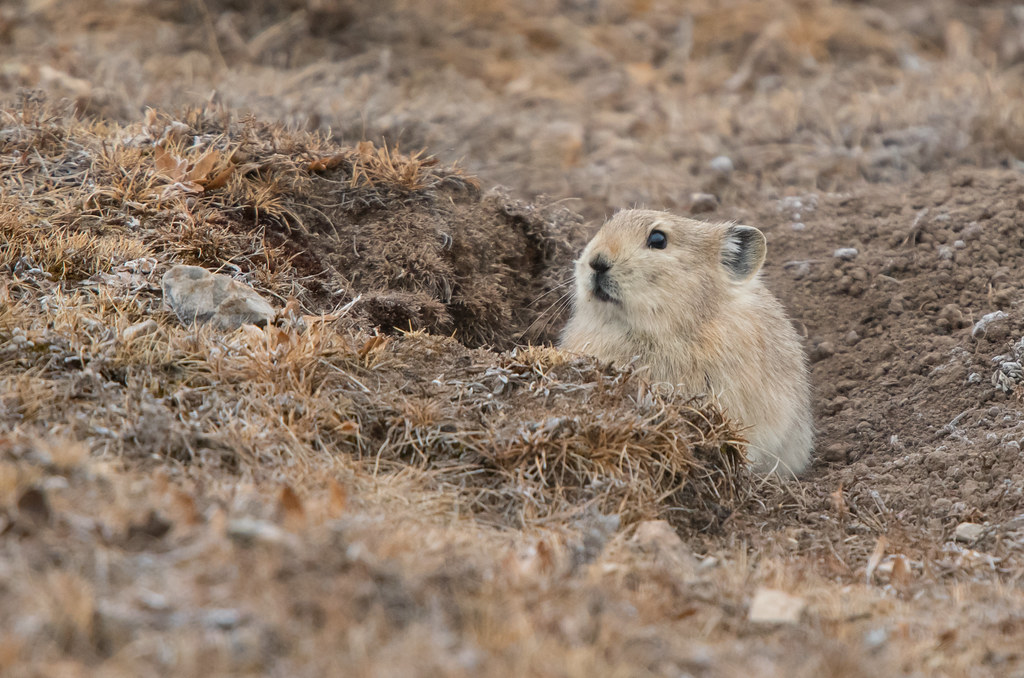
Plateau Pika


And, finally, Hodgson's paper to the Asiatic Society of Bengal:


*As well as the Plateau Pika, which he named Lagomys Curzoniae, he also described as a new species Mustela Témon which is now regarded as a subspecies of the Mountain or Altai Weasel, Mustela altai temon.

Beolens B, Watkins M, Grayson M. 2009. The Eponym Dictionary of Mammals. Baltimore: Johns Hopkins University Press


Hodgson BH. 1858. On a new Lagomys and a new Mustela inhabiting the north region of Sikkim and the proximate parts of Tibet. Journal of the Asiatic Society of Bengal 26, 207-208


Thursday, 7 May 2015

Asiatic Lions: A Conservation Success Story

If, like me, you were under the impression that the Asiatic or Indian Lion was confined to overgrazed degraded habitat with its only stronghold the Gir Forest in Gujarat then you would be wrong. The Asiatic Lion is a conservation success story, as we found when in Gir in April. The population is now spread well beyond the old hunting park of the Nawab of Junagadh, as young animals have left ranges occupied by established prides. Details of the 2010 Census (411 animals in all) are shown on the local wildlife conservations trust's Asiatic Lion website.

Early morning in Gir

At a population level, the only threat to their remaining a viable wild population would appear to be the outbreak of an infectious disease. At an individual level, lions living outside the protected areas get killed by trains and road traffic, and seem, judging by reports in local newspapers, prone to falling down wells; some are killed by farmers but we were told that a rapid compensation scheme for cattle and buffaloes taken by lions now keeps the nomadic herders, the Maldhari people, onside.

Young lioness in the late afternoon

Lions need food and a marked feature of management of the Gir complex of parks and sanctuaries has been the increase in the number of wild ungulates, from 10,000 in 1974 to 50,000 in 2005 (54 per lion in 1974; 139 in 2005). Water troughs, cleaned and filled by water tanker during the dry season, and a reduction in the number of domestic ungulates as Maldharis have been resettled, appear to have been important in improving the habitat across Gir.

Traditionally, the view was taken that the lions of Gujarat had been through a severe population bottleneck in the early years of the 20th Century when the population was thought to be under twenty.  Whether this information was correct and whether more recent studies on genetic variation are reliable (some suggesting inbreeding depression, others showing heterozygosity) are open to question. From my quick reading of the literature, the research effort on Indian lions should be aimed urgently at determining the amount of genetic variation because management strategies in situ and ex situ depend on that knowledge.

Since the lion's original range extended as far east as Bengal, the establishment of viable populations in the wild far enough away from Gir to prevent the spread of disease would seem an obvious move. Attempts to reintroduce lions outwith Gujarat seem mired in politics, with the state government opposing plans to establish a population in Madhya Pradesh. State pride in conserving the lions does not, it appear, extend to letting anybody else in on the act. I have been unable to determine the current state of play in this silly squabble.

In terms of ex-situ conservation, there are captive populations in India and Europe. The sorry tale of cross-bred African and Indian lions in zoos need not concern us here. A breeding programme started at Sakkarbaug Zoo in Junagadh but now including other zoos in India has produced nearly 200 offspring. It is these animals that have been exported to European zoos.

Our visit to Gir coincided more or less with the Zoological Society of London's announcement on building a new enclosure for Asiatic Lions and collaborating with the state of Gujarat to 'save the sub-species'. British newspapers report that the population is 'now down to 400' and that London Zoo is, in so many words, stepping in to prevent the further decline. Such arrant nonsense does ZSL's reputation no good, providing the anti-zoo lobby with ammunition that the zoo world is more concerned with keeping large mammals in zoos to attract visitors than with real conservation efforts in the wild. Yes, zoos in Europe can ensure that a population of Asiatic Lions is maintained should a disastrous disease strike but surely there are far more urgent and severe threats of extinction in the world than the well-managed habitat and booming lions in Gujarat.

Gujarat really does take its lions very seriously. The Ahmedabad edition of the Sunday Times of India for 5 April, for example, shows in the British journalese of the 1930s still in use in India, the draconian measures being taken to limit the tourist industry around Gir. To quote from the first:

People making plans to go lion spotting in Gir sanctuary this summer vacation should prepare to face a severe shortage of rooms and inflated tariffs. The majority of hospitality units will be shut following the Gujarat high court crackdown on illegal hotels and farmhouses in an around the sanctuary.
     The HC ordered action against the illegal encroachment s after it took suo motu cognizance of an anonymous letter complaining that forest management in Gir has become subordinate to the tourism industry. The government immediately identified 128 such "encroachers", who run hospitality units in the buffer zone around the sanctuary...the authorities first targeted farmhouses and 72 such places have been sealed...authorities sealed nearly 70% of rooms in small farmhouses.
     ...There are 34 big hotels around the sanctuary with permission to operate 390 rooms all put together. The committee is tasked to seal the remaining rooms and disconnect power supply to them.

A few days later we read that a 'luxury' hotel belonging to the Taj group had been ordered by the High Court to close down two days later. Such press cutting are shown on on the Asiatic Lion website.

Before going to Gir, we should I seen (and I do not remember watching it when it was first shown) the BBC programme made by Icon Films in 2006 in the Natural World series. That gives a much more realistic view on the recovery of the lion population up to about 2005. It can be seen on YouTube here.

The Nawab of Junagadh
The man responsible for preserving the Gir Forest and the Indian Lion was the Nawab of the princely state of Junagadh, Muhammad Mahabat Khanji III Rasul Khanji (1900-1959)—a man about as popular in India as cholera. On partition of India in 1947 he declared Junagadh to be part of Pakistan. The overwhelmingly Hindu population of the state, which would have been an isolated enclave in India, objected. After a series of events that could have formed the story of a work by W.S. Gilbert he fled to Pakistan with money from the state treasury, most of his wives and some of his hundreds of dogs. Junagadh was then invaded by the Indian army and became part of India. His dogs, which were costing India a fortune to feed, were shot. The whole story is here.

We called in while driving through Junagadh from Gir to Rajkot to look at the Mahabat Maqbara, a mausoleum built over the tomb of a previous Nawab at the end of the 19th Century. Sadly, this magnificent edifice is in a state of decay, surrounded by litter. The paved area was being used for an informal cricket match to the great delight of the male Brits who watched ball after ball being sent over walls and buildings by a batsman who delighted in punishing the full toss (every ball bowled) while the fielders had to try to recover the ball from the various buildings and busy road.

For his work in saving the lions, we felt like raising a glass to the memory of the Nawab. Unfortunately, we could not do so. Gujarat is a 'dry' state.

Monday, 4 May 2015

Parakeets vs Rat Snake: A Remarkable Encounter in the Gir Forest of Gujarat

The first of a short series on our trip around the national parks and sanctuaries of Gujarat with Naturetrek. We came across this remarkable battle between Rose-ringed Parakeets aka Ring-necked Parakeet (Psittacula krameri) and a Rat Snake (Ptyas mucosus now sillily feminised to P. mucosa apparently). The noise from the tree, where the parakeets had a nest hole, drew everybody’s attention as we were driven along the track in the Gir Forest. The defence by the parakeets was a collective display of aggression that involved a great deal of fluttering, feinting and biting the tip of the snake’s tail. Reinforcements flew in, and the question was then: how related are members of the defending flock—previous offspring or siblings maybe—and which family members looked after the dangerous end of the snake? You will see the outcome if you watch the video to the end (better viewed at full size in YouTube), suffice it to say that there was an eventual and then hasty downward retreat.


Where the parakeets who were living dangerously in attacking the snake following J.B.S. Haldane’s famous dictum on kin selection: I would lay down my life for two brothers or eight cousins?

Thursday, 11 September 2014

Zoology: India gets it wrong again

You really could not make it up. I read in Science (15 August 2014):

India bans dissections
A campaign to bar dissections in India's university classes has scored a major victory. India's University Grants Commission, which sets India's standards for university education, has banned the dissection of animals in zoology and life science university courses. That follows a decision in March by the Medical Council of India to prohibit animal dissection in undergraduate medical courses; it may extend the ban to postgraduate courses. The group People for the Ethical Treatment of Animals has argued that computer models and simulations can replace dissection and that several frog species are now endangered due to large numbers of zoology students collecting them for experiments.

I actually looked at the issue date to check that it was not 1 April. For a country that has made and continues to make bad decisions for the protection of its wildlife I really thought this report was a joke. Future Indian biology and medical students (not, sadly, necessarily the same thing) are to be handicapped for life while the tiger and dhole continue to decline. While in the old (i.e. my) days I argued that the value of dissecting a whole range of invertebrate and vertebrate types was afforded too much importance in schools and universities, I would still regard some dissection as an essential part of being and learning to be a zoologist, medic, dentist or vet (veterinarian, to American readers). In silico and in plastercasto cannot replace the knowledge, experience and sheer nous that will be needed in their future careers gained from handling organs and tissues in freshly killed animals and seeing how and why animals have come to be constructed. With hindsight, I did learn than just the morphology from afternoons spent over a stinking formalin-preserved dogfish digging out the afferent and efferent branchial arteries and the cranial nerves.

Incidentally, to rebut the final point in the report, there is actual evidence that heavy collection of amphibians for laboratory use had no effect on the population*. In search of a soft target, The Unthinking Green religion also forgets the human food trade and the frogs that fill the markets in southern Asia, and the three real causes of the decline in amphibian populations: Overpopulation; Overpopulation; Overpopulation.

I am afraid that India's ban will achieve nothing, other than the perpetuation of ignorance.

------------

*Cooke AS, Morgan DHW, Swann MJS. 1990. British Herpetological Society Bulletin 33 9-11.