Showing posts with label history. Show all posts

Friday, 23 October 2020

I know who that is! J.B.S. Haldane—a new biography—and the editor of Water Life magazine

I was reading the new biography of J.B.S. Haldane by Samanth Subramanian to see if it could tell me anything important I did not know already. In brief, it did not (and I would take issue with some of the author’s interpretations of modern biological thought but that’s by the by). Feeling slightly irritated by the prose I came across a photograph on page 223 of Haldane with his first wife at a meeting of the Communist Party of Great Britain in 1939. On the left is an almost complete face of a woman. She is not identified there or by the picture agency which supplied the photograph. I realised it was Margery Elwin, editor of Water Life magazine. I scanned the page to compare it with a photograph of Margery Elwin taken in 1937/38. I then asked others to judge if it was the same person; all agreed it was.


The photograph in Subramanian's book on Haldane


Left, Margery Elwin in 1937/38

I have written about Margery Elwin and Haldane previously here. The photograph puzzled  me because although they had been in contact in 1937 and 1938 by letter, she wrote to Haldane in 1946 as if they had not met previously. She explained that she was a member of the Communist Party and an avid supporter of the Daily Worker which she need not have done had they previously met. My guess is she sat near the Haldanes in 1939 but perhaps could not get round to introducing herself to the great man. 


In the 1950s both she and her husband, Louis C. Mandeville, worked for Haldane, she keeping stocks of drosophila and he newts with both working on fish. A link with Haldane was evident when she took his line in an article for amateur fishkeepers in defence of Lysenko when the latter had become utterly indefensible. Lysenko, a favourite of Stalin, destroyed the pursuit of proper genetics and caused the death of Vavilov, its leading proponent, in the USSR. The take home message is that then—and now—even the most distinguished scientists could be political activist first and scientist second. Subramanian argues, as have others, that in Haldane’s mind marxism and science were united, with the USSR as its faultless exemplar.


Subramanian S. 2020. A Dominant Character. London: Atlantic Books


Tuesday, 20 October 2020

How good at keeping and breeding animals was London Zoo in the 1950s? The fellows’ rebellion and the search for historical data


In my last post I described how data had been gathered to investigate the breeding record, survival of young and rates of mortality at London Zoo up to 1957. What is not apparent from the bland title of the paper is the political battle that was being waged in public within the membership of the Zoological Society of London, and that the data presented were part of the defensive ammunition in that battle.

The Zoological Society of London is unusual in that its ordinary members were—and are—called ‘Fellows’. One of the privileges enjoyed by Fellows was exclusive access along with their guests to London Zoo on Sunday mornings. However for this and other privileges the subscription was only £3 a year and in the mid-1950s had not been raised since 1832. The soon-to-be Sir Solly Zuckerman became Secretary in 1955, having been assured that troubles earlier in the 1950s had gone away. He soon discovered that all was not well. He found that ‘many fellows simply regarded the Zoo as a convenient, if unusual social club’ and that the subscriptions did not make up the loss of gate money from the public on Sunday mornings. In short, the fellows were being subsidised by the Society which was contrary to the Society’s status as a charity. To put the figures into some sort of perspective, the annual subscription would, in 2021, be the equivalent of two adult entry tickets to London Zoo. Given that entry to fellows and a guest was virtually unlimited and that the full economic cost of providing a restaurant and grounds for the exclusive use of fellows had not been taken into account, the force of the Zuckerman case is blindingly obvious.


The rebellion by some fellows was one of a number of the years against its own administration. It was brought about by the decision to open the Zoo to the public on Sunday mornings from 3 November 1957. The following months saw a rebel group formed and a long legal action against the Council of the Society. The details have been explained a number of times and I will not go into detail except to note that an initial ruling against the Society by an ancient judge which seemed crazy at the time and even crazier now was overturned by the Court of Appeal. Council and Zuckerman had won; the rebels were routed.


There is little mention in Zuckerman’s memoirs of the leading rebels but both the initial and final leader are worthy of a mention because their backgrounds in some respects are similar. The instigator was Henry Cobden Turner (1888-1970), usually referred to as a retired Manchester businessman. He was an electrical engineer and head of Salford Electronic Instruments (SEI). He and his team there either invented or co-invented the proximity fuse which proved invaluable against such targets as the V1 flying bomb; they were also involved in the development of radar. Turner was known to fight for what he thought were his rights. In the 1950s he formed a professional and personal friendship with Professor R.V. Jones CH FRS (1911-1997), then Professor of Physics in Aberdeen but earlier the key player in the ‘battle of the beams’, as described in his book Most Secret War. Turner’s letter to British and U.S. governments seeking financial recognition for the proximity fuse are held in various archives. Jones in a 1972 book review described what happened:


In a few cases, further research will be required before a definitive account can be given; for example, one of the principal originating teams of the proximity fuse, that at Salford Electrical Instruments under the late H. Cobden Turner, is not mentioned. This is a pity because Cobden Turner, as unrewarded a patriot as any I know, could have told a remarkable story (he did in fact receive a modest share of the proximity-fuse award made by the Royal Commission on Inventions; but in the expectation of receiving more had already over-committed it to the presentation of a stained-glass window to his minister-son-in-law's church).


In one of those infuriating ‘I wish I’d asked him that if only I’d known’ moments I corresponded with R.V. Jones and had lengthy conversations by telephone in the couple of years before he died. I would really like to have known if Turner had discussed his role in the Zoo rebellion with him.


Because Turner, having started the rebellion at the Zoo, lived in the north of England and was not on hand to lead the attack, leadership passed to another head of an engineering company, this time based in London. Reginald John Knowles (1898-1962) was awarded the Military Medal as a private soldier in the East Surrey Regiment in 1917; he had also been Mayor of the London Borough of Hendon in 1951-52. It was Knowles who took the ultimately doomed legal action against the council of the society and it was Knowles who was ordered by the court to pay half the costs; he apparently failed to do so. Israel Sieff and his brother-in-law Simon Marks then running Marks & Spencers picked up the hefty bill.


The gripe of many of the fifty or so rebel fellows was I noted earlier about their loss of privileges, especially Sunday-morning opening. However, there was another complaint not about privileges for fellows but about the performance of London Zoo as a zoo. The Times of 5 December 1957 reported on the meeting of the rebels:


     …during which several Fellows, in­cluding a former councillor of the society and Mr. George Cansdale, ex-Superintendent of the Zoo spoke regretfully of what they called a *grave deterioration" in standards. 

     Mr. Cansdale. who was asked to resign from his post as superintendent in 1953. and who is now associated with two com­mercial zoos emphasized at the outset that he had no ulterior motive in attending the meeting. 

     He went on: “The London Zoo, which was regarded as outstanding not many years ago, is to-day regarded with contempt by some of the foremost zoologists in the world. The management is grossly inefficient, breeding results are appal­ling, and in general conditions have sadly deteriorated.” 

     By Continental standards, Mr. Cansdale declared. “the London Zoo is very heavily overstaffed at all levels, from keepers right to the top. The council could achieve a saving of not less than £20,000 a year by proper economies.” 

     Mr. Turner, who said he had last year gone round the world inspecting zoos in India. Africa, and Australia, described the London Zoo as “now in the eighth or ninth place," instead of being, as it was once, the best in the world. The condition of the gardens and animal houses should be improved, he said, by spending the money raised, first, on the animals them­selves; secondly, on those who looked after them; thirdly, on the layout of the gardens: and fourth, on the secretariat.
     Mrs. D. Pinto-Leite, who said she had worked for more than 11 years in the zoo. began by genially informing the company “I only know about apes.” She had been a Fellow since 1910. The condition of the zoo now compared with those days was *appalling." she said. “I have no confidence in anyone there, from the management downwards, except a few of the keepers—and the animals."
     She was followed by Mr. A. Tabelin, who said he had visited the zoological gardens for 10 years. You go there todav and you find empty cages and animals in the wrong cages," he said.


The Council and Zuckerman clearly interpreted George Cansdale’s intervention as a continuation of the war with Leo Harrison Matthews FRS, who was not only Scientific Director but also running the Zoo with the help of just a secretary. It appears that it was Matthews who delivered the earlier ultimatum to council that Cansdale must be removed from office—a topic I will return to in a future post.


At the AGM of the society on 15 January 1958, Zuckerman launched attacks on Turner and Cansdale, neither of whom was present. He dealt with the question of Sunday opening and indicated that the subscription would be raised to £10. However, I suspect that after two years in post, Zuckerman was aware that the Zoo was in the doldrums but was not prepared to admit it to the rebels. Indeed Zuckerman’s proposals were the first steps in his plans for recovery. The gulf between the interests of fellows who were scientists and those who were later categorised as ordinary fellows was exposed by letters to The Times. The big guns came out in force in support of Zuckerman’s changes. One letter was signed by Sir Gavin de Beer FRS, director of the Natural History Museum, Carl Pantin FRS in Cambridge, Peter (later Sir Peter) Medawar FRS and John Zachary Young FRS, both of University College London, on behalf of over 150 zoologists who were fellows of the society.


Zuckerman did take Cansdale’s claims about breeding results and mortality seriously. It seems inconceivable that these performance indicators had not been a matter of regular report. Although Cansdale complained about the competence of the figures on mortality notified to fellows after Zuckerman’s blast at the AGM, he himself does not seem to have improved the collection of data while Superintendent. Nevertheless, two people were given the job of extracting as much meaningful data as was possible from the historical records. The first was Eric Hayton Ashton (1926-1985) a member of Zuckerman’s department of anatomy in Birmingham and one of his first B.Sc. students there.  The second was Gwynne Vevers, Zuckerman’s pre-war student at Oxford and since 1955 curator of the aquarium at the Zoo. They sifted through the records and came up with a series of tables and graphs. Figures on breeding on mortality are difficult to interpret because it depends not only on the quality of care but also on the balance of naturally long-lived and short-lived animals in a collection. However, the general trends were clear and their paper was published in early 1959. The main conclusions can be quoted from the summary:


  • Apart from the period during the Second World War when the numbers of vertebrates dropped sharply, the collections have, since the mid-1930s, fluctuated around a level of some 5000 exhibits. The numbers of species and subspecies have, during the past seven years, varied slightly around an average of approximately 1200.
  • Mammals now account for some 30 per cent of the total exhibits, birds for 60 per cent while reptiles and amphibians comprise 10 per cent. Approximately 90 per cent of the mammals and birds exhibited are from wild species.
  • The birth rate in the collections as a whole now stands at 14 per 100 exhibits. The corresponding value for wild species is 11.8. These figures are among the highest attained during the periods for which records are available.
  • More than 90 per cent of the animals born in the menagerie during 1957 survived to the end of the year. The average survival rate for the past three years is higher than at any time since the opening of Whipsnade Park in 1931.
  • The mortality rate for the entire vertebrate collections stood, during 1957, at 21. This figure is less than at any time either before or after the Second World War. 


Zuckerman clearly could not resist adding a foreword which explained the reason for the study and stressed its main conclusions:


When trying to discover what substance there was to a number of state­ments about mortality and birth rates in the Society’s collections, to which wide publicity was given in the National Press, I made a preliminary analysis of the vital statistics of Regent’s Park and VVhipsnade. The results of this analysis, which were incorporated in the Report of the Council of the Society for 1957, showed that, contrary to view that mortality rates are now rising and birth rates falling in the Regent’s Park Gardens, the reverse is the case. Since this was only a preliminary analysis, I suggested to Dr Ashton and Dr Vevers that they might undertake a more detailed study of the Society’s vital statistics. The results are incorporated in the present paper…

     …The index which stands out most clearly as a mark of the Society’s progress in the field of animal husbandry, which we can justly claim is subject to stricter and stricter scientific control as every year passes, is clearly that of mortality, which gives a measure of the health of our animals. This index fell steadily from the beginning of the century until the early 1930’s, and then showed a tendency to rise through the Second World War, and the post-war years. To-day it is declining steeply, a change which reflects not only the value of the new hospital and pathological services which we brought into operation three years ago, but also the increasing use of modern clinical methods in the care of our animals. We do not know, and it is possible we shall never know, the natural longevity of most of the animals in our collection. We can only go on hoping, therefore, that this index will continue to fall. 


The results were further publicised by an article in New Scientist.


Below is the graph from the paper showing mortality rates. However, the figures were open to several interpretations. For non-domestic animals at London, the mortality rate for mammals had in general fallen since the Second World War to 29%, for birds it had fallen slightly to 21% but for reptiles and amphibians it had risen sharply to 67%. It was only when data from wild and domestic species were combined and figures for Whipsnade (with an entirely different balance in the collection) were included that the mortality rate in 1957 was calculated at 21%. For non-domestic species at London Zoo it was 29% and had changed little since 1946-48.


Any propaganda value to be derived from the paper by Ashton and Vevers was not needed. It was published around the same time, and the article in New Scientist a few weeks after, the Court of Appeal gave its judgement in favour of the council.


Those reading this article will have realised by now that while this longitudinal study showed a bumpy but steady improvement with time, there was no comparison made with other zoological collections in Britain or the rest of the world. In management speak there was no benchmarking.


Finally I add the wry note that while George Cansdale was concerned about the competence of the figures on mortality he should try finding the figures now. The anti-zoo lobby together with the news media always on the lookout for bad news have caused zoos to stop publishing these figures in their annual reports. In the zoos of the 21st century, oozing with political correctness and sickening anthropomorphism, animals must be seen as dying at a ripe old age or of some incurable condition. After the great advances in husbandry and veterinary care from the 1960s, I feel sure that performance has increased markedly in the best zoos of the world but I can find no data to confirm or refute that view.


…And if you think that was the end of the Society’s troubles you would be wrong. Zuckerman’s continuation and reinforcement of the practice of packing its council with powerful friends and supporters from the great and the good backfired spectacularly after his long spell as Secretary and then as President.


Ashton EH, Vevers HG. 1959. The numbers of exhibits, births and deaths in the menagerie at Regent’s Park: 1835-1957, and in Whipsnade Park 1931-1957. Proceedings of the Zoological Society of London 1959, 489-514.


Ashton EH, Vevers HG. 1959. The vital statistics of zoo populations. New Scientist 5 (26, 16 April 1959), 


Donovan B. 2005. Zuckerman: Scientist Extraordinary. Bristol: Bioscientifica


Jones RV. 1972. Review of The Challenge of War by Guy Hartcup. Electronics & Power, October 1972, 366.


Zuckerman S. 1988. Monkeys, Men and Missiles. London: Collins.


Wednesday, 14 October 2020

Primates at the Zoo in Victorian London: Matters of Life and Death

On 10 September I wrote (here) about the astonishing number of primates (1,300 individuals of 166 species) that arrived at London Zoo in the years 1883 and 1895 and indicated that the death rate must also have been high since the available accommodation would have been filled many times over. I then remembered that some time in the 1950s Gwynne Vevers had been involved in a survey to see how the Zoo was then doing compared with the past, over a large part of which his father, Geoffrey Marr Vevers had been Superintendent of the Zoo. I found the paper—more on the reasons why this was done will be in a subsequent post—and found the most relevant figures. Although data for primates alone could not be extracted the mortality rate for all vertebrates (both wild and domestic) except fish was approximately 45% in the 1880s-90s. In other words, given a stock of 100 animals at the start of the year, 55 would be left at the end. We also know that primates were a particular concern when Chalmers Mitchell took over as Secretary in 1903 because of the high incidence of tuberculosis. The chances of an individual primate surviving for five years after arrival were very low indeed.

These figures can also be used to back calculate the approximate number of primates housed by the Zoo at any one time.  If we assume that the death rate for primates was 50% and that the number in the Zoo did not change from year to year then it does not need much arithmetic to show that the number of primates kept in the various houses was somewhere between 150 and 200, towards the lower end of the estimate if some of the monkeys that arrived were passed on to other owners. It is also possible to calculate a holding of 155 individual primates in 1946-48, lending some credence to a figure of around 175 in 1883-1895. In 1957 the mortality rate for primates was 25%. The great advances in wild animal husbandry and veterinary knowledge of later decades were still yet to come.


It does not saying that the odds of a primate surviving for 10 years (perhaps half its maximum lifespan) in the late Victorian zoo was very low indeed. However, the figures would have been highly skewed with the majority living only a short time after arrival while a few would have made it into old age.


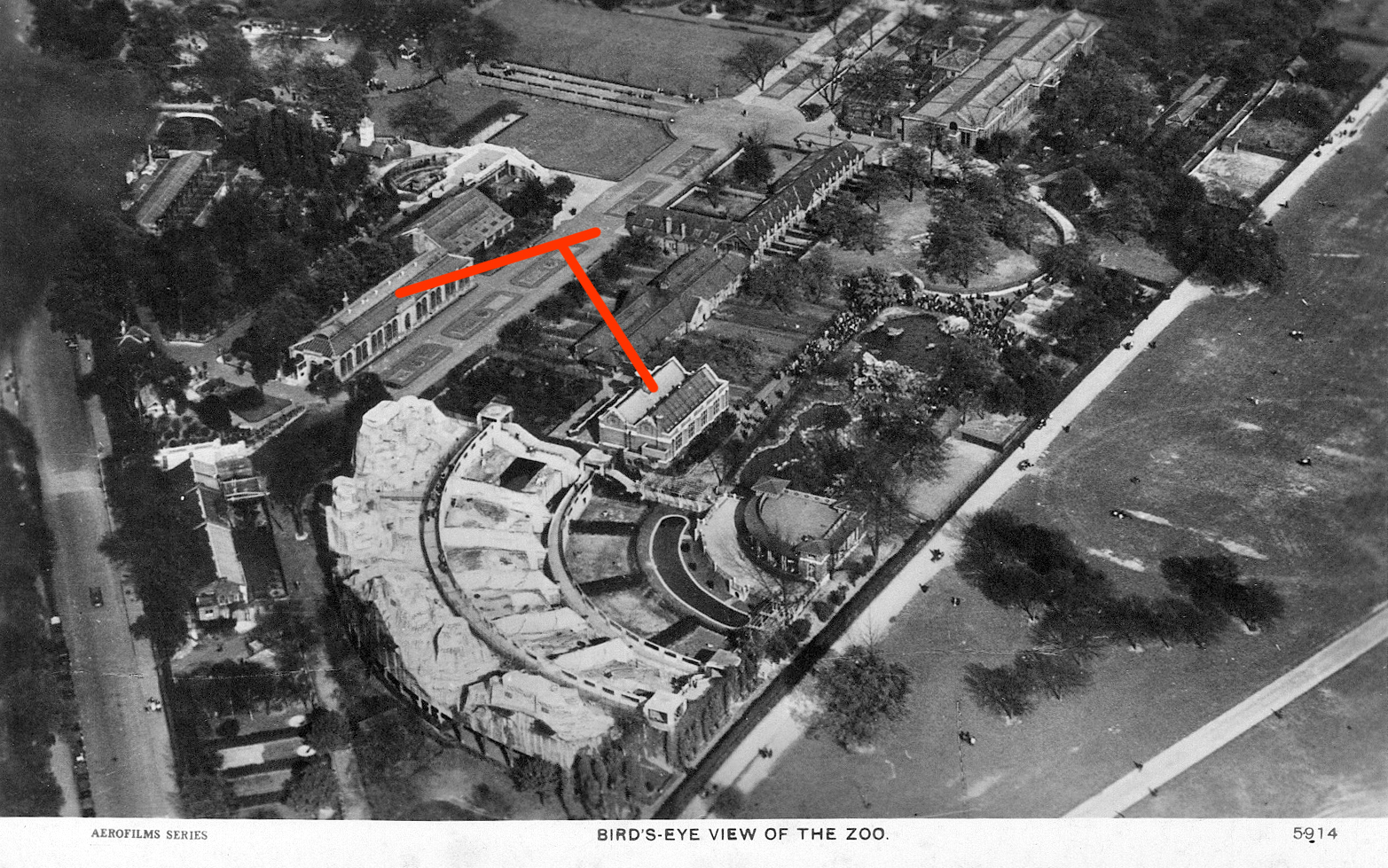
The two man houses for primates were replaced as soon as possible during the Mitchell regime, plans being interrupted by the First World War. These photographs show the old Monkey House and the Ape House. The Ape House had just been completed ‘at great cost’ when Mitchell was successful in his campaign to become Secretary in 1903. He disapproved of it mightily as, ‘A supreme example of the belief that anthropoid apes, like other denizens of the tropics, required, above all, protection from cold’. He had it demolished as soon as he could and by 1927 it had been replaced by the present Reptile House; the new Monkey House was opened in the same year, only to be replaced in the early 1970s as yet another example of how primates should not be kept.


This postcard of London Zoo has an Aerofilms photograph from 1921
The old Monkey house is indicated on the left, the Ape House (opened in 1903) on the right
Both were demolished later in the 1920s


This postcard of the Mappin Terraces shows the Ape House beyond
From the fashion and the sparse vegetationmy guess is this is photograph was taken shortly after the terraces opened in 1913


Ashton EH, Vevers HG. 1959. The numbers of exhibits, births and deaths in the menagerie at Regent’s Park: 1835-1957, and in Whipsnade Park 1931-1957. Proceedings of the Zoological Society of London 1959, 489-514.


Mitchell PC. 1929. Centenary History of the Zoological Society of London. London: Zoological Society of London


Friday, 9 October 2020

William Harvey and the Circulation of the Blood. Learn how science is done from a classic film

First-year students confined to their living quarters and online teaching by the resurgence of covid-19 would do well to watch the film, William Harvey and the Circulation of the Blood. This classic, filmed in 1971-72 for the Royal College of Physicians, was itself a third remake of the same title; the original version was made in 1928 to celebrate the publication of Harvey’s De Motu Cordis three hundred years earlier with another version in 1957 for the tercentenary of Harvey’s death. The history of the three versions is explained in the third version, with the first being the idea of Sir Thomas Lewis FRS (1881-1945) and Sir Henry Dale FRS (1875-1968).


In overthrowing the teachings of the ancient anatomists he had been fed while studying at the University of Padua, William Harvey established the circulation of the blood and the working of the heart not simply by positing from anatomical observations but by experiment. But, as the film shows, he used ways of thought that are still essential for knowledge to advance today.


The student or anybody else watching this film learns the importance of:


  • Experiments that are simple, direct and, therefore, elegant
  • The value of taking a comparative approach—gaining knowledge from a variety of organisms in order to test a generality
  • Armchair physiology—using simple quantitative data to test competing hypotheses
  • Using a mechanical analogy—the heart as a fire engine pump is an example
  • Knowing the  historical literature in detail
  • Travel to see and hear current thinking in different centres of excellence


The full version can be found HERE on the Wellcome Foundation website. The Wellcome provided the financial support needed to make the film. There are somewhat shorter versions also online but the few extra minutes are well worth watching.


William Harvey was a great scientist before the word was invented and a true exponent of Nullius in Verba thirty years before the Royal Society was founded.


The film was directed, produced and photographed by Douglas Fisher FRPS for the Royal College of Physicians. Douglas Fisher had made films for the Wellcome Foundation and is remembered for his filming for Granada Television’s Zoo Time in the 1950s, and for his later wildlife films.


The writers and researchers for this version were the historian Gweneth Whitteridge (1910-1993), Charles Edward Newman FRCP (1900-1989) and Leonard Maslin Payne (1911-2000), Librarian at the Royal College of Physicians. Harvey’s experiments were reconstructed by Michael de Burgh Daly (1922-2002) who was Professor of Physiology at St. Bartholomew's Hospital medical school and Leonard George Goodwin FRS (1915-2008) then Director of Science at the Zoological Society of London. Len Goodwin also read the words of William Harvey, translated from the Latin, for the soundtrack.


Quaint and redolent of instructional films of the middle decades of the 20th century, this classic is now nearly 50 years old. Shall we see fourth version, this time using video and computer graphic simulations, for the 400th anniversary of De Motu Cordis in 2028?


Tuesday, 29 September 2020

A Press Cutting from 1932: Burgess Barnett, Lord Moyne and Galapagos Marine Iguanas at London Zoo


This photograph I came across connects three topics I have written about before:

  1. Dr Burgess Barnett shortly after taking over as Curator of Reptiles at London Zoo. I have found it difficult to find photographs of him and I will add this to the article on his life and works. The article here on Barnett, incidentally, is one of the most popular on this site.
  2. Lord Moyne (Walter Edward Guinness, 1880-1944) back from an earlier expedition cruise than the one in 1934-35 in which he brought back Komodo dragons. That trip was well documented but the earlier one was not. Article can be found here.
  3. Galapagos Marine Iguanas. Four collected by the Moyne Expedition being handed over to London Zoo. Article on Marine Iguanas in captivity here.


I have been unable to find find the name of the yacht Moyne used in 1932 since he seemed to have owned two at the time, both were converted passenger vehicles. My guess it was the MY Roussalka since she had tanks fitted during conversion to hold sufficient diesel fuel to cross the Pacific. Many of Moyne’s records were lost when the vessel sank after striking a rock in Killary Bay, Ireland, in 1933. That may account for the lack of information. All the passengers and crew, including Moyne, escaped.


Four Marine Iguanas were brought back by Moyne. A discussion on the ZooChat forum some time ago, notes that they were mentioned in the 1933 Zoo Guide with the statement that seaweed was brought up from Cornwall to feed them. One only was noted in 1934 and all mention had disappeared by 1935. So far I have found no description of how the Marine Iguanas were kept at the Zoo. Clearly, they did not do well, as was the case with many reptiles until the last thirty years or so.


Moyne also brought a Flightless Cormorant (Phalacrocorax or Nannopterum harrisi) and five Galapagos Doves (Zenaida galapagoensis). David Seth-Smith wrote of their arrival, the first in Britain in the case of the cormorant, in Avicultural Magazine. He provides no further information though on the expedition itself. We can though deduce that Moyne visited the west coast of Isabela (Albemarle) and/or Fernandina (Narborough) since that is the only place in the Galapagos the endemic Flightless Cormorant can be found.


Finally, a few observations in the photograph. I have not been able to identify the publication. It was obviously taken in the public area of the Reptile House—the barriers remain unchanged today. It would appear though that the fronts of some of cages were of wire mesh and not glass. The photograph has an odd appearance and only after looking at it for some time did I realise that Moyne’s hands and arms seem out of place. His right hand is grasping the lizard’s tail but the one shown apparently as the left hand seems to be coming out of thin air. Has there been some heavy retouching, or even the merging of two negatives?


Sunday, 27 September 2020

The Way Things Were: Two Dead Gorillas, One Live Gorilla…and One Dead Hunter

 On 4 August 1919 The Times reported under the headline 'New Creatures at the Zoo' reported how things were going at London Zoo a year after the end of the First World War. It contained this statement:


The regular visitor and the sedulous zoologist will still see many gaps in the collection. It cannot be expected that these will be filled until the conditions of transport are more normal, and the desire to “profiteer” had disappeared from the tropical jungle. None the less there is now a good collection at Regent’s Park, more representative and richer in rare animals than any other menagerie in Europe…


A riposte came in a letter published 8 December that year, the gap of four months reflecting the time it had taken for the copy of The Times to reach East Africa and for a letter to reach London in return.


Sir,—Re your article published in The Times of August 4th 1919, under the heading of "New Creatures at the Zoo.” The statement that "it is not expected that the gaps in the collection of animals in the Zoological Gardens will be filled until the desire to profiteer has disappeared from the tropical jungle” is of considerable interest to us, as until recently we were five brothers (now four) who are engaged in big game hunting in Uganda and Central Africa, chiefly for ivory and skins, but always with on eye to obtaining some rare live animal which might be sold to the highest bidder, either the Royal Zoological Society or a similar society on the Continent or in America. 

     In conjunction with coffee planting in Uganda, we always made a living out of this in pre-war days, and in June last, when we were demobilised, two of us proceeded to the Belgian Congo on a hunting expedition. During this trip some ivory and lion skins were obtained, and we were also fortunate enough to secure a newly born female gorilla on Mount Mikeno at an altitude of 10,000ft; this animal is now three months old, and is in the best of health, and we have decided to sell her to the highest bidder, and have already invited an offer from the Royal Zoological Society; we also secured the skins and complete skeletons of a full-grown male and female gorilla, for which we.also intend inviting offers from various museums and from any private collectors with whom we can get in touch. 

     Unfortunately this otherwise successful expedition was marred by the death of one of the two “profiteers,” who was killed by a lion near Rutsburu, in the Belgian Congo, during the return, journey, they having camped there tor a few days in order to secure some lion skins and cubs if possible before leaving the Congo. 

     Possibly profiteering is carried on in connexion with buying and selling animals, but to describe this as "profiteering in the tropical jungle” tends to give the public the idea that the man who actually hunts the animals is the profiteer, whereas the hunter merely sells his specimens to the highest bidder.
     There are various agents in every country who buy up animals from natives and others in order to sell them again to zoological societies and collectors, but these gentlemen are not to be found in the jungle, but in the towns in close proximity thereto, and, whether or not their dealings can be described as profiteering is not for us to say, but we would remind the writer of your article that prices out here for all necessities have gone up enormously since the Armistice, and there is no doubt that this is due to a great extent to profiteering at home, and would suggest to him that he would be making better use of his pen if he left us in the jungles alone and turned his attention to those well-fed and well-housed profiteers at his own doorstep, who by their dealings are doing the country incalculable harm. , 

                                                                       We are. Sir, yours, &c.,

                                                                       FOUR JUNGLE PROFITEERS? 


There is nothing to add other than that the writer of the report in The Times would have been Peter Chalmers Mitchell. He continued as correspondent for that newspaper while Secretary of the Zoological Society. It is no surprise that this great self-publicist found himself responsible for propaganda at the War Office in the First World War. I do not know who the ‘Four Jungle Profiteers’ were but they must have been known to the dealers of the time since John D. Hamlyn, the major London animal dealer after the war, reproduced their letter in his house publication, Hamlyn’s Menagerie Magazine published in the same month as their letter to The Times.


I assume, since the original article was about London Zoo, that the Royal Zoological Society referred to was the Zoological Society of London which operated then as now under a Royal Charter but which never included ‘Royal’ in its title. The other but unlikely possibility is that the ‘profiteers’ were referring to the Royal Zoological Society of Scotland, i.e. Edinburgh Zoo, which did then and still does use the Royal title.


Finally, the gorillas would have been Mountain or Eastern Gorillas, Gorilla beringei. I wonder what happened to the baby gorilla and, indeed, to the remains of the ones, one of which was presumably the mother, that were shot. Does a museum somewhere in the world have them?


Wednesday, 16 September 2020

What on earth was the Bald-headed Chimpanzee?

When I was looking through the numbers of individuals and of species of primate that arrived at London Zoo between 1883 and 1895, I came across an animal I had never heard of. It was listed as the Bald-headed Chimpanzee, Anthropopithecus calvus Du Chaillu; Habitat Gaboon, West Africa. Reference was given to three papers in Proceedings of the Zoological Society and to one in Nature. The Zoo had purchased two of these animals, one in 1883, the other in 1888.

I knew that only two species of Pan (which replaced Anthropopithecus) have been recognised for many years and that since the Bonobo does not occur in Gabon (Gaboon) the Bald-headed Chimpanzee must have been lumped into Pan troglodytes, the Chimpanzee. But why did the Zoo think it had specimens of a different species?


I found the answer in the paper in Nature written by Philip Lutley Sclater (1829-1913), the Society’s Secretary. After discussing other possible species of chimpanzee described by earlier authors, he wrote: 


In 1860 the well-known traveller Mr. P. B. Du Chaillu gave his account of the anthropoid apes of the Gaboon to the Boston Society of Natural History (see Proceedings of that Society, vol. vii. p. 296). Mr. Du Chaillu described, as a new species of chimpanzee, Troglodytes calvus, “with the head entirely bald to the level of the middle of the ears behind” and “having large ears” while he identified the N'tchego of Dr. Franquet as being nothing but the adult chimpanzee (T. niger). In a second communication to the same Society [op. cit. p. 358), he described another new species of chimpanzee, with a black face, but the forehead not bald, which he called Troglodytes kooloo-kamba, from its peculiar cry. 

     In 1861 the late Dr. J. E. Gray examined Mr. Du Chaillu's specimens of apes, and came to the conclusion that both his supposed new species were only varieties of the common chimpanzee (see P.Z.S., 1861, p. 273}. Such also, as was stated by Dr. Gray, was my own opinion at that time, and I have remained in a doubtful state of mind on the subject until a recent period. But the acquisition of the fine, female specimen of chimpanzee, generally known by the name of “Sally,” by the Zoological Society in 1883, caused me to change my views very materially. There can be no doubt that this animal, when compared with specimens of the ordinary chimpanzee, presents very essential points of distinction. The uniform black face and nearly naked forehead, which is only covered with very short black hairs, together with the large size of the ears, render “Sally” conspicuously different from the many specimens of the common chimpanzee (at least thirty in number) that the Society has previously re­ceived. I was at first inclined to believe that “Sally” might be referable to the Troglodytes tschego of Duvernoy. But nothing is said, in M. Duvernoy’s description, of the bald forehead; and the small ears attributed to the N'tchego, are directly contrary to this hypothesis, as in “Sally” these organs are exceedingly large and prominent. On the whole, I was inclined to believe that “Sally” might belong to the Troglodytes calvus of Du Chaillu, and she was accordingly entered in the Register of the Society’s Menagerie as the Bald-headed Chimpanzee (Anthropopithecus calvus), which is cer­tainly a very appropriate name, even if it be not technically correct. 

     In the beginning of December we purchased of Mr. Cross, of Liverpool (from whom we had also ob­tained “Sally”) a second specimen of the Bald-headed Chimpanzee, likewise a female, which, although much smaller in size, closely resembles “Sally” in every other respect.


This is the sketch of ‘Sally’ from Sclater’s article in Nature.


The story of the Bald-headed Chimpanzee was taken up by the media throughout the world; Scientific American ran an article in 1889 based on Sclater’s report. The Times (20 December 1888) reported enthusiastically on the arrival of the second specimen that ‘has attracted great attention from naturalists, as being the only example of this distinct form of Chimpanzee known in captivity, and also on account of its remarkable intelligence’.


The reader will have gathered that the criteria for describing and naming a new species were, even with the risk of judging processes and thoughts in the past through 21st-century eyes, not rigorous. It is not then surprising to find that the Bald-headed Chimpanzee came to be lumped, along with other proposed species, into what is simply the Chimpanzee. After a number of changes in taxonomy from a plethora of authors, that species is now known as Pan troglodytes. The chimpanzees from Gabon fall into the Central Chimpanzee subspecies, P. t. troglodytes—the 'Tschego' referred to by Sclater.


The first character Sclater argued was different in the two female chimpanzees were the nearly naked forehead. I see in Handbook of the Mammals of the World that female Chimpanzees ‘in particular, have a tendency to go bald on the crown’. That character, varying between individuals and with age therefore goes by the board. The second character was the size of the ears. I can find nothing in the literature on variation in the size of the ears. However, between childhood and adulthood a clear relative reduction in the size of the ears compared with the head—an example of negative allometry—can be seen. Are there further changes, as in human ears, with age such that the ears become larger? Or is there simply a lot of variation in size and conformation just as, again, in the human population. I suspect, with no quantitative evidence, that this is the case. There is a photograph here of a number of Chimpanzees together and the degree of variation between them in terms of the shape of size of the ears can be seen.


Not only images of ‘Sally’ survive. I found this depiction, described by Finch & Co of London as a ‘rare sculpture’ in bronzed finished plaster by Rowland Ward (1848-1912) better known, perhaps, as a taxidermist.


'Sally'
from Finch & Co website


Sclater PL. (as P.L.S.). 1889. The bald-headed chimpanzee. Nature 39, 254-255.


Thursday, 10 September 2020

Monkeys in late Victorian London. An astonishing number arrived at the Zoo

 Although difficult to quantify, anybody who has read Hannah Velten’s Beastly London or Leonard Robert Brightwell’s The Zoo Story, will realise that in the years before the First World War, Britain was awash with exotic animals imported for sale as pets or exhibition by travelling showmen as well as by the comparatively few zoos. For example, Brightwell wrote of London Zoo:
A steadily increasing flow of exhibits poured in from all sources, princes, hunters, dealers and even schoolboys. The animal trade may for one reason or another gradually change its centre of activity. Liverpool has always been one such base of its operations, but in [Abraham Dee] Bartlett’s time the Mecca was in the notorious Ratcliffe Highway, now the eminently respectable St. George’s Road, East, a stone’s-throw from Tower Bridge. The writer has vivid memories of dealers in this quarter, great names that vanished quite suddenly during the Edwardian era. There on the skirts of dockland the great Jamrach and his equally famous rival Hamlyn kept their crowded shops with crazy stable-yards behind, These stables were old warehouses, three stories high and packed with animals of every kind. When a lion roared the whole of one of these aged and rotten buildings rattled in a manner threatening instant collapse. But some spectacular deals were made here, and there are endless stories told of these kings of zoological commerce…

When I totted up some of the numbers of animals that arrived at the Zoo in the 12 years between 1883 and 1895, I was astonished to find over 1,300 individual primates of 166 species (using the identifications and taxonomy of the time). That is a rate of arrival of more than two per day, week in week out, year in year out. Numbers varied from a single Gorilla and one Aye-Aye to over 100 each of Crab-eating Macaques and Rhesus Macaques. The vast majority were presented by private individuals.

With primate arrivals running at over a hundred per year, a demographer is not not needed to point out that the available accommodation would soon be full to the brim and that many of the animals would not have reached their expected lifespan of, in many cases, several decades. Without looking at the records for each year, some will have gone to other collections while some will have been killed as they became unmanageable (the K.B.O. often left unexplained in reports but an abbreviation of Killed By Order). We do though know that the death rate of primates in the indoor accommodation of the time was high. Tuberculosis was, just as in the human population of London, endemic and an improvement in housing and care was the aim of the incoming Secretary in 1903, Peter Chalmers Mitchell.

There was a joke about old-style zoology; a zoo was just a place to keep animals until they could be studied properly—when dead. The Zoological Society’s Prosector throughout the period in question was Frank Evers Beddard FRS (1858-1925). Beddard was Prosector from 1884 until he retired in 1905. He had the responsibility of dissecting suitable specimens and, guided by a set of rules established by a committee, for distributing specimens and parts of animals to interested parties, including university departments, museums and medical schools. He also hosted scientists who wished to work in the prosectorium. Even as late as the 1950s there were disputes as to who was to receive priority in the distribution of specimens. How such matters were decided  on a day-to-day basis when Beddard was in charge is not clear. As well as specimens in whole or in part going to the destinations mentioned some skins went to taxidermists including the famous Edward Gerrard. Details of who got what and when were kept in a book now in the archives at the Zoo.

Important scientists worked in the dead house, as the prosectorium was usually called, and there is a strong case to be made for the view that the only scientific use for an animal in the Zoo was when it was dead. Earlier in the 19th Century, Richard Owen the great anatomist, anti-evolutionist and parasite on royalty, had discovered the parathyroid gland—in an Indian Rhinoceros. Clinicians worked there too. For example, the neurologist Wilfred Harris (1869-1960) applied because he needed to study the brachial plexus of a monkey in order to determine the components of the Vth cranial nerve. His aim was to change surgically the innervation the muscles of a young child who suffered from local paralysis caused by poliomyelitis. After his retirement in 1935 Harris returned to the Zoo to make a systematic study of the brachial plexus throughout the vertebrates, including the Giant Panda. He produced a book on that one topic.

Another visiting worker in the Prosectorium was Peter Chalmers Mitchell. In 1903 he was appointed lecturer in zoology and botany at the Charing Cross Hospital Medical School. His research at the zoo was on the anatomy of birds, particularly of the alimentary canal. Again, he had plenty of specimens at his disposal. I will return to the Beddard-Mitchell relationship in a future article.

Monkeys were still coming into London in considerable numbers in the decades after the First World War. Hamlyn’s Menageries Magazine, published by the importer and dealer John Hamlyn, make fascinating reading since the issues show the numbers of animals he, and sometimes his remaining rivals, had in stock or were being shipped. For example, in January-June 1919, he received 426 primates (some just described as ‘monkeys’). By then Jamrach’s had ceased trading but other dealers were on the scene. George Chapman, with premises on Tottenham Court Road, apparently bought out the Hamlyn business after John Hamlyn’s death in 1922. Chapman was a major supplier of primates and other animals (a final Thylacine, for example) to London Zoo including the  >100 Hamadryas Baboons for Monkey Hill in 1925.

The old records also show why the breeding records were so poor and why self-destructive behaviours were so common in zoo monkeys. Many, perhaps most, had been hand-reared in their country of origin, kept as house pets and then passed on when their owners could not cope with them. They did not know what they were when they arrived. They were simply crazy, mixed-up monkeys who may not even have recognised others of their species. Psychopathies, poor nutrition and infectious diseases were the norm in these unfortunate animals kept in the 19th and much of the 20th century.


The old Monkey House at London Zoo demolished early 1920s
There was no outdoor accommodation


Opened in 1903 this house was replaced by present Reptile House in the mid-1920s


Brightwell LR. 1952. The Zoo Story. London: Museum Press.

Felger EA, Zeiger MA. 2010. The death of an Indian Rhinoceros. World Journal of Surgery. DOI 10.1007/s00268-010-0603-4 

Nieman, E. 2001. Wilfred Harris (1859-1960). In, Twentieth Century Neurology: The British Contribution, edited by FC Rose. Singapore: World Scientific

Velten H. 2013. Beastly London.  London: Reaktion.

Zoological Society of London. 1896. The Vertebrated Animals Now or Lately Living in the Gardens of the Zoological Society of London. Ninth Edition. London: Longmans Green.