Showing posts with label Brian Houghton Hodgson. Show all posts

Monday, 23 December 2019

The King’s Tibetan Mastiffs in 1820s London. An interesting paper in Archives of Natural History

Long gone are the days when a zoo would welcome an exotic breed of dog to exhibit. But that is what the then new London Zoo had to do in 1828; had to do twice in fact because the animals in question were given to the Zoo, then taken away again because, it was said, they were intended as a gift for King George IV, and then given back to the Zoo by the King. The dogs were a pair of Tibetan Mastiffs.

Having seen Tibetan Mastiffs guarding domestic yaks from wolves on the Tibetan Plateau in the midst of a snowstorm, and having been warned to give them a wide berth—a very wide berth—because of their size and ferocity, I can understand why the keepers of the King’s animals at Windsor were perhaps keen to pass them on to the Zoo.

Recently, David Lowther (Durham University), Ann Sylph (Librarian of the Zoological Society of London) and Mark Watson (Royal Botanic Garden, Edinburgh) published an account of the Tibetan Mastiffs in Archives of Natural History*. The dogs were part of a collection sent from Nepal by the famous diplomat/naturalist Brian Hodgson. Only the mastiffs arrived alive in Calcutta, and they, along with thousands of plant and some (dead) animal specimens were taken to London by Nathaniel Wallich (1785-1854). On 20 July 1828, he delivered the dogs to the Zoo. Three days later the dogs were returned to Wallich, ‘having been sent to the Society by mistake’.

The authors speculate as to whether it was Hodgson or Wallich who wanted the mastiffs delivered to the King. Hodgson was building a case for his election as a Corresponding Member of the Society (CMZS). Wallich, who was Superintendent of the East India Company’s botanical garden, had, by contrast, much to be gained by currying favour with the King, including gaining a royal patron and subscriber to his illustrated book on the plants of Asia.

Whatever the motive, the mastiffs were back at the Zoo four months later, this time presented ‘by His Majesty’. There they did not last long—both were dead by 9 January 1829. the highly contagious viral disease, canine distemper, spread rapidly through the Zoo’s dogs on numerous occasions, and this was one of them.


Hodgson had paintings of birds and mammals done by native artists in Nepal. From Lowther et al (see below)


Twenty-years later, a Tibetan Mastiff was given to Queen Victoria by the Governor-General of India. It lived in the kennels at Windsor Castle from 1847 until 1856. 


*Published by the Society for the History of Natural History https://shnh.otg.uk. Membership is highly recommended.

Lowther D, Sylph A, Watson MF. 2019. Brian Hodgson’s Tibetan Mastiffs: twice presented to the Zoological Society of London. Archives of Natural History 46, 220-229.

Wednesday, 31 January 2018

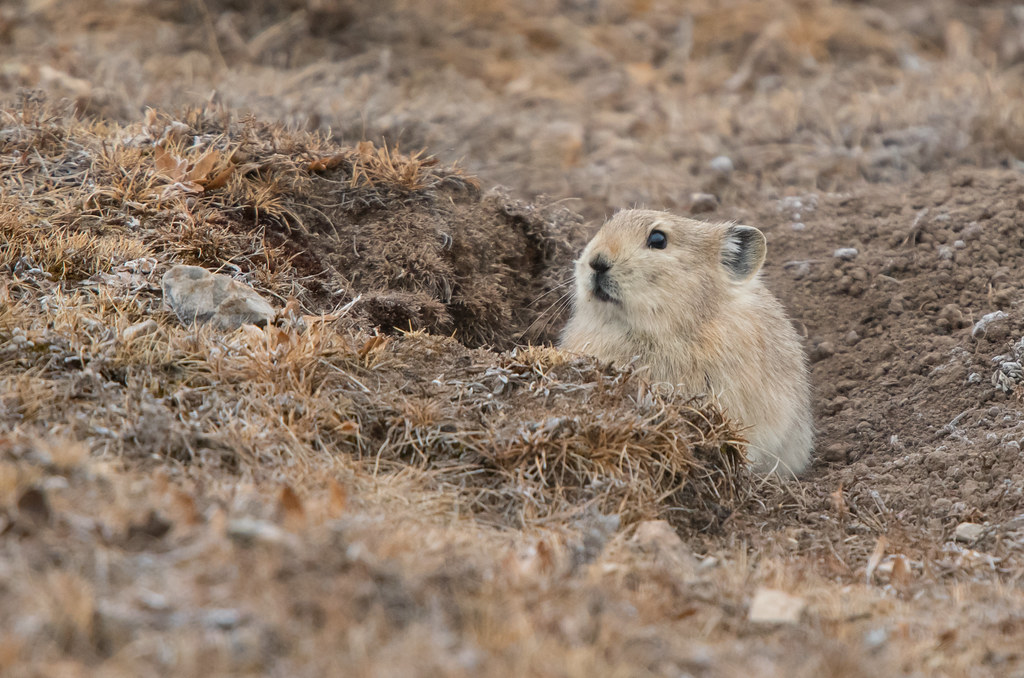
Plateau Pika, O. curzoniae. Who was Mrs Curzon? I think I have found out

In 1858 Brian Houghton Hodgson (FRS 1877) gave the pika he first described and I wrote about in my last post, and now known to be a keystone species of the Tibetan Plateau, the specific name curzoniae. He ended his description:
This beautiful little animal is appropriately dedicated to the Hon’ble Mrs Curzon.
In the Eponym Dictionary of Mammals, the authors state: ‘Unfortunately this is as full a description of the lady as we can find’.

But who was she? The requirements for our Mrs Curzon are that as the Honourable Mrs Curzon she must have been the daughter of a viscount or baron, or to have married the son of one, and, it could be argued, have had a strong connexion with India.

I have been digging in genealogy websites and find that, out of several possibilities, Augusta Latham Hallifax (1837-1917) fits the bill. She was the daughter of Brigadier-General Robert Dampier Hallifax (sometimes shown as Halifax) and was born in South Africa. She married the Honourable Ernest George Curzon (1828-1885) on 14 January 1856 at Umbala (now Ambala), 120 miles north of Delhi.

Ernest George Curzon eventually became Colonel of the 52nd Regiment of Foot which served in India from 1853 until 1865. The regiment (later to become part of the Oxfordshire Light Infantry) took part in the Siege of Delhi during the Indian Mutiny in 1857, marching from Ambala. Augusta’s father would also have been in the Siege of Delhi had he lived long enough. Colonel of the 75th Regiment of Foot (later merged as part of the Gordon Highlanders), he was given the job as a Brigadier of leading one of two brigades from the vast military cantonment of Ambala to besiege Delhi. However, having passed Karnal, he became so ill that he was sent back there where he died on 1 June 1857. The Commander-in-Chief of the Army in India, George Anson, a Whig politician as well as a soldier, had died of cholera, four days after leaving Ambala, so it is possible or even highly likely that Hallifax was also a cholera victim.

Ernest George Curzon was the seventh child (out of ten) of Richard William Penn Curzon-Howe, 1st Earl Howe. Therefore he had the courtesy title of ‘The Honourable’, as did his wife. Four of Ernest and Augusta’s six children were born in India.

Hodgson’s paper* describing what we now know as the Plateau Pika appeared in the Journal of the Asiatic Society of Bengal. Volume 26 was published in 1858 but the papers were received in 1857. Indeed, his paper noted that it was sent from Darjiling (Darjeeling) in April 1857, fifteen months after Augusta Hallifax became ‘the Hon’ble Mrs Curzon'.

Fortunately, the National Portrait Gallery has two photographs (albumen prints) of Augusta taken in London by the French photographer, Camille Silvy (1834-1877) in 1860 (her fourth son was born in London in 1861):


Augusta Latham Curzon (née Halifax [sic] NPG Ax50799
©National Portrait Gallery, London

NPG Ax50798 ©National Portrait Gallery, London


Or does somebody have a better candidate for the beautiful little Mrs Curzon?

And here is Tim Melling's photograph of a Plateau Pika taken at about the same time as my video:

Plateau Pika


And, finally, Hodgson's paper to the Asiatic Society of Bengal:


*As well as the Plateau Pika, which he named Lagomys Curzoniae, he also described as a new species Mustela Témon which is now regarded as a subspecies of the Mountain or Altai Weasel, Mustela altai temon.

Beolens B, Watkins M, Grayson M. 2009. The Eponym Dictionary of Mammals. Baltimore: Johns Hopkins University Press


Hodgson BH. 1858. On a new Lagomys and a new Mustela inhabiting the north region of Sikkim and the proximate parts of Tibet. Journal of the Asiatic Society of Bengal 26, 207-208