Showing posts with label Rovinj Marine Biological Station. Show all posts

Friday, 21 August 2020

Rovinj: The Sheffield Zoology Field Trip in 1964. Part Three. Reptiles and Amphibians

Algyroides nigropunctatus
from Hellmich
In writing about Sheffield Zoology’s first field course in Rovinj now in Croatia and then part of Yugoslavia at Easter 1964, my mind wandered into the difficulties we encountered in identifying the reptiles and amphibians from the surrounding countryside and town. With the wealth of information now available both in print and online it must be difficult to appreciate that nearly 60 years ago the only source on European species in English was a book by Walter Hellmich1 published in 1962. I took that with me.

Some specimens were easy to identify from the limited number of illustrations and descriptions. But a juvenile snake (later identified as the Balkan Whip Snake) and what seemed to be one, but possibly two, species of lizard was more problematical. They ended up, and I cannot remember how, with a GP in Wolverhampton, Dr John V. Tranter2 who was very active in amateur herpetological circles in the West Midlands. He got hold of a copy of the standard German checklist3 of the time by Robert Mertens and Heinz Wermuth as well as consulting Boulenger’s catalogues of specimens in the British Museum. He found all the unknowns, including those I suspected from the descriptions in Hellmich were the Dalmatian Wall Lizard. That species, originally Lacerta melissellensis4 but now Podarcis melissellensis, is now well-known to be polymorphic. In short there were two forms of this species around Rovinj, with one more common than the other. The least common bore a striking resemblance in terms of coloration to the Italian Wall Lizards seen and collected in the area but of lighter build and with smaller, less-pointed jaws.

We finally identified all the species (with current scientific names shown):

Bufo bufo. Common Toad
Bufotes viridis. Green Toad
Hyla arborea. Common Tree Frog
Lissotriton vulgaris. Smooth or Common Newt
Algyroides nigropunctatus. Dalmatian Algyroides, Keeled Lizard
Podarcis muralis. Common Wall Lizard
Podarcis siculus. Italian Wall Lizard
Podarcis melissellensis. Dalmatian Wall Lizard
Pseudopus apodus. Glass Lizard. Glass ‘Snake’, Scheltopusik
Hierophis gemonensis. Balkan Whip Snake

Podarcis sicula campestris
from Hellmich
In our meanderings through the countryside during the late afternoons until, on some days, dusk, we encountered almost nobody. On the edges of the town, the local human inhabitants were at first wary but after establishing that we were not Germans were friendly and helpful. Sons and daughters learning english at school were summoned to translate as best they could and their fathers and grandfathers became even friendlier when I told them that my father had not only been stationed on the island of Vis and had met Tito and his partisans but that he had been through Croatia in the back of an army lorry as far south as Pula in 1945. Eventually the conversation turned to reptiles and they explained to me that in late March only the small lizards and snakes appear from hibernation. In April-May, they said, we could have expected to see larger lizards and snakes as well.

As a matter of interest, I wondered recently what other reptiles are known to occur in the area around Rovinj. I looked at the distribution maps in the 2016 Field Guide5 and came up with the following list in addition to those shown above:

Salamandra salamandra. Fire Salamander
Triturus carnifex. Italian Crested Newt
Bombina variegata. Yellow-bellied Toad
Rana dalmatina. Agile Frog
Pelophylax kl. esculenta. Edible Frog
Pelophylax ribibundus. Marsh Frog
Testudo hermanni. Hermann’s Tortoise
Emys orbicularis. European Pond Terrapin
Tarentola mauritanica. Moorish Gecko
Hemidactylus turcicus. Turkish Gecko
Lacerta viridis, Eastern Green Lizard
Zootoca vivipara. Viviparous Lizard
Slow Worm. Anguis fragilis
Hierophis viridiflavus. Western Whip Snake
Elaphe quatuorlineata. Four-lined Snake
Zamensis longissimus. Aesculapian Snake
Coronella austriaca. Smooth Snake
Telescopus fallax. Cat Snake
Natrix natrix. Grass Snake
Natrix tessellata. Dice Snake
Malpolon insignitus. Eastern Montpelier Snake
Vipera ammodytes. Nose-horned Viper

There are a number of reports, mainly from amateur German and Austrian herpetologists, on field trips made to the same area. The nomenclature varies a little because there has been argument over whether, for example, it is the Eastern or Western Green Lizard (L.bilineata) that occurs there while the status of pool frogs, Pelophylax, remains problematical.

We have never been back to Rovinj. Looking at the area on Google Earth there seems to have been considerable expansion of the town. The countryside looks to have been tidied up and I wonder how many areas of scrub with large boulders inhabited by Algyroides have survived. I shall never forget walking along a country lane and hearing a noise which sounded like a huge flock of geese. Only as we got nearer and found no geese did we realise the sound was coming from the bushes and small trees surrounding a pond. The noise was being emitted by male tree frogs, gathered in the early spring waiting for females (a few were around the edges of the pond) to arrive.


European Tree Frog
Green Toad
Common Toad

The above photographs were taken with my Rolleiflex 4 x 4 on Agfacolor CT18 reversal film. Lighting was from a flashbulb. A more unsuitable camera for close-ups would be hard to imagine because of the nature of a twin-lens reflex. The camera was focused through the viewing lens and then raised by the distance between the viewing and taking lens to remove the effect of parallax. Animals could and did absent themselves from the scene while that shift was being made, resulting in a wasted frame.


1 Walter Hellmich (1906-1974) was Chief Keeper of the Zoological Collection of the State Museum in Munich. His book was originally published in German in 1956 (Die Lurche Und Kriechtiere Europas. Heidelberg: Carl Winter). The English version is: Hellmich W. 1962. Reptiles and Amphibians of Europe. (English Editor Alfred Leutscher). London: Blandford.

2 Died 2 November 2014, aged 79

3 Mertens R, Wermuth H. 1960. Die Amphibien und Reptilien Europas. Frankfurt: Kramer. Robert Mertens (1894-1975) and Heinz Wermuth (1918-2002) had revised an earlier checklist by Mertens and Lorenz Müller (1868-1953) (the latter was Hellmich’s mentor in Munich). There was at the time an inordinate fondness for describing subspecies, an enthusiasm I do not share.

4 Named for Melisello, now called Brusnik, an islet near Vis.

5 Speybroeck J, Beukema W, Bok B, Voort J van der, Velikov I. 2016. Field Guide to the Amphibians and Reptiles of Britain and Europe. London: Bloomsbury.

Peaker M, Peaker SJ. 1968. Spring herpetofauna of the Rovinj area (Istria, Yugoslavia). British Journal of Herpetology 4, 36‑37.

Lilge D, Wicker R. 1972. Bemerkungen zu den Eidechsen der Umgebung von Rovinj (lstrien). Salamandra 8, 128-136.

Tuesday, 11 August 2020

Rovinj Marine Biological Laboratory. The Sheffield Zoology Field Trip in 1964. Part Two. The official history 56 years later

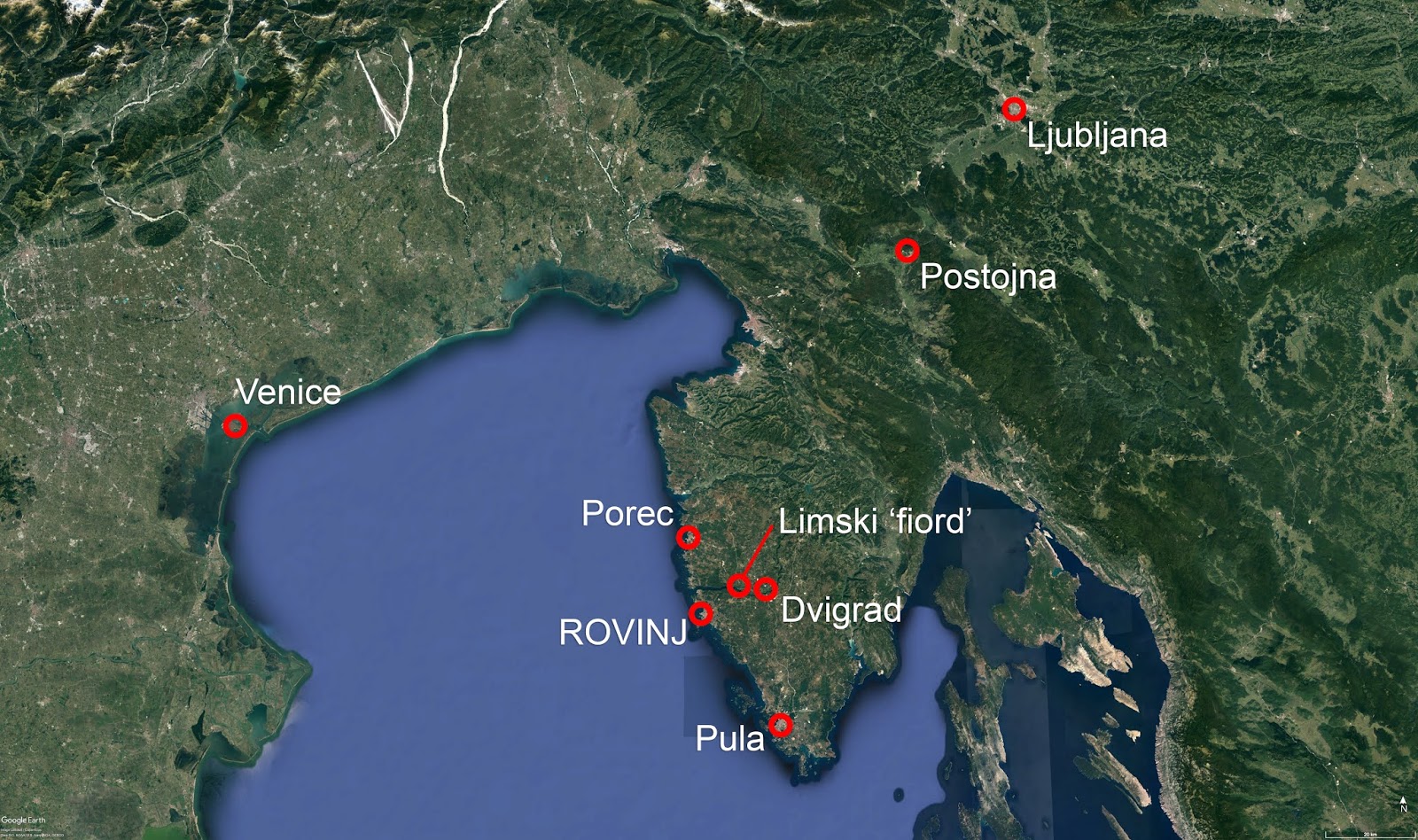
When I wrote Part One (30 May 2015) I was aware that E.T.B. Francis had written an account for the University of the first field trip to Rovinj, then in Yugoslavia, from Sheffield’s zoology department. I had written up a report on the reptiles and amphibians we found during the afternoons we were not in the lab, out and about doing the marine biology or visiting places of wider interest. He caught me in the corridor to say that he had sent the report in to the university’s Gazette. However, until a couple of months ago I had not seen what he had written. Then I found on eBay a copy of the Gazette published in October 1964. When it arrived I was pleased to see that it contained the article. With it in hand I have been able to put names to places we had visited and to draw a map and after further Google searches, to caption more accurately the photographs I had taken. At the end of this article I have also added a series of explanatory notes.

First though, I should remark that the trip to Rovinj was revolutionary for the early 1960s. Language students had to spend time abroad but for undergraduate science students a field course in continental Europe was something very special.

Rovinj Marine Laboratory

This is Francis’s complete account from the Gazette:

ROVINJ, EASTER 1964


For many years past it has been a tradition amongst zoological departments that honours students should spend some time during the Easter vacation at a marine station to study ecological and faunistic problems associated with animal life in the well defined habitats of the sea shore and shallow seas. Such students, at the same time, get the valuable experience of examining and identifying living animals collected personally from their natural habitat.
     Considerable emphasis has always been placed on the importance of such studies by the department of zoology at Sheffield, but this year a difficulty arose since the laboratory at Robin Hood’s Bay belonging to the University of Leeds—to which the second year honours students would normally have gone—is in the process of rebuilding and enlargement and was therefore unavailable. Accordingly Professor I. Chester Jones decided on a bold experiment and set arrangements in operation which resulted in a party of 31 students and 7 staff travelling to Rovinj where the Jugoslav government has a research station on the Istrian coast of the Adriatic.
     Two laboratories, one large and one small, were made available by the Director of the Station, Dr. D. Zavodnik, and the Station’s research vessel. Bios, was chartered on several occasions. Thus it was possible to study the faunas characteristic of several types of substratum—hard bottom, secondary hard bottom, sand, mud, shingle—found at moderate depths off shore, as well as the littoral fauna of the shore itself. The use of the Bios also enabled samples of plankton to be collected and studied, thus giving the opportunity to examine forms, both larval and adult, specially adapted to a floating life at the surface of the sea.
     The fauna as a whole proved exceptionally rich, both in quantity and quality, northern species such as are found round the coasts of Britain mingling with others characteristic of Mediterranean waters, the one sometimes supplanting the other in characteristic ecological associations.
     Morale and enthusiasm were high: staff shared with students the excitement of examining alive species which had hitherto been unknown, even to the most experienced members of the party, outside the pages of specialist textbooks. Over 180 species were individually identified and at least seven or eight new records were added to the fauna lists. It is very doubtful whether so rich a zoological experience could have been obtained in the same period of time around the shores of Britain—certainly not from one station alone.
     In addition to the faunistic work a serious and extensive study was made of the speciation of the limpets occurring locally, including a chromatographic analysis of their pigments, in order to compare the forms found at Rovinj with those previously studied in former years from British waters. The Jugoslav government has a station for the culture of oysters and mussels at Limski Fjord, some eight miles north of Rovinj, and the party was able to visit this and to see something of the techniques used.
     As a side-line two devoted herpetologists in the party spent every spare moment of their time in the study and collection of the local amphibia and reptiles. In all they captured some 103 individuals comprising four species of lizards, four species of amphibia and one species of snake.
     Outside the strictly zoological purposes of the excursion, occasions were made to take advantage of such cultural opportunities as the neighbourhood offered. Thus the party took a day off to visit Venice, travelling each way by a specially chartered bus and spending five hours in that unique city. On another occasion a half-day was spent visiting the ancient Roman city of Pula, where there is still a well preserved first century amphitheatre attributed to Augustus, and other relics of Roman times. Even the coach journeys to and from the railhead at Ljubljana on the outward and homeward journeys were utilized. The limestone caves at Postojna were visited on the outward journey. These are famous not only for exceptionally fine stalactite and stalagmite formations, but also as the home of the blind cave-salamander, Proteus anguinus, which the party was able to see alive. On the homeward journey a stop was made at the deserted medieval village of Dvigrad near Kanfanar to visit the church of St. Anthony and to see the very fine and vivid fifteenth century frescoes, and at Porec to visit the sixth century basilica of St. Euphrasia with its fine mosaics, comparable with those of Ravenna in brilliance.
     This remarkably successful expedition would have been impossible but for the enthusiasm, energy and organizing ability of Dr. F. J. Ebling, who not only planned the whole enterprise beforehand, but shouldered the day to day responsibility for its successful conclusion. He deserves great credit and the gratitude of all who benefited from his efforts.
     At the Rovinj end the way was prepared by Anton Perusko and his wife Gillian (nee Gillian Glen, B.Sc. Sheffield 1959). In spite of having to care for two young children, Gillian Perusko met the party at Ljubljana and escorted it to Rovinj and throughout the whole visit acted as general guide, interpreter and liaison officer. Anton Perusko made use of his official connexion with the “Auto-Kamp” Enterprise to smooth away many spiky corners connected with the accommodation, transport and such like matters. Without their invaluable help and full co-operation the venture could never have succeeded or even been contemplated.
     Much friendliness and co-operation was shown by Dr. Zavodnik and his staff at the laboratory as well as by the staff of the “Jadran” Enterprise at whose hotel the party stayed. At the Jadran Hotel it was introduced to many interesting national dishes; in fact, with the exception of milk-fed lamb, which is traditional for “Big Friday” and Easter Day, no major dish was repeated on the menu throughout the whole period. In the interest of international relations the Jadran Enterprise organized a dance on Easter Saturday to which many local people came to meet the English party of whom they had been told by the national radio and press.
     Valuable as the zoological assets of the excursion proved to be, it is clear that these are by no means the only entries on the credit side of what must remain for all who participated a most memorable experience.
 
E T B Francis 

The Places


My Photographs


I took my ‘Baby’ Rolleiflex 4 x 4 camera. This took 12 exposures on 127 size film. I used Agfacolor CT18 reversal film which is now known to be prone to degradation with time and to be ‘grainy’. Differences in processing may be partly responsible for the poor long-term reputation of this film. Unfortunately, despite being stored in identical conditions, the Rovinj films have survived amongst the least well of the photographs I have stored. The film base has warped, false colours have crept in from the edges and some have faded.

The Journey from the Hook of Holland to Ljubljana via Munich


The Rhine from the train to Munich

Vineyards in Germany from the train

Vineyards from the train

Somewhere in Austria from the overnight train from Munich to Ljubljana

We had several hours in Munich on the way out. The two of us wandered out of the station and found a beer hall which Google Earth shows to be Augustiner Stammhaus. We had steak and chips with, of course, beer. I was in the same establishment seven years later for a dinner during the International Physiological Congress. More beer was consumed.

Postojna Cave 

(2 slides I bought)


Rovinj

M/V Bios - the research vessel

Rovinj: Hotel Jadran (Adriatic) centre
Rovinj from the Bios
Rovinj

Rovinj

Rovinj. The shop on the left sold filigree jewellery for which what is now
the Croatian coast is famous. My wife brought the bracelet (below)


Pula


Venice


The Sheffield party in St Mark's Square


We travelled to and from the bus by vaporetto

Limski 'fiord' north of Rovinj


Film Set for The Long Ships (filmed in 1963) near the end of Limski 'Fiord'


Dvigrad


Church of St Mary of Lukać


Unwelcome Fauna


My wife’s (then girlfriend) abiding memory the Rovinj trip is arriving back with an unwelcome guest. She left the party at Harwich since her parents were living in Suffolk. Drying herself after a bath she though she had developed a new mole. Closer inspection revealed a large blood-swollen  tick. She blamed—and still does—the Munich-Hook of Holland sleeper.


Notes


  1. The 31 students were the 2nd years honours group plus a few from 3rd year.
  2. The staff were F.J.G. Ebling, E.T.B. Francis, O. Lusis, J. D. Jones, D. Bellamy, L. Hill plus Mr Hancock, the chief technician.
  3. D. Zavodnik was one of the authors of the history of the Rovinj laboratory.
  4. The hotel we knew in Rovinj as the Hotel Jadran was originally called the Adriatic. It has been refurbished and is again known as Hotel Adriatic.
  5. Not mentioned was the visit to the film set built for The Long Ships near the end of Limski ‘fiord’. I read that it is now fallen down. However, The Viking Restaurant was built on the site by the film’s caterer and can be found on Google Earth. It is accessible, as was the film set, by road.
  6. The deserted medieval village of Dvigrad is now a major tourist site. My photographs are not in the church Francis mentioned but in the Church of St Mary of Lakuć.
  7. Dates, as mentioned in part 1, the date of entry into Yugoslavia was 17 March with departure on 1 April. Remembering the journey, we must have left Sheffield on 15 March and returned, carrying the microscopes we had taken with us, on 3 April.
  8. After the appearance of Part 1, I was contacted by several ex-Sheffield students who had been to Rovinj in succeeding years. The Easter field course continued into at least the early 1970s. Len Hill told me in 2015 that they ended because in our time such courses were funded as part of the honours course by grants from local authorities to the individual student. Then funding was given direct to the universities to fund such activities. However, the funds disappeared into the maw of university administrations and funding for these field courses ceased.

Francis ETB. 1964. Rovinj, Easter 1964. 1964. University of Sheffield Gazette, Number 44, October 1944, 74-75.

Saturday, 30 May 2015

Rovinj Marine Biological Laboratory in 1964. Part One

A SECOND PART has been added on 11 August 2020. It can be found HERE.
----------------

A marine biology field trip was part of every zoology degree in the 1960s. For those of us in second year at Sheffield in 1964 we were not to enjoy the delights of the Robin Hood’s Bay Marine Laboratory—the usual venue—and the temperatures of the North Sea in March. Instead we were going Yugoslavia and the Marine Station at Rovinj on the Istrian coast. The Adriatic seemed much more appealing than the North Sea.

How the trip to Rovinj came about was, we recall, down to a former Sheffield student married to a Yugoslav who had become manager of the new hotel a short walk from Rovinj. Visiting Sheffield she persuaded John Ebling (1918-1992) of Rovinj’s possibilities not only for the marine life but also for side visits including the nearby Limski ‘fiord’, the Roman amphitheatre at Pula and, just within reach for a day, Venice.

When I scanned all my old slides a few years ago I came across the photographs I had taken on the Rovinj trip. I also realised that I knew nothing of the history of the Rovinj marine laboratory, or indeed whether it had survived to the present century. I do recall that the Sheffield staff (faculty for American readers) found it difficult to make contact with the inhabitants of the laboratory, of which I remember seeing only two, both dressed in those immense white labcoats that nearly reached the floor and favoured by Central and East European scientists of the time. We were asked not to wander from the large laboratory into the nether reaches of the building but one day John Ebling did venture back there to make some degree of contact with the locals and on his way seen a very large glass tank containing a shoal of cuttlefish. He managed to persuade those in charge that we lesser mortals should see that sight and it was one not to be missed. The shoal moved as if joined by invisible thread with the individuals changing colour and pattern in a display that was not only bewildering but also in unison.

Here is my photograph of the Rovinj Marine Biological Station taken in late March 1964 (my old passport shows entry to Yugoslavia on 17 March and exit on 1 April):

Rovinj Marine Biological Station. March 1964

I now find that the Rovinj laboratory is a constituent of Croatia’s Rudjer Boskovic Institute and still operating as a marine biological laboratory. I then found papers on its history. It was founded in 1891 as a field station of the Berlin Aquarium Unter den Linden (1869-1910), a commercial operation that also displayed non-aquatic animals including the first gorilla in Germany. Rovinj as a town in Istria was then part of the Austro-Hungarian empire. After the First World War Istria was under Italian rule and the laboratory came to fall under the aegis of an Italian-German consortium with a co-director appointed from each side by the Royal Italian Oceanographic Committee and the Kaiser Wilhelm Gesselschaft. At the end of the Second World War, the laboratory was closed for three years. Istria became part of Yugoslavia and the national academy took charge. That was obviously the state when we were there in 1964. With the breakup of Yugoslavia, Rovinj became part of Croatia in 1991. With such upheavals it is hardly surprising that the laboratory, its library and its reference collections suffered. The books, papers and specimens were moved to Italy in 1943 and it would appear that the building was wrecked.

The original purpose of the Rovinj marine station was to supply living organisms to the Berlin Aquarium. It also came to supply living and preserved materials throughout Europe. The histories shown below explain how it came to acquire a research function through the activities of Rudolf Virchow (1821-1902) famous as the ‘father of modern pathology’ and for cell theory but infamous for his opposition to Darwin.

In 1964 the laboratory had a small boat, Bios, shown here at Rovinj. She took us on a cruise up the Limski ‘kanal’, a ria where oysters and mussels were grown in large numbers. On a cold, damp day light relief was provided by the exploration of the set of the not-worth-watching movie, The Long Ships, which had recently been filmed there.

Bios, the laboratory's boat. March 1964

We all stayed at the Hotel Jadran. It had been built before the First World War to attract tourists to the town. Much Prošek (a name now banned by the EU) was consumed after dinner. On Easter Sunday (29 March) we were given boiled eggs for breakfast that had been died a deep, virulent purple. The lurid eggs put some of the ladies who may have consumed too much Prošek the evening before off consuming them but a male student who obviously loved eggs worked his way through them; I lost count after he got to six.

Rovinj with Hotel Jadran (centre). Photographs were Agfacolor
slides now notorious for deteriorating with time
The pace of marine biology was not taxing and we had an afternoon trips to Pula with its Roman amphitheatre as well as a whole day by bus to Venice. The countryside was alive with lizards warming themselves in the spring sunshine and breeding amphibians. The chorus of hundreds of tree frogs in the bushes surrounding a pond was unforgettable. The reptiles and amphibians of Istria were little known in the English-speaking world at that time and we published a note* on what we had found.

One of the lizards, Algyroides nigropunctatus; a male

Other photographs I took can be seen on Flickr.

PART TWO was added on 11 August 2020. It can be found HERE.


----------------------------


These two papers describe the history of the Rovinj marine laboratory and include references to earlier descriptions:

Lucu, Č & Marsoni, SS. 2013. Tribute to Professor Massimo Sella - former scientist and Director of the Marine Biological Station in Rovinj - on the occasion of the 120th anniversary of marine research in Rovinj (1891-2011). Periodicum Biologorum 115, 105-108.

Zavodnik, D, Zavodnik, N & IveÅ¡a, L. 2001. The 110th anniversary of the marine research station at Rovinj (Adriatic Sea, Croatia). Reference collections. Nat. Croat. 10, 53–60.

*Peaker, M & Peaker, SJ. 1968. Spring herpetofauna of the Rovinj area (Istria, Yugoslavia). British Journal of Herpetology 4, 36‑37