Showing posts with label Water Life Magazine. Show all posts

Friday, 3 March 2017

More on Natasha du Breuil and her fish and reptile keeping acivities in Hong Kong in the 1950s

I have written previously of Mme Natasha du Breuil's fascinating life and her interest in aquaria and reptiles (here, here and here).

I have found more articles in Water Life magazine which throw some light on her activities and her helpfulness to others.

In an article in the June-July issue of 1953 (a Coronation Special) G.W. Drummond wrote:


     Recently I returned to Hong Kong from Korea and paid many interesting visits to Madame du Breuil. I am indebted to her for many kindnesses, her authority on "anything Chinese" and her vivid interest in anything to do with fish.     Madame du Breuil is keenly interested in the many species of marine fish that abound around Hong Kong and had kept Scatophagus argus, together with two unamed types, in 50 per cent sea water for some time. They were in beautiful condition and I imagine that before long a larger marine tank will be installed in her house. I hope to be able to assist her in collecting some of the fish found locally.     I am also indebted to a friend of Madame du Breuil, a Miss Chu who arranged for me to visit a local Chinese herbalist. He had been successfully breeding Neon Teras for some time...

I have been unable to find anything about G.W. Drummond. His opening statement about returning from Korea might suggest he was in the armed forces. He did include in his article several photographs, typical of the many roadside stalls selling aquaria and fish in Hong Kong in the 1950s and 60s.

Captioned: A fish vendor displaying his
wares in Mercer Street, Hong Kong

Captioned: A local inhabitant glazing outdoors in Hong Kong
Captioned: Catching Semi-banded Barbs in the New Territories

In the same issue it was reported that Mme. du Breuil had 'achieved a successful shipment of live newts by air to Dr G Myers (U.S.A.). It is believed that this species of newt...has rarely been imported alive into the United States. The newts for the special shipment were collected locally by Mr Romer...' Mr Romer was of course John Dudley Romer (1920-1982).

The newts were the Hong Kong Warty Newt Paramesotriton hongkongensis then known as Cynops chinensis (see my blog post on the species).

Finally in the June-July 1956 in her letter to other members of Aquarists' Internationale, she reported on a few of her fish and then:
     The Chinese fishermen's children brought me two sea turtles. They are leathery black, with white fringes round their flippers and a faint white pattern on the head and a longish tail. For the first few days they refused all food, but now go greedily after bits of lean meat. They live in a marine tank...

Tuesday, 2 June 2015

Aquarists and Fish-keeping in the 20th Century. Part 6: Charles Schiller and the Hispaniola at Scarborough

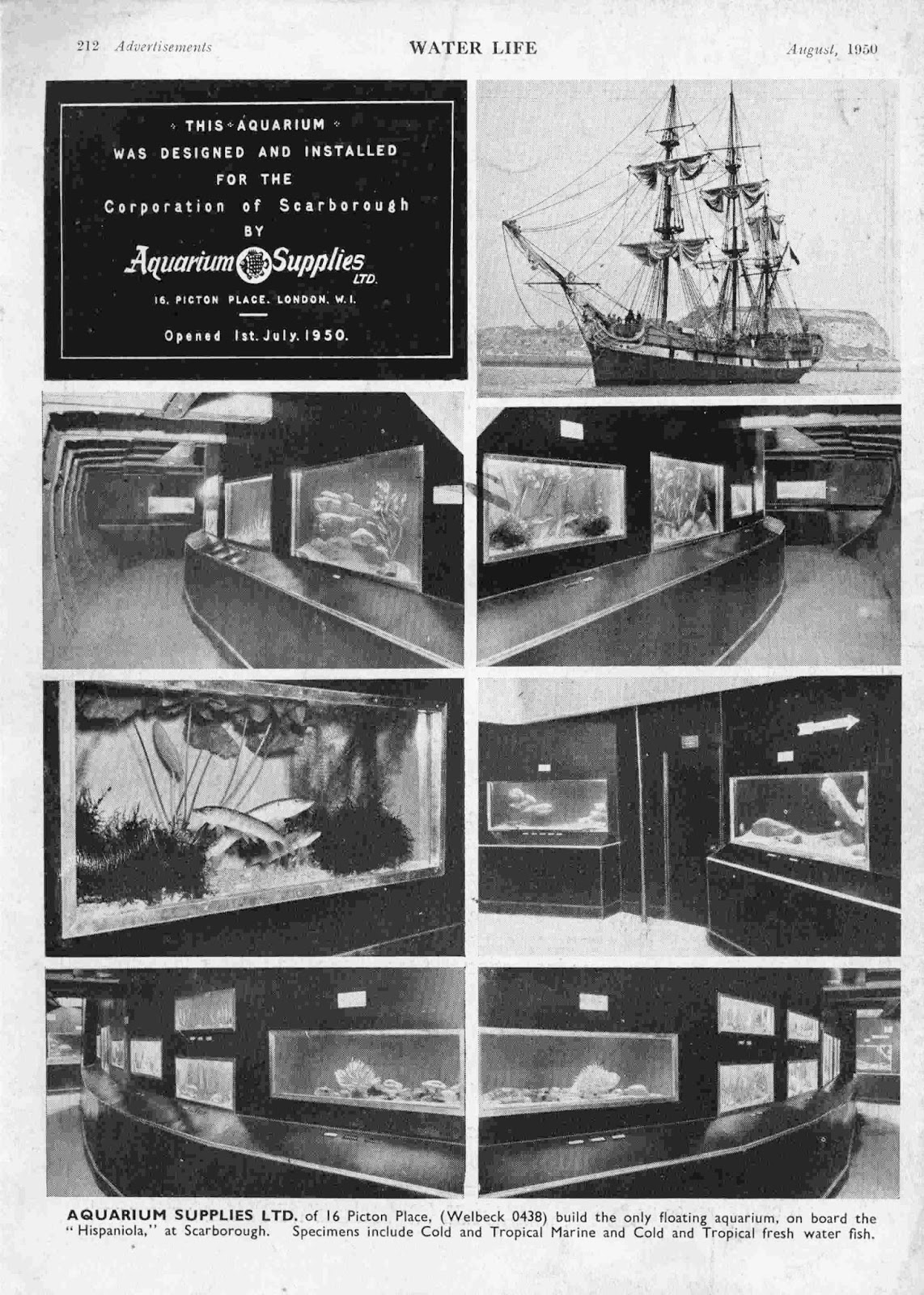
British seaside towns in the 1950s were in the business of attracting holidaymakers and animal exhibits of one kind or another often filled the bill. Aquariums were (and still are popular) especially on wet days in towns where boarding house landladies turfed their inmates out after breakfast and locked the door until 'tea' time, sometime after 5 pm. Scarborough, a Yorkshire town on the east coast of England, always competed hard to attract the holiday pound. In 1949, the town corporation had built a boat with a pirate crew to sail across the freshwater mere to an islet covered in sand from the beach. Once there the children carried with their parents could dig for buried treasure. How do I know this? Well, I was one of the children but I apparently refused to dig for treasure; I was not going to be shouted at by some piratical slavedriver and join a bunch of thugs throwing sand everywhere. So, with the full dignity of a five-year old I withdrew my labour. The whole venture was an enormous success for Scarborough, if not for me, and ran in the holiday season for many years. The pirate 'ship' was called the Hispaniola. However, Scarborough then acquired another Hispaniola, an ocean-going vessel built in the 1880s and named Ryelands that had starred in the 1950 Disney film Treasure Island. This one was moored in the harbour and this is where Charles Schiller appears in the story.

Charles Schiller's company, Aquarium Supplies, built a public aquarium in this second Scarborough Hispaniola in 1950. This is from Water Life and Aquaria World of August-September 1950:

...Internally, the ship's structure has been considerably altered to accommodate the large tanks in which fish from all parts can be seen in surroundings made to represent as near as is possible their natural haunts.
     Largely responsible for the co-ordination of the work of setting up the tanks is Miss Joyce Noble who comes from Durban, South Africa and who, with the advice given by technologists from laboratories and research stations, took steps to ensure that the correct effect was achieved in each separate section. The photograph below shows her on the deck of the vessel where only a short while ago fierce mock fights and walking the plank episodes were undertaken. Miss Noble was carrying out the more peaceful task of selecting samples of rockwork and is seen holding a particularly fine piece of pure white coral from the Great Barrier Reef, presented by the local museum. The other picture shows that Miss Noble herself gets into appropriate dress to seek out suitable material from stretches of the coast.
     From what I hear of the project, I think that the Scarborough authorities are to be congratulated on the venture and Aquarium Supplies, Ltd, on the way they have made a first-class job of the conversion and setting-up. I have no doubt that aquarist's [sic] societies from all over the country will be keen to arrange day outings to this well-known Yorkshire seaside resort and to make a visit to the Hispaniola the chief event of the day.
     For those unable to make a trip there for the time being, I am hoping to be able to give a description of the aquarium in a later issue, detailing the construction of the tanks and listing the creatures to be seen.
     Incidentally, whilst mentioning Aquarium Supplies, Ltd. it was this firm which set up the aquarium in the Ideal Homes Exhibition, Berg House illustrated in the last issue.
     Mr. Schiller, assisted by Miss Joyce Noble, was responsible for designing the layout of aquariums in the homes of a number of well-known people, including Lord Rothermere, Miss Gracie Fields, and the Western Brothers. Another achievement of the firm was to secure the commission to install a tank in Buckingham Palace.

It is not surprising that Charles Schiller had a full-page back-cover advertisement in the same issue:


The floating aquarium was called the Hispanioquarium. The ship then apparently soon moved to appear as Moby Dick to Morecambe, another town trying to attract holidaymakers, but was destroyed by fire in 1970. There is no mention of the aquarium still being present.

Tuesday, 20 January 2015

Water Life Magazine 1936-1958: Part 5. The Final Volume 1957-58

Fishkeeping and Water Life continued its mix of articles each month to the end with an emphasis on keeping fish in aquaria. There was less attention paid to water life in the wild and to animals other than fish, amphibians and reptiles than in the original Water Life. There was less to enthuse the young about the biological sciences. However, writers on reptiles and amphibians included Alfred Leutscher, Robert Bustard and Mary White. John Clegg (author of the Observer’s Book of Pond Life) wrote a few articles on pond life. Included in the writers on fishkeeping were Professor C.W. Emmens and Laurence E. Perkins who became editor of The Aquarist.

The final issue in December 1958 contained the following announcement:


The editor, Leslie W Ashdown, followed up this statement:

     Past and future. In the last issue of “FISHKEEPING AND WATER LIFE” we should like to thank our many thousands of readers who have given this journal their support over the last 13 years [since it was resurrected under this name after the war].
     We believe the hobby to be worthy of a high-class production and have attempted to provide this but costs have outstripped revenue.
     We feel this paper has played a significant part in fostering the hobby and we hope to continue our association through the fish-keeping features which will appear weekly in “Cage Birds”, commencing with the December 11 issue.—L.W.A.


The fishkeeping articles in Cage Birds were very small and soon disappeared. I do not know what happened to the editor. The only clue is that a Leslie W Ashdown died in Essex in 1961 aged 34. Could that have been the last editor of the magazine?

Water Life Magazine 1936-1958: Part 4. The Editor and the Cardinal Tetra

I have a bound volume 13 of Fishkeeping and Water Life, the final successor to Water Life. It comprises 14 monthly issues, from November 1957 to December 1958. The Editor was Leslie W. Ashdown. He gave a talk on BBC radio on 18 March in a programme entitled, Breeding Tropical Fishes.

Ashdown asked for a ruling from the International Commission on Zoological Nomenclature on the scientific name of the Cardinal Tetra, now a common aquarium fish but then a newly-imported species. In his letter of 14 May 1956 he explained that there were two names for the species and it was a question of which one had priority: Cheirodon axelrodi Schultz 1956 or Hyphessobrycon cardinalis Myers and Weitzman 1956. He also stated that the issue of Tropical Fish Hobbyist in which the former was described was marked April 1956 but was dated 20 February while the latter was described in Stanford Ichthyological Bulletin was dated 21 February, one day later. He concluded, The fish is likely to become widely used by aquarists, and it is important therefore that the scientific name to be used for it should be determined without delay…

Cardinal Tetra
By Axel Rouvin (Used on Wikipedia)

The story from there is well described in a book review by Scott A Schaefer of the American Museum of Natural History in Copeia in 2003:

In addition to the socioeconomics of the ornamental fishery, the history of the discovery and controversy surrounding the original description of the cardinal tetra are almost as colorful as the fish itself. Although not detailed herein, the literature indicates that a small characin similar in color to the neon tetra (Paracheirodon innesi) had been discussed by German biologists and aquarists as early as 1952 (Weitzman, 1956; Geisler and Annibal, 1986). In 1956, specimens were sent independently to L. P. Schultz by Axelrod, who originally acknowledged (Axelrod, 1956) that the specimens had been received from a New Jersey fish dealer on 10—11 February 1956, and to G. S. Myers and S. H. Weitzman by W. T. Innes and Paramount Aquarium (Myers and Weitzman, 1956). Both Schultz (1956) and Myers and Weitzman (1956) published a description of the species in February 1956, and, after a contentious debate and split vote, the International Commission (ICZN) ruled on the priority of the name Cheirodon axelrodi Schultz (ICZN, 1957; Opinion 485). So that the commercial interests of the exporters were protected, these authors were not provided with precise locality information on the specimens provided to them, with Axelrod (1956) contending that they had come from Porto Velho (Rio Madeira), Brazil, and Myers contending that they had come from Manaus.

One has only to read the letters concerning this case to have grave doubts whether the fish should have been named after H.R. Axelrod. As Denys Tucker of the British Natural History Museum noted in a submission to the Commission:

…I can add nothing further to this aspect of the problem, except the expression of a certain curiosity as to why Vol. 4, No. 4 of the Tropical Fish Hobbyist should carry the precise date 20 February 1956, and the succeeding one reverts to the similar form May-June 1956. I feel that the Commission should carefully weigh all the possible implications of this phenomenon.
A factor that I would emphasize in favour of Hyphessobrycon cardinalis Myers & Weitzman is that this name was clearly published as a voluntary act of publication by these authors and in a journal normally serving as a vehicle of taxonomic publication. Cheirodon axelrodi Schultz, on the other hand, does not appear to have been deliberately published by its author.
Dr. Schultz sent a personal letter to Mr. H.R. Axelrod which the latter apparently published on his own responsibility in the Tropical Fish Hobbyist…a lay journal…


The general feeling to this day is that the ICZN had been duped. Some journalists have been more explicit in their accusations. The question is: did Ashdown know the story and deliberately try to expose what had gone on? Axelrod’s Tropical Fish Hobbyist magazine and books were, after all, making inroads into the British market at the time and British aquarists in the know must have been aware of what had happened to W.T. Innes and his successful lawsuit against Axelrod.

Monday, 19 January 2015

Water Life Magazine 1936-1958: Part 3. The Editor and J.B.S. Haldane

As I have acquired some copies of Water Life magazine I have also bought batches of The Aquarist, the other British magazine of the period that contained articles on reptiles and amphibians. In 1952, Margery Elwin wrote a series of three articles for The Aquarist which means she must have given up the editorship of Water Life on a date between 1946 (see below) and 1952. The only reason I noticed them was that my eye struck one word: Lysenko, and on reading it through I realised that she was giving serious consideration to Lysenko being right. By 1952, I thought, one had to be something of an apologist for communism Soviet style still to be mentioning Lysenko in a magazine article. And then, that’s when I found the links with J.B.S. Haldane, brilliant polymath, geneticist, evolutionary theorist, marxist and, for a long time, apologist for the Soviet state under Stalin.

I will not dwell on Lysenko here, other than to remind readers of what happened to conventional ‘western’ geneticists as Lysenko’s views that the environment could alter genes were adopted as fact, thereby supporting the Soviet view of how communist organisms ought to behave. Conventional Mendelian geneticists, opponents of Lysenko and his flawed doctrine of inheritance of acquired characteristics were crushed by the state. Nikolai Vavilov, an internationally recognised authority on crop genetics and a Foreign Member of the Royal Society was arrested in 1940 and sentenced to death. That sentence was commuted to imprisonment for 20 years; he died in prison of starvation in 1943.

Incidentally, my guess is that Lysenko, having discovered vernalization of seed, failed to differentiate parental effects, that now come under the heading of epigenetics, from genetic effects in breeding experiments, and got carried away in his interpretation of his own and Michurin’s results. As he rose to political dominance of agricultural science he dismissed ‘pure’ science. To Lysenko, biologists were ‘fly-lovers and people haters’. To non-comrade western biologists Lysenko was a shit.

J.B.S. Haldane’s papers are available online. The first contact with Margery Elwin recorded was in 1937. She wrote to him a year later about the ‘Walthamstow Wonder’, an albino Common Frog: You remember the “Walthamstow Wonder” - that albino frog which I brought to show you last year? It’s owner’s brother has now found a number of real albino tadpoles, four of which I have acquired…She goes on to describe the tadpoles and continued: If you would like any of the tadpoles Dr Fox is trying to dispose of them at 5/- each, I believe. She also asked for a fruit fly culture and the recipe for the culture medium.


She seems to have written another letter shortly after the first to report that the owner had obtained  spawn from crossing the albino with a light-coloured female. She had some of the spawn and sent some of it to Haldane.


Haldane replied on 18 March 1939: Dear Miss Elwin, Thank you very much indeed. We have put the spawn into a tank and will do our best, but you will realise how difficult it is to be sure of rearing a batch of tadpoles. I heartily congratulate the owner on having kept the frog alive during the winter and got it to breed. He also sent recipes for fruit fly culture medium.

The Walthamstow Wonder was described in the 12 July 1938 issue which I have not seen. The follow-up article by F.B. Fox, describing the hibernation conditions, was in the issue of 28 March 1939.

The next correspondence, from 1946, is more revealing and confirms what I had begun to think from the articles from 1952 in The Aquarist. She wrote to Haldane from her home address on 2 June to say that Water Life was being revived as a quarterly magazine‡, that she was still the editor and asking him to write an article on ‘scientific method’ at three guineas per 1000 words. She continued:

I hope you don’t think this is a great cheek but I always read your articles in the Daily Worker [the official organ of the Central Committee of the Communist Party of Great Britain] of with great interest and you have the sort of approach I should like to have. Incidentally I am a member of the Communist Party and an enthusiastic supporter of the D.W. and am going to invest some of my new earnings in shares in the Peoples Press. I haven’t written to you on our official paper because I wanted to tell you this, but if you would be willing to write for us I will then approach you officially.
I must now stop as I am due to go canvassing with the D.W! Hoping I shall hear from you soon.

Haldane replied from University College on 14 June; yes he would write an article but would prefer to have the magazine rather than cash. He said that his wife (then Helen Spurway) was working on newts; that they had some Green Swordtails with pink eyes and asked if anything was known of the genetics. He added that she should get an article from R.A. Lantz of Manchester who ‘has probably the best collection of amphibia in Britain. During the war he was the Fighting French consul in Manchester’. Finally, he invited her to see his wife’s collection and asked her to introduce him to the Guppy Society. He signed off, ‘yours fraternally’.

There is a very good background to the reason so many British scientists of the 1930s and 40s were marxists and communists in Diane Paul’s paper:

     Their major concern, however, was not with Marxism as a guide to scientific practice or to the history of science…their concern was with the social relations of science - with the relation of scientists to the mass public, the government, the schools and universities, the other professions, and the culture in general.They believed that culture to be largely ignorant of, when not actually hostile to, the natural scientific enterprise and they aimed to change things by reforming both science and society. In fact, they saw the reconstruction of science and the scientific reconstruction of society as interdependent tasks. Science they wished to rationalize and to redirect, away from war especially; and society they wished to reorganize in accord with scientific principles and in ways that would support further scientific progress. In general,they thought no one more qualified for the task of scientifically reorganizing society than themselves.

The default of the process that clones British scientists is still set to the left, often the far left, of centre.

There must have been visits by the Mandeville’s to Haldane at UCL because there is a letter in the archive from Haldane on 27 November asking Louis if he could photograph about three more newts in the next 10 days for Helen Spurway in order for her to have slides for her talk in Germany. He added: She apologizes for not asking you earlier, but has been intensively over-worked because of dereliction of duty by a colleague which has nearly killed our Drosophila stocks and kept her on a 14 hour day (sometimes 36 hours at a stretch) for the last month. We have only 1 flash bulb, but several more are on order.

From then, the Mandevilles became involved with genetics research in Haldane’s Biometry Department at UCL. In 1948 Haldane supported their case to the local fuel office for two tons of coal to heat their fish house. In the days of real austerity after the war, coal was rationed, and the amount requested more than doubled that which the household could have bought during a whole year. Temporary emergency exemptions were made for exigencies such as a bedroom that needed to be heated for a sick child. I remember well parents and grandparents coming to see my grandfather at all hours bearing a chit from the fuel office. He ran the local co-operative society’s coal yard and instead of waiting until he was in the office, they tried to ensure that he would arrange for a special delivery of an extra bag as soon as was possible. The bureaucracy entailed by coal rationing was onerous (I helped him even at the age of five or so by stamping the latest updates on delivery notes with a large rubber stamp and a red ink pad). Extra coal was difficult to get and Haldane wrote to the local fuel office: ‘This greenhouse is used to house experimental animals on which scientific research of considerable importance is carried out’. The outcome is not recorded.

Louis Mandeville was appointed an Honorary Research Assistant by UCL in 1949. Haldane wrote: …who is an old student of this College, is a dental surgeon who is doing part-time research in animal genetics in this Department. He has a paper in the press describing original research in the field of human inheritance. I wish to recommend that he be appointed Honorary Lecturer. The paper in press at the time was on the congenital absence of permanent maxillary lateral incisor teeth*. I have not been able to find any further publications on his work at UCL.

Margery Mandeville in a letter in 1957 (see below) states that she was in charge of Drosophila stocks for about 3 three years, and there is a note in the Haldane archive from about 1950, showing the lines she had in culture.

The results of her research in the 1950s, Pathological melanosis in an intergeneric hybrid† were published in Nature in 1957. It begins: During the past three years, I have been working on the genetics of an apparent intergeneric cross between two viviparous cyprinodonts, Xiphophorus helleri and Mollienisia sphenops. Some of the results may interest not only geneticists but also those engaged in the fields of endocrinology and cancer research. Her address is given as Zoology Department, Chelsea Polytechnic. She must have had some position at Chelsea, which is now part of King’s College, London but I have not been able to find any records online in which to look for information.

Haldane and Spurway left Britain, lock, stock and barrel, for India on 24 July 1957. The final letter in the UCL collection is from Margery Mandeville to Professor Lionel Penrose FRS then occupying the Galton Chair at UCL. On 29 July she asked if her fish could be housed at UCL now that Helen Spurway had vacated the space for tanks. She explained, Up till now I have kept my fish at home but this is becoming increasingly more difficult as I now have no one to look after my fish or attend to the fish-house fire when I am away from home. I want to continue this work but I am afraid this will be impossible unless I obtain more satisfactory accommodation for animals. Professors Haddow, Horning and Koller of the Chester Beatty Research Institute, are very interested in the results I am obtaining and so is Professor Huxley. At the moment I have an expenses grant from the British Empire Cancer Campaign. This is only £50, but I think I should have no difficulty in getting it increased if necessary.

And that is as much as I know. Lacking most of the post-war copies of Water Life I do not know when Margery Elwin ceased to be editor of Water Life or what happened to her after 1957, if she was successful in getting her fish housed at UCL and what her role was at Chelsea Polytechnic.

What I do know is that she was responsible for a highly informative, science-based magazine that had the key players of the 1930s as contributors. How very different from the magazines of the present century.

Finally, the only photograph I have found of Margery Elwin, taken I think by Louis Mandeville at the Dutch congress of aquarium clubs in late 1937 or early 1938.

From Water Life 22 February 1938. Margery Elwin would then have been 29


‡The publisher in the 1940s was the Poultry World empire, Iliffe Press. The Writers’ & Artists’ Yearbook for 1947 shows that Water Life and Aquaria World was published by Iliffe Press, Dorset House, Stamford Street, London. They presumably bought the title after the war from The Marshall Press.

*Mandeville LC. 1950. Congenital absence of permanent maxillary lateral incisor teeth: a preliminary investigation. Ann Eugen, London 15, 1.

†Elwin, MG. 1957. Pathological melanosis in an intergeneric hybrid. Nature 179, 1254-1255.

See:

Clark, R. 1968. J.B.S. The Life and Works of J.B.S. Haldane. London: Hodder and Stoughton

Paul, DB. 1983. A war on two fronts: J. B. S. Haldane and the response to Lysenkoism in Britain

Journal of the History of Biology 16, 1-37

Thursday, 15 January 2015

Water Life Magazine 1936-1958: Part 2. The Editor, Margery Graves Elwin

The editor of the magazine in the 1930s and 40s was Margery Graves Elwin. The magazine covered the whole of aquatic and some terrestrial life. It was not confined to keeping fish, reptiles and amphibians but included ponds and pond life, aquatic plants, invertebrates, birds and mammals. It provided accurate information on this wide range of topics and the fact that I concentrate on articles on amphibians and reptiles and those of general interest does not mean to say that its role in the other areas of natural history should be ignored. In short, Margery Elwin did an excellent job and I am full of admiration that she managed to get an issue out each week.

Margery Graves Elwin was born in Southwark, London, on 5 August 1908 to George Richard Elwin, a medical practitioner, and Eliza Beatrice, née Graves. At the 1911 Census, the family was living at 82 Black Friars Road, Southwark. There was a Dispenser boarding with them, which would suggest George Elwin was a general practitioner, and they employed a housekeeper.

She graduated from the University of London, BSc (Special Honours) in 1932. The records show University College and Birkbeck College, the latter and her age (24) suggesting that for part the degree course she was a part-time student. She was married in 1936 to Louis Caustin Mandeville. They had a son on 5 April 1939 and the following announcement appeared in Water Life:


By then she had given a talk on a BBC London Regional Programme, ‘The Care of Pets’ on 9 July 1938 at 12.45 under the title, ‘Fish and Aquaria’. She also described the then new species, Corydoras arcuatus now called the Skunk Catfish, in a paper in Journal of Natural History in 1939.


During this time, the Water Life series of booklets was launched, the first of which she wrote. The booklets were written by contributors to Water Life.


Louis Mandeville was a major contributor to Water Life and, later, to The Aquarist until the 1960s at least; he was also a lecturer to fishkeeping societies. By profession he was a dentist (L.D.S. R.C.S.). He was born on 27 October 1910, the son of Joseph Louis, a motor cab driver, and Ethel Amy. At the 1911 Census they were living at 1 Millais Buildings, Westminster. He was commissioned in the Army Dental Corps as a Lieutenant on 27 May 1940 but left the army, as Captain, on 13 October 1945 ‘on account of disability’. I then found records that showed he became Principal School Dental Officer for Ealing in London, and retired in 1970/71.

In the 1930s, the Mandevilles lived at 6 Thornberry Court, Isleworth but then moved to 79 Eastcote Road, Ruislip.

Louis died in Bristol in 1983, Margery also in Bristol in 2005, aged 96.

But the story does not end there because of the involvement of J.B.S. Haldane—yes, the ‘inordinate fondness for beetles’ Haldane. His letters are available online and those to, from and about Margery and Louis Mandeville will be the subject of my next post.

Monday, 12 January 2015

Water Life Magazine 1936-1958: Part 1

Cover of Water Life of 14 March 1939
I shall start this story at the end. In the late 1950s, a series of booklets, including Hardy Reptiles and Amphibians by L.G. Payne and Land and Water Tortoises by Amphibius, was being advertised and published as the ‘Water Life’ Series. The publisher was Water Life, Dorset House, Stamford Street, London and was part of the Poultry World publishing empire, until recently the owners of what was Cage Birds and then Cage & Aviary Birds.

Inside the back cover of the booklets, Water Life is described as a periodical produced to foster and cater for the interests of the aquatic hobby all over the world. Publication was described as every alternate month. I searched for the magazine in newsagents and bookstalls without success. Only recently have I discovered that Water Life, by then called Fishkeeping and Water Life ceased publication in December 1958, a few months after I developed a burgeoning interest in amphibians and reptiles. Over the past year or so I have acquired some copies of the magazine but they are difficult to find.

The Zoo library catalogue outlines the stages in the rise and fall of Water Life. It was first published in 1936. From March 1940 until June 1941, presumably as paper restrictions were imposed during the war, it was incorporated in Animal and Zoo Magazine, the official magazine of the Zoological Society of London until publication ceased in 1941. In 1946 it continued as Fishkeeping and Water Life. The catalogue shows the last issue as 1957 but it was in fact December 1958. Sometime, and I suspect in 1946, the publisher changed.

This magazine was clearly an important supplier of information to amateur herpetologists in the 1930s. Although I do not yet have all the information I would like, I do have sufficient to make a start and to show something of the content of the magazine.

So, it’s back to the beginning. The original publishers and printers were The Marshall Press with their works in Milford Lane off The Strand in London. I have not been able to find much about the activities of The Marshall Press but I have found they produced books on cage birds, gardening and small-holding, type faces, biography and religion. On the latter, that by Alexander James Ferris, When Russia Bombs Germany, with the 5th edition published in 1942, claims that the events of the Second World War were foretold in the bible. It is good to know that little matter has been cleared up. However, Wikipedia says that this work sold over 60,000 copies and was very popular amongst those of the christian persuasion. However, George Orwell reviewed the book and considered Ferris to be a ‘religio-patriotic lunatic’. Well, there’s a surprise. However, I digress.

The Marshall Press was liquidated in 1961.

Marshall Press published Water Life every week. I repeat, every week. That must have been quite a job even if each issue comprised only 8-14 pages. Who edited the magazine and who wrote for it I shall consider in the next post.

Incidentally, I am posting this and the more general articles on Water Life in two blogs. Because Water Life must have had a considerable influence of aspiring young biologists in the 1930s and later, the more general posts will be on this site. There will be some downloads of articles on herpetology available later; they will only be on my other blog: Reptiles, Amphibians and Birds: A Historical Perspective of their Care in Captivity.