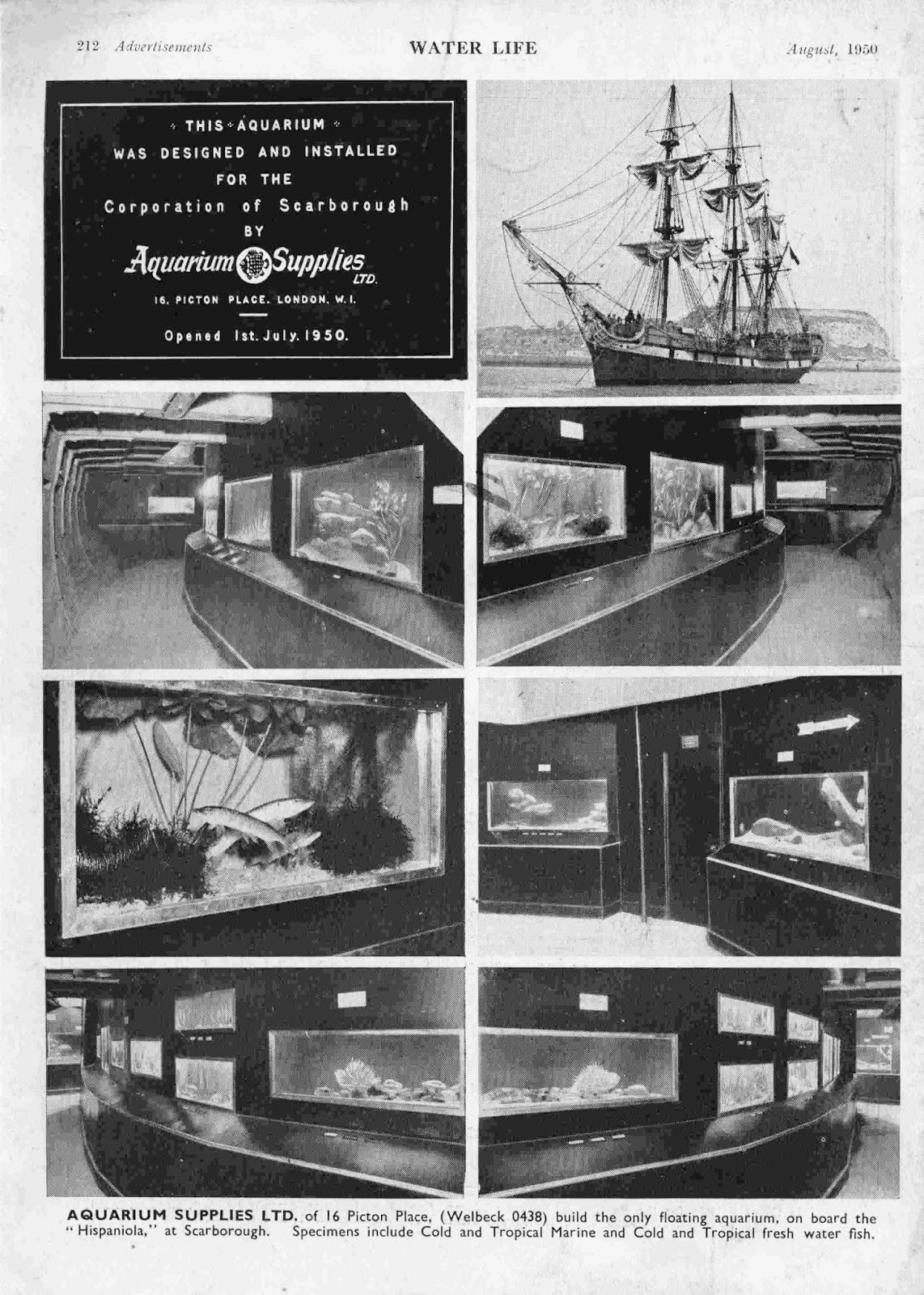
This article from the Golden Jubilee (October 1974) edition of The Aquarist and Pondkeeper by Paul William Charles de Zille Schiller (1906-1980) covers his activities in the tropical fish trade in the early to middle decades of the 20th Century. The Editor, Laurence E. Perkins, added the note on Charles Schiller which is also reproduced below. I have already covered Charles Schiller in my post of 17 February 2015.
Charles Schiller's knowledge of the Aquatic trade spans a period of almost sixty years. Below he recalls the growth of his own business, and some of the fascinating characters it has brought him into contact with.
For me it all started before the First World War, when I was only eight years old. My father was the Court Florist and held the Royal Appointment for Edward VII and George V and his very exclusive establishment was situated in Wigmore Street, London W.l. My interest grew with the years and in 1926 I built, what I believe to be, the first chromium-plated steel-frame aquarium, which I proudly installed in the shop near the cash desk. This created tremendous interest, and before long I was inundated with requests from people who wanted a similar tank of their own. And so it was that by the beginning of the Second World War I had a staff of 26 who did nothing but service aquaria all over the West End of London and beyond. As far as I know, at that time ours was the only concern selling or devoting our attentions exclusively to tropical fish—we had nothing to do with goldfish, although I believe there was much more money to be made out of them at the time. Our clients included many doctors, dentists and consultants in the district, and eventually our fame spread further afield. I remember one noble Earl who had an estate in Leicestershire. We installed a very beautiful tank there, but unfortunately they were in the habit of giving wild parties, as a result of which—usually on the Monday morning—we had to send staff all the way to Melton Mowbray to re-instal the tank, which might contain the contents of a bottle of whisky which had been given to the fish for fun!
My parents became so interested in my hobby that they allowed me to use the first floor of the Wigmore Street premises as a showroom—in fact it was there that we held the first meeting of the Guild of British Aquarists, which was a society formed by people in the trade—in those days mostly goldfish purveyors. Eventually the property next-door also became available, and it was decided that, as my aquatic business was expanding fast, I should take these premises also.
The first immersion heaters were made in my father's cellar in Wigmore Street. When Pyrex glass was invented in the late 1920s, we started using it as a cover for our immersion heaters, which previously had been enveloped in a mica wrapping and then sealed in a brass tube and nickel-plated. We made all our own aquaria, and when a local wrought-iron manufacturer decided to give up business we took the firm over together with a number of the staff. This gave us our first real entry into the manufacture of aquariums on a large scale. All aquariums were turned-out with polished slate bottoms—these were much sought-after because it was considered that the plants grew very much better. Eventually bi-metal (which originated in the U.S.A.) became available in this country and we began manufacturing thermostats, which were very accurate, considering the crude way in which we originally made them.
In those days the Germans knew so much more than us about the hobby, and we constantly turned to them for supplies. Apart from a few fishes brought over here by amateur enthusiasts, Germany was the main source of new specimens. Two young men in Hamburg started a business known as 'Aquarium Hamburg', and subsequently we became their English agents. Being situated in such a busy port, they used to send students all over the world to collect fish. It was quite usual for them to book space on a ship—perhaps two or three cabins, which they had specially heated, and air laid on. There were no plastic bags in those days, and the fish used to come over either in aquaria or in large tanks. When my own stocks became really low, I used to book a cabin on one of the tramp steamers going out from London Docks, go over to Hamburg and bring back specimens—perhaps 5,000 or 6,000 at a time. In those days the journey used to take about 48 hours. There was no radio, and once you were away from London nobody knew where you were until you arrived in Hamburg. 48 hours in one cabin in a rough sea was no fun, I can tell you!
Aquarium Hamburg soon built up a fine reputation throughout the world. Between the wars the company decided to teach America the hobby, and opened-up a depot along the Hudson River some 35 miles or so from New York. The two partners used to do turn-and-turn-about: one would remain at the parent company in Hamburg whilst the other would be in the States. I re-visited Germany in 1949 to see if I could re-establish business connections. As you know, Hamburg was in a state of almost complete ruin, and I was more than surprised to find that their buildings were still standing together with those of the Women's Clinic in the next block.
Another regular source of supply over the years has been a certain well-known Chinaman in Singapore. At one time he built-up a very thriving business supplying the Germans, and occasionally there was enough to spare for us. We used to ship them in the care of the ship's baker on the P. & O. boats— the old 'Rajputana' and the 'Rawlpindi', unfortunately both sunk during the War. A large number of Rasbora and similar fish were brought over by Japanese crews who kept them in the kitchens. I once called at the Docks to inspect some fish which had arrived for me and found that in the large kitchen on one of the Japanese boats, the kitchen ranges had been closed down, and a number of the ovens lined with zinc trays in which the various fish had been put. On one occasion a ship had to put into Marseilles on the way home because the crew had used all the available fresh water on board. The small tropicals used to come over in large earthenware crocks in which the travelling Chinese are reputed to put the remains of their families who die en route.
Development of the hobby was very steady between the wars but when hostilities broke out in 1939, all imports ceased and very many of us were called-up. My connections were completely severed until 1946 when I returned home and opened my own retail aquarist shop. Sometimes on Saturday afternoon I would close the shop, dash off to London Airport, and get a flight over to Hamburg or Brussels. I was looking for Neons, which I discovered could be purchased either in Hamburg or Liege for the same price. It was a complete mystery to me where these fish originated, although it was rumoured that they were bred in East Germany and smuggled over the border to the Western Zone. Incidentally, I imported the first Neons ever to be seen in this country—I think it was about 1936. In those days I used to travel by Hillman's Airways, which was a line run by a London taxi owner who specialised in cut-price fares to the continent. He had a fleet of De Havillands, and this could be quite a lot of fun. I used to bring back 100 Neons at a time, and if I remember correctly we paid £1.00 each for them.
During the past twenty-five years I have spent a great deal of time travelling all over the world, and the aquatic trade has seen many changes. Until about two years ago, anyone wanting to heat an aquarium in the home generally used what we call 'separates'— that is a separate heater connected to a thermostat. Although a number of firms developed an automatic heater with a thermostat in the same tube, it was a long while before these caught on. Now it appears that nobody really wants the separates except those few hobbyists who have more than two or three tanks. Combined heater/thermostats are so sophisticated nowadays, and the results so regular, that to mess about connecting wires from one small instrument to another no longer makes any kind of sense.
Now that I am fast approaching seventy, looking back I can recall many interesting and a few almost eccentric characters, most of whom are sadly no longer with us. One of the latter was poor old Freeman of Waterloo Goldfishery who met a rather untimely end. It was his habit to collect a few water plants before breakfast, and one day he failed to return. We believe that he must have suffered a heart attack, because his unfortunate wife eventually found him in the pond with his head well and truly stuck in the river mud.
Mr. Walter Woolland of Woolland's of Knightsbridge provided us with one of our most interesting commissions. He became a real tropical fish enthusiast and decided that he wanted to breed Mollies. It was arranged that one of my suppliers in Florida would put on the steamship 'Washington' in New York, 80 cans, each with a trio of Mollies. In those days they were worth about £7 10s a trio, and I shall always remember going down to Plymouth to meet the ship and bringing the 80 cans up to London. A special first-class coach had been reserved, and the engine put on two hours in advance in order to heat up the carriages. Subsequently Mr. Woolland became so interested in breeding this fish that he asked us to build several 16 ft. long aquariums on the first floor of his building.
A French Count came into my shop one day and purchased out of hand a 24 in. aquarium with chromium-plated edges. He also bought all the trimmings—heater, thermostat, sand, rock plants, a selection of fish, and when I asked him where he'd like it delivered, he said: "Oh, I have a flat on the Champs Elysees in Paris, here is the address." So the next day I had to go over and instal the tank. Fortunately I was able to get back by teatime—Hillman's Airways again! The French now have exquisite taste in aquaria and accessories. I find it difficult to imagine a similar incident taking place today.
I recall another occasion just before Christmas 1934. I was closing my shop somewhat late when I observed a large black face trying to look through the window which was covered in mist. I answered the door and invited him in. He was a very large gentleman indeed and exquisitely dressed for the City—bowler hat, rolled umbrella and a beautiful overcoat. He apologised profusely, but eventually entered the shop and asked the price of nearly everything on show. As he was about to depart, he turned to quite a nice outfit I had there and said: "How much is that?" "£25," I said, hoping desperately to get rid of him. "Wrap it up," he replied. Well, of course, you can't wrap up a thing like that, but I suggested that if he liked to send transport for it (it was obvious that he wanted it in a hurry) I would arrange to instal it free of charge. In those days we normally charged about five guineas to go to someone's house and instal a really nice outfit. A car duly arrived, and when my staff returned, having completed the assignment, they reported one very satisfied customer. The following day was Saturday —early-closing day—and having nothing to do until meeting my fiancee in the evening, I decided to go round and inspect the job for myself. The house in Camden Town was a large Georgian mansion, but the district itself had been allowed to run down and was rapidly deteriorating into a slum. The door was opened by a rather sleazy looking Irish maid who invited me in. From inside the house there suddenly appeared an apparition dressed in a pair of old, very soiled flannel bags and an athletic vest. With a sense of shock, I recognised my immaculate customer of the previous night. He was extremely cordial, said how pleased he was with the aquarium and invited me to look over the house. Well, I have never seen anything else quite like it. There were the most beautiful antique furniture and objets d'art. The man obviously had exquisite taste. Apparently he had made a great deal of money and decided to invest in beautiful things. Having looked over the house—which left me almost breathless—we went into the huge dining room. Running down the centre of the room was a large refectory table, beautifully set, with lace mats and silver. A great dish sat in the middle containing fruits out of season, and in the corner was a very large hot-plate. On the other side was a 3-manual electrically blown organ! My host insisted that I stayed to lunch, in spite of my statement that I had already lunched some two hours earlier. We were shortly joined by three gentlemen who looked suspiciously like thugs, and whom I supposed were his bodyguards. They looked and behaved in a manner reminiscent of all Hollywood gangster films you ever saw. We all sat down, and the maid entered carrying a large covered dish which she put on the hot-plate. I wondered what exotic feast lay beneath, and was much surprised to find that all the ceremony was due to a plate of sausages and mash.
Before leaving I received a further invitation for my fiancee and myself to attend dinner on the following Tuesday evening, and a polite request was made that we should dress for the occasion. We turned-up at the appointed time, and were introduced to a number of guests, all of whom were in formal dress, like ourselves. However, there was no sign of our host who, it transpired, was down in the underground kitchens preparing the meal. He later explained that when he gave a dinner party he liked to send his cook out for the night and do everything himself. There were eight courses and everything exquisitely served. Our host insisted upon serving all the courses himself, with the aid of the two maids, but still dressed in his old flannel bags and vest! I called to see him at his City office shortly afterwards—a superb apartment, very much after the style of his house but everything in complete contrast to his weird apparel at home. He subsequently ordered a number of aquaria in most unusual shapes—one was a half-moon, and I know where this tank is today, still in running order. He was, in fact, one of the cleverest of share manipulators in the City, much sought-after by the underworld, to whom he regularly gave advice. It is very strange that beautiful things often seem to go hand-in-hand with people like this. As a matter of fact, two of the biggest international crooks of the time were very good customers of ours. But let me tell you of a rather different type of client whom we served for many years.
Now in those days it was my habit to go into work before breakfast, and one early morning a very well known customer of mine poked his head around the corner and asked if I would arrange to instal an aquarium at No. 145 Piccadilly. During breakfast I happened to mention this to my parents, and they said: "Oh, yes, the Duke and Duchess of York." So of course I was determined to give them something very special. The aquarium was first installed in the children's playroom—the children being Princess Elizabeth and Princess Margaret Rose. The following day I was summoned by the Duchess—now the Queen Mother—who remarked that the aquarium was far too beautiful for the children, and requested me to transfer it to the morning room on the ground floor. There was an awful lot of work involved, but I was well rewarded. Every visitor to the house saw the tank, and this provided a first-class introduction to many valuable clients. When the family moved to Buckingham Palace after the abdication of Edward VIII, both the tank and our activities transferred with them. One day the Queen (as she then was) noticed that her little red guppy had become very fat, and she asked her page to enquire as to the reason. Once more I was summoned to the Presence, and I explained that the guppy was a live-bearing fish, and would eventually produce young. Their Majesties thought this was excellent news, but were dismayed when I explained that as fast as the new fish were born they would probably be eaten by the other residents. However, I agreed to lend them a small tank in which to isolate the mother. As many hobbyists will know, these live-bearing fish will occasionally hang fire and decide not to produce for a time. This was unfortunate as the Royal Family were going away the following weekend for a holiday. Their departure became imminent and still no small fish appeared. It occurred to me as I went to feed the fish each morning that perhaps it would do no harm on the last day to put three or four of my own little baby fish in the tank to avoid anyone being disappointed. This I did, and having completed my rather deceitful task, I returned to breakfast. I had hardly been home more than 10 minutes when a frantic call from the Palace told me of the happy event, and so, of course, back I went. I was more than happy to discover that following my earlier visit the guppy had in fact produced her own family, so I didn't feel such a cheat after all!
This hobby of ours has suffered many ups and downs. There have been times when it appeared that there was an aquarist shop on almost every street corner. Sadly, this kind of situation usually brings fairly widespread bankruptcies in its wake, although I believe there is still plenty of scope for the dedicated aquarists. So many folk have attempted to open shops on the strength of a few weeks' experience, only to find that the large profits they expected were just not there.
In order to succeed as a retailer you not only need years of experience but also the ability and patience to pass on your knowledge to even the most exasperating of customers. The effort involved is usually repaid many times over. At my age patience is a fading virtue! There was a time when I would have chased one particular fish round a tank containing six hundred Neons just to please a lady. Nowadays I must admit that I would feel more inclined to tell her to go and jump in the tank herself!
Seriously though, I am appalled at the number of shops in existence today which are either unwilling or unable to offer reliable advice. Before the War I was responsible for five different departments in Selfridge's, in addition to running my own business. I think the 'Old Man' must turn in his grave at the way that most so-called retail staff behave nowadays. I trust that future generations will see a return to genuine professionalism in all branches of industry, in which case, with a little luck—it is just possible that there is hope for us all yet.
This is an advertisement from the Aquarist for Springfield heaters/thermostats for aquaria:
I also came across a report in Water Life of a talk given by Charles Schiller in 1936:
The Chairman then asked Mr. Charles Schiller to give his lecture on the " Lighting and Filtration of Aquariums." Mr. Schiller dealt first with filtration, explaining that filtration does two things: (1) it removes solids from the water and (2) by passing the water through carbon it removes gases, the efficiency of this latter process depends on the quality of the carbon and the time the water is in contact with it. Mr. Schiller then went on to deal with the ordinary air-lift filter, and also the "Schiller" system, which is a German patent*. He also described a method of using three large jars connected to each other which, with the aid of a powerful pump, will filter the water in a twelve-gallon tank in ten minutes. At this point Mr. Schiller gave an interesting description of the making of the aquarium for the Queen Mary and the difficulties experienced and how they were overcome.
Dealing with the lighting of aquariums, interesting points which Mr. Schiller mentioned were, that when plants are lighted they also require heat for satisfactory growth, that minute quantities of salts, such as 1 /1,000th part, make a great deal of difference to the growth of plants, and that the nearer the light is to the water the better it is. He also mentioned that a 60-watt strip lamp is required to light two cubic feet of water.
Some interesting data given as to the effect of light on plants were as follows:—Tank illuminated six hours per day—plants died and rotted. Tank illuminated eight to nine hours per day—growth good. Over and above this amount of light the plants become lanky It was also mentioned that sixteen hours' use of a 30-watt lamp will not equal eight hours' use of a 60-watt lamp.
At the end of his lecture Mr. Schiller answered a very large number of questions. He was then thanked for the trouble and care he had taken to give the club such a very interesting lecture, and the meeting concluded amid applause.
*I have searched for this patent but have failed to find it.
Finally, in this series, the cover of the Golden Jubilee edition: