Thursday, 15 January 2015

Water Life Magazine 1936-1958: Part 2. The Editor, Margery Graves Elwin

The editor of the magazine in the 1930s and 40s was Margery Graves Elwin. The magazine covered the whole of aquatic and some terrestrial life. It was not confined to keeping fish, reptiles and amphibians but included ponds and pond life, aquatic plants, invertebrates, birds and mammals. It provided accurate information on this wide range of topics and the fact that I concentrate on articles on amphibians and reptiles and those of general interest does not mean to say that its role in the other areas of natural history should be ignored. In short, Margery Elwin did an excellent job and I am full of admiration that she managed to get an issue out each week.

Margery Graves Elwin was born in Southwark, London, on 5 August 1908 to George Richard Elwin, a medical practitioner, and Eliza Beatrice, née Graves. At the 1911 Census, the family was living at 82 Black Friars Road, Southwark. There was a Dispenser boarding with them, which would suggest George Elwin was a general practitioner, and they employed a housekeeper.

She graduated from the University of London, BSc (Special Honours) in 1932. The records show University College and Birkbeck College, the latter and her age (24) suggesting that for part the degree course she was a part-time student. She was married in 1936 to Louis Caustin Mandeville. They had a son on 5 April 1939 and the following announcement appeared in Water Life:


By then she had given a talk on a BBC London Regional Programme, ‘The Care of Pets’ on 9 July 1938 at 12.45 under the title, ‘Fish and Aquaria’. She also described the then new species, Corydoras arcuatus now called the Skunk Catfish, in a paper in Journal of Natural History in 1939.


During this time, the Water Life series of booklets was launched, the first of which she wrote. The booklets were written by contributors to Water Life.


Louis Mandeville was a major contributor to Water Life and, later, to The Aquarist until the 1960s at least; he was also a lecturer to fishkeeping societies. By profession he was a dentist (L.D.S. R.C.S.). He was born on 27 October 1910, the son of Joseph Louis, a motor cab driver, and Ethel Amy. At the 1911 Census they were living at 1 Millais Buildings, Westminster. He was commissioned in the Army Dental Corps as a Lieutenant on 27 May 1940 but left the army, as Captain, on 13 October 1945 ‘on account of disability’. I then found records that showed he became Principal School Dental Officer for Ealing in London, and retired in 1970/71.

In the 1930s, the Mandevilles lived at 6 Thornberry Court, Isleworth but then moved to 79 Eastcote Road, Ruislip.

Louis died in Bristol in 1983, Margery also in Bristol in 2005, aged 96.

But the story does not end there because of the involvement of J.B.S. Haldane—yes, the ‘inordinate fondness for beetles’ Haldane. His letters are available online and those to, from and about Margery and Louis Mandeville will be the subject of my next post.

Monday, 12 January 2015

Water Life Magazine 1936-1958: Part 1

Cover of Water Life of 14 March 1939
I shall start this story at the end. In the late 1950s, a series of booklets, including Hardy Reptiles and Amphibians by L.G. Payne and Land and Water Tortoises by Amphibius, was being advertised and published as the ‘Water Life’ Series. The publisher was Water Life, Dorset House, Stamford Street, London and was part of the Poultry World publishing empire, until recently the owners of what was Cage Birds and then Cage & Aviary Birds.

Inside the back cover of the booklets, Water Life is described as a periodical produced to foster and cater for the interests of the aquatic hobby all over the world. Publication was described as every alternate month. I searched for the magazine in newsagents and bookstalls without success. Only recently have I discovered that Water Life, by then called Fishkeeping and Water Life ceased publication in December 1958, a few months after I developed a burgeoning interest in amphibians and reptiles. Over the past year or so I have acquired some copies of the magazine but they are difficult to find.

The Zoo library catalogue outlines the stages in the rise and fall of Water Life. It was first published in 1936. From March 1940 until June 1941, presumably as paper restrictions were imposed during the war, it was incorporated in Animal and Zoo Magazine, the official magazine of the Zoological Society of London until publication ceased in 1941. In 1946 it continued as Fishkeeping and Water Life. The catalogue shows the last issue as 1957 but it was in fact December 1958. Sometime, and I suspect in 1946, the publisher changed.

This magazine was clearly an important supplier of information to amateur herpetologists in the 1930s. Although I do not yet have all the information I would like, I do have sufficient to make a start and to show something of the content of the magazine.

So, it’s back to the beginning. The original publishers and printers were The Marshall Press with their works in Milford Lane off The Strand in London. I have not been able to find much about the activities of The Marshall Press but I have found they produced books on cage birds, gardening and small-holding, type faces, biography and religion. On the latter, that by Alexander James Ferris, When Russia Bombs Germany, with the 5th edition published in 1942, claims that the events of the Second World War were foretold in the bible. It is good to know that little matter has been cleared up. However, Wikipedia says that this work sold over 60,000 copies and was very popular amongst those of the christian persuasion. However, George Orwell reviewed the book and considered Ferris to be a ‘religio-patriotic lunatic’. Well, there’s a surprise. However, I digress.

The Marshall Press was liquidated in 1961.

Marshall Press published Water Life every week. I repeat, every week. That must have been quite a job even if each issue comprised only 8-14 pages. Who edited the magazine and who wrote for it I shall consider in the next post.

Incidentally, I am posting this and the more general articles on Water Life in two blogs. Because Water Life must have had a considerable influence of aspiring young biologists in the 1930s and later, the more general posts will be on this site. There will be some downloads of articles on herpetology available later; they will only be on my other blog: Reptiles, Amphibians and Birds: A Historical Perspective of their Care in Captivity.

Sunday, 11 January 2015

Cowbirds and Cars; Gulls and Golf Balls

Brown-headed Cowbird (male)
By Bear golden retriever from auburn,ny, usa
Photograph used on Wikipedia
I had a quick look at a paper* in Proc Roy Soc which shows that cowbirds fly away from moving vehicles at a certain distance rather than responding to the speed of approach. At sufficiently high speeds that strategy is fatal, ending in a splat. The birds do not have time to get away and become instant roadkill. Anecdotal observations on the local beaches and in the fields suggest that gulls and pigeons respond similarly. Dogwalkers upset local birdwatchers as their hounds put to flight the large flocks of gulls and waders that gather near the mouth of the Doon. It seems to me that no matter what the speed of the dog is, the birds take flight at a set distance, leaving dogs to the frustration of having missed again. In short, the ‘flight distance’ is just that and the speed of approach does not come into the reckoning. Do they respond differently to aerial predators?

A hazard which does not seem to be recognised as such by gulls is the golf ball. I have seen at least three gulls hit by golf balls in circumstances where they seemed to have every opportunity to take avoiding action. The first time was over 30 years ago. My friend and former colleague, an ornithologist of note, hit a less than perfect but long shot straight down the middle of the fairway towards a flock of Black-headed Gulls. The ball flying about a foot above the ground hit one the birds in the nape of the neck. The bird turned head over heels several times and ended up with its feet in the air. We though it must be dead but as we approached it turned over, shook itself and took off to join the rest of the flock. Then again, a couple of years ago, my playing partner, hit a juvenile Lesser Black-backed Gull with a low-flying ball. This one was hit side on and bowled over onto its back. This time we approached to within a few yards until, once again, the bird opened it eyes, got to its feet and flew away. Finally, last year, another partner with a very long but, it has to be said, sometimes inaccurate drive pulled his ball into an area of rough well beyond the fairway. Those of us watching saw the ball hit a gull side on. As we hurried to see what had happened to the bird and to see if we could find the ball, we were unsighted from the site of the collision. Thinking the bird would still be on the ground injured if not dead, we searched the whole area. There was no sign of a bird, alive or dead; it must have flown away.

Two of these birds ended up on their backs and appeared dead for a short time. Whether this was ‘tonic immobility’ or ‘playing dead’ or whether the birds were stunned by the impact I do not know but that state is extremely easy to induce in a number of birds. Just turning domestic geese and ducks over while keeping their heads in the shade is often sufficient to induce total quiescence for long periods and stories of bird hypnotists go back hundreds of years.

So not only do the birds not ‘see’ an approaching golf ball, they seem to absorb the impact surprisingly well and live on to face the foxes which, judging by the bones and feathers, kill and eat a good number each year.


*DeVault TL, Blackwell BF, Seamans TW, Lima SL, Fernández-Juricic E. 2015 Speed kills: ineffective avian escape responses to oncoming vehicles. Proc. R. Soc. B 282: 20142188. http://dx.doi.org/10.1098/rspb.2014.2188 

Thursday, 8 January 2015

Yetis, Polar Bears and Brown Bears: Things are Seldom What They Seem

In my post, Abominable Snowman: Yetis from The Long Walk to Bear mtDNA of 22 July 2014, I reported:

The new properly-published genetic evidence is from mitochondrial DNA extracted from hair samples. Short sequences in a highly conserved gene from two samples of ‘yeti’ hair, one from Ladakh (golden-brown in colour) and one from Bhutan (reddish-brown), showed a 100% match to DNA recovered from a Pleistocene fossil of Ursus maritimus, the Polar Bear, but not with examples of modern polar bears.

This conclusion* has now been challenged successfully by C.J. Edwards (Oxford) and R. Barnett (Copenhagen). They found a 100% match of two Yeti hair sequences with a modern Polar Bear, not the Pleistocene fossil. However, Edwards and Barnett then go on to suggest that the DNA might have been damaged in the Yeti hair and that since only a single-base change is needed to identify the sequence as fitting Polar Bear, an alternative origin for the hair samples from Ladakh and Bhutan can be proposed: Ursus arctos isabellinus, the Himalayan form of the Brown Bear and long associated with the Yeti myth. The authors conclude:

As the two hair samples tested by Sykes et al. were golden-brown (Ladakh, 25025) and reddish-brown (Bhutan, 25191), and as the most parsimonious explanation of the sequences recovered is that they came from brown bear and exhibit DNA degradation, we would contend that the hair samples are, in fact, from Himalayan brown bears and not from ‘a previously unrecognized bear species, colour variants of U. maritimus, or U. arctos/U. maritimus hybrids’ as claimed. 

Three of the original authors responded:

Although the error is certainly unfortunate, it does not change the conclusion that the sequences recovered from the ‘yeti’ hairs connect to U. maritimus nor does it invalidate any of the possible explanations discussed in the paper. Importantly, for the thrust of the paper as a whole, the conclusion that these Himalayan ‘yeti’ samples were certainly not from a hitherto unknown primate is unaffected…We stressed in the original paper that the true identity of this intriguing animal needs to be refined, preferably by sequence data from fresh tissue samples derived from a living specimen where DNA degradation is no longer a concern

Where would I put my money if I had to choose the most likely source of the Yeti hairs? Brown.


View image | gettyimages.com                                                                           Himalayan Brown Bear


*Sykes, BC, Mullis, RA, Hagenmuller, C, Melton TW, Sartori M. 2014. Genetic analysis of hair samples attributed to yeti, bigfoot and other anomalous primates. Proceedings of the Royal Society B 281, 20140161

†Edwards CJ, Barnett R. 2015 Himalayan ‘yeti’ DNA: polar bear or DNA degradation? A comment on ‘Genetic analysis of hair samples attributed to yeti’ by Sykes et al. (2014). Proceedings of the Royal Society B 282: 20141712. http://dx.doi.org/10.1098/rspb.2014.1712 

‡Melton TW, Sartori M, Sykes BC. 2015 Response to Edward and Barnett. Proceedings of the Royal Society B 282: 20142434. http://dx.doi.org/10.1098/rspb.2014.2434 

Wednesday, 7 January 2015

Cancers and Tissue Cell Divisions: Yes…But…

A recent paper in Science* was widely covered in the national and international press. By gathering data on the total number of cell divisions in human tissues (x) and the incidence of cancer in those tissues (lifetime risk)(y), the authors emerged with a correlation coefficient (r) of 0.81 between the variables. In other words, the more renewing cell divisions, the greater the incidence of cancer. These findings then suggest that 65% (i.e. r2) ‘of the differences in cancer risk among different tissues can be explained by the total number of stem cell divisions in those tissues’.

from Tomasetti & Vogelstein. Science 347, 78-81
The authors then go on to suggest that this finding suggests a mainly stochastic effect of DNA replication as the cause of most human cancers. Thus the newspaper headlines: Cancer risk mainly bad luck, etc. To a great extent the findings confirmed my own prejudices, at least for the initiation of an error in replication. However, there is the major consideration of whether that initial error is eliminated and how rapidly and if at all the initial error progresses to a cancerous growth.

The authors also attempted to distinguish the effects of the chance effects of replication from other possible causative agents such as environmental factors and inherited mutations. Essentially their method seems a sophisticated version of looking at those cancers falling above the regression line and classifying them as extra risk. As might be expected the lung of smokers fell into this category.

The authors also suggested that their findings indicate that most cancers, the 65%, do not arise from environmental factors. And then I began to think a bit and then I began to look at their data. On the first point, I thought of the effect of cosmic radiation, and, indeed of a whole-body x-ray. Does not that affect all dividing cells equally? Whether one of your cells gets hit or not is down to chance, bad luck, but it is still an environmental effect that cannot be distinguished from a simple replicative error. With any non-tissue-specific environmental effect, the correlation coefficient could be the same, but the intercept of the regression line with the y-axis would be shifted upwards.

I then realised that data from some key organs of high cancer incidence were missing from the analysis: mammary gland and prostate—not missing because they had been missed out but missing because the necessary data do not exist. But as the following diagram from Cancer Research UK shows, breast and prostate cancer are so important in the overall incidence (the former accounting for 30% of all cancers in women and the latter for 25% in men) that it would be highly informative to see where they fit in the picture (including and excluding the BRCA mutations).

The 20 Most Common Cancers in 2011. Number of New Cases, UK
Interesting as the present data are they are in one species, the only one that counts for most cancer researchers. However, if the relation between number of cell divisions and lifetime incidence of cancer in a tissue is universal then the same correlation should emerge in other species. Can the necessary data be extracted from the current literature for mammals…or birds…or reptiles…?

Finally, my eyebrows started a slight twitch when I read in the paper: Most cells in tissues are partially or fully differentiated cells that are typically short-lived and unlikely to be able to initiate a tumor. Only the stem cells—those that can self-renew and are responsible for the development and maintenance of the tissue's architecture—have this capacity. Well, up to a point Lord Copper, and the general point is taken, but I can never get out of my head Peter Wooding’s electron micrographs showing fully differentiated, secreting mammary cells in the process of division.


*Tomasetti C,  Vogelstein, B. 2015. Variation in cancer risk among tissues can be explained by the number of stem cell divisions. Science 347, 78-81.

Monday, 5 January 2015

Penguins’ Eggs and the Scott Expedition: Cherry-Garrard, Sidney Harmer and Small Worlds

I know this sounds like a I’ve-danced-with-a-man, who’s-danced-with-a-girl, who’s-danced-with-the-Prince-of-Wales story but it actually illustrates how small the scientific world was in Britain in the years before the 1939-1945 War.

In my reading of the antarctic literature and the heroic attempt to obtain embryos of the Emperor Penguin (posts I made throughout 2014 on this site) by Edward Wilson, Henry Bowers and Apsley Cherry-Garrard in the Antarctic winter of 1911, I came across Cherry-Garrard’s run-in with Sidney Harmer, Keeper of Zoology at the Natural History Museum, or, in those days, the British Museum (Natural History).

Wilson, Bowers and Cherry-Garrard after their
return from the Emperor Penguin colony at Cape Crozier
Cherry-Garrard’s animus to the Museum began when Cherry-Garrard delivered the penguins’ eggs to the Museum after Wilson and Bowers died with Scott on their return journey from the South Pole. Then in his book, In The Worst Journey in the World, he pulled no punches. His account begins:

Let us leave the Antarctic for a moment and conceive ourselves in the year 1913 in the Natural History Museum in South Kensington. I had written to say I would being the eggs at this time. Present, myself, C.-G., the sole survivor of the three, with First or Doorstep Custodian of the Sacred Eggs. I did not take a verbatim report of his welcome; but the spirit of it may be dramatized as follows:
FIRST CUSTODIAN. Who are you? What do you want? This ain’t an egg-shop…You’d best speak to Mt Brown: it’s him that varnishes the eggs.
I resort to Mr Brown, who ushers me into the presence of the Chief Custodian, a man of scientific aspect, with two manners: one, affably courteous, for a Person of Importance (I guess a Naturalist Rothschild at least) with whom he is conversing, and the other, extraordinarily offensive even for an official man of science, for myself…

Sara Wheeler in her biography of Cherry-Garrard, Cherry, describes how Harmer, Keeper of Zoology since 1909 and Director of the Museum since 1919—and now Sir Sidney—responded to the attacks on the Museum both to the press and to Cherry-Garrard himself. Harmer also pulled no punches: “the story seems devoid of any semblance to the truth”, and insisted that his staff had been maligned. George Bernard Shaw helped Cherry-Garrard with a series of letters (as he had with the book) and Harmer was left defending the impossible since Grace Scott, Captain Scott’s sister, had accompanied Cherry-Garrard on a subsequent visit to the BM, and confirmed in writing the attitude of the ‘custodians’.

Wheeler says the main culprit at the museum had died and I have not been able to identify him.

Arguments with Harmer had, however, begun earlier. Cherry-Garrard was invalided out of the army early in the 1914-18 War with ulcerative colitis and worked on his notes from the expedition. Those on the Adélie Penguin he submitted to Harmer (who was editing the reports from the Scott expedition) to see if they were publishable (according to him) or to be published (as can be inferred from Harmer’s reply). Harmer stated that the notes were not publishable as they stood. Wheeler says Cherry-Garrard, always fragile mentally as well as physically, exploded in a letter to Harmer and at the end of it raised his treatment at the hands of Harmer’s staff: “I handed over the Cape Crozier embryos, which nearly cost three men their lives, and has cost one man his health, to your museum personally, and . . . your representative never even said ‘thanks’.”

Between these spats, Cherry-Garrard supported Harmer over the slaughter of penguins for oil and meat in a letter to The Times (18 February 1918):

Sir,—May I back Dr. Harmer’s letter pointing out the danger of attacking penguin rookeries? If the slaughter of penguins and seals or the collection of penguin eggs is to be undertaken, the public should insist that it is done under the effective control of the Governments concerned, probably those of Australia and New Zealand. The true Antarctic penguins are fairly safe at present; there is no danger that the rookeries of the Emperor penguin will be harmed unless people want to go bird-nesting in 170deg. of frost; and the Adelie penguin is protected by the pack ice. But there is very great danger for the sub-Antarctic penguins which live in the islands north of the pack ice, and which are therefore more accessible…

Harmer it seems was a difficult man to fall out with. In his Obituary Notice for the Royal Society, W.T. Calman (1871-1952) noted:

…It is related that when the Trustees of the British Museum were considering the appointment of a Director, a very important person who was also a Cambridge man urged his appointment to the vacant post on the grounds that ‘Nobody could possibly quarrel with Harmer’.
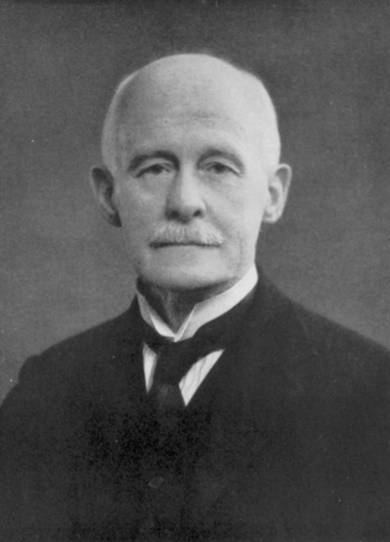
Sir Sidney Harmer FRS
Harmer is known for his role in the protection of whales in the southern oceans. Sidney Harmer was one of the old school zoologists who knew the entire Animal Kingdom while specialising in a particular group or groups. He was renowned for his work on what was then the Polyzoa but now often called the Bryozoa. At Cambridge he also became interested in whales, for example, a stranded Sowerby’s Beaked-whale on the Norfolk coast. When he moved to the BM he initiated the scheme under which stranded whales were reported to the Museum. According to his Obituary Notice, he did a great deal of work on whales which was never published and tried to sort out the classification of the dolphins.

His major contribution to the conservation of whales started in 1913. Calman wrote:

It is not clear when the Colonial Office first asked for help from the Museum in connexion with the whaling industry, if, indeed, they did ask for it. All that seems to be recorded is that in 1913 Harmer prepared a ‘Memorandum relating to whales and whaling’ which was printed on Colonial Office paper.

In order to mark whales to study their migration, Harmer supervised the first experiments with a large cross-bow to fire a marker into the body that could be recovered when, rather than if, the whale was killed and cut up by whalers:

At one time he had a large oil-cloth model whale behind the Museum and I seem to remember him in morning coat, striped trousers and bowler hat, excitedly watching the first shots…with this very barbarous-looking mediaeval weapon.

In short, Harmer became a first champion for whales. He analysed the statistics collected by the whaling companies and warned of the rapidly increasing rate of destruction of the whale populations around Antarctica.

To return to the first line of this post, I realised that I had met Sidney Harmer’s daughter, Iris Mary, and indeed that she was known by many of my former colleagues. At an event, I think to mark the 40th anniversary of the founding of the Institute of Animal Physiology at Babraham (since re-named as the Babraham Institute), Marthe Vogt, who had formally retired from the Institute in 1965 and would have then been 85, brought her former boss’s widow, Lady Gaddum, then aged 94. Shortly afterwards, incidentally, Marthe Vogt moved to live with her sister in California and lived until the age of 100 years and 1 day. Lady Gaddum, née Iris Mary Harmer, married Sir John Gaddum (Director of Babraham from 1958 until shortly before his death in 1965) in 1929.

I now find that Iris Mary Harmer had been involved in an important discovery. She was what would probably now be described as a clinical scientist after graduating with a first from Cambridge and then a London medical degree. She worked with Sir Thomas Lewis at University College, London on the famous ‘triple response’ and provided some of the first evidence, in papers published in 1926 and 1927, for the release of a histamine-like substance (Lewis’s H-substance) in human skin in response to minor injury. She died in 1992, aged 98.

So, there we have it, the very small world of British science in the early years of the 20th century. I talked with a woman—who was the daughter of a man—who upset an explorer—who collected Emperor penguin eggs on Scott’s final expedition. Much more interesting than to have danced-with-a-man, who’s-danced-with-a-girl, who’s-danced-with-the-Prince-of-Wales, don’t you know.


Sunday, 21 December 2014

Extinction of Pollinating Insects and the History of Agricultural Improvement

There were numerous papers of interest in 12 December issue of Science. Amongst them was one on the history of the disappearance of pollinating insects from the British countryside by Jeff Ollerton, Hilary Erenler, Mike Edwards and Robin Crockett of the University of Northampton*. They used 494,117 records held by the Bees, Wasps and Ants Recording Society (BWARS) and defined locally extinct species as those not recorded for at least 20 years, despite extensive efforts by naturalists. Twenty-three bee and flower-visiting wasp species have become extinct in Britain since the mid-19th century including ones that were widespread. 

The analysis shows clearly that the most rapid phase of local extinction began in the 1920s, suggesting that changes agricultural practices that were or had been taking place were responsible. The authors suggest the import of guano in the latter half of the 19th century hit bee and wasp populations in two ways, firstly by increasing grass growth at the expense of wild flowers and, secondly, by obviating the need for strict rotational cropping. Rotational cropping à la ‘Turnip’ Townshend involved a fallow year—good for nectar-rich ‘weeds’—and a legume year—good for long-tongued bees.

From Science 12 December 2014
The proportion of permanent grassland also increased dramatically during the late 19th and early 20th century. Even before the massive effort of the 2nd World War to make Britain self-sufficient in food, lessons from the 1st World War were being applied in the 1920s and 30s to increase productivity on British farms. The authors point out that the Haber process (always called the Haber-Bosch process in my day and a favourite question in chemistry exams) allowed the industrial manufacture of nitrogen fertilisers and led to the further decline of wild flowers.

One statement, I was somewhat surprised about is: …beginning in the 1920s, before the agricultural intensification prompted by the Second World War, often cited as the most important driver of biodiversity loss in Britain. I think those who were aware of the history of agricultural development in Britain would have known that the changes were already well under way in the 1920s and 1930s, not just the 1940s. 

The chapter ‘Grassland Research’** by Frank Raymond (1922-2012) describes the changes that occurred in grassland from the 1800s to the 1970s. The records used by Ollerton and his colleagues begin during the agricultural depression of the last quarter of the 19th century when the productivity of British grasslands deteriorated until the 1914-18 War. So pollinating insects would never have had it so good. A great deal of land was ploughed up for arable farming during the War. After the war, the drive to adapt the system of ley farming (a period of grass-growing in a rotation of crops) to the establishment of more persistent and productive grasses really took off. This drive was led by Sir George Stapledon FRS and his Welsh Plant Breeding Station. Because of the close links maintained with leading farmers the new practices and varieties of grass spread quickly since productivity was so markedly increased. However, this is where there appears to be a dichotomy between grassland productivity and the results of the study on pollinating insects. There was another Depression in the 1930s and the improvements that were available could not be adopted. Stapledon’s survey of 1937/38 showed only a small percentage of grassland was fully productive, huge areas had reverted to scrub and much of the land went untenanted. It could be argued that this should also have been a boom time for pollinating insects. However, according to the results obtained, extinction continued apace. One explanation is that there is a delay between the introduction of new practice and extinction. Indeed, the paper includes this cautionary note:

Our study adds to a debate on the rates and causes of regional and country-wide extinctions of British biodiversity (including invertebrates, vertebrates, and plants) and the limitations imposed by data quality. The available data for bee and flower-visiting wasp extinctions within Britain show that there are deep historical roots to this loss in pollinator diversity that correlate with transformations of land management related to changes in agricultural policy and practice, a conclusion also drawn by these other studies. Agriculture accounts for 70% of British land use, strongly suggesting that this relationship is causal, though the exact drivers of extinctions are clearly multifactorial and complex. For example, for some species there may have been a mismatch in the timing of extinctions in relation to specific agricultural changes (an “extinction debt”) that we cannot currently identify.

Notwithstanding the outstanding questions on timing, and ignoring the major changes in arable farming and the loss of hedgerows, there is no doubt that the system we ended up with in Britain—intensive grassland production, geared to the output of milk and meat and based on rye grass monocultures, must have had an effect on the abundance of pollinating insects and on the survival of species that depend on plants that were eliminated by such systems. I had that same sinking feeling in the pit of the stomach when I looked at our fields at the Hannah as I do when looking at agricultural monocultures throughout the world—oil palm, rubber, tea, coffee, wheat, maize etc. etc. My question to my former and late colleagues, Malcolm Castle and David Reid, was always whether we could incorporate more traditional grassland plants. The answer in the 1980s was ‘No’ as they explained why. Would the answer in 2014 still be ‘No’ and if so, are the present conservation measures on farms sufficient not only to prevent further loss of biodiversity but also to enable the recolonisation by pollinating species that have become locally extinct over the past 100 years or so?

-------------------

*Extinctions of aculeate pollinators in Britain and the role of large-scale agricultural changes. 
Ollerton et al. Science 346, 1360 (2014); DOI: 10.1126/science.1257259 

**Raymond, WF. 1981. Grassland Research. In Agricultural Research 1931-1981, ed Cooke GW. pp 311-323. London: Agricultural Research Council.