Showing posts with label Penguin. Show all posts

Sunday, 6 August 2017

Bill Sladen (1920-2017): Penguins and Salt Glands

A number obituaries of William Joseph Lambart Sladen who died on 29 May aged 96 have been published in recent weeks. While they all record his pioneering studies on penguins in the Antarctic, his later involvement with migration and conservation projects in the northern hemisphere and his detection of DDT in penguins in the 1960s, they do not mention his involvement with a major scientific discovery of the 1950s which explained how penguins and other birds survive at sea.


Obituary in The Times

This year, marks the 60th anniversary of the announcement of the discovery of salt glands by Knut Schmidt-Nielsen and the publication of an abstract describing the work in Federation Proceedings. A full paper appeared in the American Journal of Physiology in March 1958. A month later a paper in Nature appeared entitled, Nasal salt secretion in the Humboldt Penguin by Schmidt-Nielsen and Sladen, which suggests that the work was done only a short time after that reported in the first paper on the Double-crested Cormorant Phalacrocorax auritus.

Schmidt-Nielsen and Sladen wrote:


In order to establish whether extra-renal salt excretion is of importance in the salt balance of other marine birds, we took advantage of the colony of Humboldt’s penguins (Spheniscus humboldti) in the laboratory of one of us (W.S.). These birds had been caught in the wild six months before, they were doing well in captivity, and were considered to be free of disease. Trial experiments in April 1957 showed that nasal secretion did occur, so the following experiments were performed.

The rest, as they say, is history.

How Schmidt-Nielsen and Sladen got together to do the study I do not know. Since the penguins were kept in Sladen’s lab at Johns Hopkins, I assume the male penguin used was given its salt-loaded fish in Baltimore.


I found this photograph of an Emperor Penguin skull which shows the
supra-orbital position of the nasal salt glands

Sladen by this time had already made his name from studying penguins in the Antarctic. British-born, medically-qualified and working as medical officer as well as biologist for the Falkland Islands Dependency Survey—FIDS—now the British Antarctic Survey, he was sole witness to the horrendous hut fire at Hope Bay in November 1948 that resulted in the death of two members of the survey team. After the fire he spent the next sixteen days alone and out of radio contact, sleeping in a tent, until the main survey party returned. He continued his work on penguins during this time, writing his Oxford doctoral thesis in Charles Elton’s Bureau of Animal Population.

Sladen moved to the U.S.A. in 1956, initially on a research fellowship, and became a U.S. citizen in 1962. He remained based at Johns Hopkins while commuting to the Antarctic and Arctic for his research.


Adélie Penguin - adult and chick
Sladen's early work was on this species at Hope Bay, 9 miles along the
coast from Brown Bluff on the Antarctic Peninsula where I took these
photographs on 26 January 2005.

Salt-gland secretion in this species was described by Donald S Douglas
in the 1960s.

I am taking video of the tens of thousands of Adélie
Penguins at Brown Bluff

Schmidt-Nielsen K, Jörgensen CB, Osaki H. 1957. Secretion of hypertonic solutions in salt glands. Federation Proceedings 16, 113-114

Schmidt-Nielsen K, Jörgensen CB, Osaki H. 1958. Extrarenal salt excretion in birds. American Journal of Physiology 193, 101-107

Schmidt-Nielsen K, Sladen WJL. 1958. Nasal salt secretion in the Humboldt penguin. Nature 181, 1217-1218

Monday, 5 January 2015

Penguins’ Eggs and the Scott Expedition: Cherry-Garrard, Sidney Harmer and Small Worlds

I know this sounds like a I’ve-danced-with-a-man, who’s-danced-with-a-girl, who’s-danced-with-the-Prince-of-Wales story but it actually illustrates how small the scientific world was in Britain in the years before the 1939-1945 War.

In my reading of the antarctic literature and the heroic attempt to obtain embryos of the Emperor Penguin (posts I made throughout 2014 on this site) by Edward Wilson, Henry Bowers and Apsley Cherry-Garrard in the Antarctic winter of 1911, I came across Cherry-Garrard’s run-in with Sidney Harmer, Keeper of Zoology at the Natural History Museum, or, in those days, the British Museum (Natural History).

Wilson, Bowers and Cherry-Garrard after their
return from the Emperor Penguin colony at Cape Crozier
Cherry-Garrard’s animus to the Museum began when Cherry-Garrard delivered the penguins’ eggs to the Museum after Wilson and Bowers died with Scott on their return journey from the South Pole. Then in his book, In The Worst Journey in the World, he pulled no punches. His account begins:

Let us leave the Antarctic for a moment and conceive ourselves in the year 1913 in the Natural History Museum in South Kensington. I had written to say I would being the eggs at this time. Present, myself, C.-G., the sole survivor of the three, with First or Doorstep Custodian of the Sacred Eggs. I did not take a verbatim report of his welcome; but the spirit of it may be dramatized as follows:
FIRST CUSTODIAN. Who are you? What do you want? This ain’t an egg-shop…You’d best speak to Mt Brown: it’s him that varnishes the eggs.
I resort to Mr Brown, who ushers me into the presence of the Chief Custodian, a man of scientific aspect, with two manners: one, affably courteous, for a Person of Importance (I guess a Naturalist Rothschild at least) with whom he is conversing, and the other, extraordinarily offensive even for an official man of science, for myself…

Sara Wheeler in her biography of Cherry-Garrard, Cherry, describes how Harmer, Keeper of Zoology since 1909 and Director of the Museum since 1919—and now Sir Sidney—responded to the attacks on the Museum both to the press and to Cherry-Garrard himself. Harmer also pulled no punches: “the story seems devoid of any semblance to the truth”, and insisted that his staff had been maligned. George Bernard Shaw helped Cherry-Garrard with a series of letters (as he had with the book) and Harmer was left defending the impossible since Grace Scott, Captain Scott’s sister, had accompanied Cherry-Garrard on a subsequent visit to the BM, and confirmed in writing the attitude of the ‘custodians’.

Wheeler says the main culprit at the museum had died and I have not been able to identify him.

Arguments with Harmer had, however, begun earlier. Cherry-Garrard was invalided out of the army early in the 1914-18 War with ulcerative colitis and worked on his notes from the expedition. Those on the Adélie Penguin he submitted to Harmer (who was editing the reports from the Scott expedition) to see if they were publishable (according to him) or to be published (as can be inferred from Harmer’s reply). Harmer stated that the notes were not publishable as they stood. Wheeler says Cherry-Garrard, always fragile mentally as well as physically, exploded in a letter to Harmer and at the end of it raised his treatment at the hands of Harmer’s staff: “I handed over the Cape Crozier embryos, which nearly cost three men their lives, and has cost one man his health, to your museum personally, and . . . your representative never even said ‘thanks’.”

Between these spats, Cherry-Garrard supported Harmer over the slaughter of penguins for oil and meat in a letter to The Times (18 February 1918):

Sir,—May I back Dr. Harmer’s letter pointing out the danger of attacking penguin rookeries? If the slaughter of penguins and seals or the collection of penguin eggs is to be undertaken, the public should insist that it is done under the effective control of the Governments concerned, probably those of Australia and New Zealand. The true Antarctic penguins are fairly safe at present; there is no danger that the rookeries of the Emperor penguin will be harmed unless people want to go bird-nesting in 170deg. of frost; and the Adelie penguin is protected by the pack ice. But there is very great danger for the sub-Antarctic penguins which live in the islands north of the pack ice, and which are therefore more accessible…

Harmer it seems was a difficult man to fall out with. In his Obituary Notice for the Royal Society, W.T. Calman (1871-1952) noted:

…It is related that when the Trustees of the British Museum were considering the appointment of a Director, a very important person who was also a Cambridge man urged his appointment to the vacant post on the grounds that ‘Nobody could possibly quarrel with Harmer’.
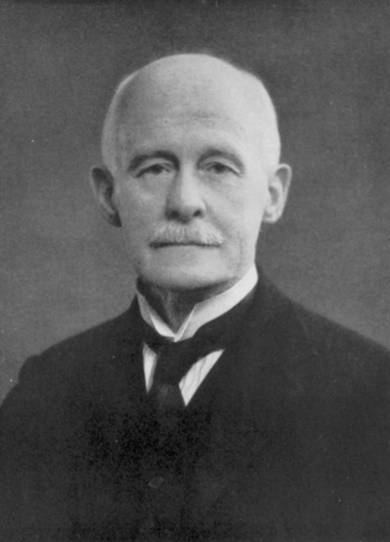
Sir Sidney Harmer FRS
Harmer is known for his role in the protection of whales in the southern oceans. Sidney Harmer was one of the old school zoologists who knew the entire Animal Kingdom while specialising in a particular group or groups. He was renowned for his work on what was then the Polyzoa but now often called the Bryozoa. At Cambridge he also became interested in whales, for example, a stranded Sowerby’s Beaked-whale on the Norfolk coast. When he moved to the BM he initiated the scheme under which stranded whales were reported to the Museum. According to his Obituary Notice, he did a great deal of work on whales which was never published and tried to sort out the classification of the dolphins.

His major contribution to the conservation of whales started in 1913. Calman wrote:

It is not clear when the Colonial Office first asked for help from the Museum in connexion with the whaling industry, if, indeed, they did ask for it. All that seems to be recorded is that in 1913 Harmer prepared a ‘Memorandum relating to whales and whaling’ which was printed on Colonial Office paper.

In order to mark whales to study their migration, Harmer supervised the first experiments with a large cross-bow to fire a marker into the body that could be recovered when, rather than if, the whale was killed and cut up by whalers:

At one time he had a large oil-cloth model whale behind the Museum and I seem to remember him in morning coat, striped trousers and bowler hat, excitedly watching the first shots…with this very barbarous-looking mediaeval weapon.

In short, Harmer became a first champion for whales. He analysed the statistics collected by the whaling companies and warned of the rapidly increasing rate of destruction of the whale populations around Antarctica.

To return to the first line of this post, I realised that I had met Sidney Harmer’s daughter, Iris Mary, and indeed that she was known by many of my former colleagues. At an event, I think to mark the 40th anniversary of the founding of the Institute of Animal Physiology at Babraham (since re-named as the Babraham Institute), Marthe Vogt, who had formally retired from the Institute in 1965 and would have then been 85, brought her former boss’s widow, Lady Gaddum, then aged 94. Shortly afterwards, incidentally, Marthe Vogt moved to live with her sister in California and lived until the age of 100 years and 1 day. Lady Gaddum, née Iris Mary Harmer, married Sir John Gaddum (Director of Babraham from 1958 until shortly before his death in 1965) in 1929.

I now find that Iris Mary Harmer had been involved in an important discovery. She was what would probably now be described as a clinical scientist after graduating with a first from Cambridge and then a London medical degree. She worked with Sir Thomas Lewis at University College, London on the famous ‘triple response’ and provided some of the first evidence, in papers published in 1926 and 1927, for the release of a histamine-like substance (Lewis’s H-substance) in human skin in response to minor injury. She died in 1992, aged 98.

So, there we have it, the very small world of British science in the early years of the 20th century. I talked with a woman—who was the daughter of a man—who upset an explorer—who collected Emperor penguin eggs on Scott’s final expedition. Much more interesting than to have danced-with-a-man, who’s-danced-with-a-girl, who’s-danced-with-the-Prince-of-Wales, don’t you know.


Friday, 10 October 2014

Nutrition, Exercise and Survival in an Extreme Environment: Scott, Wilson, Bowers, Oates and Evans of the Antarctic in 1911-191

As a result of my blog posts on the search for Emperor Penguin eggs that continued for decades in the 20th Century, I have been reading more and more about Scott, Amundsen and Shackleton and their expeditions. Every schoolboy knew the bare bones of the stories of the fatal end of Scott’s party and of how Amundsen got to the South Pole first. Indeed the memory of Captain Oates is evoked regularly but irreverently on the golf course as one of our party trudges off gloomily into the deep rough muttering to his companions, ‘I may be gone for some time’.

A few years ago I tried to get some impression of Scott from Fiennes’s book Captain Scott but I found it unreadable and quickly gave up. It was with some trepidation that I worked my way through hagiographies from the 1920s and 30s, the attempted demolition of Scott and all his works of the 1980s and 1990s, and the more balanced accounts of the 21st Century. The best is Apsley Cherry-Garrard’s (who was with Wilson and Bowers on the horrendous winter journey to the penguin colony at Cape Crozier) The Worst Journey in the World, first published in 1922. Before I started reading on this topic I was aware that the rations for the journey were, with hindsight, markedly inadequate for the energy expended in hauling sledges. I was not aware that scurvy was such a problem.


Scott's party at the South Pole, from left: Oates (standing), Bowers (sitting),
Scott (standing), Wilson (sitting), Evans (standing).
Bowers used a piece of string attached to the camera shutter
I then found the recent essay by Halsey and Stroud, 100 years since Scott reached the pole: a century of learning about the physiological demands of Antarctica, published in Physiological Reviews in 2012. That essay shows plainly just how short the rations fell compared to modern measurements of energy expenditure made by Stroud during man-hauling in Antarctica. It seems that the polar party (Scott, Wilson, Bowers, Oates and Petty Officer Evans) wasted away in their efforts to reach the next and then the next food depot containing daily rations that were themselves inadequate. Add to that the effects of lack of vitamin C, and the unseasonal extreme cold to which the polar party are now known to have been exposed, and it is fairly easy to see how they did not survive.

In 1992-93 on a one-way journey to the pole, Stroud and Fiennes were burning an average of 6,000 kcalories per day. Over a 10-day period ascending to the plateau they were expending nearly 11,000 kcalories per day—that’s over 7 times basal metabolic rate and that, of course, included periods of rest. The rate of expenditure during man-hauling the sledges (10-12 hours per day) must have been extremely high by any standard. By contrast, Scott’s rations provided 4,200 kcalories per day on the ice-shelf and 4,500-4,600 on the summit.

Halsey and Stroud take into account the various factors that would have affected the polar party and the deterioration in their condition that became manifest after those chosen not to reach the pole turned for the journey home across the Antarctic Plateau, down the Beardmore Glacier and across the ice-shelf. Extreme cold, inadequacy of food and water, lack of vitamin C, sleep deprivation and high altitude must have all contributed to the steady and vicious circle of decline of all members of the party, starting with Petty Officer (to distinguish him from Lieutenant Evans—see later) Evans, then Oates and finally Scott, Wilson and Bowers.

I had not previously realised that the polar plateau is so low in oxygen; the partial pressure is only about 510 mm mercury, 30% lower than at the coast and lower than would be predicted from its average altitude of 2,300 m. The effective altitude in terms of the partial pressure of oxygen is about 2,800 m (over 9,000 ft). About 1 in 50 present-day travellers to the Amundsen-Scott Research Station suffer chronic altitude sickness.

Adélie Penguin and chick. Brown Buff, Antarctic Peninsula
26 January 2005
In reading Halsey and Stroud’s account, a few questions came to mind. Firstly, how long does it take the appetite to increase and the gut to adapt and thereby process the amount of energy-dense food needed to match the very high expenditure? Or, if indeed, given the combined effects of cold, altitude and exercise, can any such adaptation be sufficient? Halsey and Stroud noted that some individuals in Scott’s expedition could not  absorb a high-fat diet and that even though they must have been in a state of negative energy balance by Christmas Day 2011, Scott and Wilson could not finish their special dinner. But I can see why those who could not take a high-fat diet did not persist in order to see whether they could become adapted to it; diarrhoea, which a number in the expedition suffered at various times, at an average summer temperature of -25°C does not bear thinking about.

Secondly, what was the importance of the lack of vitamin C on their survival. My impression is that it was more important, perhaps, than some commentators, but not others, have argued. Petty Officer Evans’s initial decline appears attributable to scurvy, from the malaise and lethargy to the lack of healing. In this respect, the condition of Lieutenant ‘Teddy’ Evans (later Admiral Lord Mountevans), one of the Last Supporting Party which turned for the trek back to the coast on 4 January 1912, is worth noting (Halsey and Stroud concentrated on the five members of the polar party). He became ill, clearly of scurvy, with obvious signs by 22 January and only got back to recover because of the truly heroic efforts of his companions, Petty Officers Crean and Lashly and then the medical care given by Atkinson. Lieut. Evans and Petty Officer Evans (according to the reference to Fiennes for the latter in Halsey and Stroud) were averse to eating raw or nearly raw meat, unbeknown to them their only source of Vitamin C. However, the concentrations of Vitamin C in muscle meat are very low any my guess is that lightly-cooked meat from the ponies killed and left at their supply depots would have provided the merest smidgeon of ascorbate. Much has also been made of the absence of the classic clinical signs of scurvy in the polar party but there could well have been subclinical effects at work. In trying to find evidence on the latter I have been bedevilled by the plethora of claims from the dietary supplements industry, quacks and conspiracy theorists.

But there is more that can be added to this story. Dogs were used by Amundsen and by Scott, and ponies by Scott. Neither species needs exogenous vitamin C but both were underfed. The dogs were often driven, like the ponies, to complete exhaustion*. Amundsen saved his men from the fate of Scott’s man-hauling party at the cost of 41 of his 52 dogs used to pull the sledges to the Pole and back.

Halsey and Stroud conclude their essay by considering whether current physiological knowledge and technological advances would protect present-day man-haulers on a similar journey to that nearly completed by Scott in 1911-12. They conclude that they would not:

…the return journey to the South Pole from the Antarctic coast is only just within reach for the most capable of people. The four-month summer window each year, during which man-haulers must inevitably pull insufficient food in environmental conditions that conspire to induce rapid wasting, today still represents an enormous, potentially life-threatening physiological challenge.

While Halsey and Stroud provide a cogent explanation for the gradual decline of the polar party with time, I think they could have made more of their statement:

This cycle would have been accelerated during the final weeks both due to dehydration because of reduced resources to melt water and due to the unusually cold temperatures that they suffered during February and March; these would have served to further decrease pulling power, and increase the energy costs of sledge-pulling due to the friction of snow when below around 􏰀30°C 

Susan Solomon's† analysis of the weather records to me at least indicates the reason for the failure of the polar party (except of course for Petty Officer Evans who had already died, and possibly for Oates who already had, but did not report, frostbite that eventually limited his mobility) to reach safety. On the Ross Ice Shelf the weather was very cold, much colder than a few weeks earlier and much colder than average. Apart from the direct effect of the cold, the deterioration in the surface conditions meant that the huge effort of hauling a sledge did not translate in the coverage of sufficient distance each day. As frostbite in Oates and, eventually, Scott, supervened, the vicious circle of decline accelerated rapidly.

All writers on the fate of the polar party are left with the question of whether Bowers and Wilson could have survived had they left Scott in the tent who by then had a badly frost-bitten foot. I think the odds were on their survival, heavily in the case of Bowers, slightly less so for Wilson. Why they did not opt for a push to the depot is, though, a question best left to those with expertise in group psychology. My reading of it is that both found it impossible to leave Scott.

The relatively rapid end to the hopes of Scott and his party is well summed-up by Susan Solomon and Stearns in their concluding remarks to their paper in PNAS:

The observations of the extremely cold temperatures reported by Scott and his companions in March of 1912 do not imply that these frigid conditions alone caused their deaths. Indeed, one man perished before these challenges were encountered and another was already suffering from frostbite, as has been noted. But the unusually cold temperatures that prevailed over an extended period of several weeks substantially contributed to the tribulations faced by Scott and his team during the final stages of their battle for survival. In spite of their plight, the party continued to record the scientific data that provide key information regarding their fate. Those measurements show that they endured minimum temperatures more than 10°F lower than the average that can now be derived from multiple years of automated measurements for the period from February 25 to March 19 near 80°S on the Ross Ice Shelf. On some particular days in March, the daily minimum temperatures in 1912 were more than 20°F colder than the climatological average. These conditions likely contributed to frostbite and extreme fatigue in the men, as well as to the friction of the very cold snow surface that amplified the physical demands of the strenuous task of man-hauling their supplies by sledge, and thereby slowed their progress. Scott and his last two companions died near the 29th of the month, after enduring what might be dubbed “the coldest march.”

On reading the various suggestions—which often turned into assertions—of the causes of the loss the the polar party, writers have tended to promote a single cause while dismissing others. My firm impression is that it what was not a case or either/or but of a combination of circumstances that formed the perfect storm of a positive feedback loop, with the weather accelerating that final phase, and the descent, to mix metaphors, into a never-ending bottomless pit.

The Coldest March. 2001. Yle university Press. Solomon S & Stearns CR. 1999.On the role of the weather in the deaths of R. F. Scott and his companions. Proceedings of the National Academy of the USA 96 13012-13016

*In this respect it is interesting to note the studies on Alaskan sled dogs covering 490 km in a race over 70 hours at -35 to -10°C; their energy expenditure was an enormous 11,200 kcalories/day. http://www.ncbi.nlm.nih.gov/pubmed/9401699

South Shetlands. Livingston Island from Half Moon Island
27 January 2005


Thursday, 26 June 2014

In Search of a Penguin’s Egg. Why?...Continued

Since writing In Search of a Penguin’s Egg. Why? on 8 April, I have read more and more on antarctic exploration in order: first, to understand why Edward Wilson, chief of the scientific staff of Scott’s final (1910-1912) expedition and who died with Scott, was willing to go to such lengths to obtain embryos of the Emperor Penguin; second, to try to understand why the Falkland Islands Dependency Survey (FIDS) was still trying to collect embryos in the late 1950s. I have also found, in the literature, the fate of the embryos collected by Nelson Norman in 1959.

However, the Scott expeditions (Discovery, 1901-04; Terra Nova, 1910-1912) were not the first to collect penguin embryos. Robert Neal Rudmose Brown (1879-1957) and James Hunter Harvey Pirie (1878-1965), members of the Scottish National Antarctic Expedition led by William Speirs Bruce (1867-1924), collected embryos at different stages of development of the Gentoo (Pygoscelis papua) and Adélie (P. adeliae) penguins. These embryos were brought back to Edinburgh where they were examined by David Waterston and Auckland Campbell Geddes of the anatomy department ‘through the kindness of Dr W.S. Bruce’.

The Scottish National Antarctic Expedition left Troon on 2 November 1902. Scotia, formerly the Norewegian whaler Hekla, had been refitted for the antarctic at the now defunct Ailsa shipyard in Troon, a short distance from where I shall be teeing off from the 1st at Royal Troon at 7.50, as usual on Fridays, tomorrow morning (weather permitting, of course). This successful expedition returned on 21 July 1904 to the Marine Biological Station at Millport, now sadly reduced to a study centre for schools. I shall return to the Scottish National Antarctic Expedition later since its very existence has a bearing on later developments.


Route of the Scotia

Scotia
Waterston and Geddes wrote up their findings for the expedition’s report published on 21 October 1909.

With regard to these developmental facts the question arises:— Is the duck's or the penguin's wing the more direct descendant of the common ancestor; or have they both diverged from the common stock approximately equally, but in opposite directions. Embryology alone cannot answer this question, but the evidence is clear in this, that the fore limb of the penguin in its development goes through a progressive and continuous series of stages along one unbroken line. The mesoblastic portion of the fore limb elongates, but its characters do not alter. It elongates, however, with a relatively greater rapidity towards the end of development, whereas the duck's fore limb, after being relatively longer than the penguin's ever is, regresses rapidly. So that the answer to our question, so far as the embryological evidence is concerned, must be that the wings of both these birds are different from the ancestral wing, and that the differentiation has been in opposite directions and that the common ancestor was a flying bird of a somewhat primitive type depending in large measure for the spread of its wing upon bone and muscle.
Their conclusions could not be more clear; the ancestor of modern birds and penguins was a flying bird.
One of the two laboratories on Scotia

Bruce had placed his penguin specimens with two of the leading anatomists/embryologists in Britain. David Waterston was demonstrator in anatomy at Edinburgh. In 1909, the year of publication of the report, he went to the chair at King’s College, London but in 1914 moved to the Bute chair of anatomy at St Andrews (as a golfer he perhaps could not resist the temptation of the Old Course). He died at the age of 70 in 1942, still occupying the Bute chair.

Coats Land. The expedition named this part of the
continent for the Coats family, the sewing cotton
manufacturers (now the multinational Coats plc),
who funded the expedition.
Auckland Campbell Geddes went on to a remarkable career. At the time of the penguin work he was assistant to the Professor (only one per department in those days), D.J. Cunningham, author of the famous Manual of Practical Anatomy. On graduation in 1908, he was appointed demonstrator. He was late to qualify because he had interrupted his medical studies to serve in the Highland Light Infantry during the Boer War.

His first public achievement from 1908 lived on until recently. His suggestion that the army volunteer force should be named The Territorial Force was adopted by Lord Haldane (JBS’s uncle), then Secretary of State for War. In 1909 he went to Dublin as Professor of Anatomy and then, in 1913, to McGill University in Montreal. He returned on the outbreak of war. He rose from Major in the 17th Northumberland Fusiliers in 1914 to Brigadier-General and Director of Recruiting at the War Office in 1916-17. He was then elected Member of Parliament for Basingstoke and Andover in 1917, becoming Minister of National Service from 1917 to 1919. He was then British Ambassador to Washington from 1920 to 1923. Sadly, he lost the sight of one eye. After his recovery, he served as Chairman of Rio Tinto. in 1942 he was injured by a flying bomb and also lost the sight of his other eye. He became Baron Geddes of Rolvenden in 1942. He died in 1954, aged 74.

The collectors of the penguin eggs also became well established. Rudmose Brown (1879-1957) was botanist on the Scotia Expedition. After working for Bruce after their return, he turned to geography, becoming Lecturer at Sheffield in 1907 and Reader at Manchester in 1920. He returned to Sheffield as Professor of Geography in 1931, retiring in 1945. In both World Wars, he served in Admiralty intelligence. Throughout, he continued his interest in the Arctic and Antarctic. He died in Sheffield in 1957.

Pirie (1878-1965) was the expedition’s medical officer, geologist and bacteriologist. On his return he was a medical practitioner in Edinburgh until 1913 when he joined the Colonial Service as a bacteriologist in Kenya. He was Deputy Director of the South African Institute for Medical Research from 1926 until 1941. In 1940 he gave the name Listeria (after Joseph Lister) to the bacterial genus. In 1948 he was living in Bournemouth on the south coast of England.

So, did Wilson not realise that the findings from the Scotia expedition would render his quest for Emperor penguin embryos unnecessary? Or did he judge the Emperor to be so different, in fact unrelated to the Adelie and Gentoo, that he thought the findings irrelevant? Was he even aware of the results from the Scotia expedition? Was he too busy with his work on the grouse disease inqjuiry and preparing for the Terra Nova expedition to study Waterston and Geddes’s findings between their publication in October 1909 and the departure of the Terra Nova in June 1910? I have been unable to find the answers to any of these questions from reading about Edward Wilson.

However, here’s where the politics of polar exploration kicks in. The Scotia expedition and its leader, Bruce, were regarded as the lowest forms of life by the power broker in British antarctic exploration, Sir Clement Markham, President of the Royal Geographical Society. All my reading indicates that Markham was rightly considered by later commentators a classic Monster. However, Markham’s personality is beside the point. The animus to Bruce was so great that I find it difficult to see Wilson raising any of the (excellent) results of that expedition in discussions over whether it was worthwhile to attempt the journey to Cape Crozier to collect the Emperor embryos with Markham in full control of the expedition and Scott, Wilson’s friend but Markham’s protégé.

From what I have read so far, I conclude that the collection of Emperor embryos was Wilson’s big ‘thing’ and had been his big ‘thing’ since his earlier discoveries on this species in the Discovery expedition of 1901-1904.

Geoge Seaver, in his book on Wilson, states that he gave three lectures to fellow expedition members and that ‘his own notes of them have been preserved but those taken by Scott and others are not without interest…In his second lecture he traced the descent of Penguins from the primitive lizard-bird, explaining their anatomy, and finding corroborative evidence in their primitive fossilized remains’. Those notes could well be worth examining anew to see what Wilson’s understanding was at that time.

Apsley Cherry-Garrard, Wilson’s protégé, who with Wilson and Bowers undertook that indescribable winter journey from Cape Evans to the rookery at Cape Crozier wrote in The Worst Journey in the World:
What is this venture? Why is the embryo of the Emperor penguin so important to Science? And why should three sane and common-sense explorers be sledging away on a winter's night to a Cape which has only been visited before in daylight, and then with very great difficulty?The Emperor is a bird which cannot fly, lives on fish and never steps on land even to breed. It lays its eggs on the bare ice during the winter and carries out the whole process of incubation on the sea-ice, resting the egg upon its feet, pressed closely to the lower abdomen. But it is because the Emperor is probably the most primitive bird in existence that the working out of his embryology is so important. The embryo shows remains of the development of an animal in former ages and former states; it recapitulates its former lives. The embryo of an Emperor may prove the missing link between birds and the reptiles from which birds have sprung*.
After the deaths of Scott, Wilson, Bowers, Oates and Edgar Evans on their return from the Pole, Cherry-Garrard obtained a series of embryos from Adélie Penguins at Cape Royde. He wrote:
It was always Wilson's idea that embryology was the next job of a vertebral zoologist down south. I have already explained that the penguin is an interesting link in the evolutionary chain, and the object of getting this embryo is to find out where the penguins come in. Whether or no they are more primitive than other nonflying birds, such as the apteryx, the ostrich, the rhea and the moa, which last is only just extinct, is an open question. But wingless birds are still hanging on to the promontories of the southern continents, where there is less rivalry than in the highly populated land areas of the north. It may be that penguins are descended from ancestors who lived in the northern hemisphere in a winged condition (even now you may sometimes see them try to fly), and that they have been driven towards the south. 
If penguins are primitive, it is rational to infer that the most primitive penguin is farthest south. These are the two Antarcticists, the Emperor and the Adélie. The latter appears to be the more numerous and successful of the two, and for this reason we are inclined to search among the Emperors as being among the most primitive penguins, if not the most primitive of birds now living: hence the Winter Journey. I was glad to get, in addition, this series of Adélie penguins' embryos, feeling somewhat like a giant who had wandered on to the wrong planet, and who was distinctly in the way of its true inhabitants.
So Cherry-Garrard in 1922 seems to be expressing a different reason for collecting embryos—that the most southern could be the most primitive penguins but not the most primitive bird—from Wilson in 1910. But the phrase if not the most primitive of birds now living could be taken to mean that it still might be shown that the Emperor is the most primitive bird. Alternatively, if not actually means even if not.  I tend to think it means the latter since otherwise he would be contradicting himself in these paragraphs.

Cherry-Garrard collected embryos from the Adélies during that period after the remaining members of the expedition found the bodies of the polar party, Scott, Wilson and Bowers. Surely Wilson in the many months they had together would have mentioned to Cherry-Gerrard whether Adéle embryos had been examined previously. That leads me to think that Wilson had not seen the report of the Scotia Expedition before embarking on Terra Nova. Original documents and notes on the contents of the libary taken by Scott and his party could well provide more information.

The story of penguin embryos does not end there…

----------------------
Waterston D, Geddes AC (1909) Report upon the anatomy and embryology of the penguins collected by the Scottish National Antarctic Expedition. Transactions of the Royal Society of Edinburgh 47 part 2, number 10, 223-244

Seaver, G (1933) Edward Wilson of the Antarctic. Naturalist and Friend. London: John Murray

*There is a difference in wording between the Pimlico edition 2003 (Vintage 2010) and that available online as a Project Gutenberg eBook; the latter appears to be from the original 1922 edition published by Constable in 1922.

‡Excellent photographs of the expedition are at: