The Daurian Redstart (Phoenicurus auroreus) is a common winter visitor to Hong Kong. AJP photographed this one recenty on the island of Lantau. This is a male.

The Daurian Redstart (Phoenicurus auroreus) is a common winter visitor to Hong Kong. AJP photographed this one recenty on the island of Lantau. This is a male.
AJP sent these photographs from Hong Kong a couple of weeks ago. The Tawny Rajah (Charaxes bernardus) is a large and fast flying butterfly. Uncommon in Hong Kong, he saw a number flitting around behind Pak Lap Wan beach on High Island. A female actually settled very close for a frame-filling photograph.


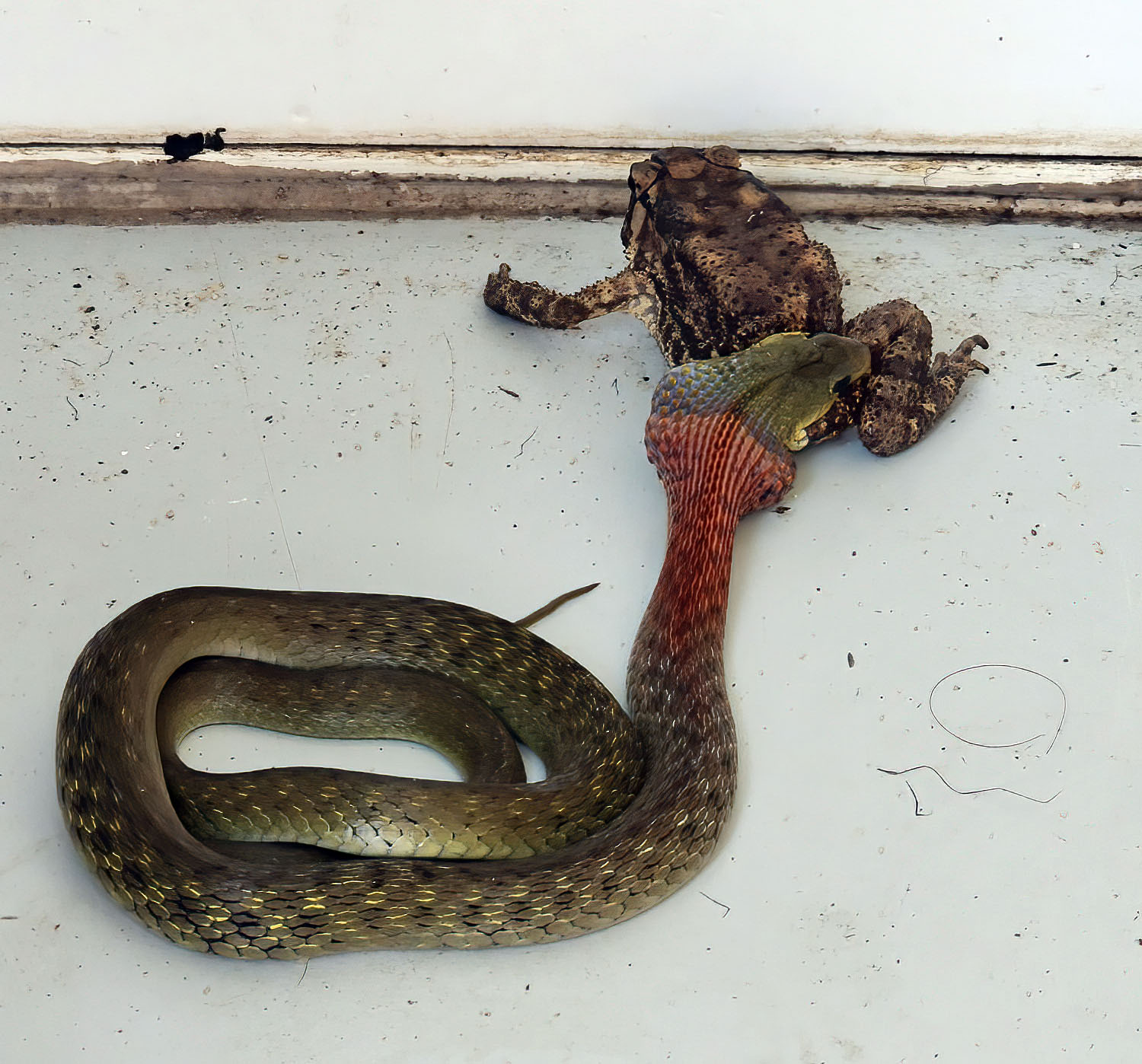
My daughter-in-law and grand-daughter were treated to this sighting in the ladies’ lavatory of an outdoor play centre in the New Territories of Hong Kong last weekend. This a is a Red-necked Keelback, a snake that is both venomous and poisonous, but one which was thought to be neither for decades.
The species, now Rhabdophis subminiatus, was lumped in with our Grass Snake in the genus Natrix as harmless colubrid snakes. It is now known that it is a rear-fanged, venomous snake. There has been at least one fatality and a number of cases of severe haemorrhage after people have been bitten. Then it was discovered that the snake is not only venomous, it is, like all members of the genus, poisonous too. It accumulates toxins from the toads it eats and stores them in glands in the neck, the nuchal glands. Any attack or approach by a predator is met by the snake adopting one of three defensive posture in which the neck is pointed towards or moved to contact the predator. For example, the mouth is pointed downwards with the neck arched upwards.
The nuchal glands were discovered in a Japanese species of the genus by Nakamura in 1935. Nakamura also realised the glands, which lie just under the skin, produce something noxious. He was sprayed in the eye with yellow droplets as he decapitated the snake. He could not fail to notice the great pain. Others, previously, had noticed sore eyes after handling these snakes. Malcolm Smith (1875-1958), after he retired as house physician to the royal household of Siam, studied the nuchal glands in a number of species. They are paired structures which in some species extend the length of the back as well as the neck.
The glands are unusual in that they have no lumen for secretion to accumulate nor a duct to the exterior. The yellow, foul-smelling secretion is formed by breakdown of the secretory cells and also contains lymphatic and pigment cells. It is easy to see how a predatory bird grasping the snake by the neck break the skin and be confronted, in effect, by toad toxins. However, breaking the skin and damaging the nuchal glands may not be the only way for the secretion to be released.
In 2011 Kevin Messenger, Daniel Rosenberg, Kevin Caldwell and William Sargent came across a Red-necked Keelback in a hole on the side of a water catchment on Lantau island in Hong Kong. The snake after it had been caught, but not by the neck, arched its neck against a glove and then secretion began to ooze from the region of the nuchal glands. How, without ducts to the exterior this was accomplished is not known. Would contraction of the neck muscles suffice? Is there a myoepithelium surrounding the glands which might contract? Is there a mechanically weak pathway to the exterior for the secretion to reach the surface? What are the mechanisms providing defence against, and transport from the gut to the glands, of toad toxins? Much remains to be discovered about the Red-necked Keelback and others of its genus.
My grand-daughter was very lucky to see the scenario of killing, feeding and getting hold of defensive toxins. The toad, Duttaphrynus melanostictus, was not so lucky.
Messenger KR, Rosenberg D, Caldwell KK, Sargent WL. 2012. Rhabdophis subminiatus helleri (Red-necked Keelback). Defensive Behavior. Herpetological Review 43, 497.
Mori A, Burghardt GM, Savitzky AH, Roberts KA, Hutchinson DA, Goris RC. 2012. Nuchal glands: a novel defensive system in snakes. Chemoecology 22, 187-198 DOI 10.1007/s00049-011-0086-2
In the days when colour printing was extremely expensive, the Avicultural Society had special appeals for funds to support the appearance in Avicultural Magazine of the occasional colour plate. A well-known bird artist was then commissioned. Although the whole run of the Society’s magazines can be found online, the plates rarely see the light of day. Therefore I decided to show one, now and again, on this site. This is the 14th in the series.
– – – – – – – – – –

The artist for this plate was Chloe Elizabeth Talbot Kelly (born 1927) who went on to illustrate a number of field guides. Her paintings of birds appear in art sales. She began painting in 1945 at the Natural History Museum in London.
The article accompanying this plate was written by Arthur Alfred Prestwich (1903-1987) who was for many years Secretary of the Avicultural Society.
The Buff-Throated Sunbird, Chalcomitra adelberti, is a West African species. It was first collected by and named for Vice-Admiral Marie-Charles Adelbert le Barbier de Tinan (1803-1876).
Avicultural Magazine Vol 75, 1969
What a surprise it was to see behaviour I had seen in frogs around 1959 described in the news media a couple of weeks ago. And what a delight when I looked up the original paper that the same behaviour had first been recorded by Ronald Henry Maxwell Savage (1900-1985) (see my earlier articles here and here) in 1934.
The recent paper which attracted media attention reiterated Savage’s observations on female Common Frogs, Rana temporaria. In to order to escape amplexus, which can sometimes, or often, involve more than one male in the female-grabbing frenzy of what the authors term ‘explosive’ breeders, the female uses a numbers of tactics. Grunting (thought to be ‘I have already laid my eggs so you are wasting your time’ signal is one such tactic. Others are rolling sideways and playing dead for sufficiently long for the males to lose interest. Different tactics were employed by female frogs of different size. Larger ones mainly grunted and rolled; smaller ones did the same but were more likely to appear dead.

Amplexus of a single female with a number of males is known to be a dangerous activity for the female which can lead to drowning. So keen are the males that even goldfish in the same pond may not escape the clutches of a male frog.
These tactics of mate avoidance can be interpreted in two ways. First, they enable a female to select a mate, perhaps on the basis of who can kick away their rivals. Second, the female while having arrived at the breeding pond may not be physiologically ready to ovulate and lay eggs, and having males hanging on for longer than necessary may be a dangerous encumbrance. In other words, on a particular occasion, are females ridding themselves of particular males or all males.
I saw and heard all the tactics described in Common Frogs I was keeping around 1959. For some reason I cannot now remember I had them in a large container in my grandfather’s greenhouse. I recall there was only one female with about four males. After all the mating ball activity, things settled down with just one male in amplexus. The female did not lay her eggs until about a week later which always led me to suppose that there was some physiological process occurring leading to ovulation. By contrast in our garden pond (until it was ruined by local vandals) I have seen females join males and lay their eggs during the first night of amplexus.
Dittrich C, Rödel M-O. 2023. Drop dead! Female mate avoidance in an explosively breeding frog . Royal Society Open Science 10, 230742 DOI: 10.1098/rsos.230742
Savage RM. 1934. The breeding behaviour of the common frog, Rana temporaria temporaria Linn., and of the common toad, Bufo bufo bufo Linn. Proceedings of the Zoological Society of London 104, 55-70.
Whoever gave this butterfly—common throughout much of Asia—its English name must have had a sense of humour. Lepidoptery was in the past a favoured pastime of members of the clergy and the embarassment of having to say or write the name must caused a shudder to those narrow-minded nonconformists who reserved the title for 'fallen' women or even those spotted in the street wearing lipstick. The strictures of the clergy were adopted by the 'respectable' man in the street. Indeed, fathers of my mother's generation were adamant that their daughters were not going out in the street wearing make up, 'like a painted jezebal'.
This Painted Jezebel (Delias hyparete) sat still long enough to be photographed by AJP north of Tai Po in the New Territories of Hong Kong last week.

 |
| Richardson's Ground Squirrel aka Flickertail |
I have lost count of the number of times I have been to Grasmere in the Lake District for Rank Prize Funds symposia. Not all that long ago the only place in the village it was possible to get a mobile phone signal was by the church tower. I did not know until today that the grave of Sir John Richardson FRS FRSE (1787-1865) lies only a few yards from where I struggled with my Nokia. Indeed, in June were were in North Dakota watching this eponymous Ground Squirrel harvest the grass seeds and leaves from around it burrow; in July I was back in Grasmere—but not in the churchyard.
It also took me years to discover that a ground squirrel I kept in the early 1960s was of this species. They were listed by animal dealers of the time as Flickertails. It was only when I got a hold of Walker’s Mammals of the World that I found there other common and scientific names. So common is the ground squirrel that North Dakota has the nickname, Flickertail State. The tail which is small really does flick but in long grass the movement is difficult to see. My Flickertail became tame, up to a point. It would take food from the hand but any closer movement meant a rapid retreat to a cave I had arranged on a thick substratum of dried earth and sand in which it could dig.
Sir John Richardson was born in Dumfries, and a graduate of Edinburgh medical school. He served as a naval surgeon and arctic explorer. He was a friend of Sir John Franklin and a member of the latter’s expeditions of 1819-1822 and 1825-1827. He was also involved in the vain search for Franklin and his team in 1847. Joseph Sabine FRS (1770-1837) lawyer, turned horticulturalist, botanist and zoologist named the ground squirrel after Richardson in 1822.
Richardson’s Ground Squirrel has been assigned to several genera over the years. For decades it was known as Spermophilus richardsonii but in 2009 that genus was split into eight and S. richardsonii became Urocitellus richardsonii.
Seeing these ground squirrels involved nothing more than walking out of the hotel door in Minot, North Dakota and looking over an area of mown grass between the hotel and the main road. There these ground squirrels popped up and down into their burrows, not concerned at all by vehicular traffic but soon disappearing when humans walked by.
