Tuesday, 27 April 2021

R Maxwell Savage: The Forgotten Doyen of British Ecological Herpetology Part 4: The Smell of Algae

Maxwell Savage’s big idea was that Common Frogs are attracted to ponds for breeding by the odour emitted by algae in the water. This phenomenon, he argued, would explain the timing in response to earlier rainfall, the preference for one pond over another, why frogs do not spawn in every pond and why frogs may spawn in a pond one year but not the next.

His hypothesis was based on his earlier observations on the food, or at least the gut contents, of tadpoles of which algae formed a large part; no point in spawning in a pond with no algae. In addition he found that frogs spawned in ponds with higher phosphate and potassium concentrations, in other words water ideal for the growth of plants. He suggested that in summer ‘higher’ plants grow rapidly and deplete the water of minerals. Runoff from rain in the winter then carries minerals, particularly phosphate, into the ponds which then leads, with increasing length and intensity of daylight, to an algal bloom and it is the smell of the algae that frogs take as their cue to migrate to the source of the odour. In essence he provided an explanation for the effects of amounts of rainfall in the months before spawning on the timing and direction of migration as well as the choice of pond.


Cartoon illustrating Maxwell Savage's hypothesis 


Savage realised that a problem arose with frogs moving to ponds against the direction of the wind. He suggested that various physical phenomena involving different movement of air at ground level, in ditches which frogs often use to reach ponds, and eddying could overcome the objection.


Savage further argued that it is possible to dispense with some substances in or produced by ponds as possible attractants. The first is water itself or the direct effect of rainfall since many frogs hibernate in ponds or very damp surroundings from which they migrate to a breeding pond. Then there were carbon dioxide (ubiquitous), ammonia (frogs would be ‘drawn to manure heaps’) and hydrogen sulphide (probably not released into the air), methane (again ponds would not be the only source). Instead he firmly came down on the side of volatile organic compounds produced by algae:

…It is, however, not the higher plants that do this [impart the characteristic of pond water], but the algae. There is much information on this matter, for it is of economic importance. If certain species of algae grow in drinking-water reservoirs to too large an extent, the consumers complain that the water tastes or smells. The odours are not always unpleasant, but people do not like water that has a strong smell or taste, whatever it is. The odours are due to essential oils elaborated by the algae, and the smells are so characteristic that a skilled person can detect and identify the species of alga sometimes before it can be located under the microscope. I once detected a smell from a pond (Large Totteridge) many yards from the bank, and suspected from the textbook description that it was due to Synura livella[*]. Micro­scopic examination showed that this species was abundant in the water 

     The fit of this hypothesis with most of the facts in the field is very good. The smells are found in ponds—nowhere else in the whole countryside. Any particular smell is probably only found in a few ponds for there are so many species of algae that, in a limited area, there are hardly any two ponds with the same flora. Ponds tend to have the same species in successive years, but this is not invariably so…

The observational and statistical associations that Savage unearthed make a compelling case for the central role of aquatic algae; they tie everything together. As good as Savage was in observing and drawing evidence from lots of different fields into a plausible hypothesis, the fact remains that there have been no experimental tests of what remains a fascinating possibility at least and a high probability at best.

There are two points to stress at this stage. The first is that Savage’s hypothesis concerns one species, the Common Frog, Rana temporaria. Various species of amphibian are now known to use a variety of mechanisms for navigation during migration. The evidence that frogs head for the pond in which they grew as tadpoles as their breeding pond (‘homing’) now seems to be strong and it is here that evidence suggests that Savage’s algal hypothesis cannot be the whole story. I have seen frogs accumulating on the earth of three filled-in ponds at the normal time of breeding; in two cases spawn was laid with no hope of its survival. (A similar phenomenon has been observed in toads.) Were these frogs that had not strayed far and using a local memory map to return home? Would frogs from further away not have been drawn to the bare earth of a filled-in pond?

Savage was clearly disappointed by the reception given to his hypothesis while realising the difficulties in taking things further, as demonstrated by the following extract:

It would be quite wrong to conclude this chapter leaving the reader with the impression that the algal hypothesis has been universally accepted. In fact, it is probably true to say that the general attitude has been one of polite incredulity…

And:

Frogs live their aquatic life invariably among algae, which dominate the life of a pond. It has been said that if all the higher plants in a pond were to be removed and replaced by glass models of the same shape and size, the animal life in the pond would go on just the same. Re­move the algae, and life would be vastly different. Knowing the number of parallels between the behaviour of frogs and the behaviour of algae, and that no two essential oils have the same chemical com­position or the same smell, I have always thought the hypothesis suffered from the difficulty of proof, rather than from any improba­bility. But there is no need to despair. After all, it was only in late 1957 that we had experimental proof that satellites were kept in their orbits by gravitation. Up till then the whole thing had been a hypo­thesis, based on a number of parallels! 

What Savage did not deserve was to be ignored by many of those who came after him. For example, in one chapter of a book published in 2005 which I will not name since it does not deserve even adverse publicity, Savage does not get a mention even though such factors as rainfall and odours in triggering spring migration in amphibians are discussed at considerable length. Like Trevor Beebee before me I find the omission of Savage—and not just in that one case—both astonishing and inexcusable.

However, all is not last since last week the popular BBC programme Countryfile included an item on frogs and a contributor said they were attracted to their breeding ponds by the smell of algae.


In the next article I will discuss how Maxwell Savage tried in his final research paper to take his algal hypothesis further but had to swap species in order to do so.


*the smell of Synura and the chemical composition of the odours produced is described in this YouTube video.


Wednesday, 21 April 2021

R Maxwell Savage: The Forgotten Doyen of British Ecological Herpetology Part 3: His 1961 Book on the Common Frog


Ronald Henry Maxwell Savage’s book, The Ecology and Life History of the Common Frog (Rana temporaria temporaria) was published in London by Pitman (1961) and in the USA by Hafner, New York in 1962. An online version of the USA edition can be found here; this version is also offered for sale as a ‘print’ version of bound photocopied pages with the claim that the work is in the public domain. With Savage having died in 1985, i.e. 36 years ago, the work is still, as I understand the law, under copyright in the UK and also I suspect in the USA.

It has proved an interesting exercise to re-read the book after first reading it more than than 55 years ago. I have also been able to compare my impressions with reviews written at the time. I am reproducing those reviews here because while recommending strongly that it should still be read by those working on amphibians as professionals or amateurs it is useful to consider what contemporary reviewers thought of it and its various strengths and weaknesses. I have found four reviews in searches; each has important things to say

The most extensive review was that written by Richard George ZWEIFEL (1926-2019) of the American Museum of Natural History for Copeia:

Dr. Savage has concentrated most of his research effort for more than 30 years on the ecology in the British Isles of this one species of frog. This book is in large part a compilation of the results of research reported in a series of papers that com­menced in 1935. although new data are presented and old data are in some instances re­-examined and reinterpreted. It is most worth while to have this published material and new information assembled in one narrative. 

The author's concept of ecology cuts across a broad spectrum of scientific disciplines and he is ready to delve into any subject that may illuminate some phase of the life of his chosen animal. Thus, illustrating his ap­proach. we find material on the biochemistry of the jelly of the frog's egg, experiments on the behavior of young tadpoles in relation to water deficient in oxygen, observations on the relationship of gut contents to growth rate in tadpoles (how much of what a tad­pole consumes is really food?), statistical in­vestigation of density of internal parasites as a measure of mortality (from causes other than parasites) in tadpoles, and an analysis of the relationship of direction of wind to the number of frogs migrating to the breed­ing ponds, to mention just a few of many topics lucidly presented. 

The book is arranged in ten chapters, nine of which treat various aspects of the ecology and life-history of the frog, beginning with eggs and young tadpoles and going lull cycle to breeding behavior. The tenth chapter discusses statistical and other methods of study. An appendix treats in detail statistical aspects of problems dealt with in earlier chapters and a second appendix consists of a glossary. 

The longest chapter of the book is devoted to investigation of the influence on the date of spawning of variables in the external environment. Voluminous data on spawn­ ing dates (collected by volunteer observers cooperating with the Royal Meteorological Society) were available to Savage, who ex­amined the data statistically for possible correlations of weather with variation in spawning dates at different localities and in different years. The weather data used are those recorded at Government weather sta­tions, but Savage is well aware that his ani­mals do not live in weather instrument shelters. He points out that as long as there is reasonably good correlation between varia­tion at the instrument site and in the ani­mal's habitat he can make statistically valid use of the available data. Erroneous inter­pretations are not likely to result, and only low correlations of weather and behavior will be obscured. Nevertheless, when Savage can cite temperatures of spawn as different as 15° and 2I.5°C on the same day in the same area (but in different ponds) one cannot help but wish that data had been gathered somewhat closer to the microhabitat of the animals. 

The analysis of single elements of weather in relation to spawning offered little enlightenment, for Savage observed in the field and confirmed over the calculator that neither rainfall nor temperature alone correlated closely with date of spawning. When he studied the effects of climatic variables act­ing together, however, he uncovered signifi­cant correlations. The data were analyzed by means of "Joint functional regression dia­grams,” three-dimensional graphs in which isophenes representing spawning dates mean­der across a grid with two weather vari­ables (chosen in various combinations from monthly mean temperature, monthly mean rainfall and percentages of possible sunshine) on the axes. These laboriously constructed diagrams illustrate well the complex inter­ actions of the various environmental influences and make it apparent why analysis of single factors gave meager results. 

Another chapter deals with food, hiberna­tion. and migration. Little space is devoted to food. Savage tabulates the stomach con­tents of 17 frogs and provides additional data from the literature to contrast the food of Bufo and Rana. The conclusion that differences in food habits between the spe­cies are related in part to habitat differences between frogs and toads—“they eat what hap­pens to be there”—is certainly sound, al­though the suggestion that “Anura in general are not indiscriminate feeders" may raise some questions, depending upon how broadly one interprets “indiscriminate." There is certainly little evidence for taxonomic discrimination. For example, a recent paper by Inger and Marx (Exploration du Parc Na­tional de l’Upemba, fasc. 64, 1961) shows that a majority of the African species they studied had eaten representatives of three or four phyla. Referring to Bombina variegata in captivity, Savage states “They reject mealworms." citing this as an instance of animals being most ready to feed on prey they are most likely to find in their natural habitats. But the Bombina I  have kept for several years, orientalis and bombina as well as variegata, would long ago have starved had they rejected mealworms. 

Savage presents some information on hiber­nation sites, hut devotes the bulk of the chapter to a discussion of migration to the breeding ponds and the hypothesis that the characteristic odor given a pond by its algal flora is detected at a distance and guides the frogs to the proper pond. No effective chal­lenge to this hypothesis has been made since it was first presented many years ago, and the evidence for similar phenomena in anadromous fish returning to the stream in which they hatched and for homing in newts adds credibility to the hypothesis. 

This is a stimulating book and the reader will find himself comparing the behavior of Rana temporaria with that of the frogs he knows, mentally testing Savage's explanation against the actions of other species. Parallels between the European species and its North American relative Rana sylvatica are partic­ularly striking. The paragraphs describing the relatively brief appearance of adult frogs at the breeding ponds very early in the year, the concentration of egg masses in a shallow, restricted part of the pond, the swarming of newly hatched tadpoles atop the disintegrating masses of jelly all could have been written about sylvatica. It is only when Sav­age tells us that temporaria avoids wooded areas that we note a marked difference from the habits of the wood frog. 

A facet of the work disappointing to me is the slight use made of the marking-recap­ture technique of study. Savage makes his feelings plain: "I believe that the animals being studied should receive as little inter­ference as possible, for as soon as one does anything to them, they are no longer ‘at home.' By all means use any laboratory methods to study the environment, but leave the animals themselves alone." One can deduce growth rates, movements and sur­vivorship bv a variety of ingenious methods, but the concrete evidence provided by marked animals is often best. Savage did utilise paper tags for temporary marking of some animals, and some of the data most interesting to me were derived from these ani­mals. One frog tagged in its hibernating pond was recaptured in a breeding pond and thus verified (as no other data could have) one source of the breeding population of this particular pond. 

The records of 52 tagged frogs in one local population prevent a fascinating picture of the fluctuating composition of that popula­tion during the breeding season. On any night the tagged males outnumbered the tagged females, sometimes by as much as six to one, and among tagged individuals there were almost twice as many males as females. Males tended to remain at the bleeding pond for several days in succession, or return after disappearing for one or more days, whereas females in this instance were not in attend­ance for more than one night. Savage tells us that the number of the sexes are about equal, so the unbalanced sex ratio probably merely reflects the male habit of spending several nights in the pond. (Tenacity can have its rewards: male No. A18 mated with different females three nights in succession.) 

Savage concentrated his study at the breed­ing ponds, and consequently offers very little concerning the life of the frogs during the period when they are neither breeding nor hibernating. A chapter only two pages in length covers the life of the juvenile frog. Estimates given of three to six breeding frogs per acre are based on the number of egg masses counted in the ponds, but we are not told how the author knew the extent of the area served by each pond. Surveys of a large number of ponds showed that no pond served as a breeding site every year. What happens to the frogs when a pond is de­serted? An intensive marking program might provide an answer. 

The author makes broad hut somewhat spotty use of the literature. Thus, as an ex­ample of geographic variation in embryonic temperature tolerance, he cites the work by Volpe on Bufo americanus but not the work of Moore on Rana pipiens. Again, he cites without critical comment a report that the eggs of a species of Rana have a thermal death point of 45°C. a figure far higher than reported for any anuran whose eggs have been adequately studied. A purely personal feeling, but one that I expect is shared by many readers, is a dislike for the abbreviated style of litera­ture citation used (probably favored by pub­lishers because of saving in type setting) and for grouping of citations at the close of each chapter. I much prefer to see titles cited in full and to have the references in one place. 

A brief review cannot do justice to the years of effort and enlightened inquiry that went into the research, nor can it touch on more than a few of the subjects explored in the book. Anyone interested in the ecol­ogy of amphibians will profit from reading it; I recommend it highly. 

The following was written for Journal of Animal Ecology by Thomas Townley MACAN (1910-1985) while at the Freshwater Biological Association:

It is a commonplace idea that a distribution map should not be studied unless something is known about the distribution of the collectors from whose data it is compiled. More novel per­haps is the suggestion that a general ecological work should not be studied without some know­ledge of the author. Dr Savage writes in the foreword that he has been working on frogs for 30 

years, his degrees and where he took them are set out on the page before, and that is all the information there is about him. What sort of job has he held during the 30 years? What facilities in the way of collaborators and apparatus did it provide? How much time was he able to devote to frogs? What influenced him to follow certain lines in preference to others? These are some of the questions that readers may ask. As this is a pioneer work of its kind, and ecologists may learn from what Dr Savage did not achieve as well as from what he did, answers would have been useful. 

The author has been chiefly concerned with the factors that affect the date and place of oviposition and the behaviour before and during the process, but in the course of the 30 years he has investigated many other aspects of the biology of the common frog. These observations, together with those, often few and unimportant, of other workers are the subject of the first eight chapters. How much remains to be found out is striking; that is not a disparagement of Dr Savage's achievement but a demonstration of the length of time that work of this kind takes. The distribution of the species is established, but no explanation of the limiting factors is yet available. It is known what tadpoles eat, but not from what they derive nourishment, which makes a gap in any discussion about the factors limiting sizes of populations. The sizes of adult populations and the factors that limit them are also in need of further study.


Not until about the middle of the book does Dr Savage reach the work which has been his main interest. Fig. 20 is a map of the British Isles covered with ‘isophenes', lines drawn through places where the spawning date is the same. In a small area of South Wales and of North Devon, and in the south of Ireland, spawning is in January; to be exact, before 30 January which is day 30. Spawning between days 31 and 40 is also confined to the south and west. Late spawning, between days 71 and 80, is a phenomenon of the east side of England and the midlands. The latest spawning, after day 100 (10 March), is in the Pennine area. Incidentally this map is not accompanied by any information about how the data was gathered, nor on how many observations each isophene is based. 

In general the earliest breeding is found in places with the highest rainfall. Temperatures near freezing-point a month before spawning are associated with early spawning at a lower rainfall than at higher temperatures. When the weather two months before spawning is examined, early spawning is found to be associated with temperature above 6°C and is not greatly affected by rainfall. Light also plays a part. It is surmised that these climatic factors react on the frog through one or several species of algae, an outburst of which stimulates spawning. Some readers will be disappointed to find that there is still this big gap to be bridged by theory only, but the author argues cogently in support of the line he has chosen to pursue.

I am not competent to pass an opinion on the joint functional regression diagrams and the statistical methods on which these conclusions are based, but my colleague, Miss C. Kipling, praises them. Anyone interested in the factors governing any regular event such as oviposition or emergence is likely to find Dr Savage's method worth study. 

There is a danger that some readers, put off by the incompleteness of the earlier chapters, will lay the book aside before they reach the author’s main work. On the other hand it is valuable to have this scattered information brought together in one place. Many will be grateful to Dr Savage for bringing it together, and he is to be congratulated on the amount that his own researches have contributed and on the fair way in which he has written about what is known and what is not known. 

The following review for The Naturalist appeared over the initials E.B. Since the journal was based in the University of Leeds I soon found that the reviewer was Edward BROADHEAD, then senior lecturer in zoology and an expert on psocids, insects on which my ignorance is total:

This book is an account of the research, carried out by the author as a recreation, on the ecology of the common frog. It covers all stages of the life history egg, tadpole, juvenile and adult frogs and much information is brought together on parasites, distribution and breeding behaviour. The section on the relation between spawning dates and weather in chapter 8 is new and of great interest, and a full account of the method used and of other statistical methods in chapter 10 adds considerably to the value of the book.

 The book is written in a chatty and enthusiastic style. The author's work is recorded in great detail and with a wealth of comment and discussion, but the book would have been improved by a better balance. The work of others is mentioned but never in the detail accorded to the author’s own papers, and very often the comment and discussion on some of the factual material presented is excessive, much space being given in some places to pure conjecture as, for instance, on pp. 79 et seq. where density dependence is discussed. 

Finally, my old friend ‘Amo’, Emmanuel Ciprian AMOROSO FRS (1901-1982), wrote the following for New Scientist. He, I think, had met Savage at Zoological Society of London meetings. Amo had recently worked on the ‘marsupial frog’ Gastrotheca marsupiata while professor at physiology at the Royal Veterinary College.

Maxwell Savage has been interested in the Common Frog and its tadpoles for a long time and he has courageously undertaken to write this account of their lives. Nor does he speak only as a compiler; his 30 years of research on the amphibia qualify him unusually well for the undertaking. The material is organized in 10 chapters and in these the student of behaviour should find as much of interest as the ecologist, for examples of observed be­haviour under a wide range of circumstances are given liberally. The general biologist should appreciate the information presented on reproduction, growth, mor­phology and like topics, while students of population may note outstanding factual contributions and unanswered questions alike. 

The author is at his best when he is talking about the riddle of migration and his claims for his algal hypothesis are modest. The book not only solves many of the mysteries surrounding the movement of the frogs to the ponds but is also replete with facts about their life history and behaviour. It is unfortunate, however, that only a small group of specialists will be able to profit properly from this work, as several defects reduce its value for a wider audience. The organization is loose and the more outstanding highlights of the re­searches are swamped in the telling by redundant detail; it is thus difficult to use the volume for reference. Furthermore, each section seems to be addressed to those who already know that field and its history rather thoroughly. Perhaps the author will reply that he intended his book for just such an audience. If so, it is a very limited one; and it may be questioned whether any­one with so great a grasp of the subject will not have made a similar synthesis for himself already. 

Altogether, while one familiar with Savage's work will find here little that is wholly new, there is a vigour and a modi­cum of fresh thought that is stimulating and as a summary of Savage's thinking the book is valuable. 

 I can add very little to those reviews other than to point out that while some of the discussions are  to modern eyes completely beyond their sell-by-date (matters physiological for example) and, as I remarked in the first article of this series, errors were made in drawing the statistical material together, the whole approach that Savage took (‘he is ready to delve into any subject that may illuminate some phase of the life of his chosen animal’, as Zweifel put it) shines through.

Savage did himself a disservice by not adding some biographical information and the circumstances under which he operated as a part-time herpetologist. While the research, like any other, has to be judged on its merits regardless of the circumstances of the person doing it, I do think some information would have added greatly to the interest in his work and to a much deeper appreciation of his devotion to his pursuit. I also think Amo hit the nail on the head by recognising the difficulty the average reader would have in reading the book and in implying that hard editing would have been of great benefit; there the publishers were amiss in not insisting on it. Savage, though, answered the question of who the book was intended for in the first paragraph of the Preface: ‘I wrote the book for myself’.


In the next article I discuss Savage’s big idea and the evidence he gathered.


Amoroso. EC. 1961. Book Review. The Ecology and Life History of the Common Frog by R. Maxwell Savage. New Scientist 12 (23 November 1961), 511-512.

EB. 1961. Book Review. The Ecology and Life History of the Common Frog by R. Maxwell Savage. The Naturalist 1961, 35.

Macan TT. 1962. Book Review. The Ecology and Life History of the Common Frog by R. Maxwell Savage. Journal of Animal Ecology 31, 398-399.

Zweifel RG 1962. Book Review. The Ecology and Life History of the Common Frog (Rana temporaria temporaria) by R. Maxwell Savage. Copeia 1962, 667-669.


Thursday, 15 April 2021

The Frog Man. R Maxwell Savage: The Forgotten Doyen of British Ecological Herpetology Part 2

R. Maxwell Savage
from Beebee 2010

In my last post I described the work done by R. Maxwell Savage on the relations between local climate and weather on the time of annual spawning of the Common Frog, Rana temporaria, in Britain. I also noted that I was delighted to find that Trevor Beebee, who found reference to Savage’s often seminal work on amphibians lacking and information on his life absent, had launched an appeal for information. As a result a biography appeared in Herpetological Journal in 2010, 25 years after Savage’s death. More information on Savage’s professional life has emerged and it throws considerable light on the approaches Savage took in studying the Common Frog at all stages of development, from the formation and workings of frog spawn and the life of the tadpole to the triggers for breeding. 

There cannot be many scientists who have had papers in Nature for their amateur as well as their unrelated day job. For that matter, there cannot be many scientists who have received research grants from the Royal Society and a PhD for their spare-time pursuit. R. Maxwell Savage had all of these distinctions as well as the Stamford Raffles Award from the Zoological Society of London in 1967.

Ronald Henry Maxwell Savage* was born in Wood Green, London, on 2 May 1900, the third child of the company secretary of an explosives company. The Savage family had a coat of arms and Savage appears in Fox-Davies’s book, Armorial Families†. From Queen’s College Cambridge (1918-21) he graduated in Natural Sciences. He was a chemist and worked for his entire professional life, 1921-1965, for S. Maw Son & Sons at Barnet in Hertfordshire. Founded in the 1820s the company manufactured surgical instruments, medical kits, as well as common pharmaceuticals, at a large factory built when the form outgrew its London premises. eBay has products made by Maw: infant feeding bottles; bedpans; invalid cups; inhalers; toothpaste; surgical gear and bandages. Field dressings were supplied to British and allied forces and, from published papers, dressings were a particular concern to Savage from the 1930s to the 1950s. Some of the testing and improvement of surgical dressings was done in collaboration with surgeons at the London teaching hospitals. Means of sterilizing dressings, the performance of thrombin-containing dressings designed to speed up blood-clotting and improving the absorbency and holding capacity of dressings were the subjects of some of the papers Savage published in medical journals. He was also involved in the use of chlorophyll as a deodorant—a craze for a while in the 1950s when we had chlorophyll toothpaste, chewing gum, soap, shampoo, lotions etc. With arguments raging on the efficacy of some of these products Savage demonstrated, using proper test procedures and statistical analysis, that ‘chlorophyll on cotton pads does reduce the odour of decomposing blood, the probability of our results arising by chance being less than one in 2,000 million’.

Savage was, in short, the epitome of the brave new world of industrial research in the 1930s. 

His approach to the development and improvement of products, was quantitative, experimental and observational; it included bioassays, testing and quality control that depend on rigorous statistical treatment. It is these attributes that he carried over into his research in the field and in his home laboratory on the Common Frog and other amphibians. He did experiments and used statistical techniques on his field data that put him years ahead of his time—and in so doing probably made much of his work incomprehensible to biologists of the day. I can just imagine the expression on the faces of those who listened to the papers he gave at the Zoological Society in the 1930s. Members of the audience would not, to put it politely, have been familiar with the concepts he presented. It is perhaps not surprising that he complained that his work had been met with ‘polite incredulity’.

I have made a list of his publications from his day job and of those on his research on amphibians;  it is appended below.

In the 1939 Register, the emergency census taken as preparation for war, Savage was living with his wife and incapacitated mother at Derwent Avenue, Mill Hill. He is described as ‘Chemist: analytical and research. Works Manager: surgical dressings’. He was chief chemist for Maw Son & Sons. It was the field dressings made by Savage’s team that were issued to soldiers in the field as ‘First Field Dressing’ packs that could be brought out of a battledress pocket and applied quickly to a bullet or shrapnel wound. Maws supplied many of the field dressings, first aid kits and surgical dressings to military and civil defence organisations and it is clear that as Savage’s research on surgical dressings went on into the 1950s that he was seeking continuous improvement in the company’s products.

British Army First Field Dressing Pack
by S Maw Son & Sons

Savage wrote of how he first became interested—and how that interest was encouraged—in research on amphibians. As a young man he came back from a holiday in France with some Yellow-bellied Toads, Bombina variegata. He was encouraged by Hampton Wildman Parker (1897-1968) then in charge of reptiles and amphibians at the Natural History Museum in London to publish some of the observations he had made and to do more. Savage noted the incongruity of a taxonomist encouraging research which was far from taxonomic but Parker was a Cambridge graduate, like Savage, in natural sciences which included biological subjects and chemistry. It seems possible that they had met in Cambridge because Savage graduated in 1921 and Parker (although three years older) in 1923. The paper on B. variegata was published in 1932 in Proceedings of the Zoological Society (PZS), since retitled Journal of Zoology.

Throughout the 1930s and beyond he published a string of papers on the Common Frog, mainly in PZS. I will not dwell on what he did in this article since I shall write follow-ups on specific aspects, including his book which pulled together his earlier work, as well as on his main hypothesis which occupied much of his time over the next 40 years.

This might though be a good place to put his huge amount of fieldwork in context. In his words:

The area lay on the borders of Middlesex and Hertfordshire, and covered about eighty square miles. Within this area 92 ponds were kept under observation over a period of ten years. None were observed for the whole of this time, for most of the observations were made between 1934 and 1938, although less systematic observations were maintained for another twenty years afterwards, and some of the ponds were known for twenty years before.


The ponds were within driving distance of where he lived, first in Mill Hill and then Hadley Wood.


The approximate area containing the 92 ponds studied by Maxwell
How many survive?

His work on tadpoles was written up for his University of London PhD thesis, The Ecology of Anuran Tadpoles, at Birkbeck College. The date given in the library catalogue is 1950-1951.

Both Savage and Louis Lantz were industrial chemists who worked, as amateurs, on herpetological matters in England. It is evident from Savage’s papers that they were in regular contact. Indeed, Savage collected Painted Frogs for Lantz on the French island of Port-Cros. He was in regular contact with Burgess Barnett—with whom he shared an interest in the mechanism of blood clotting—over the solidification of frog spawn after laying. We also know that Deryk Frazer helped him with summarising phenological data. When Savage was looking at the feeding mechanisms of tadpoles, Laurence Cooper Stuart (1907-1983) of the University of Michigan sent him specimens of a microhylid. Other names are mentioned in his book and it is clear that he was connected with all the key players in his areas of interest, in his ‘amateur’ as well as in his professional life.

Savage thanked his wife, Violetta, née Hetherington, whom he married in 1931 for helping him with fieldwork in the 1930s; they were married in 1931. He also thanked a Dr W.F. Purdy (also acknowledged in one of his papers from Maw Son & Sons) for help with transport and advice on presentation of the figures, and a Mr A. Edwards; I have been unable to find any information on either.

Trevor Beebee mentions that Savage from the 1920s onwards travelled widely on holidays in continental Europe. The fire-bellied toads from France I mentioned above which started his research activity were one obvious result of his travels as were the painted frogs sent to Louis Lantz.

Savage was a Fellow of the Royal Institute of Chemistry and of the Zoological Society of London. He became a member of the British Herpetological Society soon after its foundation in 1947, and was one of my predecessors as editor of its journal, the British Journal of Herpetology (now Herpetological Journal).

On retirement the Savages moved from Hadley Wood to Welwyn where Ronald Maxwell Savage died in 1985.

In the next article in this series I will discuss his book and its reception before moving on to discussion of his big idea, some of his earlier research and of his studies on Xenopus.


†Argent, on a fesse dancetté between four lioncels three in chief and one in base sable, two doves each holding in the beak a branch of olive proper. Mantling sable and argent. Crest—On a wreath of colours, in front of a lion’s jamb couped or, grasping a branch of holly fructed proper, a saltire sable. Motto—“A te pro te”. That coat of arms (a variant of those by branches of the Savage family) appears to have been granted to Henry Maxwell Savage (1861-1938) in 1918.

*He seems to have dropped H[enry] from his initials; he always published under the name R. Maxwell Savage.

Beebee TJC. 2010. Ronald Maxwell Savage, 1900-1985: a tribute. Herpetological Journal 20, 115-116.


Ronald Henry Maxwell Savage

Publications and Radio Broadcasts

Herpetology


Note that the volume numbers of Proceedings of the Zoological Society are ones currently listed on the ZSL publication website. Various other methods of numbering the volumes were used in the past and may be encountered in Savage’s own papers and book.

Savage RM. 1932. The spawning, voice, and sexual behaviour of Bombina variegata. Proceedings of the Zoological Society of London 102, 889-898.

Savage RM. 1934. The breeding behaviour of the common frog, Rana temporaria temporaria Linn., and of the common toad, Bufo bufo bufo Linn. Proceedings of the Zoological Society of London 104, 55-70.

Savage RM. 1935. The influence of external factors on the spawning date and migration of the common frog, Rana temporaria temporaria Linn. Proceedings of the Zoological Society of London 105, 49-98.

Savage RM. 1935. The ecology of young tadpoles, with special reference to some adaptations to the habit of mass‐spawning in Rana temporaria temporaria Linn. Proceedings of the Zoological Society of London 105, 605-610.

Savage RM. 1937. The ecology of young tadpoles, with special reference to the nutrition of the early larvae of Rana temporaria temporaria Linn., Bufo bufo bufo Linn., and Bombina variegata variegata Linn. Proceedings of the Zoological Society of London 107, 249-260.

Savage RM. 1939. The ecology of young tadpoles, with special reference to carbohydrate changes in development, and to the function of the envelope. Proceedings of the Zoological Society of London 108, 465-480.

Savage RM. 1939. The distribution of the spawn-ponds of the common frog, Rana temporaria temporaria Linn., over a portion of the London clay and associated drift. Proceedings of the Zoological Society of London 109, 1-19.

Savage RM. 1942. The burrowing and emergence of the Spade‐Foot Toad, Pelobates fuscus fuscus Wagler. Proceedings of the Zoological Society of London 112, 21-35.

Savage RM. 1950. Observations on some natural epizootics of the trematode Polystoma integerrimum among tadpoles of Rana temporaria temporaria. Proceedings of the Zoological Society of London 120, 15-37.

Savage RM. 1952. Malcolm Smith (1951). The British Amphibians and Reptiles [book review]. Journal of Animal Ecology 21, 162-163.

*Savage RM. 1952. Ecological, physiological and anatomical observations on some species of anuran tadpoles. Proceedings of the Zoological Society of London 122, 467-514.

Savage RM. 1955. The ingestive, digestive, and respiratory systems of the microhylid tadpole Hypopachus aguae. Copeia 1955, 120-127.

Savage RM 1956. Thermal function of the envelope of the egg of the common frog Rana temporaria, with observations on the structure of the egg clusters. British Journal of Herpetology 1, 57-66.

Savage RM. 1961. The Ecology and Life History of the Common Frog (Rana temporaria temporaria). London: Pitman.

Savage RM. 1963. A speculation on the pallid tadpoles of Xenopus laevis. British Journal of Herpetology 3, 74-76.

Savage RM. 1965. External stimulus of the natural spawning of Xenopus laevis. Nature 205, 618-619.

Savage RM. 1971. The natural stimulus for spawning in Xenopus laevis (Amphibia). Proceedings of the Zoological Society of London 165, 245-260.


*Footnote to this paper: This paper has been condensed from part of a thesis approved by the University of London for the degree of Ph.D

Professional


Savage RM. 1936. Penetration of heat into surgical dressings. Chemist and Druggist 125(2943), 14.

Savage RM, Chambers WP. 1938. Optimum temperature of formation of a blood clot. Nature 141 287-288.

Savage RM. 1940. Sterility tests on surgical dressings. Quarterly Journal of Pharmacy and Pharmacology 13, 237-251.

Savage RM. 1942. The sterilization of paraffin surgical dressings. British Medical Journal 1942(1), 472-474.

Savage RM. 1944. The sterilising action of steam admixed with air and other gases. Chemist and Druggist 142(3362), 73.

Savage RM. 1945. The sterilisation of surgical dressings. Pharmaceutical Journal 1945, 254.

Chambers WP, Savage RM. 1945. A comparison of methods of analysis of euflavine gauze with observations on the effect of sterilisation. Quarterly Journal of Pharmacy and Pharmacology 12, 237-234.

Savage RM, Bryce DM, Elliott JR. 1952. The water retention coefficient of surgical dressings. Journal of Pharmacy and Pharmacology 1952 4, 944–958.

Bryce DM, Savage RM. 1953. A note on surface-active agents and surgical dressings. Journal of Pharmacy and Pharmacology 5, 911-915.

Bryce D, Savage RM. 1953. Chlorophyll. British Medical Journal 1953(1), 833.

Savage RM. 1954. The sterilization of surgical dressings. Journal of Applied Bacteriology 17, 278-285.

Savage RM. 1954. A statistical study of variation in surgical dressings. Journal of Pharmacy and Pharmacology 6, 843-858.

Savill A, Daynes G, Savage RM. 1956. Bread. Lancet 267, 1071.

Savage RM. 1957. Sterilization of dressings. British Medical Journal 1957(2), 235.

Savage RM. 1962. Sweetened dummies. British Medical Journal 1962(2), 801.

Radio Broadcasts


3 February 1956. Naturalists’s Notebook. Edited by Maxwell Knight. Produced by Brandon Acton-Bond

8 March 1959. The Naturalist. BBC Home Service. Introduced and edited by Maxwell Knight. Produced by Jeffery Boswall


Tuesday, 23 March 2021

Frogs: Climate and Spawning. R Maxwell Savage: The Forgotten Doyen of British Ecological Herpetology Part I

Frogs in Ayrshire were spawning last week, a few days before World Frog Day 2021 but unchanged over the past 40 years. Continuing the theme of what external events trigger amphibians to breed, I wondered what had happened further after the extensive research of R. Maxwell Savage on the Common Frog, Rana temporaria in Britain from the 1920s to the 1950s. Savage was something of a mystery man as far as I was concerned. Not only to me I discovered because I was delighted to find that Trevor Beebee had found himself in a similar position. Trevor appealed for information and the result was contact with the Savage family and a short biography in a 2010 issue of Herpetological Journal. I will return to Savage’s life and achievements in a later post but I should say now that I have him down, using my grandsons’ terms, as a super-hero in British herpetology.


I remember reading Savage’s book, The Ecology and Life History of the Common Frog (Rana temporaria temporaria) rather quickly around 1963-64, three years after it was published; quickly because it had to be returned to the library. However, I do remember being aware that one of its main conclusions, that earlier spawning is associated with higher rainfall in the month or so before the actual event, I knew of before then. But how did I know and how did the person who told me know when I could remember being told the story before the publication of Savage’s book in 1961?


Some conversations and their locations stick in the mind while other events disappear from the memory banks. In summer 1959, several of us were in the Junior Biology Lab of the former and now completely demolished Henry Mellish Grammar School and with nothing much to do after taking ‘O’ levels were surveying the biodiversity (in modern terminology) of the school pond. We were talking about tadpoles and frogs when the senior biology master James John Key, who died in 1976 at the young age of 59, told us the story he had picked up about rainfall and spawning. Only when I was doing online searches on Savage did I remember how Jim Key had found out: Ronald Maxwell Savage was on the BBC Home Service radio programme The Naturalist on 8 March 1959. In the programme, edited and introduced by Maxwell Knight, ‘R. Maxwell Savage shows how the spring emergence and spawning of the common frog are stimulated by changes in the weather’ (Radio Times 5 March 1959).


Jim Key listened to that programme and to others on science, not only to keep himself informed of developments but as a source of ammunition for his arguments in the staff room with Stanley Revill, the senior history master, antiquary and archaeologist, who would ask provocative questions in order to stimulate conversation on weightier matters than who had last used the ink eradicator. For example, both listened to P.B. Medawar’s Reith Lectures in 1959, The Future of Man. By this time I was in the Lower VIth and Jim would appear, looking for arguments against (preferably) or for Stan’s latest pronouncement. ‘Natural selection has ended’ was one that kept us going right to the staff room door as Jim re-entered the fray.


After that digression, I want to consider what Savage had done that led him to the conclusion on the importance of rainfall. In Britain spawning date varies with geographical location and from year to year. Savage tried to determine the cause of these variations. It was only a part of his research on the Common Frog but it is an interesting one—and an important one given the effect of climate and weather on natural events. His paper was published in 1935 but he expanded on that exercise in his 1961 book.


Savage’s study of the spawning date of Common Frogs was an exercise in phenology—the study of the times of recurrence of natural phenomena and in particular the influence of climate on plants and animals. Britain has long been obsessed by such events as hearing the first cuckoo in spring or the first flowering of a plant. An enormous ‘citizen science’ project ran between 1891 and 1948 organised by the Royal Meteorological Society with up to 600 recorders submitting returns in some years. Each year a Phenological Report appeared. In the earlier years, the date of frogs spawning was reported but not included in the annual report. Savage searched the individual returns so that he had as complete a set of data as possible.


Savage produced this map from his analysis of phenological reports


Savage then extracted seven meteorological readings from the Monthly Weather Reports compiled by the Meteorological Office. This was a massive task and he received special permission to borrow each volume of reports to work on at home during the evenings and weekends. In these days before computers, Savage entered the data by clipping punched cards (2,734 in all) and then sorted them for each variable by passing a needle through the relevant hole and allowing those clipped to fall out of the stack. In that way, the standard method in statistical operations of the time, he built up tables for analysis and ‘joint functional regression diagrams’.


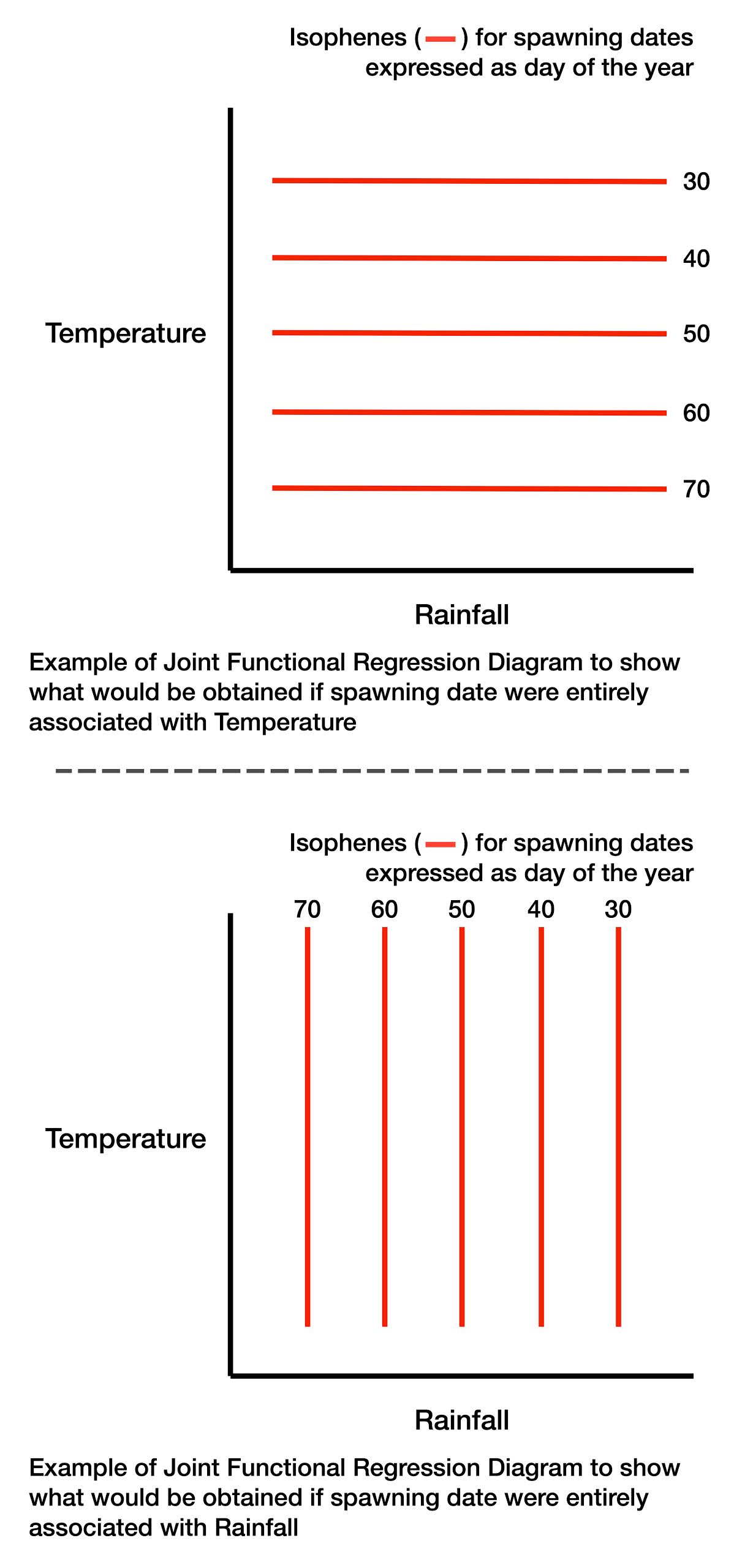
The diagrams he produced need a little explanation. He was able to plot on a graph, with average monthly rainfall and average monthly temperature as the axes, points at which spawning occurred on certain dates (expressed as day of the year, eg 1 January = 1 etc). He then joined equal dates of spawning with a line—an isophene—analogous to an isobar on a weather map. Each diagram then had a family of isophenes ranging from early spawning (day 20, i.e. 20 January) to very late spawning (day 90, 31 March).


To digress for what he would have obtained had the date of spawning been simply associated with temperature or rainfall, I show theoretical diagrams below. In each case the isophenes would be parallel to one axis or the other. But Savage did not obtain isophenes parallel to an axis. The isophenes were curved showing a complicated relationship between temperature, rainfall and spawning date.


Savage's Diagrams showing isophenes of day of spawning.
The shades areas are where there we no data


Savage’s significant contribution was to look at the patterns of rainfall, temperature and spawning not just in the month of spawning but in each of the two months before spawning. However, he then hit a problem because the usual month of spawning was not the same throughout Britain, as his map showed, and was sometimes variable from year to year in any one region. Therefore for each record he designated the month of spawning as M0, the previous month as M1 and the month before that as M2. The reader of his book can be confused by this notation because it would have seemed more logical to denote the month before breeding as M-1 etc.


He had to use months as the unit because the meteorological records were presented as averages for a particular month. That made his conclusions for the month of spawning, M0, potentially less valuable as he explained: 


It is obvious that the weather near the end of M0 cannot affect the actions of frogs spawning at the beginning, and, for that reason, the use of a mean value for this month must introduce errors. It is, however, a property of the weather that it runs in spells, so that the Meteorological Office can head its monthly reports with a condensed summary in a short phrase, such as “Warm in the west, colder and windy in the rest of the country”. The mean values used in this work are therefore not so bad a measure as would appear at first sight.


Savage went into considerable detail in attempting to interpret the three diagrams. I will limit what follows. In general, in the month of spawning (M0), early dates for spawning are associated with higher rainfall; both relatively and high and relatively low temperatures with low rainfall are associated with later spawning. A similar conclusion can be reached about the month before spawning (M1). By contrast, two months before that of spawning (M2), temperature is far more important, higher temperature being associated with earlier spawning. An effect of rainfall is still present particularly at lower temperatures.


It is the marked association of rainfall in the preceding month or so with the date of spawning that Savage talked about on the BBC in 1959.


Savage demonstrated clearly an association between rainfall and spawning date, an association stronger at that time than the effect of temperature. It doesn’t need stating that demonstration of an association is not a demonstration of causation or that rainfall is not a proxy for some other event associated with high rainfall. However, the shift in spawning date seen after the extremely cold winter of 1947 (with ponds frozen until after day 70) argues in favour of an effect of, at least, severe changes in environmental conditions. In 1940-46 in south-west England the average day of spawning was 36 (5 February); in 1947 it was 77 (18 March).


Ecologists have often seemed reluctant to embrace experiment (a criticism that does not extend to Savage) and as far as I have been able to determine, there has been no experimental test of the effect of rainfall and temperature on the date of spawning. If, say, frogs from parts of the east of Scotland or of east Anglia (regions with late average spawning dates) were moved to Cornwall would they conform to the early spawning date observed there?


Savage thought he knew why higher rainfall is associated with early spawning and how the effect is brought about. This is an important I shall return to in a future article since it is a theme that runs through all Savage’s observations and research.


Ronald Maxwell Savage spent an enormous amount of his time—months of work he stated—in pre-computer days on extracting the data, preparing the data for analysis and doing the final statistical calculations. He thanked ‘Dr Frazer’ [John Francis Deryk Frazer, 1916-2008] for copying out the spawning dates from the Phenological Reports. Therefore, I find it odd that Deryk Frazer made so little of the approach or of Savage’s findings, confining the inadequate description to a short paragraph, in his Reptiles and Amphibians in Britain which was  published in 1983 in the New Naturalist series,. Perhaps I should not have been too surprised because in the same volume he also misinterpreted Savage’s later work.


As well as producing his diagrams, Savage, a skilled exponent of statistical analysis for reasons I will explain in a later article, used multiple regression analysis on the meteorological, location and spawning date data in order to determine the influence of individual factors. In addition to rainfall and temperature he included altitude, latitude, longitude and hours of bright sunshine. From this analysis he obtained a multiple linear correlation coefficient of 0.74, remarkably high, he suggested, for such data; I agree. That would account for just over 50% of the variation in spawning data observed and, as Savage observed, could well be an under-estimate for reasons he explained.


I thought I would try, using Savage’s multiple regression equation that he showed in his book, and average local data to see if it produced a spawning date in the right ball park. However, I soon realised that one term (temperature in M2) was missing entirely and the coefficients for latitude and longitude seemed 10x out. Using the equation as it is shown produced nonsensical answers. Unfortunately, I have found no reference to its use by others nor to its obvious errors which must have occurred during conversion of units, copying or type-setting. If it were usable it could have provided a valuable tool to test the effect of increasing environmental temperatures on spawning date (see below) and how well it corresponded to current data on climate and spawning dates. It is unfortunate that the absence of ‘hard’ editing is often evident in Savage’s papers as well as in his book. There are some obvious errors as well as the reader—well this reader—being left puzzled by what seems to be an error, omission or lack of explanation. One example is that the beta coefficients shown in the regression equation on page 143 (with one missing) are not the same as shown in Table 7 on page 145.


Savage also showed the beta coefficients obtained in his regression analysis (i.e. the slope, negative or positive, for each component). He used their relative size to estimate the main factors. Retarding influences (i.e. later spawning dates) were associated with higher temperature in M0; increase in latitude; increased sunshine in M1. Accelerating influences were: increase in longitude; raised temperature in M2; increased rainfall in M1. These conclusion can, of course, also be deduced from his diagrams.


Therefore, In any one location from year to year, the effects of geography removed and the list of influences can be shortened. Retarding are: increased sunshine in M1; high temperature in M0. Accelerating are: high temperature in M2; increased rainfall in M1. However, this could not be the whole story since, as Savage observed, although some ponds were near together the frogs spawned at different times. Again, I will return to how Savage explained the differences in a later article.


Savage appreciated the importance of an effect on winter temperature (i.e. in M2) on spawning date and its compatibility with what was known about frog physiology. Gametogenesis is temperature dependent and Trevor Beebee found that between 1979 and 1994, although spawning date did not change significantly over that period at a single site, there was a strongly negative correlation with overall winter maximum temperatures*.


It would seem that the tradition of making rather little of Savage’s extensive work and statistical analysis, as exemplified by Frazer’s book and pointed out by Trevor Beebee, lives on. For example, in a recent paper on the possible effects of climate change on breeding in the Common Frog, Savage is mentioned but only in respect of noting that spawning dates may be different in ponds in the same area. Completely ignored in this new phenological analysis across a number of sites from 1994 onwards was the importance of the timing of rainfall in the months before spawning as found by Savage and the acceleration of spawning by higher temperatures in M2 but a retardation of spawning with high temperatures in M0. There was incidentally, no statistically significant trend for spawning dates to be earlier, although there was a tendency in that direction. The plot of spawning day versus year would have been dismissed by a late colleague as just ‘a swarm of bees’. Savage may have been wrong—or right—in his conclusions but his findings have to be explained in the light of further evidence, not ignored, as well as being taken into account in designing statistical procedures to analyse changes with time.


Finally, and with more on Ronald Maxwell Savage to come, the original data sources still exist. Somebody could re-extract the information, which would be time consuming but the months spent on statistical analysis—which could go much further than even Savage could crank out by hand—would be reduced to minutes. Given the importance of determining the effect of anthropogenic warming, these historical phenological records could be of much greater significance than Savage could ever have anticipated.


Beebee TJC. 1995. Amphibian breeding and climate. Nature 374, 219–220. 


Savage RM. 1935. The influence of external factors on the spawning date and migration of the Common Frog, Rana temporaria temporaria Linn. Proceedings of the Zoological Society of London 105, 49-98.


Savage RM. 1961. The Ecology and Life History of the Common Frog. London: Pitman.


Tuesday, 16 March 2021

The Mouse Adrenal X-Zone Revisited


This photomicrograph (from here) shows the cross section of a female mouse.
The medulla (M), X-zone (XZ) and zona fasciculata (ZF) of the cortex are labelled.
The outer, zona glomerulosa, of the cortex can be seen but is not labelled 


Introduction

For a few months in 1965-66 I worked on the aptly-named X-zone of the mouse adrenal in Hong Kong. In 2018 I wondered what had happened to research on the X-zone. Had its function been discovered? The answers were in fact ‘rather little’ and ‘no’ and so I offered to give a talk at an annual Society for Endocrinology meeting in an attempt to stir up some interest in a problem that has intrigued those interested in the workings of the adrenal gland since the 1920s. This I did in November 2019 at Brighton meeting of the British Endocrine Societies.


I have written below an account of the cellular origins of the X-zone because it now transpires that we were misled in the 1960s by the misinterpretation or misreporting of early findings and that, in fact, the early workers were right about where it came from during development of the embryo. In addition, nobody it seems had spotted an important paper published in 1942 that made our experiments in Hong Kong unnecessary. But first the personal historical background:


Four weeks after we had arrived in Hong Kong, I received an aerogramme from John Phillips he had written on 28 November 1965. He was on his first ‘long leave’ from the University of Sheffield and was spending it back in Sheffield with Ian Chester Jones, where, until December 1962 he had been a lecturer. We had been up to Sheffield several times before leaving for Hong Kong on 1 November and the general idea was that I should have a look to see if steroid hormones found in vertebrates occur in invertebrates as well. I was beginning to see what we had in terms of chromatographic equipment and chemicals in order to make a start when that aerogramme arrived. He wrote:


…I listened to Prof Paul Delost give a lecture on the X Zone last night and I was surprised to hear that he considers the X zone to be under medullary control. He bases this conclusion on the absence of an X zone in an adrenal in which the medullary tissue has been aspirated from the centre of the gland with a needle and vacuum pump—the other gland remaining as a control. The interesting thing about this preparation is that if you castrate the post-pubertal male the X zone reappears in the gland with a medulla but not in the other adrenal without a medulla…But the main criticism of Delost’s approach is that he destroys the vascular bed of the adrenal. This can be overcome by an operation called “enucleation” in which the whole of the adrenal is expressed leaving only the capsule from which a new adrenal cortex regenerates. Will you get some male mice and enucleate adrenals before puberty…


That I did and the results were clear. Given though the techniques available at the time it was difficult to envisage taking the approach further. The caravan moved on.


Cellular Origins of the X-Zone


After its description1 but misidentification in 1924 by Kiyoshi Masui and Yasushige Tamura of the Imperial University of Tokyo (with a further publication in English in 19262) and  its naming in 1927 to reflect its unknown function by Evelyn Howard (1904-1999) then at Stanford3, the X-zone of the mouse adrenal excited the interest of pioneering endocrinologists who did not yet describe themselves as such. The structure, which develops after birth between the cortex proper and the medulla, still befits its name; the function of the X-zone remains unknown4,5. Early work was concerned with its origins and with its hormonal control since it disappears at puberty in males and during first pregnancy in females6.


In terms of hormones in the circulation, androgens cause the X zone’s disappearance while LH (luteinising hormone) from the pituitary is necessary for its maintenance4,7. Although excellent research was done in the early years on the possible cellular origins of the X-zone it is only more recently that cell lineage studies using molecular markers have provided further evidence that it is derived from the fetal or inner adrenal cortex, as opposed to the definitive or outer cortex which forms the well-known zones of the adrenal: glomerulosa, fasciculata, reticularis (references in4). Therefore, the X-zone of the mouse appears to be homologous with the human fetal adrenal cortex, which, as its names implies is present only in the developing fetus. Such an origin was suspected by some early workers who referred to the ‘human fetal X-zone’ but strongly denied by others. Other possible homologues are the juxtamedullary zones of various size and appearance observed in some other eutherian mammals (cat, rabbit, voles, hamsters, and shrews)6,8.


In this short article I first consider whether the more modern findings on the origins of the X-zone are consistent with the early studies since the over-riding impression created in the mind by reading reviews and papers from the latter half of the 20th century is that the X-zone is derived from the inner cells of the zona fasciculata or, in other words, is just another zone of the definitive cortex. Then I review the evidence from little-known perturbative experiments, published, to modern eyes, in obscure places, that throw light on the origins of the X-zone.


That the X-zone is derived from the fetal or inner cortex is entirely consistent with the findings of Harry Waring9 who was then working in Liverpool for an M.Sc. The topic was suggested to him by a forgotten promoter of endocrinology in Britain, a famed lecturer in zoology, Ruth Culshaw Bamber (1889-1970) who was always known as Mrs Bisbee.  Horace ‘Harry’ Waring (1910-1980) showed in 1935 that during embryonic development there is—initially—an intermingling of the cortical and medullary elements. Remodelling then concentrates the medulla until there is a clear separation from the cortex. He identified cells, comprising what he called the interlocking zone, between the medulla and cortical elements. These cells became concentrated around the time of birth into a layer around four cells thick. The outer cortex in the meantime was growing and forming the usual zones. But it was that layer of interlocking cells that went on to form the X-zone after birth. Later, as the X-zone degenerated there was left a ‘medullary connective tissue capsule’ or ‘juxtamedullary capsule’ around the medulla formed, it was presumed, from the collapsed stroma9.


In 1928, Ruth Deanesly (1901-1997) in London had already observed that after degeneration of the X-zone some of its cells remained around the juxtamedullary capsule10. Therefore, the key early finding that a secondary X-zone forms after castration of male mice can be explained by growth from these cells, i.e. remnants, capable of division, of an inner (fetal) cortex rather than from a differentiation of cells from the inner zone (z. fasciculata in the mouse) of the outer (definitive) cortex.


I cannot explain why the view prevailed, despite evidence to the contrary, that the X-zone was part of and derived from the outer or definitive cortex. As one example, the following is from the highly influential review written by Helen Wendler Deane (1917-1966) published in 19628, four years before her early death:


These [X-zone] cells differentiate postnatally, at about 2 weeks, from the inner portion of the fasciculata (Whitehead 1933a, Waring 1935).


The problem with this statement is that neither Raymond Whitehead11, working in Manchester, nor Harry Waring9 drew any such conclusion. Only Waring of the two studied the origins of the X-zone and his conclusion was, as I have noted above, entirely different.


All the above evidence, even the sophisticated and relatively recent cell lineage studies, have been observational. Those seeking direct, experimental evidence that throws light on the origin of the X-zone would at first sight be discouraged since it all appeared over 50 years ago in obscure publications and/or written in French while one important paper had, I discovered recently, been overlooked entirely.


Until I found that paper, the first experimental work that has a bearing on the problem was thought to have been that in the 1960s from Paul Delost’s laboratory at the University of Clermont-Ferrand in France and in particular that of his student Parviz Chirvan-Nia who later returned to Tehran University of Medical Sciences in Iran. They took advantage of the fact that a secondary X-zone develops after castration in male mice. Their most pertinent finding12,13 was obtained in mice from which the adrenal medulla had been removed by aspiration through a very fine pipette, a technically difficult procedure. In males in which the entire medulla had been removed, a secondary X-zone failed to develop after castration. By contrast, if even a small piece of medulla remained, an X-zone developed around it. The effect was local; the untreated contralateral adrenal was unaffected.


All of Delost’s work from the 1950s onwards was published in French and had received little attention in the English-speaking world. However, on 27 November 1965 Delost was invited by Ian Chester Jones (1916-1996) to give a seminar in Sheffield, having been one of Chirvan-Nia’s external examiners earlier that year. His old student, John Guest Phillips (1933-1987; FRS 1981), on leave from the University of Hong Kong, was also there and while intrigued by Delost and Chirvan-Nia’s work he and Chester Jones were concerned that, in aspirating the medulla, the venous drainage from the adrenal would have been destroyed. They thought that a complementary approach, that of enucleation, in which end of the adrenal is snipped off and the medulla and most of the cortex squeezed out, would be a useful test. After enucleation the outer cortex redevelops and shows a normal zonation but without a medulla. As a result, John Phillips sent me an aerogramme the next day asking if I, having arrived in Hong Kong four weeks earlier as a PhD student, would take it on. This I did and the results were identical to those obtained by Chirvan-Nia and Delost: a secondary X-zone failed to develop if the medulla had been removed completely; if even a small remnant of medulla remained after incomplete enucleation, an X-zone developed around it14.


In 2019 while preparing a talk5 for the Society of Endocrinology on what has happened to research on the X-zone I discovered our experiments had simply confirmed what had already been published. The same approach, enucleation, had yielded the same results in 1942. The paper, which appears not to have been quoted by anybody working in or reviewing the field, was by Murchie Kilburn McPhail (1907-1987) and his student H.C. Read, of Dalhousie University in Canada15. I can only assume that it was missed because it appeared in wartime, albeit in a leading journal, when scientists were otherwise occupied. However, another paper from the same authors from the same year was picked up and referred to.


Suggestions as to possible mechanisms as a result of these experimental approaches, for example what would now be termed a paracrine effect of medullary cells on the inner cells of the  cortex against the direction of blood flow, can now be discarded since the removal of the medulla would by any technique result in the extirpation of the inner cortical anlagen formed in and around the juxtamedullary connective tissue capsule after degeneration of the X-zone.


In conclusion, the original observations by Harry Waring on the origins of the X-zone and the experimental evidence on the necessity of the adrenal medulla for the presence of an X-zone are entirely consonant with the X-zone being derived from the fetal or inner cortex and not the definitive or outer adrenal cortex. The recognition that there are two populations of cortical cells only one of which is responsible for the classical zonation of the adult adrenal gland explains many of the false leads followed, blind alleys entered and bold assertions made by those working in the field during the middle decades of the 20th century.


Research over the past 96 years has established the hormonal control of the adrenal X-zone and seemingly settled its cellular origins. Will we also know its function by the time of the centenary of its discovery?


1. Masui K, Yamura Y. 1924. The effects of gonadectomy on the structure of the suprarenal glands of mice, with special reference to the functional relation between this gland and the sex gland of the female (Translated). Nihon Chikusan Gakkaiho 1, 55–79.

2. Tamura Y. 1926. Structural changes in the suprarenal gland of the mouse during pregnancy. Journal of Experimental Biology 4, 81–92.

3. Howard E. 1927. A transitory zone in the adrenal cortex which shows age and sex relationships. American Journal of Anatomy 40, 251-293.

4. Huang C-C J, Kang Y. 2019 The transient cortical zone in the adrenal gland: the mystery of the adrenal X-zone. Journal of Endocrinology 241, R51–R63.

5. Peaker M. 2019. What happened to the adrenal X-zone. Endocrine Abstracts 65 SE 1.1. DOI: 10.1530/endoabs.65.SE1.1.

6. Chester Jones I. 1957. The Adrenal Cortex. Cambridge: Cambridge University Press.

7. Gannon A-L, O’Hara L, Mason JI, Jørgensen A, Frederiksen H, Milne L, Smith S, Mitchell RT, Smith LB. 2019. Androgen receptor signalling in the male adrenal facilitates X-zone regression, cell turnover and protects against adrenal degeneration during ageing. Scientific Reports 9, 10457.

8. Deane, H.W. 1962. The anatomy, chemistry, and physiology of adrenocortical tissue. In The Adrenocortical Hormones Part 1. Handbuch der Experimentellen Pharmakologie, edited by Eichler O & Farah A, subedited by Deane HW, 1-185. Berlin, Springer.

9. Waring H. 1935. The development of the adrenal gland of the mouse. Quarterly Journal of Microscopical Science 78, 329–366.

10. Deanesley R. 1928. A study of the adrenal cortex in the mouse and its relation to the gonads. Proceedings of the Royal Society B 103, 523–536.

11. Whitehead R. 1933. The involution of the transitory cortex of the mouse suprarenal. Journal of Anatomy 67, 387–392.

12. Chirvan-Nia P. 1965. Données nouvelles sar la zone X surrénalienne de las souris. Doctoral Thesis, Université de Clermont.

Brudieux R., Chirvan-Nia P., Delost P. 1966. Sur les relations directes entre la médullo-surrénale et le cortex surrénal. Journal de Physiologie, Paris 58, 213-217.

14. Peaker M, Phillips JG,. Peaker SJ. 1967. A relationship between the medulla and the X-zone of the mouse adrenal. In Proceedings, Third Asia and Oceania Congress of Endocrinology, edited by Litonjua A, vol. 2 317–321. Manila.

15. McPhail MK, Read HC.  1942. Regeneration of adrenal gland following enucleation and transplantation with special reference to X-zone. Endocrinology 31, 486–492.