Thursday, 22 November 2018

Joan Procter, Arthur Loveridge and the Pancake Tortoise. 1. Arthur Loveridge in Tanganyika

To complete what I have to say about Joan Procter, I want to turn to what was then—and still is—regarded as her most important scientific investigation.

Deemed too chronically ill to be a university student, Joan Procter came to the attention of George Albert Boulenger at the Natural History Museum because of her enquiries about reptiles. He invited her to join him as an unpaid assistant when she left school in 1916. At the Museum she soon established a reputation for her work and when Boulenger retired in 1920 she took charge of the reptiles and received ‘a small stipend’; she was then 23.

She worked and published on a wide range of species as well as producing drawings, paintings and models for display cases. Her best known scientific work was that on the Pancake Tortoise published in 1922. She was able to do this work because Arthur Loveridge was sending specimens to the Museum from Tanganyika. His account of how he got the tortoises and why they were so sensational was published in his book, Many Happy Days I’ve Squandered first published in 1944 in USA and 1949 in UK.

     From Tabora I went to Dodoma, in central Tanganyika, the chief town of arid and desiccated Ugogo. It is a region that has always had a fascination for me. You never know what you will encounter on the leopard-haunted kopjes which relieve the flat monotony of the thorn-bush plain on which the township lies. 
     It was while scrambling over a kopje one evening that I came upon a strange-looking tortoise. The reptile was lying dead at the foot of a precipitous rock, some forty feet in height, near the summit of the hill which rose at least five hundred feet above the plain. From the flattened and fragmentary remains I concluded that the tortoise had been crushed by a falling rock and was of a species unknown to me. As Salimu and I examined it together we discussed its appearance, and I urged him to be on the lookout for more since he was free all day whereas I had only two hours each evening in which to go hunting. When a few days later he returned triumphant with a living example, I was much elated, for I recognized it as similar to the dead one and rightly assumed that it was a Tornier’s tortoise (Testudo tornieri), then considered the rarest of East African species and about the only one which I had not found. During succeeding evenings we located two further batches of the reptiles in crevices or beneath rocks but despite redoubled efforts found no more during the three weeks in which I was stationed at Dodoma. 
     The reason for the flattened appearance of these tortoises was now apparent; they could squeeze beneath rocks or into fissures which afforded them greater protection from hyenas and other carnivores than a strong shell could. Not only is their shell reduced to the thinness of stout paper but it is full of holes or fenestrations. Of these the largest is a great diamond-shaped opening that occupies most of the central portion of the lower shell or plastron. In such areas the creature is protected only by its handsomely patterned black and yellow, “tortoise-shell” shields. So soft and thin are the fenestrated bony plates forming the shell that it is a simple matter to squeeze the tortoise between finger and thumb. 
     The tortoise takes full advantage of this flexibility, as I soon found on trying to remove one from beneath a boulder. It inflated its lungs sufficiently to obtain additional purchase against the roof and floor of its retreat and, bracing its strongly clawed feet—some of the claws were over half an inch long—used them as struts so as to render its extraction extremely difficult. This can be accomplished eventually by gently and persistently working the reptile to and fro when you happen to be able to get a grip. I spent an hour, Salimu helping me, in dislodging three of the tortoises from a fissure into which they had clambered. Their flattened shells have a further asset; they enable them to right themselves quickly when they fall upon their backs, as must happen fairly frequently to tortoises living on rocky kopjes. Several times I have come across an unfortunate leopard tortoise (Testudo pardalis babcocki) which had slipped as it climbed some rock and fallen back so that the deep and convex shell lodged between two boulders. The poor tortoise, being unable to turn over, had perished miserably. 
     The agility of these light and long-clawed pancake tortoises was revealed when I put them in an enclosure surrounded by wire netting; about six inches of the wire was buried in the ground, leaving a fence two and a half feet high. While this was adequate to restrain Bell’s box tortoises (Kinixys belliana belliana), my pancake friends scoffed at it; they clambered up the netting to the top, where they balanced precariously for a fateful moment before toppling over to one side or the other. Nothing daunted if it was the wrong side, they would try again with such persistence that several succeeded in escaping. It was the same when they were put in a deep box; again and again, despite frequent falls, they climbed up in the corners in an almost incredible fashion. To my surprise I found that these tortoises from Dodoma could swim, though opportunities to practise the art must be rare in so arid a region as Ugogo. Had they been water tortoises like the familiar leathery flapjacks (Amyda spp) of the southern lakes and rivers or the fossilized Archelon of the Upper Cretaceous of North America, one would have explained their shell reduction as an adaptation to an aquatic life where a measure of lightness might facilitate swimming. 
     Duly labelling each of my half dozen tortoises Testudo tornieri, I shipped them off to the British Museum, where they arrived some months before I did. When at last I walked into Dr. G. A. Boulenger’s office, almost his first question was an inquiry as to what treatment or preservative I had employed to soften my tortoises and render them flat for packing! When I explained that they were naturally soft and that I had brought a pair back alive as a present for the London Zoological Gardens, he was amazed, declaring that they were the most interesting reptiles that had reached him during a lifetime devoted to herpetology. “What is this name Testudo tornieri?” he asked as he turned one of the reptiles over and over and glanced at its label. I gave him the reference and then and there he compared my series with the figures and description of Tornier’s tortoise. Finding them different in several minor respects, he asked if he might describe them as a new species (Testudo loveridgii) before the Academy of Science in Paris, of which he was president that year. 
     The announcement received considerable attention and the late Lord Rothschild urged me to get him a pair upon my return to East Africa. There seemed little likelihood at that time of my ever being within many hundred miles of Dodoma, but a year later the opportunity occurred for me to send Salimu. I told him not to spend more than a month and, whether successful or not, promised him his wages in addition to a bonus equivalent to one shilling for each tortoise he could find. Of course I was to pay his fare to and fro. He bargained for his wife’s fare also, and I conceded that. From our previous experiences both of us thought that these tortoises were extremely rare, so I was not surprised to learn that when he presented my letter of introduction to the provincial commissioner at Dodoma, the latter guffawed on reading it and said to Salimu: “So you’ve come to look for tortoises. Well, you’ll not find any here, for I haven’t heard of or seen one in all the years I’ve been here.” 
     Ten days or so later Salimu was back at Kilosa with a broad smile and sixty tortoises. Naturally he was pleased at making nearly two months’ extra pay in so short a time. “However did you manage to find so many?” I inquired. It had taken him the best part of three days to find the first, he said; then he showed it to the local tribesmen, offering them a few cents for any they brought him. Obviously the assumed rarity of the species was due largely to its secretive ways, for who would think of looking for tortoises beneath rocks? Yet it is there that they spend most of their time, emerging to feed only in the early morning. 
     It was in January that Salimu made this journey and found eleven under a single flattish boulder, where it is not unreasonable to assume that they were æstivating, for January and February are the hottest months in central Tanganyika. Yet it was in late January and February that mating took place among my captives, and the single egg was laid in July or August; one of these eggs was buried beneath a rockery in the enclosure. The fact that only a single egg is laid, an observation corroborated at the Philadelphia Zoo by Messrs. Conant and Downs, is eloquent testimony to the success of the adaptations which have rendered life so secure for the pancake tortoise that it has no need to lay a large number as do so many members of the order Chelonia. The eggshell is very thin and brittle and unusually elongate, for though it is only an inch or so in width it is from if to i| inches in length. 
     The hardiness of the pancake tortoise is attested to by the fact that, though it was midwinter when I took the first pair to Europe and they had to live in unheated trains and houses for over a week, one of them survived in the London Zoo for eight and a half years. During much of the journey they subsisted on bread and jam, for I had nothing else to offer them. Salimu’s numerous captives throve on lettuce or tender cabbage leaves, and one that I surprised on a kopje at Tabora was busily engaged in nibbling grass. 
     The sequel to the capture of the big series, intensively studied first by the late Dr. Joan Procter and in part by Dr. Otto Wettstein, was the latter’s discovery that Tornier’s original specimen was abnormal but might be matched by individuals in my series. Thus all represent one highly variable species now known as Malacochersus tornieri, for its many peculiarities justified the creation of a new genus for its reception.

Arthur Loveridge (1891-1980) at the outbreak of the First World War had just been appointed at the age of 23 as Curator of a new museum in Nairobi, Kenya. He was born in Penarth, near Cardiff, in Wales. His father was an ‘Ironmonger and Ship Furnisher’ who had been born in England; he mother was born in Ireland. Keen on natural history he had always wanted to be a museum curator. He had done a year as a student at University College Cardiff before getting a job at the University Museum in Manchester. He moved to the National Museum of Wales when he seized on the opportunity of the job in East Africa.

Carl Gans (1923-2009), who new Loveridge and who appears again as an important player in Part 2 of this story, wrote a splendid obituary on Loveridge. In it, he wrote:

The spectacular difference between Loveridge and other enthusiastic boy-naturalists was his total commitment to the pursuit of natural history as a career. In 1914, at the age of 24, he applied for the curatorship of the Nairobi Museum, advising in the application that he had over 300 cases of natural history and anthropological specimens and over 250 jars of “spirit-preserved” reptiles. He noted proudly that he was prepared to handle techniques of mounting and preserving all of his captures, described his complex system of registration and collecting numbers, and referred to an 80-page catalog, with short descriptions of all specimens, all typed by himself. Even his handwriting was small and meticulously formed with little change between top and bottom of pages or successive sheets. Field notes and labels (as well as his many letters) alike were beautifully readable.

The reason he was in that part of German East Africa first called Tanganyika after it was ceded to British control and now part of Tanzania is that he joined the East African Mounted Rifles and fought the German troops there. He collected specimens throughout this period, sometimes even while under fire. Specimens were stored in jars and bottles ‘liberated’ (in the British Army’s sense of the word) from the enemy. The war ended and after a time back in Nairobi he became Assistant Game Warden of Tanganyika in 1921. However, his location soon shifted.

As well as the British Museum and London Zoo, Loveridge sent specimens to the Museum of Comparative Zoology at Harvard, as well as amassing his own private collection. In 1924, Thomas Barbour, of that museum and with a very large private income, bought Loveridge’s collection for Harvard with one stipulation—Loveridge should come too. That he did and for 33 years he was at first assistant to Barbour and then Curator. He is said to have written his popular books because the pay was meagre for a curator who was not also a Harvard professor.

Stories of Loveridge’s curatorial habits abound, of a drawer labelled ‘string too short to use’, of books and specimens having to be returned to their particular place each night and chairs left properly arranged. Alfred Sherwood Romer (1894-1973) at the Museum from 1934 and Director from 1946 labelled Loveridge the “Demon Curator”.

Loveridge made five expeditions to East Africa, each lasting for a year, between 1926 and 1949. When he retired in 1957 he and his wife moved to a spot about as remote as anywhere in the world, St Helena in the South Atlantic. He made other expeditions, had trips to London and carried on working, and corresponding—slowly via the St Helena mail ships. He died there in 1980, aged 88.

I found this press photograph of Arthur Loveridge with his wife,
Mary, taken on his retirement from Harvard


Part 2 to follow considers what Joan Procter did with Loveridge’s specimens and the question of ‘inflation’.

Anon. Loveridge, Arthur (1891-1980). 2014. In, Contributions to the History of Herpetology, Volume 1, revised and expanded. Edited by Kraig Adler, pp 111-112. (Contributions to Herpetology 30, Society for the Study of Amphibians and Reptiles).

Gans C. 1981. In Memoriam: Arthur Loveridge. Herpetologica 37, 117-121.

Loveridge A. 1949. Many Happy Days I’ve Squandered. London: Scientific Book Club.

Williams EE. 1982. Arthur Loveridge—A life in retrospect. Breviora No 471, 1-12.


Friday, 16 November 2018

London Zoo’s Aquarium: The End

The news came in an email to Fellows: announcement of the inevitable end—after 96 years—of London Zoo’s Aquarium. Opened in 1924, it was then state of the art but for decades now it has been realised that the aquarium had reached the end of its useful life. It has been ‘refreshed’ a number of times, sometimes cosmetically—the entrance for example—sometimes structurally. The original large tanks were made of slate which sometimes split to spectacular and dangerous effect. Their concrete replacements were slowly affected by movement of the ground. The huge storage and filtration system for sea water (bought by ship and road tanker) has aged and better systems are now used. Forty years ago or more, Gwynne Vevers, Curator of the Aquarium (among the many jobs he did at the Zoo) told me the Aquarium needed to be replaced.

Edward George Boulenger (1888-1946) then Curator of Reptiles, prepared the outline plan after visits to large aquaria in continental Europe and became Director of the Aquarium when it was finished. John James Joass was the architect, as he was for the Mappin Terraces. The engineering of the water circulation, filtration and electrical systems was the key to success and was undertaken by Alexander Gibb and Partners. There was no plastic then and the piping for the sea water system was lined with glass since copper is lethal to marine invertebrates.

The Society failed to raise enough money to build a new Aquarium outside the Zoo but in London, while the commercial large aquarium opened in the old County Hall and in an ideal spot to attract tourists. I see the plan is now to have some sort of coral reef exhibit in the relatively new insect house and a freshwater exhibit at Whipsnade.

Even when the Aquarium was new there were others, around the coast of Britain attracting visitors However, the number of large public aquaria worldwide, most in the private sector, has led traditional zoos unable to compete. Huge heavily stocked tanks and underwater tunnels have been, and are, the order of the day for exhibition purposes, even if unsuitable for many of the inhabitants.

For those readers who have never been to London Zoo, the Aquarium was incorporated into the bottom of the Mappin Terraces, a naturalistic Hagenbeck-inspired, artificial rock edifice that rises 21 metres above Regent’s Park. When the Mappins were built in 1913-14, space was left for an aquarium underneath. Unable to proceed with the work because of the First World War, construction of the aquarium had to be delayed until the 1920s.

The whole arrangement of storage tanks high under the peaks of the Mappins, filtration system and access to the tanks for servicing was all very cleverly arranged. The only signs of the overlying structure are the wide columns in the public area. There are three halls within the structure; one freshwater; one sea water and one tropical. extending curvilinearly for 136 metres. A corner tank in the tropical hall once housed a manatee.

The famous diagram of the Aquarium showing how it fits beneath the Mappin Terraces

In the 1950s the Aquarium was often quiet with few visitors. This is because there was a charge to enter; the zoo ticket did not include access to the Aquarium. The public space was very dark and even the light from the tanks did not reach all corners. When considering the future of the Aquarium in the early 1990s I was told there were those who visited the Aquarium for activities other than making the acquaintance of its non-human inhabitants.

The type of animal accommodation provided on the lower and middle ranges of the Mappin Terraces (for bears, for example) have long been out of favour. The structure, like so many of the obsolete buildings are Grade II listed and efforts have been made to give it some use in housing animals. It is not generally realised that the concrete structure is a skin formed on wire-netting held in place and stretched between reinforced concrete framework. Erosion of the skin, particularly on the peaks, has needed costly repairs. Now, with the Aquarium gone, the Zoo has a considerable problem on its hands, one that has recurred since the 1980s—what to do with Mappins, underneath as well as on top.

I took this photograph of the Mappin Terraces in 1958


Guillery P. 1993. The Buildings of London Zoo. London: Royal Commission on the Historical Monuments of England.

Vevers HG. 1976. Management of a public aquarium. Symposia of the Zoological Society of London 40, 105-108.

Monday, 12 November 2018

Hong Kong Rodents: Huang’s Rat or Niviventer is back on the list

In my post of 2 May 2013, I considered what had happened to the name of a beautiful species of rat that occurs in Hong Kong. For decades it was known as Huang’s Rat, Rattus huang but it came to be lumped into what was Rattus fulvescens and is now Niviventer fulvescens.

The genus Niviventer was erected by Joe Truesdell Marshall (1918-205) for a group of Asian rodents previously included in Rattus. They can be distinguished by their white belly (niveus—snowy white in Latin).

Generous to a fault, I bought my wife a copy of a volume in that remarkable series The Handbook of Mammals of the World. It is the volume, Rodents II, which covers, as superbly as ever, with information up-to-date at the time of going to press, rats and mice. Having been granted access I found that Niviventer huang has been resurrected as a result of phylogenetic research in China and has been given the common name of South China White-bellied Rat.

As has been said many times, the rats and mice of China are confusing to say the least. Researchers find that specimens have been wrongly identified in museums throughout the world and one only has to look at maps of where specimens have been collected from to realise that whole regions have been missed.

Modern phylogenetics are way above my pay grade and I am not entirely sympathetic to drawing conclusions on whether a species thus defined constitutes a ‘good’ biological species reproductively isolated (or with very limited gene flow) from its near relative. I have looked up the references given in the Handbook. The main work seems to have been done with two genes, one mitochondrial and one nuclear on, in some cases, very small samples. Whether that number of genes and that number of individual samples, together with the statistical methods used, would satisfy all phylogeneticists I do not know. The authors, most of whom are based in Beijing, do make the point that more work is needed on N. huang since, on their reckoning, it may comprise more than one species.

More recently than the press date of the book, another group, based in Kunming, also examined niviventers using one mitochondrial and three nuclear genes. They found less strong evidence for the existence of N. huang as a species separate from N. fulvescens

Are there any morphological differences between the two species? The Beijing group found that N. huang could be differentiated from N. fulvescens by head and body length.


I have combined the maps in the Handbook to show the
current views on the distribution of the two species


Clearly, much more work with an extensive sampling of niviventers right across the distribution of these two and other species in China is needed but for the time being at least Huang’s Rat or Niviventer is back on the list of Hong Kong mammals, while N. fulvescens is out.

The only recent photograph I have been able to find of Niviventer huang
is this one from a website in Russian which Google Translate says in the
Russian-Vietnamese Research and Technology Centre


Wilson DE, Lacher TE, Mittermeier RA (editors). 2017. Handbook of Mammals of the World. Volume 7. Rodents II. Barcelona: Lynx Edicions.

Lu L, Ge D, Chesters D, Ho SYW, Ma Y, Li G, Wen Z, Wu Y, Wang J, Xia L, Liu J, Guo T, Zhang X, Zhu C, Yang Q, Liu Q. 2015. Molecular phylogeny and the underestimated species diversity of the endemic white-bellied rat (Rodentia: Muridae: Niviventer) in Southeast Asia and China. Zoologica Scripta 44 475-494. doi:10.1111/zsc.12117 

Zhang B, He K, Wan T, Chen P, Sun G, Liu S, Nguyen TS, Lin L, Jiang X. 2016. Multi-locus phylogeny using topotype specimens sheds light on the systematics of Niviventer (Rodentia, Muridae) in China. BMC Evolutionary Biology16, 261-272. doi 10.1186/s12862-016-0832-8 


Friday, 9 November 2018

Sea snakes and burrowing eels

Sea snakes are fascinating animals. There were a number of dead ones pickled in jars in the old Northcote Science Building of the University of Hong Kong. They had been gathered from the nets of the fishing fleet or the fishery research vessels. It was difficult to make out the form and original coloration of the pickled specimens. The most interesting, of which there were photographs, was one with a tiny head, thin neck but wider body. I now realise it was the Slender Sea Snake, Hydrophis, now Microcephalophis, gracilis, and could well have been the same preserved specimen used as an illustration in Hong Kong Amphibians and Reptiles. The timing is right since it was the only specimen caught in Hong Kong waters—in 1963 in Deep Bay.

The preserved specimen of the Slender Sea Snake used in
Hong Kong Reptiles and Amphibians. I have added the
red ellipse to show the very small head and thin neck

But why the small head and thin neck in many species of sea snake? The old idea, which turned out to be a ‘just-so’ story, was included on the short section on sea snakes (there was not a single photograph) in Schmidt & Inger’s 1957 book, Living Reptiles of the World:

It is remarkable that some of the longest of the sea snakes have a small head and slender neck and anterior half of the body, with a bulky abdominal portion that is very much larger in diameter. This curious body form, which recalls that of the extinct marine plesiosaurs, seems to be associated with the mechanical requirements for striking at prey in the water. Without any fixed fulcrum from which to launch its stroke, the free-swimming venomous snake makes use of the inertia of the heavy abdomen, while the great resistance of the water is made less by the slenderness of the head and neck…

Later, Harold and Helen Voris of the Field Museum in Chicago examined data on what species of fish the various sea snakes prey. They found that a large number of species eat eels. Subsequently it was found that the snakes with a small head feed on burrowing eels and gobies, and those with a very small head feed virtually exclusively on burrowing eels. Divers have also reported seeing some species of sea snake with their heads in a burrow. Therefore, it has become clear that the small-head-thin-neck type of sea snake is adapted to entering the long burrows of eels and emerging with a meal.

Along with their various physiological adaptations to life at sea, which I will not go into further here,  and the specialized feeding habits—including species which feed exclusively on fish eggs—a significant feature of sea snakes is the number of species within a relatively small geographical area. A recent paper* relates feeding on burrowing eels to the rapid increase in the number of species. The pursuit of a previously untapped food source has been well established in other animals as a trait that would be favourably selected and, therefore, act as a driver of speciation.


From*. I have added a red ellipse to highlight the differences in the width of the head and neck

There are more than 60 species of sea snake. A rapid speciation, accounting for 60% of known species—the fastest known amongst reptiles—occurred from about 7.5 million years ago. The change in body form associated with feeding on burrowing eels appears to have occurred in six or seven of the lineages determined by genomic analysis. In other words, there is strong evidence of convergent evolution.

The authors conclude:

Our study has revealed that trophic specialization has had a strong influence on body morphology in sea snakes, and this relationship is predominantly driven by the convergent evolution of microcephalic burrowing eel specialists. Dietary specialization appears to invoke strong selective pressures that manifest as predictable and rapid morphological changes. Future studies are needed to examine the genetic and developmental mechanisms underlying these dramatic body shape changes and address their role in speciation. 

Then I started to think about implications for how the small-headed sea snakes feed. Let’s assume the diameter of the neck equals the diameter of the eel’s burrow. If the snake swallows the eel (the diameter of the burrow) while in the burrow its neck will be twice the diameter of the burrow and it could get stuck. Therefore, is it perhaps more likely that the snake pulls the eel out of the burrow before swallowing it? But, if alive, the eel would stand a chance of escaping, so is that why the venom of these sea snakes is so powerful? To ensure that the eel is dead before being pulled from its burrow and to enable a quick kill by a snake that must swim to the surface in order to breathe? Alternatively, perhaps the snake only enters burrows that are wider than its neck. Then it could, perhaps ingest its prey without getting stuck. But a large eel in a large hole might then be too big to be swallowed by the small head (the maximum width of prey has been found to 1.5 times that of the neck)? Divers or remote cameras watching how these small-headed sea snakes feed may be the only ways of providing an answer.

The dangers of a snake swallowing its prey with its neck in a confined space was brought home to us on Boxing Day 1966 in Hong Kong. We were walking along Conduit Path a short distance from the top of University Drive when we found a dead rat snake with its head in a small hole in the bank. A good pull was needed to extract the snake. It was in process of swallowing a toad and the swollen throat had jammed the snake plus toad in the entrance to the hole. We could only assume that the oxygen within the small hole had run out and the snake had asphyxiated itself as it tried to retreat. Unwisely, with hindsight, we left the snake plus toad on the bank of earth, intending to pick it up on the way back from our walk and preserve it in the lab. But it had gone; some scavenger had made off with it.

*Sherratt E, Rasmussen AR, Sanders KL. 2018. Trophic specialization drives morphological evolution in sea snakes. Royal Society Open Science 5, 172141. http://dx.doi.org/10.1098/rsos.172141 

Karsen SJ, Lau M W-N, Bogadek A. 1998. Hong Kong Amphibians and Reptiles. Second Edition. Hong Kong: Provisional Urban Council.

Peaker M, Peaker SJ. 1968. Death of a snake while swallowing prey. British Journal of Herpetology 4, 38-39. 

Schmidt KP, Inger RF. 1957. Living Reptiles of the World. London: Hamish Hamilton.

Voris HK, Voris HH. 1983. Feeding strategies in marine snakes: an analysis of evolutionary, morphological, behavioral and ecological relationships. American Zoologist 23, 411-425.


Sunday, 4 November 2018

Joan Procter. Her Reptile House at London Zoo and Reptilian Thermoregulation

It is only when one reads the detail of Joan Procter’s Reptile House at London Zoo that one realises she was decades ahead of her time in terms of knowledge of the thermal requirements of reptiles. The Reptile House opened in June 1927. Apart from its ‘aquarium-principle’ lighting, crowd circulation and safe-handling area for venomous snakes, the spectra of both natural and artificial lighting were specified while additional heat was supplied to different places of the cages thus creating a temperature gradient which allowed the animals to bask and raise their body temperature above that of their surroundings.

In Joan Procter’s own words when describing how the Komodo Dragons were housed and how they had lived in the new Reptile House for 18 months:

They live in a large enclosure of natural shingle and soil, planted with living palm-trees, and provided with a cave, rocks, and a swimming-pool. A great deal of care has been exercised to provide proper climatic conditions. The roof is of Vita-glass, transparent to ultra-violet light, and Vita-lamps for artificial sunlight are installed together with two large flood-light lamps. Dull-heat radiators of the beam type are also fixed, and all this apparatus, which is invisible to the public. is protected by massive steel bars. Further, the rocks themselves are electrically heated with a type of black-heat radiator let into the actual rock, and controlled, together with the air-heaters by a thermostat, which in turn is governed by a fool-proof warning system. The light and heat are chiefly focussed on a large rock in the centre of the enclosure, and, as the dragons immediately discovered this, they are usually to be seen sunning themselves upon it.

Those who know anything about reptiles will recognise this as a throughly modern way of keeping lizards. As I pointed out in a previous article the Vita glass was to let ultraviolet rays in sunlight reach the animals. Her ‘Vita-lamps’ were actually ultraviolet-emitting lamps with Vita glass filters to block just the very short wavelengths which experiments had determined were deleterious.

Previously, reptiles kept in temperate climates were kept in accommodation heated to the temperature of a tropical shade environment. Most had no opportunity to bask and raise their temperature above the ambient. The science of thermoregulation in reptiles really only took off in the 1940s and the concepts like ‘preferred body temperature’ and  ‘behavioural thermoregulation’ developed. Thus while reptiles are indeed cold-blooded they were found able to maintain body temperatures above that of their surroundings during the hours of daylight by shuttling between the heat of the sun and the relative cool of the shade. Komodo Dragons have been shown, comparatively recently, to follow that pattern.

The preferred body temperature was later shown to be that which is optimal for biochemical processes within the body. Reptiles not allowed to achieve their preferred body temperature, even though kept in warm ‘tropical’ daytime air temperatures, were function sub-optimally. It is not surprising that such animals are lethargic, their immune system left unable to cope with infection and infestation, do not breed—and do not survive for very long. Reptiles, particularly larger ones, take a long time to die.

Joan Procter was aware that she had designed accommodation for Komodo Dragons that was superior to that elsewhere. She quoted from William Douglas Burden’s book Dragon Lizards of Komodo (see my article on the Burden expedition to Komodo here):

     …We hear of specimens taken to New York* that “it was painful to see the broken spirited beasts that barely had strength to drag themselves from one end of their cage to the other.”     ‘’"SureIy it is not all a matter of diet and change of climate... Perhaps…Varanus komodoensis, in order to survive, demands the freedom of his rugged mountains.” ...,but our specimens are perfectly happy in captivity, are attached to their keepers and their friends, and are putting on a great deal of weight.

I think we can take that as London 2: New York 0, 1928 style.

This photograph of a small boy and a Komodo Dragon may have been
taken in the original accommodation in the Reptile House in London
Zoo in 1932. Joan Procter and the keepers always seemed keen
to demonstrate how tame the Dragons had become

The heating and lighting equipment was not ‘off the shelf’. The General Electric Company Ltd (not to be confused with the American company of the same name) had research and development labs at Wembley. The Times (15 June 1927) in describing the new house reported:

The very elaborate electrical installation devised by the Research Department of the General Electric Company to meet the special requirements forms an achievement in electrical installation which is unique, and cannot be described in detail here. It may be said, however, that the installation has approximately 20 miles of electric cable for the heating system and 12 miles for the indicators and tell-tales, and that some of the compartments have up to 200 electrical connexions. The wiring for lighting is almost equally elaborate.

Miss Procter wanted material for the walls that could be cleaned. She therefore had the theatrical scenic artist, John Bull, use car enamel that would be resistant to scrubbing. I cannot find a photograph of any of the scenes painted on the walls of the cages—perhaps a good job since I utterly loathe naturalistic painted backgrounds.

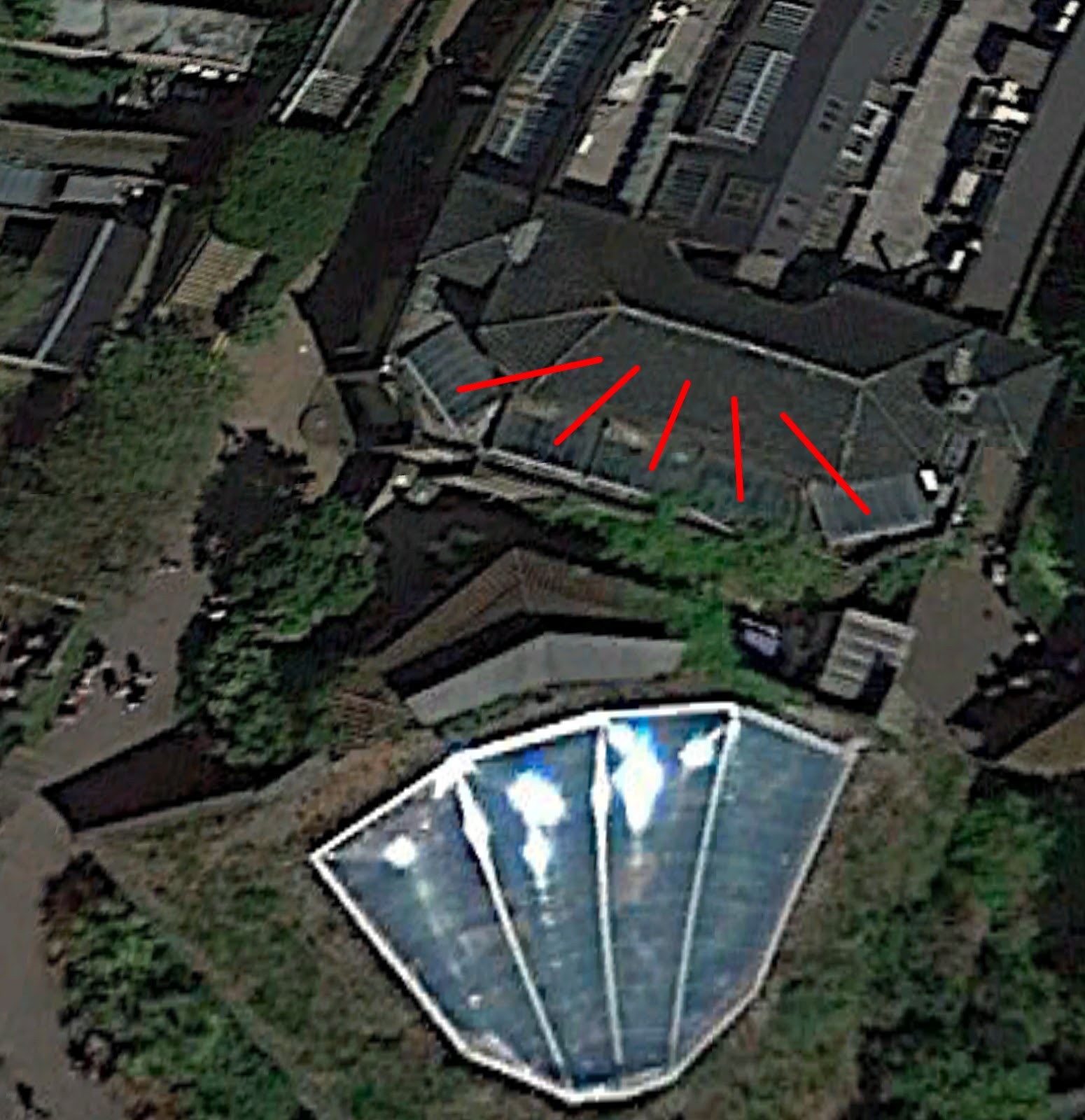
It is clear from contemporary diagrams that the Komodo Dragons were kept in the large enclosures at the southern end of the Reptile House, used, ever since I first went to the Zoo in the 1950s, to house crocodilians. Their glass roofs can be seen in Google Earth—just a short distance away from the new housing for Komodo Dragons.

This Google Earth View of the Reptile House shows the windows
above the cages where the Komodo Dragons were housed. Vita
glass was installed originally. Has it survived?
The new enclosure covered in plastic is the current housing
for Komodo Dragons

It is easy to criticise—ninety years after it opened—aspects of the Reptile House. The compartments for large snakes seem of the wrong proportions, for example. The domestic architect but President of RIBA, Guy (later Sir) Dawber (1861-1938), who took Joan Procter’s very detailed plans, made them buildable and added the external features seems to have missed a few tricks. The sides, especially the western elevation which forms one side of the alley between the equally depressing edge of the Mappin Terraces, are devoid of life. Guillery suggests the outward-facing cage on the eastern side (which often used to house interesting chelonians and is the only relief from the drabness) was inserted later. Dawber also designed—again from a detailed layout by Joan Procter and Chalmers Mitchell—the exterior of the nearby main entrance to the Zoo in the same Italianate style used by earlier architects. I sometimes wonder if Dawber took umbrage at the minor role he was accorded by the Chalmers Mitchell publicity machine; he did not attend the opening of the Reptile House.

But Joan Procter’s house was clearly a great leap forward for the Zoo. But there was still much to learn since reptiles and amphibians died in large numbers after importation. Even the best conditions will not reverse the effects of the stress of capture, storage in unsuitable accommodation and then long sea journeys at temperatures below the optimum together with under- and/or mal-nutrition. Real advances, other than air transport, in how to keep reptiles, other than the ‘easy’ species, would not come for another four or five decades.

I can't resist showing one of my photographs of these wild Komodo Dragons
taken in 2016


*These Komodo Dragons in New York seem to have been forgotten by historians. Their arrival in USA is usually given as 1934, Washington.

Guillery P. 1993. The Buildings of London Zoo. London: Royal Commission on the Historical Monuments of England.

Peaker M. 1969. Some aspects of the thermal requirements of reptiles in captivity. International Zoo Yearbook 9, 3-8. Zoological Society of London. London: Academic Press. 

Procter JB. 1928. On a living Komodo dragon Varanus komodoensis Ouwens, exhibited at the Scientific Meeting, 23 October 1928. Proceedings of the Zoological Society of London 1928, 1017–1019.

Thursday, 1 November 2018

What to do with unproductive scientists. John Postgate’s solution from the 1980s

Assortative sitting was the name of the game. I soon discovered there was nothing quite so deadly as attending a meeting of Directors of Institutes and Units of the Agricultural Research Council (ARC) (which morphed first by adding Food to its name (AFRC) and then into appallingly-named Biotechnology and Biological Sciences Research Council (BBSRC)). The first trick was to sit somewhere near the back. The second was not to sit opposite certain gentlemen whose facial expressions could induce an uncontrollable laughing fit. The third was to sit next to somebody of like mind so that you could mutter comments heavily laden with sarcasm to one another through clenched teeth. On several occasions I was both skilful enough and lucky to land next to the late John Postgate FRS who was Director of the ARC’s Nitrogen Fixation Unit.

With a father, Raymond, who founded The Good Food Guide and a brother, Oliver, who wrote, produced and appeared in the classic children’s television programmes Bagpuss and Clangers John Postgate was part of a well-known family in the second half of the 20th Century.

One topic which all Directors agreed on was what to do about those scientists who became unproductive, usually in middle age. Some went on churning the same old handle of unexciting research, others slowed down completely. In the research institutes and universities it was virtually impossible to get rid of anybody other than by a quiet word in their ear suggesting they might find more satisfaction elsewhere. If they did not take the hint, you were stuck with them. Because most of those involved had reached a certain grade in the institutes, Principal Scientific Officer, the problem became known as what to do about the clapped-out PSO. Sub-committees were set up and reported but very little happened until a financial crisis led, in England and Wales, to redundancies and the careful inclusion of the ‘clapped-out’ in an area of research to be cut—a very nasty and unfair process.

In our mutterings on the back row, John Postgate and I had very similar views. Scientists would be given a long but fixed term contract until, say, the age of 45 or a fixed time after completing their PhD. If they could then be promoted on merit they would be retained for another, say 10 year contract; if not they would be given long notice (2-3 years) that their contract would not be renewed and provided assistance in fitting themselves for employment elsewhere. Again those staying on would be subjected to a final ‘up or out’ promotion assessment.

The system we suggested would have been similar in a number of ways to that operating in the armed services to ensure the flow of young recruits into the system while retaining the highly capable scientists in the system. I had quite forgotten until I read John’s Biographical Memoir that he had published his proposed system after he retired, based on the army analogue, in a 1991 issue in New Scientist:

There is an old adage to the effect that scientists run out of steam in middle life. One would like to deny its truth, but regrettably it has substance. Most working scientists (among whom I include technologists) are familiar with the older researcher or teacher who has lost momentum. Typically he or she shows low motivation towards keeping up to date with background knowledge, a resistance to solving new problems, a reluctance to adopt new techniques and approaches.
     Scientists such as these are content to coast along as before, painting the odd lily, often quite effectively, and not getting in anyone’s way.These characteristics tend to appear early on if the science has a substantial mathematical or physical component. Sadly, scientists whose output has become lower than it ought to be in quality (not necessarily in quantity) are,on the whole, more prevalent among older age groups.
     Before I am accused of rampant ageism (by the way, I am immensely old myself), let me amplify that ‘on the whole’ proviso. Of course there is that invaluable minority of scientists who do not run out of steam with age; those who, appropriately talented and dedicated, sustain momentum and remain acknowledged leaders in their fields to a ripe old age, setting an example to everyone and achieving well-deserved rewards and honours. There are also a few young scientists who lack steam from the outset; equally there are a few late developers. But in all, the exceptions represent a very small percentage of our scientific workforce.
     In the expansive years of the third quarter of the century, institutes or departments could carry coasters along by group momentum, but those days are over for good. Even if science funding in Britain were to rise to match the norm among other developed countries, the heady days of 1950s-type expansion will not return. Today such people are a source of anxiety to scientific directors and departmental heads, because they are numerous in both the R and D sides of R&D. They unwittingly deny opportunities to young and innovative scientists, to the detriment both of their establishments’ programmes and of the country’s scientific and technical progress.
     Yet as our society becomes ever more science-based, we need an expanding scientific workforce, and it must be one capable of seeing, exploiting and developing innovations almost as soon as they appear. And we need to retain all the innovators we can get, be they old or young.
     How to do this? For reasons which stem as much from specialisation as from age, retraining and redeployment are not the answer: they rarely work among scientists, as Britain’s research councils have so painfully learnt.
     The military solved an analogous problem well over a century ago. Soldiers are recruited to fight and, above a certain mean age, they cease to be useful for that purpose. Therefore they are recruited for a fixed term only and then retired, usually with promotion and a reasonable, if modest, pension. A few who show special talents in appropriate directions are retained for non-combatant duties, but most professional military personnel return to civilian life in early middle age, to make second careers or to relax, as the case may be.
     The careers of scientists ought to follow a similar course. It would be greatly to the advantage of all concerned if they, like the military, were normally taken on for a career-length term, say 25 years, with something like the present civil service pay and promotion prospects. At age 45 they would, subject to performance, normally be promoted by one grade and retired immediately on half pay.
     A minority who retained their usefulness might or might not be promoted, but they would be invited to continue in their posts and pursue their careers normally for another decade. Then another screening would take place. A few outstanding scientists would come through the second screening and work for yet another decade; quite exceptional ones would come through again and again, and carry on well past our present cut-off age of 60 to 65.
     Professional scientists’ contracts would have to be long-term. A succession of short-term contracts would be a disaster – as today’s postdoc trap has shown. The cost of pensions for scientists leaving ought to be balanced out by lower salaries for the young scientists who fill their posts. In effect, however, a career prospect based on single long-term contracts, exceptionally renewable, would render the whole scientific work-force more alert and productive, would ease promotion of young high-fliers, and would avoid the premature rejection of outstanding achievers.
     Being the rule, early retirement would be no stigma, and it would provide society with a reserve of talent, intellectually disciplined and far from elderly, for all sorts of useful purposes – in new employment (helping with the shortage of science teachers, for example), self-employment or, if wealthy enough, in voluntary work.
     After all, the microchip revolution is on the way to making lifelong employment the exception rather than the rule in most walks of life, if only because the alternative is lifelong unemployment for too many of us. Career scientists would, as usual, simply be pointing the way ahead.
Letters followed supporting the Postgate plan but, sadly, the ensuing and  increasingly complex employment legislation prevented the adoption of any such humane scheme—and the ‘postdoc trap’ has been well and truly fallen into. But let’s not go down that road in this post and leave on the the note that John Postgate was one of the good guys. It is also worth noting that he kept lizards, fish and small mammals in his younger days, the first requirement for a biologist to fall into that category.

Postgate J. 1991. Bring in the long-service commission – Science should follow the army’s example. New Scientist 129, 65-66.
Robson R, Smith B, Dixon R. 2016. John Raymond Postgate FIBiol 24 June 1922-22 October 2014. Biographical Memoirs of Fellows of the Royal Society 62, 485-504.