Showing posts with label primates. Show all posts

Wednesday, 14 October 2020

Primates at the Zoo in Victorian London: Matters of Life and Death

On 10 September I wrote (here) about the astonishing number of primates (1,300 individuals of 166 species) that arrived at London Zoo in the years 1883 and 1895 and indicated that the death rate must also have been high since the available accommodation would have been filled many times over. I then remembered that some time in the 1950s Gwynne Vevers had been involved in a survey to see how the Zoo was then doing compared with the past, over a large part of which his father, Geoffrey Marr Vevers had been Superintendent of the Zoo. I found the paper—more on the reasons why this was done will be in a subsequent post—and found the most relevant figures. Although data for primates alone could not be extracted the mortality rate for all vertebrates (both wild and domestic) except fish was approximately 45% in the 1880s-90s. In other words, given a stock of 100 animals at the start of the year, 55 would be left at the end. We also know that primates were a particular concern when Chalmers Mitchell took over as Secretary in 1903 because of the high incidence of tuberculosis. The chances of an individual primate surviving for five years after arrival were very low indeed.

These figures can also be used to back calculate the approximate number of primates housed by the Zoo at any one time.  If we assume that the death rate for primates was 50% and that the number in the Zoo did not change from year to year then it does not need much arithmetic to show that the number of primates kept in the various houses was somewhere between 150 and 200, towards the lower end of the estimate if some of the monkeys that arrived were passed on to other owners. It is also possible to calculate a holding of 155 individual primates in 1946-48, lending some credence to a figure of around 175 in 1883-1895. In 1957 the mortality rate for primates was 25%. The great advances in wild animal husbandry and veterinary knowledge of later decades were still yet to come.


It does not saying that the odds of a primate surviving for 10 years (perhaps half its maximum lifespan) in the late Victorian zoo was very low indeed. However, the figures would have been highly skewed with the majority living only a short time after arrival while a few would have made it into old age.


The two man houses for primates were replaced as soon as possible during the Mitchell regime, plans being interrupted by the First World War. These photographs show the old Monkey House and the Ape House. The Ape House had just been completed ‘at great cost’ when Mitchell was successful in his campaign to become Secretary in 1903. He disapproved of it mightily as, ‘A supreme example of the belief that anthropoid apes, like other denizens of the tropics, required, above all, protection from cold’. He had it demolished as soon as he could and by 1927 it had been replaced by the present Reptile House; the new Monkey House was opened in the same year, only to be replaced in the early 1970s as yet another example of how primates should not be kept.
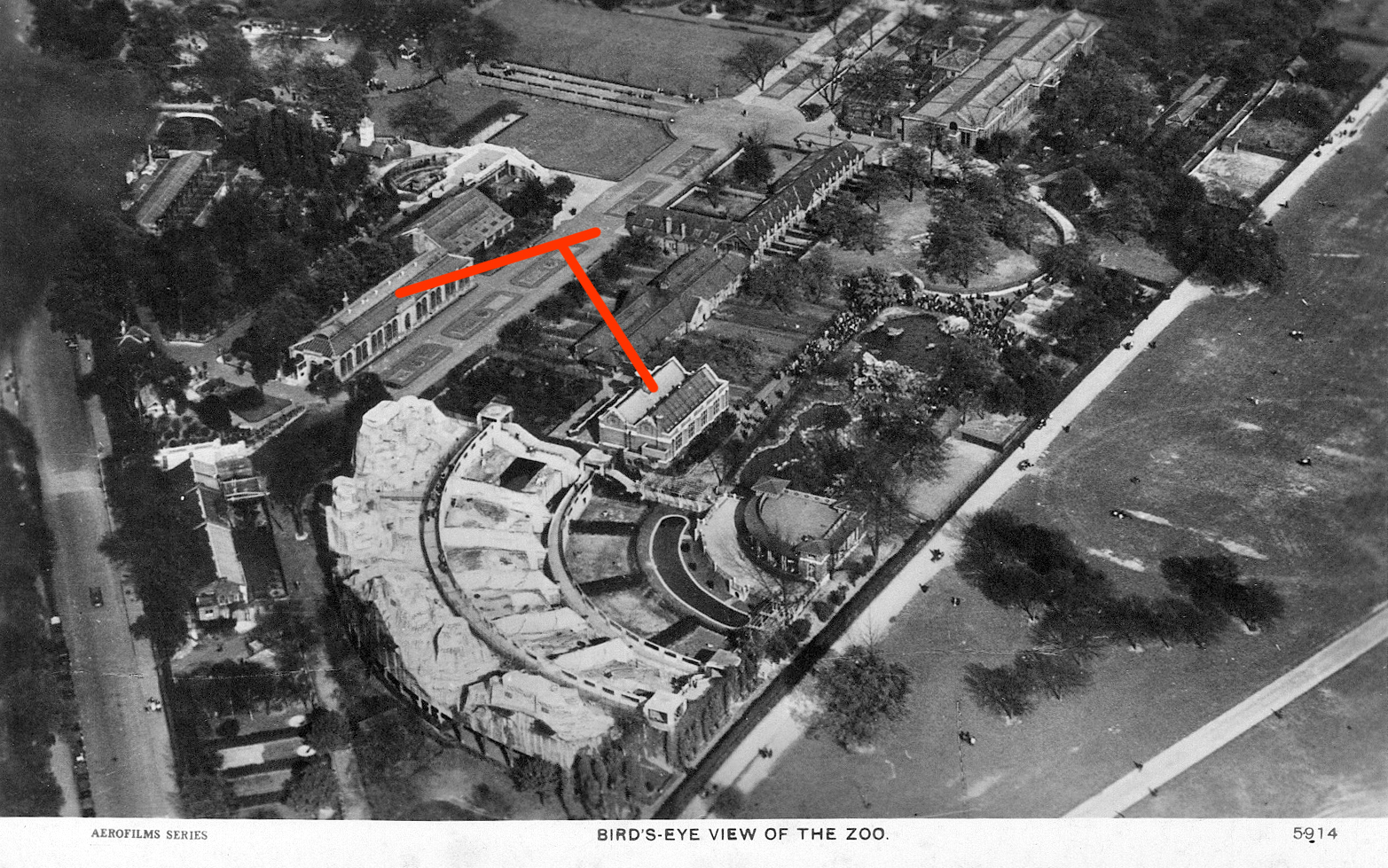


This postcard of London Zoo has an Aerofilms photograph from 1921
The old Monkey house is indicated on the left, the Ape House (opened in 1903) on the right
Both were demolished later in the 1920s


This postcard of the Mappin Terraces shows the Ape House beyond
From the fashion and the sparse vegetationmy guess is this is photograph was taken shortly after the terraces opened in 1913


Ashton EH, Vevers HG. 1959. The numbers of exhibits, births and deaths in the menagerie at Regent’s Park: 1835-1957, and in Whipsnade Park 1931-1957. Proceedings of the Zoological Society of London 1959, 489-514.


Mitchell PC. 1929. Centenary History of the Zoological Society of London. London: Zoological Society of London

Friday, 25 September 2020

De Brazza’s Monkey: an encounter in the Republic of Congo


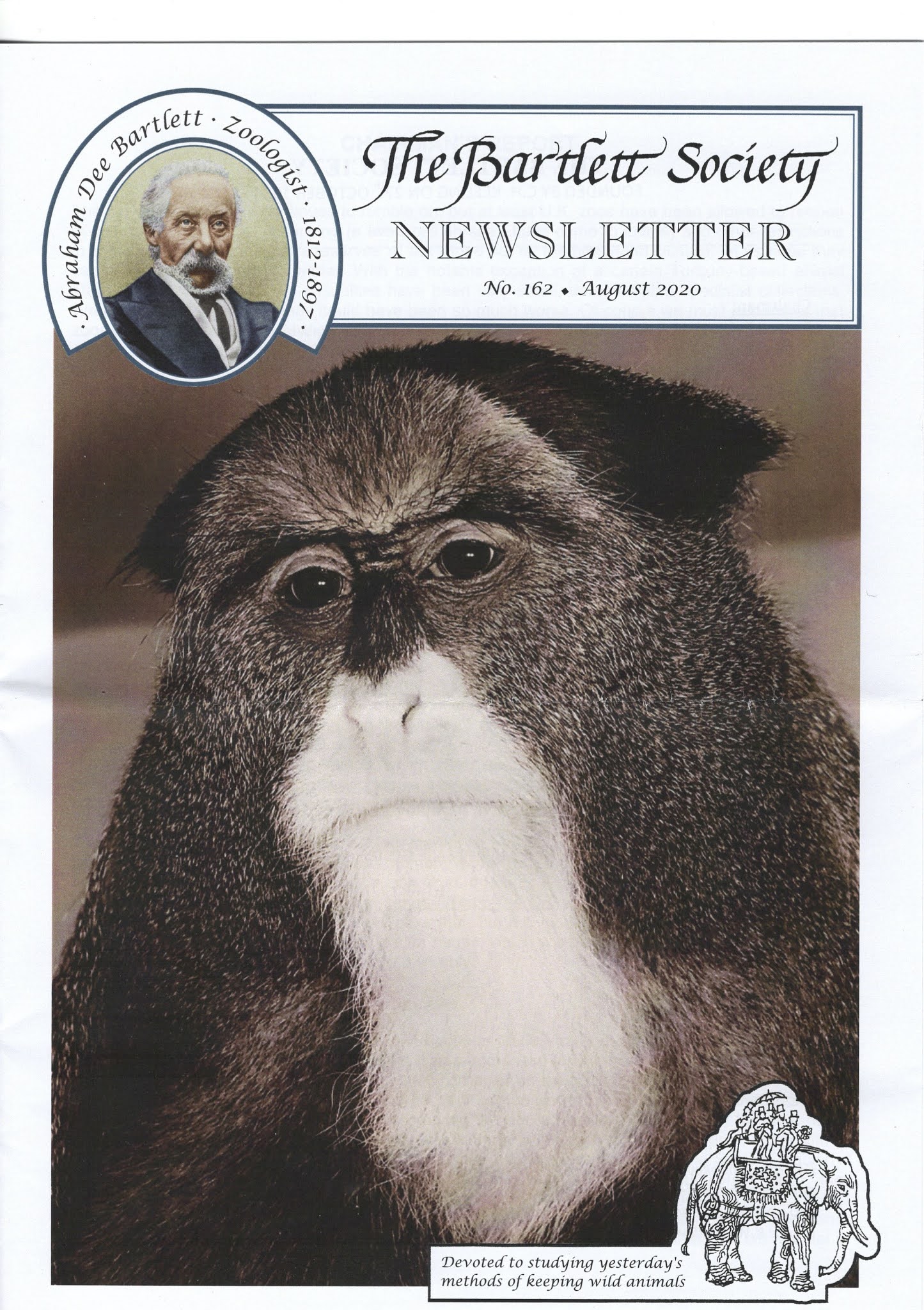
The cover of the latest edition of the Bartlett Society’s Newsletter shows a De Brazza’s Monkey, Cercopithecus neglectus, now common in zoos but in the past considered one of the more unusual monkeys to be seen in captivity; according to the Society’s checklist the first breeding in Britain was at Paignton Zoo in 1957. A question the leapt into my head: who was it that said a better name for the animal would be the Sir Thomas Beecham Monkey given the remarkable facial resemblance—complete with goatee beard—to the famous conductor? I then remembered. It was the late Clin Keeling, founder of the Bartlett Society, at one of my first visits to Pan’s Garden, the Keelings’ ill-fated collection at Ashover in Derbyshire in 1960. How the esoteric topic of De Brazzas’s Monkey came up I cannot remember but since the name Molly Badham came up whenever monkeys were being discussed I wonder if she, in the days before Twycross Zoo, had acquired some.

I was delighted to see De Brazza’s Monkey in the wild in 2014 in the Republic of Congo. Indeed there is no more appropriate place in which to do so since the capital to which we had flown from Paris is Brazzaville. The monkey is named after one Italian-born Frenchman, Jacques Camille Savorgnan de Brazza (1859–1888); the capital after his elder brother, Pierre Paul François Camille Savorgnan de Brazza (1852-1905). Jacques was responsible for the collection of natural history specimens in West Africa which were sent to France. As a result, in 1886 Henri Milne-Edwards, the half-English French zoologist, named the species Cercopithecus brazzae. Later it was realised that the species had been described ten years earlier by Hermann Schlegel and it is his name, C. neglectus, that was adopted because it had priority. Some then some began using the common name Schlegel’s Guenon or Monkey as the common name but it is as De Brazza’s that the monkey is now known. It is then a case of mismatch between the origins of the scientific name and the common name. It is a pity that the word guenon has fallen out of use for cercopithecine monkeys. Guenon, as in De Brazza’s Guenon gives an indication of geographical origin in the common name; monkey does not.


Distribution Map from the IUCN website


In the Congo


We were drifting with the current down the Lekoli River when we saw the De Brazza’s Monkeys high in the trees. We were staying at the nearby Lango Camp in the Odzala-Kokoua National Park. The monkeys were behaving as described in the book: a small group in dense vegetation; close to a river; not associating with other monkeys. While I had a good view through the binoculars of 2-3 individuals, I had insufficient time to take any video. They soon scampered behind the vegetation at the end of a thick branch.


De Brazza’s were not the only primates we saw in the Republic of Congo. As well as the the Western Lowland Gorillas I have described in earlier posts, there were: Grey-cheeked Mangabey (Lophocebus albigena); Moustached Monkey (Cercopithecus cebus); Putty-nosed Monkey (Cercopithecus nictitans); Guereza (Colobus guereza); Southern Needle-clawed Galago (Euoticus elegantulus).


None of the monkeys we saw, except the Guereza Colobus around the camp, hung around to be admired or came close to us, although I did get good footage of the Putty-nosed. Whether their apparent timidity was related to the fact that they are on the local menu as bushmeat I do not know.


Here are a couple of photographs of the Lekoli River. They are stills taken from video footage, hence the poor quality. 


Thursday, 10 September 2020

Monkeys in late Victorian London. An astonishing number arrived at the Zoo

 Although difficult to quantify, anybody who has read Hannah Velten’s Beastly London or Leonard Robert Brightwell’s The Zoo Story, will realise that in the years before the First World War, Britain was awash with exotic animals imported for sale as pets or exhibition by travelling showmen as well as by the comparatively few zoos. For example, Brightwell wrote of London Zoo:
A steadily increasing flow of exhibits poured in from all sources, princes, hunters, dealers and even schoolboys. The animal trade may for one reason or another gradually change its centre of activity. Liverpool has always been one such base of its operations, but in [Abraham Dee] Bartlett’s time the Mecca was in the notorious Ratcliffe Highway, now the eminently respectable St. George’s Road, East, a stone’s-throw from Tower Bridge. The writer has vivid memories of dealers in this quarter, great names that vanished quite suddenly during the Edwardian era. There on the skirts of dockland the great Jamrach and his equally famous rival Hamlyn kept their crowded shops with crazy stable-yards behind, These stables were old warehouses, three stories high and packed with animals of every kind. When a lion roared the whole of one of these aged and rotten buildings rattled in a manner threatening instant collapse. But some spectacular deals were made here, and there are endless stories told of these kings of zoological commerce…

When I totted up some of the numbers of animals that arrived at the Zoo in the 12 years between 1883 and 1895, I was astonished to find over 1,300 individual primates of 166 species (using the identifications and taxonomy of the time). That is a rate of arrival of more than two per day, week in week out, year in year out. Numbers varied from a single Gorilla and one Aye-Aye to over 100 each of Crab-eating Macaques and Rhesus Macaques. The vast majority were presented by private individuals.

With primate arrivals running at over a hundred per year, a demographer is not not needed to point out that the available accommodation would soon be full to the brim and that many of the animals would not have reached their expected lifespan of, in many cases, several decades. Without looking at the records for each year, some will have gone to other collections while some will have been killed as they became unmanageable (the K.B.O. often left unexplained in reports but an abbreviation of Killed By Order). We do though know that the death rate of primates in the indoor accommodation of the time was high. Tuberculosis was, just as in the human population of London, endemic and an improvement in housing and care was the aim of the incoming Secretary in 1903, Peter Chalmers Mitchell.

There was a joke about old-style zoology; a zoo was just a place to keep animals until they could be studied properly—when dead. The Zoological Society’s Prosector throughout the period in question was Frank Evers Beddard FRS (1858-1925). Beddard was Prosector from 1884 until he retired in 1905. He had the responsibility of dissecting suitable specimens and, guided by a set of rules established by a committee, for distributing specimens and parts of animals to interested parties, including university departments, museums and medical schools. He also hosted scientists who wished to work in the prosectorium. Even as late as the 1950s there were disputes as to who was to receive priority in the distribution of specimens. How such matters were decided  on a day-to-day basis when Beddard was in charge is not clear. As well as specimens in whole or in part going to the destinations mentioned some skins went to taxidermists including the famous Edward Gerrard. Details of who got what and when were kept in a book now in the archives at the Zoo.

Important scientists worked in the dead house, as the prosectorium was usually called, and there is a strong case to be made for the view that the only scientific use for an animal in the Zoo was when it was dead. Earlier in the 19th Century, Richard Owen the great anatomist, anti-evolutionist and parasite on royalty, had discovered the parathyroid gland—in an Indian Rhinoceros. Clinicians worked there too. For example, the neurologist Wilfred Harris (1869-1960) applied because he needed to study the brachial plexus of a monkey in order to determine the components of the Vth cranial nerve. His aim was to change surgically the innervation the muscles of a young child who suffered from local paralysis caused by poliomyelitis. After his retirement in 1935 Harris returned to the Zoo to make a systematic study of the brachial plexus throughout the vertebrates, including the Giant Panda. He produced a book on that one topic.

Another visiting worker in the Prosectorium was Peter Chalmers Mitchell. In 1903 he was appointed lecturer in zoology and botany at the Charing Cross Hospital Medical School. His research at the zoo was on the anatomy of birds, particularly of the alimentary canal. Again, he had plenty of specimens at his disposal. I will return to the Beddard-Mitchell relationship in a future article.

Monkeys were still coming into London in considerable numbers in the decades after the First World War. Hamlyn’s Menageries Magazine, published by the importer and dealer John Hamlyn, make fascinating reading since the issues show the numbers of animals he, and sometimes his remaining rivals, had in stock or were being shipped. For example, in January-June 1919, he received 426 primates (some just described as ‘monkeys’). By then Jamrach’s had ceased trading but other dealers were on the scene. George Chapman, with premises on Tottenham Court Road, apparently bought out the Hamlyn business after John Hamlyn’s death in 1922. Chapman was a major supplier of primates and other animals (a final Thylacine, for example) to London Zoo including the  >100 Hamadryas Baboons for Monkey Hill in 1925.

The old records also show why the breeding records were so poor and why self-destructive behaviours were so common in zoo monkeys. Many, perhaps most, had been hand-reared in their country of origin, kept as house pets and then passed on when their owners could not cope with them. They did not know what they were when they arrived. They were simply crazy, mixed-up monkeys who may not even have recognised others of their species. Psychopathies, poor nutrition and infectious diseases were the norm in these unfortunate animals kept in the 19th and much of the 20th century.


The old Monkey House at London Zoo demolished early 1920s
There was no outdoor accommodation


Opened in 1903 this house was replaced by present Reptile House in the mid-1920s


Brightwell LR. 1952. The Zoo Story. London: Museum Press.

Felger EA, Zeiger MA. 2010. The death of an Indian Rhinoceros. World Journal of Surgery. DOI 10.1007/s00268-010-0603-4 

Nieman, E. 2001. Wilfred Harris (1859-1960). In, Twentieth Century Neurology: The British Contribution, edited by FC Rose. Singapore: World Scientific

Velten H. 2013. Beastly London.  London: Reaktion.

Zoological Society of London. 1896. The Vertebrated Animals Now or Lately Living in the Gardens of the Zoological Society of London. Ninth Edition. London: Longmans Green.

Thursday, 30 July 2020

Japanese ‘Snow’ Monkeys. After bathing in a hot spring, how much heat do they lose?

In the days before central heating who can remember having to get out of a warm bath into the cold air of a bathroom in winter? It was a case of getting dry and into clothes as quickly as possible. That thought never left me as I watched the Japanese Macaques (Macaca fuscata) sitting for several hours at a time in the hot spring of Jigokudani Monkey Park in Nagano, Japan. I was reminded again when I looked through the video and photographs we had taken in 2009. We wondered at first if the thick coats of these monkeys did not wet easily and water therefore did not penetrate to the skin. However, we saw—and this can be seen in the video where there is grooming going on—that their coat is absolutely saturated. They really do get soaked to the skin.


In the depths of the Japanese winter it is easy to see that monkeys would save a considerable amount of energy needed to keep warm by sitting in volcanically warmed hot spring or onsen for part of the day. But even with a good shake after emerging from their soak in the onsen, there seemed a lot of water left to evaporate and therefore cool the body in air temperatures well below freezing.
Regardless of the length of time in the water, the cost of keeping the body warm after coming out into the cold air in terms of energy consumption would be the same. Therefore, in order to ensure that the bathing experience does not result in a net energy loss, one might expect that monkeys would stay in the hot water for relatively long periods, and that is what they do. Some sit, sometimes with their eyes closed, with their heads on a surrounding rock; others groom or are groomed while some dive to the bottom to retrieve grains of corn (which looked like wheat) that are scattered throughout the park during the day.

While I have seen research on thermoregulation in Japanese monkeys I have seen no studies or calculations on their energy balance as a result of their getting warm in onsen and then getting out with saturated thick fur, although potential problem was raised in the 1970s. The question is important because of the demonstration that the conception rate of females is higher in those with higher energy reserves and body fat. Any mechanism to reduce energy expenditure in the cold will be of advantage so there must be some sort of balance being achieved between time spent foraging and time spent immersed in hot water—and of course the downside of emerging sodden into cold air. I have been unable to find out if bathing is related to supplementary feeding in the park. A well-fed monkey that does not have to forage for so long could be one that can take time out in an onsen and thus help its energy balance.

The importance of bodily condition for reproduction in female Japanese Macaques is apparently reflected in the use of the onsen: it is mainly dominant females (who defend the pool) and they pass the habit to their daughters. Subordinate females rarely get the chance. Some adult females spend up to 10 hours in the water and some have been seen to stay there overnight. The young (who would get even colder with their relatively large surface area after emerging sodden) rarely enter the water voluntarily, although as the last sequence in the video shows, do sometimes get very wet when trying to reach their mothers in the pool.

The bathing behaviour is said to have been first seen in the early 1960s with a female immersing itself to reach some floating beans. I have not been able to find out whether bathing is confined to the one troupe which, as I noted above, receives supplementary food, or if the behaviour has been observed elsewhere where the range of the monkeys and hot springs coincide.

Here is the video from 2009:


Garcia C, Huffman MA, Shimizu K, Speakman JR. 2011. Energetic consequences of seasonal breeding in female Japanese Macaques (Macaca fuscata). American Journal of Physical Anthropology 146, 161-170.

Zhang P, Watanabe K, Eishi T. 2007. The habit of hot-spring bath in a free ranging group of Japanese macaque in the Jigokudani, Nagano Prefecture. American Journal of Primatology 69, 1425-1430.

Thursday, 16 January 2020

Frederic Wood Jones. Acerbic anatomist and those who came after him

Frederic Wood Jones
from
Biographical Memoir
In my article on Chapman Pincher and the evolution of the giraffe (1 December 2019) I wrote:

Frederic Wood Jones FRS (1879-1954), a classical anatomist, who had worked on all sorts of biological problems and phenomena from the formation of coral reefs to the lesions caused by judicial hanging, with very strange views on evolution and the value of genetics, wrote to the editor in reply to Pincher. Wood Jones pointed out that he and Robert Broom FRS (1866-1951)—the famous primate palaeontologist and anatomist also possessed of very strange views on evolution by ‘spiritual agencies’—had come up with the same idea as Pincher.

The job of writing Wood Jones’s biographical memoir for the Royal Society fell to Sir Wilfrid Le Gros Clark (1895-1971). Wood Jones had along with Arthur Keith FRS (1866-1955) and Grafton Elliot Smith FRS (1871-1937) inspired Le Gros Clark’s interest in primates and physical anthropology. However, none of the three escaped criticism by their pupil. Lord Solly Zuckerman (1904-1993) noted in his biographical memoir on Le Gros Clark that, in the biographical memoir on Wood Jones, Le Gros Clark had written:

Wood Jones he described as a man who ‘carried his arguments too far and sometimes rather seriously overstated the evidence on which he relied . . .’, as a man who was guilty of ‘needlessly caustic dis­paragement of some of the great biologists of past days’, and as one who was astute in controversy and intolerant of those who disagreed with him. 

But Le Gros Clark had gone much further than in Zuckerman’s examples. Thus:

He was obviously impressed with the precision and. detail of functional adaptations in the animal world, as pre­sumably all zoologists are. But, unlike zoologists in general, he allowed him­self to be so overwhelmed with this outstanding characteristic of living organisms that he was content to ascribe all adaptations to an obscure and undefined kind of directive force, and simply to leave it at that. There was, indeed, a distinct element of mysticism in his attitude to some of the fundamental problems of organic life and, as a result, his more popular writings aroused considerable response from the class of general reader to whom the methods and philosophy of science make little appeal. 

He ended:

A man of restless curiosity and of strong opinions, he sometimes gave an appearance of intolerance towards those who disagreed with him. He was also very critical of the development of new technical methods in anatomical research, even going so far as to imply that any method but that of scalpel and forceps (and perhaps the low power of the microscope) was beyond the proper domain of the science of anatomy. It is little wonder, therefore, that he was out of sympathy with the younger generation of anatomists; so much so, indeed, that he occasionaly [sic] allowed himself to be almost too brusque in his attitude towards them and their work. But although he was possessed of a certain natural acerbity of temperament which impelled him to express his views in somewhat unaccommodating terms, Wood Jones certainly contributed his full share (and more) to the store of comparative anatomical knowledge, and the stimulus which he gave to his students and contemporaries by his lectures and writings can hardly be exaggerated. 

I think it is worth pointing out that Wood Jones, Keith, Elliot Smith and Zuckerman (who, in turn, was critical of Le Gros Clark) came into the biological sciences through medicine. They were all professors of anatomy and clearly ill-equipped in that intellectual tradition, like, sadly, many biomedical scientists of today, to have much worth saying on the mechanisms of evolution or of the importance of the role of evolution in shaping biological systems. The zoologists and geneticists did that. Wood Jones was a man of his tradition and his time.


Le Gros Clark W. 1955. Frederic Wood Jones 1879-1954. Biographical Memoirs of Fellows of the Royal Society 1, 119-134.

Zuckerman S. 1973. Wilfrid Edward Le Gros Clark 1895-1971. Biographical Memoirs of Fellows of the Royal Society 19, 217-233.