Showing posts with label Sir Peter Chalmers Mitchell. Show all posts

Thursday, 10 September 2020

Monkeys in late Victorian London. An astonishing number arrived at the Zoo

 Although difficult to quantify, anybody who has read Hannah Velten’s Beastly London or Leonard Robert Brightwell’s The Zoo Story, will realise that in the years before the First World War, Britain was awash with exotic animals imported for sale as pets or exhibition by travelling showmen as well as by the comparatively few zoos. For example, Brightwell wrote of London Zoo:
A steadily increasing flow of exhibits poured in from all sources, princes, hunters, dealers and even schoolboys. The animal trade may for one reason or another gradually change its centre of activity. Liverpool has always been one such base of its operations, but in [Abraham Dee] Bartlett’s time the Mecca was in the notorious Ratcliffe Highway, now the eminently respectable St. George’s Road, East, a stone’s-throw from Tower Bridge. The writer has vivid memories of dealers in this quarter, great names that vanished quite suddenly during the Edwardian era. There on the skirts of dockland the great Jamrach and his equally famous rival Hamlyn kept their crowded shops with crazy stable-yards behind, These stables were old warehouses, three stories high and packed with animals of every kind. When a lion roared the whole of one of these aged and rotten buildings rattled in a manner threatening instant collapse. But some spectacular deals were made here, and there are endless stories told of these kings of zoological commerce…

When I totted up some of the numbers of animals that arrived at the Zoo in the 12 years between 1883 and 1895, I was astonished to find over 1,300 individual primates of 166 species (using the identifications and taxonomy of the time). That is a rate of arrival of more than two per day, week in week out, year in year out. Numbers varied from a single Gorilla and one Aye-Aye to over 100 each of Crab-eating Macaques and Rhesus Macaques. The vast majority were presented by private individuals.

With primate arrivals running at over a hundred per year, a demographer is not not needed to point out that the available accommodation would soon be full to the brim and that many of the animals would not have reached their expected lifespan of, in many cases, several decades. Without looking at the records for each year, some will have gone to other collections while some will have been killed as they became unmanageable (the K.B.O. often left unexplained in reports but an abbreviation of Killed By Order). We do though know that the death rate of primates in the indoor accommodation of the time was high. Tuberculosis was, just as in the human population of London, endemic and an improvement in housing and care was the aim of the incoming Secretary in 1903, Peter Chalmers Mitchell.

There was a joke about old-style zoology; a zoo was just a place to keep animals until they could be studied properly—when dead. The Zoological Society’s Prosector throughout the period in question was Frank Evers Beddard FRS (1858-1925). Beddard was Prosector from 1884 until he retired in 1905. He had the responsibility of dissecting suitable specimens and, guided by a set of rules established by a committee, for distributing specimens and parts of animals to interested parties, including university departments, museums and medical schools. He also hosted scientists who wished to work in the prosectorium. Even as late as the 1950s there were disputes as to who was to receive priority in the distribution of specimens. How such matters were decided  on a day-to-day basis when Beddard was in charge is not clear. As well as specimens in whole or in part going to the destinations mentioned some skins went to taxidermists including the famous Edward Gerrard. Details of who got what and when were kept in a book now in the archives at the Zoo.

Important scientists worked in the dead house, as the prosectorium was usually called, and there is a strong case to be made for the view that the only scientific use for an animal in the Zoo was when it was dead. Earlier in the 19th Century, Richard Owen the great anatomist, anti-evolutionist and parasite on royalty, had discovered the parathyroid gland—in an Indian Rhinoceros. Clinicians worked there too. For example, the neurologist Wilfred Harris (1869-1960) applied because he needed to study the brachial plexus of a monkey in order to determine the components of the Vth cranial nerve. His aim was to change surgically the innervation the muscles of a young child who suffered from local paralysis caused by poliomyelitis. After his retirement in 1935 Harris returned to the Zoo to make a systematic study of the brachial plexus throughout the vertebrates, including the Giant Panda. He produced a book on that one topic.

Another visiting worker in the Prosectorium was Peter Chalmers Mitchell. In 1903 he was appointed lecturer in zoology and botany at the Charing Cross Hospital Medical School. His research at the zoo was on the anatomy of birds, particularly of the alimentary canal. Again, he had plenty of specimens at his disposal. I will return to the Beddard-Mitchell relationship in a future article.

Monkeys were still coming into London in considerable numbers in the decades after the First World War. Hamlyn’s Menageries Magazine, published by the importer and dealer John Hamlyn, make fascinating reading since the issues show the numbers of animals he, and sometimes his remaining rivals, had in stock or were being shipped. For example, in January-June 1919, he received 426 primates (some just described as ‘monkeys’). By then Jamrach’s had ceased trading but other dealers were on the scene. George Chapman, with premises on Tottenham Court Road, apparently bought out the Hamlyn business after John Hamlyn’s death in 1922. Chapman was a major supplier of primates and other animals (a final Thylacine, for example) to London Zoo including the  >100 Hamadryas Baboons for Monkey Hill in 1925.

The old records also show why the breeding records were so poor and why self-destructive behaviours were so common in zoo monkeys. Many, perhaps most, had been hand-reared in their country of origin, kept as house pets and then passed on when their owners could not cope with them. They did not know what they were when they arrived. They were simply crazy, mixed-up monkeys who may not even have recognised others of their species. Psychopathies, poor nutrition and infectious diseases were the norm in these unfortunate animals kept in the 19th and much of the 20th century.


The old Monkey House at London Zoo demolished early 1920s
There was no outdoor accommodation


Opened in 1903 this house was replaced by present Reptile House in the mid-1920s


Brightwell LR. 1952. The Zoo Story. London: Museum Press.

Felger EA, Zeiger MA. 2010. The death of an Indian Rhinoceros. World Journal of Surgery. DOI 10.1007/s00268-010-0603-4 

Nieman, E. 2001. Wilfred Harris (1859-1960). In, Twentieth Century Neurology: The British Contribution, edited by FC Rose. Singapore: World Scientific

Velten H. 2013. Beastly London.  London: Reaktion.

Zoological Society of London. 1896. The Vertebrated Animals Now or Lately Living in the Gardens of the Zoological Society of London. Ninth Edition. London: Longmans Green.

Saturday, 8 February 2020

Joan Procter and Sir Peter Chalmers Mitchell at London Zoo in the 1920s-30s: A Dissenting Account from Solly Zuckerman

Solly Zuckerman with
monkey. Oxford, 1935
from
Apes to Warlords
I have written several times about Joan Procter, Curator of Reptiles at London Zoo until her death at the age of 34 in 1931, and her relationship with her boss, Sir Peter Chalmers Mitchell.

All the accounts of Joan Procter’s life and achievements were written by Chalmers Mitchell, that great self-publicist, and it is difficult to assess how others viewed her. All present-day accounts are derived from Mitchell’s various publications but I knew that sometime in the past I had come across a dissenting view. Finally, I remembered that Solly Zuckerman in the first part of his autobiography published in 1978, was the dissenter. Zuckerman, before his meteoric rise to power in British science and a life peerage, had been employed by the Zoological Society of London in 1928-1932 as Prosector—research anatomist in modern parlance—to work on the remains of the animals that died in the Zoo. As well as doing this he built on earlier research he had done in South Africa and wrote his famous book, The Social Life of Monkeys and Apes. He later became one of Chalmers Mitchell’s successors as Secretary of the Zoological Society.

This is what Zuckerman had to say on Chalmers Mitchell and Joan Procter:

Joan Procter
The main executive officer of the governing body, which is an elected and unpaid Council, is the Secretary. Sir Peter Chalmers Mitchell, who occupied that office during the five years when I was a member of the Society’s staff, was not only the Society’s un­questioned ruler, but also a well-known character in the life of London. In his time the secretaryship was a highly paid full-time post, which enjoyed a number of privileges, including a luxurious flat on the upper floor of the Society’s main office. Mitchell ruled his domain with a rod of iron, and while his chief administrator was Dr. Vevers*, he himself seemed to be ruled by Joan Proctor, the Curator of Reptiles, a young woman of powerful personality. Once I was commanded to go to see her in her house near the Zoo. This was an unnerving experience, since she kept as a pet a wild Serval cat, on which I had to keep a wary eye as she spoke. She ordered me to relieve some giant tortoises of the constipation from which she supposed them to be suffering. I did not have the slightest idea what to do but, in my anxiety to get away, said that I would attend to the matter. Later that day I joked about my impending task with Malcolm Pearson, a medical student friend. Malcolm had a nice sense of humour, and after we had discussed the matter, I sent a message to Joan Proctor’s staff to have the affected animals strung up in tennis nets by 9 o’clock the next morning, and to have pails of soapy water and syringes prepared for a visit which I and another doctor would be making. There was no need for any enemas by the time we arrived. Excitement alone had done the trick, and the centre of the new Reptile House was a terrible mess. Apart from asking me to give anti-venom serum to a keeper who had got himself bitten by a snake, Joan Proctor never bothered me again. Malcolm and I dined out more than once on the story.
Peter Chalmers Mitchell
Chalmers Mitchell was not the only member of the Society’s Council who had fallen under Joan Proctor’s spell, and when she died in 1931 at the early age of 34, a medal, one side of which bore her likeness, was struck in her honour. The intention was that it should be presented each year to a distinguished expert on reptiles, but I can find no record that it was ever awarded. Perhaps she was not sufficiently outstanding scientifically to be commemorated in this way. The one copy of the medal that I know still exists is among the Society’s memorabilia. 


I think we can take it that Zuckerman was not overly impressed by Miss Procter. Read my earlier article Joan Procter and Sir Peter Chalmers Mitchell. Scandalous Rumours at London Zoo and Whipsnade in the 1920s and try to decide if Zuckerman’s account helps us decipher what was going on.


*Geoffrey Marr Vevers (1890-1970). Not to be confused with his son, Henry Gwynne Vevers (1916-1988).

Mitchell PC. 1929. Centenary History of the Zoological Society of London. London: Zoological Society of London

Zuckerman S. 1978. From Apes to Warlords. London: Hamish Hamilton

Saturday, 29 June 2019

Feathers Fly in London. Why on earth was Chalmers Mitchell of London Zoo on the wrong side of a conservation battle of the early 1900s?

Peter Chalmers Mitchell
I have never been able to make up my mind about Sir Peter Chalmers Mitchell FRS (1864-1945). At the Zoological Society he was treated as a god; icons of his reign as Secretary between 1903 and 1935 were still around the offices in the 1990s. His biographers and obituarists concentrated almost entirely on his work running the Zoo and in his life in Spain during the civil war rather than as a scientist or writer on biological questions of his day.

The more I read about Mitchell (he adopted his second first name, his mother’s surname, to make a non-hyphenated double-barrelled surname in the Scottish style) I realised he was a skilful political manipulator and self-publicist with modest scientific credentials, even by the standards of the times.

What I did not know was his involvement—clearly on the wrong side—in a major bird protection and conservation measure of the early 20th century. Only when I read William T. Stearn’s (1911-2001) 1981 book on the history of the Natural History Museum a few years ago did I come across the story.

Sir William Flower when Director of the Natural History Museum became concerned at the vast numbers of birds being killed around the world to satisfy the fashion of adorning women’s hats with feathers, wings and even the skins of whole birds. A Bill to prohibit the importation of skins and feathers passed through the Lords but was rejected by the House of Commons in 1908. And the numbers really were vast—millions of birds each year.

Six years later, in 1914, the Trustees of the Museum supported another Bill to suppress the plumage trade on the grounds of protection (the killing of adult birds with young left to die in the nest) and conservation. However, the trade was highly profitable and trade organisations galvanised their supporters against the Society of Protection of Birds, formed specifically to lobby for abolition. A major supporter of the trade was, amazingly, the Selborne Society, named for Gilbert White and Britain’s first national conservation organisation, dedicated to the ‘preservation of birds, plants and pleasant places’. Equally amazingly, Mitchell was fielded by the group formed by the trade to oppose the proposed legislation. Instead he and many of the great and good who were members of the Selborne Society argued in favour of the trade and argued it could be supported by captive breeding: 

…to consider and suggest to those interested the best means to protect, maintain and encourage the increase of all useful species including those used in the feather trade, so as to ensure a regular supply without endangering any.

Stearn takes up the story:

The opponents of the Plumage Bill, then before Parliament, accordingly convened a meeting at Burlington House, Piccadilly, against the proposed legislation. At this meeting C.E. Fagan, Assistant Secretary of the Natural History Museum, Sidney Harmer and Ogilvie-Grant represented the Museum’s Trustees in their attempt to prohibit the import of feathers. Rather surprisingly, Dr (later Sir) Peter Chalmers Mitchell (1864-1945), Secretary of the Zoological Society of London, chose to appear on the platform in support of the plumage traders and, by reason of his office, thereby implied that the Zoological Society likewise supported them against the Natural History Museum and the bird protectionists. Fagan therefore requested Mitchell to state publicly before he addressed the meeting whether he was about to speak in his official capacity as representing the views of the Zoological Society’s Council in opposition to the Bill, or whether he was about to express his own personal opinion. Being pressed for a definite and unequivocal reply, he was forced to admit that he had no mandate from the Zoological Society and attended merely in a private capacity. This was all the Museum representatives wanted. An eye-witness recorded that ‘after the meeting Mitchell, livid with rage, stepped down from the platform and, coming up to where we were sitting, stopped in front of Fagan and positively hissed out “I demand of you a public apology!” He got an appropriate reply but no apology, public or private’. Thereafter Mitchell refused to shake hands or even to speak to Fagan. The retirement of Fletcher in 1919 as Director [of the Museum] provided the opportunity of revenge. The Plumage Bill did not, however, receive royal assent until 1921 and not until 1922 did it become operative.

Fellows of the Zoological Society were clearly disturbed by Mitchell’s behaviour and they found a spokesman in Sir Harry Johnston (1858-1927)--of Okapi fame—who wrote several letters to The Times. One, 18 February 1914, concluded:

It was further announced with some emphasis that an address on the economic preservation of birds by Mr. S. L. Bensusan, presided over by the Countess of Warwick and supported by Dr. Chalmers Mitchell, F. R. S., would take place on February 16. From the brief Press notices of the meeting published to-day, I can discern no reason why bird-lovers should abate their hostility to the unreasonable developments of the plumage trade. Dr. Chalmers Mitchell, a very distinguished biologist and the Secretary of the Zoological Society, is president of the Committee for the Economic Preservation of Birds. But unless he disavows the statement made in the pages of the Selborne Magazine that his committee deprecates legislation for tho protection of birds or would postpone it to some vague future period, he is not acting fairly towards the numerous Fellowship of the Zoological Society; for there are, I am convinced, in that society a great many persons besides myself who consider that, if the Zoological Society Is to intervene in the question at all, it should be to range itself on, the side of the Government and of the advisers of tho Government in the Natural History Museum, and assist in bringing forward as soon as possible a measure which shall on behalf of Great Britain close the now open market for the traffic in the skins of rare, beautiful, or useful wild birds.

The Countess of Warwick, incidentally, was Daisy, mistress of the Prince of Wales (Edward VII) and others.

The eventual outcome of the plumage Bill was that the Selborne Society, the first on the scene for conservation in England, was completely eclipsed by the (later Royal) Society for the Protection of Birds which now has more than one million members.

Five years later, in 1919, Mitchell certainly did have his revenge on the staff of the Museum who were sent by the Trustees to oppose him and who challenged his representation of the Zoological Society in 1914. Fagan, an able administrator, had effectively run the Museum under the less than effective efforts of two Directors. However, his pay was low. The Trustees therefore proposed with the the support of scientists in the museum to appoint Fagan as Director for a couple of years until his statutory retirement and the appointment of another scientist to the job. Mitchell organised a protest from the Royal Society and a letter to The Times signed by 20 FRSs. It would have been an easy matter to get them to sign. Here was a proposal to appoint an administrator, who was described as a ‘member of the clerical staff’ to a scientist’s job. The Trustees had to back down but they did appoint Sidney Frederic Harmer—a member of the team opposing Mitchell over the plumage Bill. Harmer, already a strong candidate, had written to Nature in support of Fagan taking over for a few years and had stated that he would not run against him. William Robert Ogilvie-Grant (1863-1924), Curator of Birds at the Museum and the other representative of the Museum who opposed Mitchell wrote to the Times:

[The Trustees] might certainly be supposed to know better what is for the benefit of the Museum than a number of university professors who, however individually able, deal with a side of natural history which has little or no connexion with the making and improvement of museum collections...I served under Owen, Flower, Lankester, and Fletcher, and have had more than thirty years’ experience of Mr Fagan as an enthusiast for the Museum, an encourager of scientific work, and as an administrator, and I should most warmly welcome his promotion to the post of which he has already done so much of the work.

Two hours before he retired the very ill Director, Sir Lazarus Fletcher FRS, in a letter wrote:

The present agitation is probably being stirred by Chalmers Mitchell who is very skilled in the memorialistic method and knows by experience and success all its possibilities. He got his own post by a successful use of the method. Nearly all the signatories have attacked the Trustees in the same way again and again…I have been a Fellow of the Royal Society for thirty years and know the line the Fellows will take.

Despite the open hostility of a number of Fellows of the Zoological Society during the feather war of 1914, Chalmers Mitchell survived as Secretary—he was skilled in packing the Council with supporters—and sailed on. Here indeed was a Scotsman on the make. 


Clarke R. 2005. Informal adult education between the wars. The curious case of the Selborne Lecture Bureau. Birkbeck College, Faculty of Continuing Education Occasional Papers No. 6

Stearn WT. 1981. The Natural History Museum at South Kensington. London: Heinemann


Sunday, 4 November 2018

Joan Procter. Her Reptile House at London Zoo and Reptilian Thermoregulation

It is only when one reads the detail of Joan Procter’s Reptile House at London Zoo that one realises she was decades ahead of her time in terms of knowledge of the thermal requirements of reptiles. The Reptile House opened in June 1927. Apart from its ‘aquarium-principle’ lighting, crowd circulation and safe-handling area for venomous snakes, the spectra of both natural and artificial lighting were specified while additional heat was supplied to different places of the cages thus creating a temperature gradient which allowed the animals to bask and raise their body temperature above that of their surroundings.

In Joan Procter’s own words when describing how the Komodo Dragons were housed and how they had lived in the new Reptile House for 18 months:

They live in a large enclosure of natural shingle and soil, planted with living palm-trees, and provided with a cave, rocks, and a swimming-pool. A great deal of care has been exercised to provide proper climatic conditions. The roof is of Vita-glass, transparent to ultra-violet light, and Vita-lamps for artificial sunlight are installed together with two large flood-light lamps. Dull-heat radiators of the beam type are also fixed, and all this apparatus, which is invisible to the public. is protected by massive steel bars. Further, the rocks themselves are electrically heated with a type of black-heat radiator let into the actual rock, and controlled, together with the air-heaters by a thermostat, which in turn is governed by a fool-proof warning system. The light and heat are chiefly focussed on a large rock in the centre of the enclosure, and, as the dragons immediately discovered this, they are usually to be seen sunning themselves upon it.

Those who know anything about reptiles will recognise this as a throughly modern way of keeping lizards. As I pointed out in a previous article the Vita glass was to let ultraviolet rays in sunlight reach the animals. Her ‘Vita-lamps’ were actually ultraviolet-emitting lamps with Vita glass filters to block just the very short wavelengths which experiments had determined were deleterious.

Previously, reptiles kept in temperate climates were kept in accommodation heated to the temperature of a tropical shade environment. Most had no opportunity to bask and raise their temperature above the ambient. The science of thermoregulation in reptiles really only took off in the 1940s and the concepts like ‘preferred body temperature’ and  ‘behavioural thermoregulation’ developed. Thus while reptiles are indeed cold-blooded they were found able to maintain body temperatures above that of their surroundings during the hours of daylight by shuttling between the heat of the sun and the relative cool of the shade. Komodo Dragons have been shown, comparatively recently, to follow that pattern.

The preferred body temperature was later shown to be that which is optimal for biochemical processes within the body. Reptiles not allowed to achieve their preferred body temperature, even though kept in warm ‘tropical’ daytime air temperatures, were function sub-optimally. It is not surprising that such animals are lethargic, their immune system left unable to cope with infection and infestation, do not breed—and do not survive for very long. Reptiles, particularly larger ones, take a long time to die.

Joan Procter was aware that she had designed accommodation for Komodo Dragons that was superior to that elsewhere. She quoted from William Douglas Burden’s book Dragon Lizards of Komodo (see my article on the Burden expedition to Komodo here):

     …We hear of specimens taken to New York* that “it was painful to see the broken spirited beasts that barely had strength to drag themselves from one end of their cage to the other.”     ‘’"SureIy it is not all a matter of diet and change of climate... Perhaps…Varanus komodoensis, in order to survive, demands the freedom of his rugged mountains.” ...,but our specimens are perfectly happy in captivity, are attached to their keepers and their friends, and are putting on a great deal of weight.

I think we can take that as London 2: New York 0, 1928 style.

This photograph of a small boy and a Komodo Dragon may have been
taken in the original accommodation in the Reptile House in London
Zoo in 1932. Joan Procter and the keepers always seemed keen
to demonstrate how tame the Dragons had become

The heating and lighting equipment was not ‘off the shelf’. The General Electric Company Ltd (not to be confused with the American company of the same name) had research and development labs at Wembley. The Times (15 June 1927) in describing the new house reported:

The very elaborate electrical installation devised by the Research Department of the General Electric Company to meet the special requirements forms an achievement in electrical installation which is unique, and cannot be described in detail here. It may be said, however, that the installation has approximately 20 miles of electric cable for the heating system and 12 miles for the indicators and tell-tales, and that some of the compartments have up to 200 electrical connexions. The wiring for lighting is almost equally elaborate.

Miss Procter wanted material for the walls that could be cleaned. She therefore had the theatrical scenic artist, John Bull, use car enamel that would be resistant to scrubbing. I cannot find a photograph of any of the scenes painted on the walls of the cages—perhaps a good job since I utterly loathe naturalistic painted backgrounds.

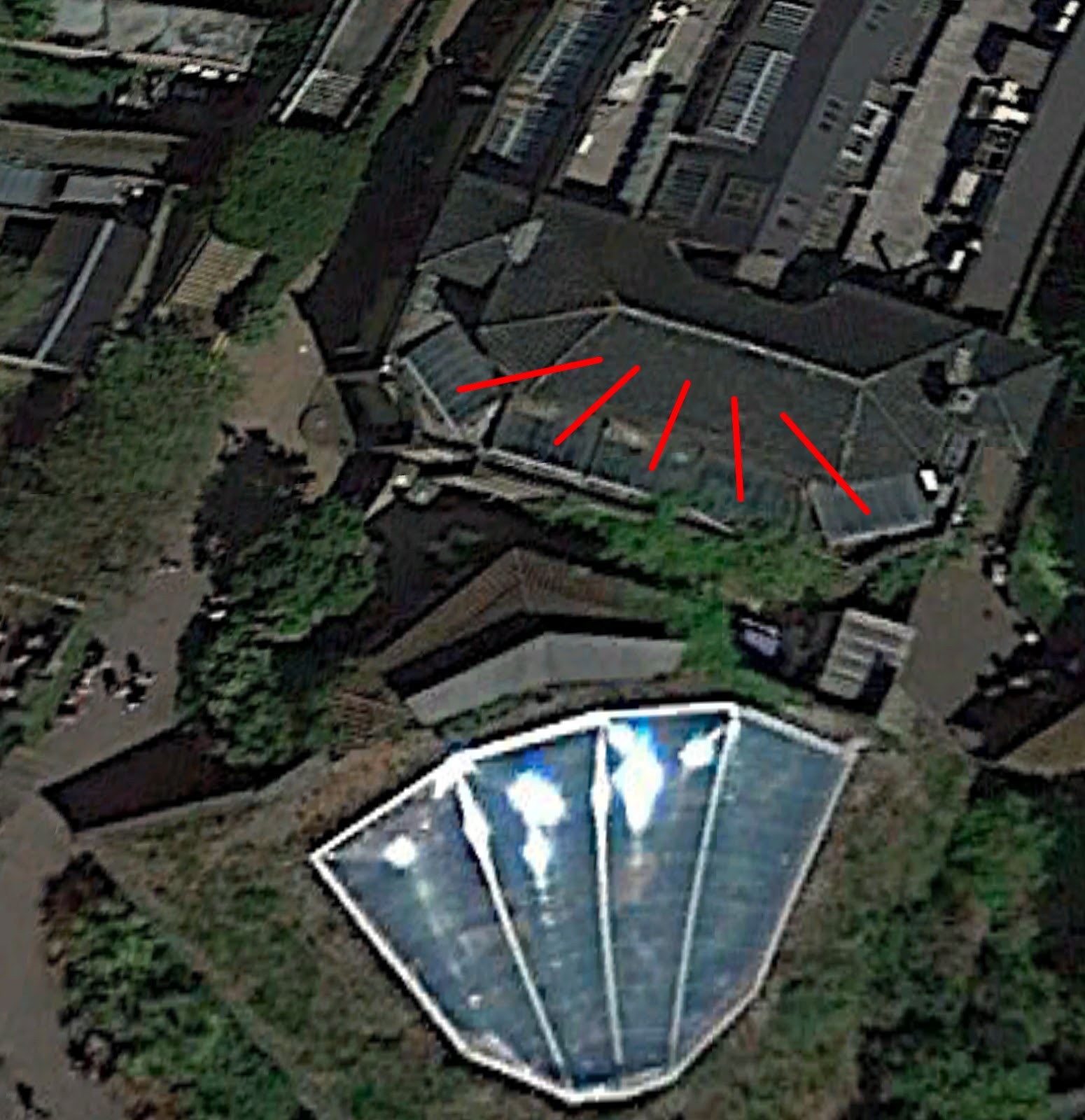
It is clear from contemporary diagrams that the Komodo Dragons were kept in the large enclosures at the southern end of the Reptile House, used, ever since I first went to the Zoo in the 1950s, to house crocodilians. Their glass roofs can be seen in Google Earth—just a short distance away from the new housing for Komodo Dragons.

This Google Earth View of the Reptile House shows the windows
above the cages where the Komodo Dragons were housed. Vita
glass was installed originally. Has it survived?
The new enclosure covered in plastic is the current housing
for Komodo Dragons

It is easy to criticise—ninety years after it opened—aspects of the Reptile House. The compartments for large snakes seem of the wrong proportions, for example. The domestic architect but President of RIBA, Guy (later Sir) Dawber (1861-1938), who took Joan Procter’s very detailed plans, made them buildable and added the external features seems to have missed a few tricks. The sides, especially the western elevation which forms one side of the alley between the equally depressing edge of the Mappin Terraces, are devoid of life. Guillery suggests the outward-facing cage on the eastern side (which often used to house interesting chelonians and is the only relief from the drabness) was inserted later. Dawber also designed—again from a detailed layout by Joan Procter and Chalmers Mitchell—the exterior of the nearby main entrance to the Zoo in the same Italianate style used by earlier architects. I sometimes wonder if Dawber took umbrage at the minor role he was accorded by the Chalmers Mitchell publicity machine; he did not attend the opening of the Reptile House.

But Joan Procter’s house was clearly a great leap forward for the Zoo. But there was still much to learn since reptiles and amphibians died in large numbers after importation. Even the best conditions will not reverse the effects of the stress of capture, storage in unsuitable accommodation and then long sea journeys at temperatures below the optimum together with under- and/or mal-nutrition. Real advances, other than air transport, in how to keep reptiles, other than the ‘easy’ species, would not come for another four or five decades.

I can't resist showing one of my photographs of these wild Komodo Dragons
taken in 2016


*These Komodo Dragons in New York seem to have been forgotten by historians. Their arrival in USA is usually given as 1934, Washington.

Guillery P. 1993. The Buildings of London Zoo. London: Royal Commission on the Historical Monuments of England.

Peaker M. 1969. Some aspects of the thermal requirements of reptiles in captivity. International Zoo Yearbook 9, 3-8. Zoological Society of London. London: Academic Press. 

Procter JB. 1928. On a living Komodo dragon Varanus komodoensis Ouwens, exhibited at the Scientific Meeting, 23 October 1928. Proceedings of the Zoological Society of London 1928, 1017–1019.

Monday, 15 October 2018

Joan Procter and Chalmers Mitchell: ‘Vita’ Glass at London Zoo in the 1920s

If you stand close to the small vivaria lining the western outer wall of London Zoo’s Reptile House and look upwards you will see daylight. Natural light was admitted as part of the design not because of any wish to save electricity but for the good of the inhabitants. The glass in the roof of the house and the vivaria was not ordinary glass but Vita, a glass of special composition to allow the transmission of rays at the ultraviolet end of the spectrum.


Entrance to the Reptile House, 2011
Photograph by William Hook via Wikimedia

Joan Procter’s inclusion of Vita glass was just one manifestation of the Zoo’s pioneering efforts, through Sir Peter Chalmers Mitchell FRS, to improve the health of zoo animals. In fact, he was riding the crest of a scientific and populist wave sweeping across the world in the inter-war years that can be summed up as: fresh air, sunshine and vitamins. The architect, John Stanislav Sadar has put the whole development of Vita glass in that context. In short, because ultraviolet rays were known to kill bacteria, and their importance in the synthesis of vitamin D was emerging, sunlight must be good for you. Put into the context of the industrial urban environment: poor housing; enormously high levels of air pollution, and the consequent human diseases of rickets, tuberculosis and chronic respiratory morbidity, it is hardly surprising that scientific, clinical,  social and commercial efforts combined to promote the outdoor life, sunshine and patent medicines.

In the 1920s it was known that ordinary glass blocked the transmission of ultraviolet rays in sunlight. Ergo, glass that would transmit ultraviolet would be healthier. To solve this problem, Francis Edward Everard Lamplough (1881-1975) appeared on the scene.


Whether Lamplough thought of the idea himself or was urged to try by scientists or others in the sunshine movement is not clear. This is what he had to say in his lecture to the Royal Society of Arts in 1929:

The scientific research involved was carried out with much encouragement from Professor Leonard Hill, and also from the authorities of the London Zoological Gardens, Dr Saleeby [Caleb Williams Saleeby, 1878-1940] and others, and early in 1925 the first full scale melting was made of window glass (designated “Vita”) pervious to the health rays.

Professor (later Sir) Leonard Erskine Hill FRS (1866-1952) was the scientific leader of the fresh air and sunshine movement. He was Director of Applied Physiology at the National Institute of Medical Research. Hill’s main interest was in using lamps that emitted in the ultraviolet or infrared to mimic the effect of sunlight on the body for therapy and prevention of rickets, for example. The Times (22 May 1928) carried the story of how Hill came to be involved:

Early in 1925 the Council of the Zoological Society of London had under consideration the construction of a new Monkey House. The existing house, built in 1864, provided no open-air cages and was arranged on the theory that artificial heat was the primary requirement for the health of these animals. Dr. Chalmers Mitchell, Secretary of the Society, had shown in 1911 by an elaborate study of the mortality statistics in the Zoo for a period of over 30 years, that health was better and the duration of life longer in monkeys (and most other warm-blooded creatures) kept with free access to the open air in all weathers and without artificial heat. Later observations showed that, although cold air was better than warm, stale air, good hygiene required also radiant heat and sunlight.
     It was decided before going to the expense of constructing a large new Monkey House to erect a small-scale experimental house in which the theoretically best conditions might be tried out during at least one winter. Fresh air and heat were easy to provide, and Dr. Leonard Hill, F.R.S., who had been working out proper, conditions for sickly children at the National Institute of Medical Research, Mount Vernon, Hampstead, and who had studied the conditions in the houses in the Gardens, described to Dr. Chalmers Mitchell the part played by ultra-violet rays. He advised the provision of electric light in globes of fused quartz which was almost, completely transparent to the health-giving rays. He also, informed him of certain laboratory experiments with a new form of glass, called “Vita” glass, which had not then been made on a commercial scale, but which was transparent to the ultra-violet rays of sunlight which were cut off by ordinary window glass. Dr. Mitchell, on behalf of the Zoological Society, commissioned the inventor of “Vita” glass to make a sufficient quantity to glaze the experimental house.
     The usual difficulties in the change from laboratory to manufacturing scale arose, but were surmounted, and the Zoo's experimental house was the first building to be provided with “Vita" glass. Spectroscopic examination showed the transparence of the new material to ultra-violet rays, and the effect on the animals was so good that the Lion House and the new Reptile House, and, later, the full-size new Monkey House, were all lighted with “Vita” glass with complete success in every case, as shown by the better health and better spirits of the animals.
Sir Leonard Erskine Hill (1866-1952) in 1934
Bassano Ltd. National Portrait Gallery


I have been able to find surprisingly little about Lamplough. Educated at Oundle and Cambridge he was awarded a First in Natural Sciences in 1904. Elected a Fellow of Trinity College in 1906, he also served as Additional Demonstrator in Chemistry between 1914 and 1917. He married Augusta Gertrude Stewart in 1907. At the start of the Second World War, he was working at the Royal Aircraft Establishment, Farnborough. He died in 1975 at Woodchester, Stroud, Gloucestershire. During the work on Vita glass he is described as Late Fellow of Trinity College, Cambridge. My impression is that he was working for Chance Brothers, the famous makers of glass and lighthouses (he had patents for a gas valve used in lighthouses in 1920-21), throughout this period though perhaps not as an employee but as an independent inventor or consultant. He was also the inventor (The Times 22 May 1928) of the artificial daylight ‘Daylamp’ and a glare filter for Chance.

Lamplough’s development of a low iron content glass that transmits in the ultraviolet range depended on the findings of Sir William Crookes that oxidised ferric iron absorbs, whereas ferrous iron transmits, ultraviolet. The Chance works would have been highly familiar with Crookes’s work since they were responsible for developing and manufacturing special ultraviolet-blocking glass. 


Spectrographs showing the transmission through Vita compared with
ordinary window glass. From Lamplough's RSA paper


The Times 22 May 1928


After the installation of Vita glass at the Zoo, the New Health Society (i.e. Hill et al.) and Saleeby’s Sunlight League promoted its use in hospitals, schools, farms and greenhouses. The Times (25 April 1933) reported that Vita glass had been installed at Clifton College in Bristol and (3rd October 1929) on a veranda roof at a hospital.


Advertisements in The Times in 1928 and 1932


When Marlborough House was being prepared for occupation by the then Prince of Wales The Times (8 November 1927) reported that his ‘business room’ was glazed with Vita. Perhaps that’s why he had the energy to pursue Mrs Simpson. Domestic houses were also targeted for sales. Indeed, those involved saw it capturing the entire market for window glass. But that optimism was not justified. Production ceased in the 1930s and stocks were gradually sold off. What went wrong?

The reasons for the rapid decline in sales of Vita glass are a mixture of doubts over efficacy, errors made in the commercial arrangements for manufacturing and marketing, price and competition. Although Lamplough dealt with the technical problems in his lecture in 1929, namely, the early, rapid but partial loss of transmission of ultraviolet when Vita glass was exposed to sunlight and the problems of dirt and grime settling on the glass, doubts remained, apparently, on its efficacy under natural conditions on buildings.

The manufacture and marketing arrangements, described by Sadar, must be an object lesson in how not to do it for business students. Chance Brothers sub-licensed* Vita plate-glass manufacture to Pilkingtons; marketing for both companies was done jointly by the ‘Vita’ Glass Marketing Board which not only caused problems for the marketing departments of the two companies but also inadvertently advanced the cause of rival and better products appearing on the world market. Tests in the U.S.A. showed that Corning’s Corex glass allowed much greater transmission of ultraviolet than Vita. I do not know if Lamplough, or the two British glass manufacturers, tried to improve his glass as better glasses appeared. Finally, there was the price which Sadar estimates as six times more expensive than ordinary window glass. In the relatively affluent 1920s installing Vita might have been seen as ‘the’ thing to have by the worried unwell (like the silly ‘health’ foods of the 2010s) or public bodies trying to improve the health of schoolchildren but by the economically depressed 1930s specifying or choosing an expensive window glass would have been a different matter. A few minutes’ exposure to natural sunlight was of course more effective in synthesising vitamin D  than hours spent behind a Vita glass window.

All the promotion of the health-promoting properties of ultraviolet ignored the growing evidence of the dangers of excessive exposure of the skin and eyes, much of it provided by Hill!. But by the 1930s such actual or possible deleterious effects of the more extreme examples of therapy by sunlight were being recognised and the medical craze of the 1920s began to fade away, to be replaced by vitamin supplementation and the careful use of high-intensity sunray lamps. In most domestic and public spaces we can only be thankful that ordinary window glass is impermeable to the ultraviolet end of the spectrum unless, of course, we fancy a getting a suntan behind the privacy of our french windows.

Two questions remain on Joan Procter’s Reptile House. The first is whether or not sufficient ultraviolet rays reached the inhabitants for the synthesis of Vitamin D. Looking at the technological solutions now applied to vivaria to supply sufficient ultraviolet to many reptiles in captivity I doubt it. The second is whether any of the Vita glass on and in the Reptile House has survived (the less than successful Monkey House was fortunately demolished in 1970 as was the Lion House). If it has, then there is a solution to the first question since the natural ultraviolet irradiance in the vivaria can be measured. However, also installed in the Reptile House were some of Hill’s ultraviolet and infrared lamps. Vita glass was also used in a very different role to that in the windows—as a cover the quartz (ultraviolet emitting lamps) lamps to shield out the short wavelengths which had proved fatal to lizards.


Original layout of the Reptile House. Only at the two ends of the building have there been changes
in inhabitants. The Times 15 June 1927


Successful in the Reptile House or not, the installation of Vita glass shows the determination of Chalmers Mitchell and Joan Procter to make London Zoo part of the movement to improve living conditions for all inhabitants of industrial Britain in the early decades of the 20th Century and to bring scientific advances to bear on problems of wild animal husbandry. As far as the Zoological Society is concerned the culmination of the fresh air and sunlight school was the opening of Whipsnade Zoo in Bedfordshire on 23 May 1931, four months before Joan Procter’s death.

*I have been unable to find any patent by Lamplough on Vita glass. Chance probably relied on protection by know-how rather than releasing the formula in a patent.

†Those aware of Chalmers Mitchell’s other jobs will realise that the reports ON him for The Times were probably written BY him as science correspondent for that newspaper.

Sadar JS. 2012. ‘Vita’ glass and the discourse of modern culture. In, Writing Design, edited by G Lees-Maffei, pp103-117. London: Berg.

Lamplough FE [he often omitted the second E). 1929. The properties and applications of “Vita” glass. Journal of the Royal Society of Arts 77, 799-811.