Showing posts with label Reptile House. Show all posts

Sunday, 4 November 2018

Joan Procter. Her Reptile House at London Zoo and Reptilian Thermoregulation

It is only when one reads the detail of Joan Procter’s Reptile House at London Zoo that one realises she was decades ahead of her time in terms of knowledge of the thermal requirements of reptiles. The Reptile House opened in June 1927. Apart from its ‘aquarium-principle’ lighting, crowd circulation and safe-handling area for venomous snakes, the spectra of both natural and artificial lighting were specified while additional heat was supplied to different places of the cages thus creating a temperature gradient which allowed the animals to bask and raise their body temperature above that of their surroundings.

In Joan Procter’s own words when describing how the Komodo Dragons were housed and how they had lived in the new Reptile House for 18 months:

They live in a large enclosure of natural shingle and soil, planted with living palm-trees, and provided with a cave, rocks, and a swimming-pool. A great deal of care has been exercised to provide proper climatic conditions. The roof is of Vita-glass, transparent to ultra-violet light, and Vita-lamps for artificial sunlight are installed together with two large flood-light lamps. Dull-heat radiators of the beam type are also fixed, and all this apparatus, which is invisible to the public. is protected by massive steel bars. Further, the rocks themselves are electrically heated with a type of black-heat radiator let into the actual rock, and controlled, together with the air-heaters by a thermostat, which in turn is governed by a fool-proof warning system. The light and heat are chiefly focussed on a large rock in the centre of the enclosure, and, as the dragons immediately discovered this, they are usually to be seen sunning themselves upon it.

Those who know anything about reptiles will recognise this as a throughly modern way of keeping lizards. As I pointed out in a previous article the Vita glass was to let ultraviolet rays in sunlight reach the animals. Her ‘Vita-lamps’ were actually ultraviolet-emitting lamps with Vita glass filters to block just the very short wavelengths which experiments had determined were deleterious.

Previously, reptiles kept in temperate climates were kept in accommodation heated to the temperature of a tropical shade environment. Most had no opportunity to bask and raise their temperature above the ambient. The science of thermoregulation in reptiles really only took off in the 1940s and the concepts like ‘preferred body temperature’ and  ‘behavioural thermoregulation’ developed. Thus while reptiles are indeed cold-blooded they were found able to maintain body temperatures above that of their surroundings during the hours of daylight by shuttling between the heat of the sun and the relative cool of the shade. Komodo Dragons have been shown, comparatively recently, to follow that pattern.

The preferred body temperature was later shown to be that which is optimal for biochemical processes within the body. Reptiles not allowed to achieve their preferred body temperature, even though kept in warm ‘tropical’ daytime air temperatures, were function sub-optimally. It is not surprising that such animals are lethargic, their immune system left unable to cope with infection and infestation, do not breed—and do not survive for very long. Reptiles, particularly larger ones, take a long time to die.

Joan Procter was aware that she had designed accommodation for Komodo Dragons that was superior to that elsewhere. She quoted from William Douglas Burden’s book Dragon Lizards of Komodo (see my article on the Burden expedition to Komodo here):

     …We hear of specimens taken to New York* that “it was painful to see the broken spirited beasts that barely had strength to drag themselves from one end of their cage to the other.”     ‘’"SureIy it is not all a matter of diet and change of climate... Perhaps…Varanus komodoensis, in order to survive, demands the freedom of his rugged mountains.” ...,but our specimens are perfectly happy in captivity, are attached to their keepers and their friends, and are putting on a great deal of weight.

I think we can take that as London 2: New York 0, 1928 style.

This photograph of a small boy and a Komodo Dragon may have been
taken in the original accommodation in the Reptile House in London
Zoo in 1932. Joan Procter and the keepers always seemed keen
to demonstrate how tame the Dragons had become

The heating and lighting equipment was not ‘off the shelf’. The General Electric Company Ltd (not to be confused with the American company of the same name) had research and development labs at Wembley. The Times (15 June 1927) in describing the new house reported:

The very elaborate electrical installation devised by the Research Department of the General Electric Company to meet the special requirements forms an achievement in electrical installation which is unique, and cannot be described in detail here. It may be said, however, that the installation has approximately 20 miles of electric cable for the heating system and 12 miles for the indicators and tell-tales, and that some of the compartments have up to 200 electrical connexions. The wiring for lighting is almost equally elaborate.

Miss Procter wanted material for the walls that could be cleaned. She therefore had the theatrical scenic artist, John Bull, use car enamel that would be resistant to scrubbing. I cannot find a photograph of any of the scenes painted on the walls of the cages—perhaps a good job since I utterly loathe naturalistic painted backgrounds.

It is clear from contemporary diagrams that the Komodo Dragons were kept in the large enclosures at the southern end of the Reptile House, used, ever since I first went to the Zoo in the 1950s, to house crocodilians. Their glass roofs can be seen in Google Earth—just a short distance away from the new housing for Komodo Dragons.
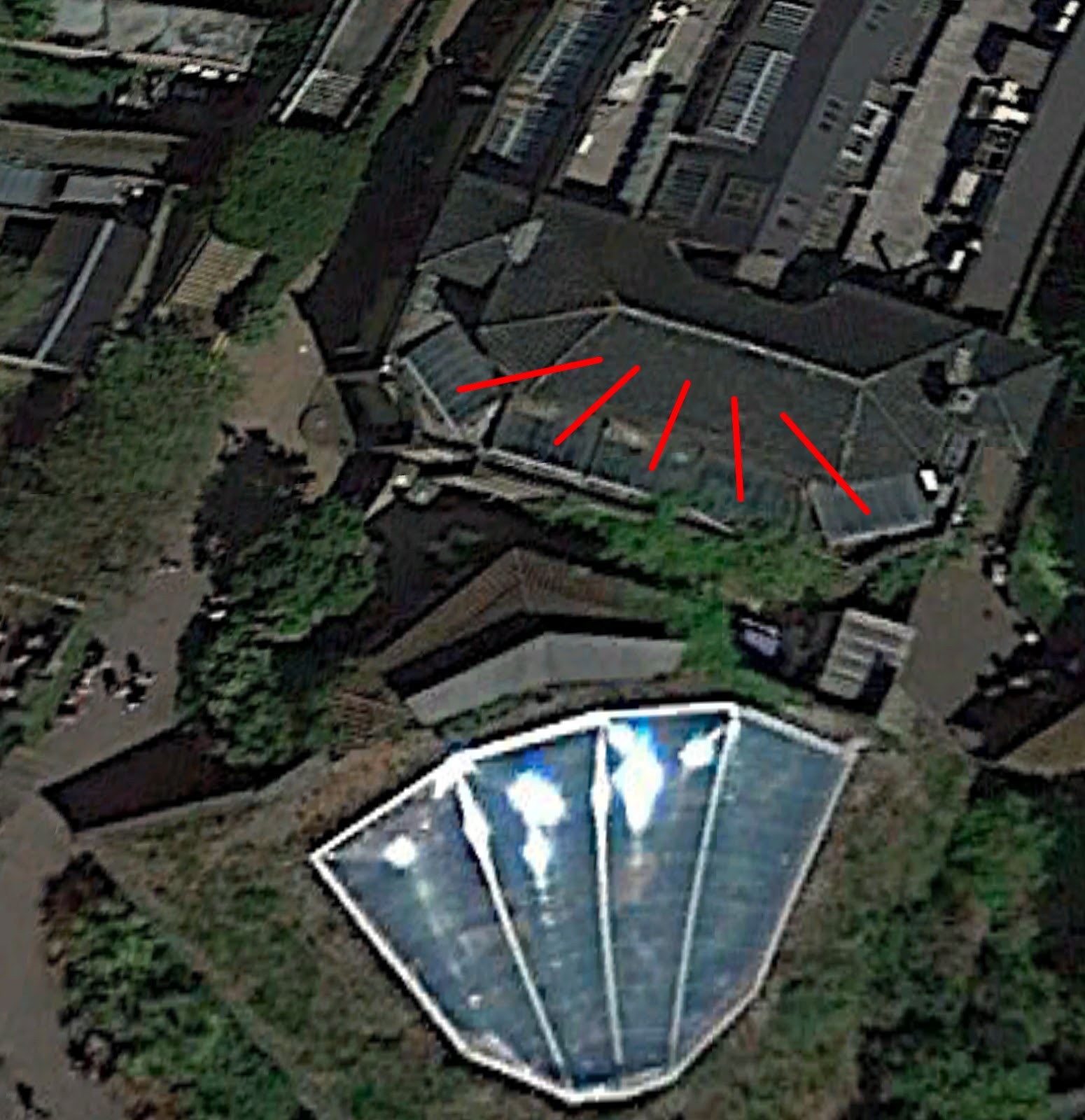
This Google Earth View of the Reptile House shows the windows
above the cages where the Komodo Dragons were housed. Vita
glass was installed originally. Has it survived?
The new enclosure covered in plastic is the current housing
for Komodo Dragons

It is easy to criticise—ninety years after it opened—aspects of the Reptile House. The compartments for large snakes seem of the wrong proportions, for example. The domestic architect but President of RIBA, Guy (later Sir) Dawber (1861-1938), who took Joan Procter’s very detailed plans, made them buildable and added the external features seems to have missed a few tricks. The sides, especially the western elevation which forms one side of the alley between the equally depressing edge of the Mappin Terraces, are devoid of life. Guillery suggests the outward-facing cage on the eastern side (which often used to house interesting chelonians and is the only relief from the drabness) was inserted later. Dawber also designed—again from a detailed layout by Joan Procter and Chalmers Mitchell—the exterior of the nearby main entrance to the Zoo in the same Italianate style used by earlier architects. I sometimes wonder if Dawber took umbrage at the minor role he was accorded by the Chalmers Mitchell publicity machine; he did not attend the opening of the Reptile House.

But Joan Procter’s house was clearly a great leap forward for the Zoo. But there was still much to learn since reptiles and amphibians died in large numbers after importation. Even the best conditions will not reverse the effects of the stress of capture, storage in unsuitable accommodation and then long sea journeys at temperatures below the optimum together with under- and/or mal-nutrition. Real advances, other than air transport, in how to keep reptiles, other than the ‘easy’ species, would not come for another four or five decades.

I can't resist showing one of my photographs of these wild Komodo Dragons
taken in 2016


*These Komodo Dragons in New York seem to have been forgotten by historians. Their arrival in USA is usually given as 1934, Washington.

Guillery P. 1993. The Buildings of London Zoo. London: Royal Commission on the Historical Monuments of England.

Peaker M. 1969. Some aspects of the thermal requirements of reptiles in captivity. International Zoo Yearbook 9, 3-8. Zoological Society of London. London: Academic Press. 

Procter JB. 1928. On a living Komodo dragon Varanus komodoensis Ouwens, exhibited at the Scientific Meeting, 23 October 1928. Proceedings of the Zoological Society of London 1928, 1017–1019.

Monday, 15 October 2018

Joan Procter and Chalmers Mitchell: ‘Vita’ Glass at London Zoo in the 1920s

If you stand close to the small vivaria lining the western outer wall of London Zoo’s Reptile House and look upwards you will see daylight. Natural light was admitted as part of the design not because of any wish to save electricity but for the good of the inhabitants. The glass in the roof of the house and the vivaria was not ordinary glass but Vita, a glass of special composition to allow the transmission of rays at the ultraviolet end of the spectrum.


Entrance to the Reptile House, 2011
Photograph by William Hook via Wikimedia

Joan Procter’s inclusion of Vita glass was just one manifestation of the Zoo’s pioneering efforts, through Sir Peter Chalmers Mitchell FRS, to improve the health of zoo animals. In fact, he was riding the crest of a scientific and populist wave sweeping across the world in the inter-war years that can be summed up as: fresh air, sunshine and vitamins. The architect, John Stanislav Sadar has put the whole development of Vita glass in that context. In short, because ultraviolet rays were known to kill bacteria, and their importance in the synthesis of vitamin D was emerging, sunlight must be good for you. Put into the context of the industrial urban environment: poor housing; enormously high levels of air pollution, and the consequent human diseases of rickets, tuberculosis and chronic respiratory morbidity, it is hardly surprising that scientific, clinical,  social and commercial efforts combined to promote the outdoor life, sunshine and patent medicines.

In the 1920s it was known that ordinary glass blocked the transmission of ultraviolet rays in sunlight. Ergo, glass that would transmit ultraviolet would be healthier. To solve this problem, Francis Edward Everard Lamplough (1881-1975) appeared on the scene.


Whether Lamplough thought of the idea himself or was urged to try by scientists or others in the sunshine movement is not clear. This is what he had to say in his lecture to the Royal Society of Arts in 1929:

The scientific research involved was carried out with much encouragement from Professor Leonard Hill, and also from the authorities of the London Zoological Gardens, Dr Saleeby [Caleb Williams Saleeby, 1878-1940] and others, and early in 1925 the first full scale melting was made of window glass (designated “Vita”) pervious to the health rays.

Professor (later Sir) Leonard Erskine Hill FRS (1866-1952) was the scientific leader of the fresh air and sunshine movement. He was Director of Applied Physiology at the National Institute of Medical Research. Hill’s main interest was in using lamps that emitted in the ultraviolet or infrared to mimic the effect of sunlight on the body for therapy and prevention of rickets, for example. The Times (22 May 1928) carried the story of how Hill came to be involved:

Early in 1925 the Council of the Zoological Society of London had under consideration the construction of a new Monkey House. The existing house, built in 1864, provided no open-air cages and was arranged on the theory that artificial heat was the primary requirement for the health of these animals. Dr. Chalmers Mitchell, Secretary of the Society, had shown in 1911 by an elaborate study of the mortality statistics in the Zoo for a period of over 30 years, that health was better and the duration of life longer in monkeys (and most other warm-blooded creatures) kept with free access to the open air in all weathers and without artificial heat. Later observations showed that, although cold air was better than warm, stale air, good hygiene required also radiant heat and sunlight.
     It was decided before going to the expense of constructing a large new Monkey House to erect a small-scale experimental house in which the theoretically best conditions might be tried out during at least one winter. Fresh air and heat were easy to provide, and Dr. Leonard Hill, F.R.S., who had been working out proper, conditions for sickly children at the National Institute of Medical Research, Mount Vernon, Hampstead, and who had studied the conditions in the houses in the Gardens, described to Dr. Chalmers Mitchell the part played by ultra-violet rays. He advised the provision of electric light in globes of fused quartz which was almost, completely transparent to the health-giving rays. He also, informed him of certain laboratory experiments with a new form of glass, called “Vita” glass, which had not then been made on a commercial scale, but which was transparent to the ultra-violet rays of sunlight which were cut off by ordinary window glass. Dr. Mitchell, on behalf of the Zoological Society, commissioned the inventor of “Vita” glass to make a sufficient quantity to glaze the experimental house.
     The usual difficulties in the change from laboratory to manufacturing scale arose, but were surmounted, and the Zoo's experimental house was the first building to be provided with “Vita" glass. Spectroscopic examination showed the transparence of the new material to ultra-violet rays, and the effect on the animals was so good that the Lion House and the new Reptile House, and, later, the full-size new Monkey House, were all lighted with “Vita” glass with complete success in every case, as shown by the better health and better spirits of the animals.
Sir Leonard Erskine Hill (1866-1952) in 1934
Bassano Ltd. National Portrait Gallery


I have been able to find surprisingly little about Lamplough. Educated at Oundle and Cambridge he was awarded a First in Natural Sciences in 1904. Elected a Fellow of Trinity College in 1906, he also served as Additional Demonstrator in Chemistry between 1914 and 1917. He married Augusta Gertrude Stewart in 1907. At the start of the Second World War, he was working at the Royal Aircraft Establishment, Farnborough. He died in 1975 at Woodchester, Stroud, Gloucestershire. During the work on Vita glass he is described as Late Fellow of Trinity College, Cambridge. My impression is that he was working for Chance Brothers, the famous makers of glass and lighthouses (he had patents for a gas valve used in lighthouses in 1920-21), throughout this period though perhaps not as an employee but as an independent inventor or consultant. He was also the inventor (The Times 22 May 1928) of the artificial daylight ‘Daylamp’ and a glare filter for Chance.

Lamplough’s development of a low iron content glass that transmits in the ultraviolet range depended on the findings of Sir William Crookes that oxidised ferric iron absorbs, whereas ferrous iron transmits, ultraviolet. The Chance works would have been highly familiar with Crookes’s work since they were responsible for developing and manufacturing special ultraviolet-blocking glass. 


Spectrographs showing the transmission through Vita compared with
ordinary window glass. From Lamplough's RSA paper


The Times 22 May 1928


After the installation of Vita glass at the Zoo, the New Health Society (i.e. Hill et al.) and Saleeby’s Sunlight League promoted its use in hospitals, schools, farms and greenhouses. The Times (25 April 1933) reported that Vita glass had been installed at Clifton College in Bristol and (3rd October 1929) on a veranda roof at a hospital.


Advertisements in The Times in 1928 and 1932


When Marlborough House was being prepared for occupation by the then Prince of Wales The Times (8 November 1927) reported that his ‘business room’ was glazed with Vita. Perhaps that’s why he had the energy to pursue Mrs Simpson. Domestic houses were also targeted for sales. Indeed, those involved saw it capturing the entire market for window glass. But that optimism was not justified. Production ceased in the 1930s and stocks were gradually sold off. What went wrong?

The reasons for the rapid decline in sales of Vita glass are a mixture of doubts over efficacy, errors made in the commercial arrangements for manufacturing and marketing, price and competition. Although Lamplough dealt with the technical problems in his lecture in 1929, namely, the early, rapid but partial loss of transmission of ultraviolet when Vita glass was exposed to sunlight and the problems of dirt and grime settling on the glass, doubts remained, apparently, on its efficacy under natural conditions on buildings.

The manufacture and marketing arrangements, described by Sadar, must be an object lesson in how not to do it for business students. Chance Brothers sub-licensed* Vita plate-glass manufacture to Pilkingtons; marketing for both companies was done jointly by the ‘Vita’ Glass Marketing Board which not only caused problems for the marketing departments of the two companies but also inadvertently advanced the cause of rival and better products appearing on the world market. Tests in the U.S.A. showed that Corning’s Corex glass allowed much greater transmission of ultraviolet than Vita. I do not know if Lamplough, or the two British glass manufacturers, tried to improve his glass as better glasses appeared. Finally, there was the price which Sadar estimates as six times more expensive than ordinary window glass. In the relatively affluent 1920s installing Vita might have been seen as ‘the’ thing to have by the worried unwell (like the silly ‘health’ foods of the 2010s) or public bodies trying to improve the health of schoolchildren but by the economically depressed 1930s specifying or choosing an expensive window glass would have been a different matter. A few minutes’ exposure to natural sunlight was of course more effective in synthesising vitamin D  than hours spent behind a Vita glass window.

All the promotion of the health-promoting properties of ultraviolet ignored the growing evidence of the dangers of excessive exposure of the skin and eyes, much of it provided by Hill!. But by the 1930s such actual or possible deleterious effects of the more extreme examples of therapy by sunlight were being recognised and the medical craze of the 1920s began to fade away, to be replaced by vitamin supplementation and the careful use of high-intensity sunray lamps. In most domestic and public spaces we can only be thankful that ordinary window glass is impermeable to the ultraviolet end of the spectrum unless, of course, we fancy a getting a suntan behind the privacy of our french windows.

Two questions remain on Joan Procter’s Reptile House. The first is whether or not sufficient ultraviolet rays reached the inhabitants for the synthesis of Vitamin D. Looking at the technological solutions now applied to vivaria to supply sufficient ultraviolet to many reptiles in captivity I doubt it. The second is whether any of the Vita glass on and in the Reptile House has survived (the less than successful Monkey House was fortunately demolished in 1970 as was the Lion House). If it has, then there is a solution to the first question since the natural ultraviolet irradiance in the vivaria can be measured. However, also installed in the Reptile House were some of Hill’s ultraviolet and infrared lamps. Vita glass was also used in a very different role to that in the windows—as a cover the quartz (ultraviolet emitting lamps) lamps to shield out the short wavelengths which had proved fatal to lizards.


Original layout of the Reptile House. Only at the two ends of the building have there been changes
in inhabitants. The Times 15 June 1927


Successful in the Reptile House or not, the installation of Vita glass shows the determination of Chalmers Mitchell and Joan Procter to make London Zoo part of the movement to improve living conditions for all inhabitants of industrial Britain in the early decades of the 20th Century and to bring scientific advances to bear on problems of wild animal husbandry. As far as the Zoological Society is concerned the culmination of the fresh air and sunlight school was the opening of Whipsnade Zoo in Bedfordshire on 23 May 1931, four months before Joan Procter’s death.

*I have been unable to find any patent by Lamplough on Vita glass. Chance probably relied on protection by know-how rather than releasing the formula in a patent.

†Those aware of Chalmers Mitchell’s other jobs will realise that the reports ON him for The Times were probably written BY him as science correspondent for that newspaper.

Sadar JS. 2012. ‘Vita’ glass and the discourse of modern culture. In, Writing Design, edited by G Lees-Maffei, pp103-117. London: Berg.

Lamplough FE [he often omitted the second E). 1929. The properties and applications of “Vita” glass. Journal of the Royal Society of Arts 77, 799-811.