Even before the function of the nasal glands was discovered by Knut Schmidt-Nielsen in the late 1950s, the comparative anatomists and palaeontologists had been at work. Brian John Marples (1907-1997) in 1932 examined the skulls of the extinct birds Hesperornis and Ichthyornis. He found large depressions above the eye indicating the presence of supraorbital nasal glands. Hesperornis was a large flightless bird that lived in a marine environment; Ichthyornis was also a sea bird about the size of a pigeon*. Both are from the Late Cretaceous (63.5-78 million years ago).

A very recent paper from workers in China and the USA describes the finding of supraorbital depressions in the skull of Iteravis, a bird from the 40 million years earlier, i.e of the Early Cretaceous. The fossil is from Liaoning in north-eastern China.
 |
| From Wang et al. 2018 |
The authors studied even earlier fossils than Iteravis on the dinosaur-bird line and could find no evidence for the presence of supraorbital glands. However, I cannot agree with the authors in accepting the lack of supraorbital glands as evidence for the absence of salt glands in very early birds, their dinosaurs ancestors or other contemporary early birds. Yes, many modern birds with salt glands have them in the supraorbital position: but many do not.
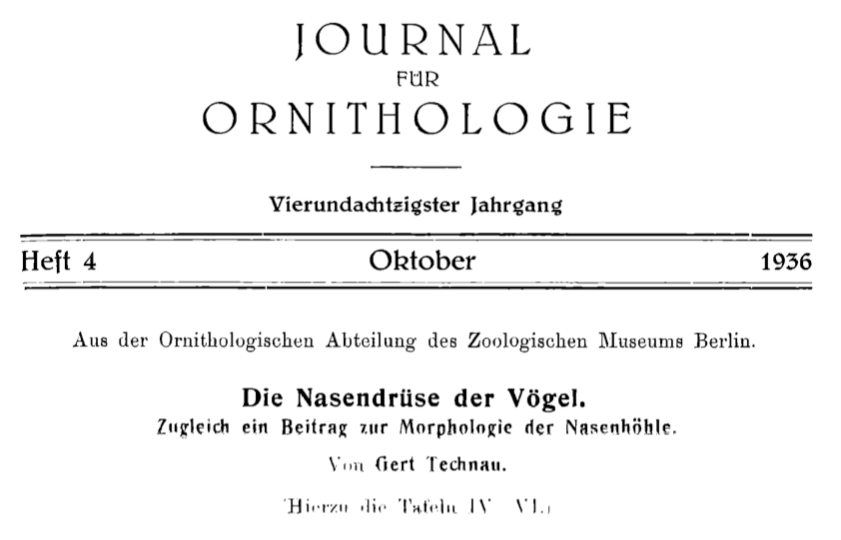
Gerhard Technau in Berlin made an extensive comparative study of the nasal glands of birds. His paper, published in 1936, is over 100 pages long. When, in 1975, we compared Technau’s findings with a list of birds known to have functional salt glands, we found that salt glands are not always in the supraorbital position. These early studies have been confirmed more recently. The salt gland in gannets, boobies, cormorants, shags, and pelicans, for example, are situated within the roof of the orbit; depressions in the bone are found there.
 |
| We used Technau's diagram for our book in 1975. We stuck with Technau's nomenclature but the sharp-eyed will notice his terminology is incorrect. His 'interorbital' (i.e. between the orbits) should be 'intraorbital' (within the orbit). |
Thus it is entirely possible that other early birds, as well as their dinosaur ancestors, had salt glands as well as those leaving evidence of supraorbital nasal glands in their fossilised remains.
The new paper is:
Wang X, Huang J, Hu Y, Liu X, Peteya J, Clarke JA. 2018. The earliest evidence for a supraorbital salt gland in dinosaurs in new Early Cretaceous ornithurines. Scientific Reports 8:3969 | DOI:10.1038/s41598-018-22412-8. Note - two - and I have only checked two - of the references given in this paper are incorrect.
Other references
Technau G. 1936. Die Nasendrüse der Vögel. Zugleich ein Beitrag zur Morphologie der Nasenhöhle. Journal für Ornithologie 84, 511-617.
( I have been able to find nothing about Technau nor his other work.)
Siegel-Causey D. 1990. Phylogenetic patterns of size and shape of the nasal gland depression in Phalacrocoridae. The Auk 107, 110-118.
Marples BJ. Structure and development of nasal glands in birds. Proceedings of the Zoological Society of London (1932), 829-844.
Peaker M, Linzell JL. 1975. Salt Glands in Birds and Reptiles. Cambridge: Cambridge University Press.
*Relevant here is the recent work on using knowledge of the structure of nasal salt glands to infer what was happening in extinct birds has appeared so far only as an abstract:
Caggiano EG, Cerio D, Porter R, Ridgely RC, Witmer LM. 2017. The nasal salt gland of extant birds: anatomical structure and its relevance for inferring the behavior and habitat preferences of extinct birds. FASEB Journal 81, Abstract 579.5.
