Tuesday, 5 March 2024

Hong Kong: Yellow-cheeked Tit

 AJP spotted Yellow-cheeked Tits (Machlolophus spilonotus) in the New Territories of Hong Kong last week. They are marked in the Hong Kong bird book as an uncommon resident, but also of captive origin. I am always suspicious of that latter label since the bird is known to occur across China not that far to the north. The habitat - mature woodland - would not have been available for many decades at least. Photographs from the early decades of the 20th century show a far more denuded landscape and with the use of anything for firewood during and immediately after the Japanese occupation, mature woodland was very sparse indeed. Re-introduction by artifical (i.e. the cage bird market) or natural (i.e. range expansion) means would seem a better term.

Whatever the origins of the present population, it is a stunning little bird.


Miss Waldron’s Red Colobus. Its role in understanding Yellow Fever

Willoughby Lowe in The End of the Trail noted that it was on their second visit to Goaso (i.e. during the 1934-35 expedition to Gold Coast) that blood samples were obtained from the specimens of monkeys they shot, including Miss Waldron’s Red Colobus. He wrote:

…the blood sample of the new monkey, brought home by my companion for Dr. Findlay, of the Wellcome Bureau of Scientific Research.

The importance of this sample is that it contained antibodies to yellow fever, indicating that at some stage of its life it had been infected. Blood they collected from specimens of other species contained no antibodies against yellow fever.  Such research was a beginning to the understanding of the role of asymptomatic non-human primates as reservoir species for the virus in Africa and the complex interactions between populations of insect vectors, human and non-human primates.

Miss Waldron’s Red Colobus thus found its way into the classic texts on yellow fever.

Does Lowe’s mention of  Fannie Waldron ‘my companion’ indicate merely that she delivered the phials to Findlay or that she was responsible for their collection and treatment? Did, I wonder, Findlay have some sort of standing arrangement with the Natural History Museum, asking collectors to obtain serum samples from mammals living in yellow fever areas?

The two papers of interest by Findlay and several co-workers are behind an Elsevier paywall. However, the gist is that Findlay with collaborators from the Pasteur Institute in Paris and the Liverpool School of Tropical Medicine’s laboratory in Sierra Leone, in a preliminary papers published in the Transactions of the Royal Society of Tropical Medicine and Hygiene in January 1936, reported antibodies in a Chimpanzee, a baboon and the red colobus. A later paper showed that Findlay with a colleague at the Wellcome had obtained further blood samples from the Gold Coast, this time obtained by two medical men and George Soper Cansdale (1909-1993), then a forestry officer and part-time naturalist.

George William Marshall Findlay
Photograph by Bassano
Wellcome Collection

George William Marshall Findlay (1893-1952) was at the forefront of research on yellow fever in the British Empire. While a medical student in Edinburgh he immediately volunteered as a medical assistant with the Belgian Army. For that he received an award from Belgium in 1914. He then graduated in 1915 and on 24 December was commissioned as ’temporary Surgeon in His Majesty’s Fleet’ in the words of the London Gazette. After the war, he held medical research fellowships and was then appointed as assistant pathologist to the Edinburgh Royal Infirmary. In Edinburgh he acquired both an MD to (with gold medal), and a DSc. (there was no PhD then, and the DSc in Scottish universities was very different to that awarded today). After a spell at the Imperial Cancer Research Fund he joined  the Wellcome Bureau of Scientific Research and began research into tropical viral diseases, including yellow fever in the field in Gambia. He wrote Advances in Chemotherapy in 1930, that term being used for chemical treatment of all diseases, infectious as well as non-infectious. During the second world war he was brought into the Royal Army Medical Corps to investigate yellow fever in Sudan and trench fever in Tunis and by 1942 was a Brigadier in the West Africa Command.

Findlay received civil honours for his work on yellow fever. He left Wellcome in 1948 to join the staff of the British Medical Association to become editor of two abstracting journals: Abstracts of World Medicine and Abstracts of World Surgery, Obstetrics and Gynaecology. He had wide interests including microscopy and in 1950 was elected became President of the Royal Microscopical Society. 

Findlay GM, Stefanopoulo GJ, Davey TH, Mahaffy AF. 1936. Transactions of the Royal Society of Tropical Medicine and Hygiene 29, 419-424.

Findlay GM, MacCallum FO. 1937. Yellow fever immune bodies in the blood of African primates. Transactions of the Royal Society of Tropical Medicine and Hygiene 31, 103-106.


Friday, 1 March 2024

Miss Waldron’s Red Colobus. The Lowe-Waldron specimens were NOT the first to reach London’s Natural History Museum


From McGraw 2005

Willoughby Lowe’s entry in the Eponym Dictionary of Mammals has a couple of unkind sentences:

He is also notorious for having shot eight specimens of Miss Waldron’s Red Colobus Piliocolobus badius waldroni in Ghana in 1933…The colobus was already rare and is now thought to be extinct. 

There is no evidence that in the 1930s where suitable forest remained the red colobus it was rare. Indeed in the 1970s large troupes were observed. Lowe did warn—correctly—that further loss of forest would have devastating effects on it and other species. In addition, providing series of specimens was exactly what the Museum instructed collectors to do since it was realised that it is important to study variation between individuals from the same location. Lowe’s specimens (12, not 8, are shown in the catalogue) were joined later by 26 collected by Angus Booth (1927-1958) (on whom more in a future article) who was warning even more vociferously about the dangers of deforestation which was proceeding apace and the ease of hunting the red colobus for meat.

Willoughby Lowe clearly believed that he and Fannie Waldron had discovered the monkey named for Miss Waldron. However, looking at the catalogue of the Natural History Museum that was not the case. Two had arrived more than 20 years earlier.

The job of sorting the collection of mammals brought back by Lowe and Waldron in 1934 and 1935 from the Gold Coast (Ghana) was given by Martin Hinton, who was in charge of mammals, to Robert William Hayman (1905-1985). Hayman made a mistake in the introduction to his paper. He had just Lowe on the 1933-34 expedition with Miss Waldron also present in 1934-35. That is incorrect. Waldron and Lowe travelled together on both.

Hayman named the red colobus as a new subspecies, Colobus badius waldroni. In his description he compared these specimens from Goaso with the nominate subspecies:

A red Colobus closely related to the Liberia and Sierra Leone form, Colobus badius badius Kerr, but differing in the distribution of the black in the pelage. In true badius the black extends from the front of the forehead back over head, neck, shoulders, and upper arms, all the back, and thence on to the outer side of the thighs as far as the knee. The black on the outside of the thighs extends behind to meet the white perineal area. The tail is dark reddish on the basal half, darkening to black on the apical half.

In this new Gold Coast race a series of eleven specimens (six adult male skins and skulls and one immature male, three adult female skins and skulls, and one adult female in alcohol) shows the following constant differences:—The forehead is dark red, deepening on the crown to black. The black either does not extend to the thighs at all, as in the majority, or, at most, as in one specimen goes no further than part way down the centre of the outside of the thigh, not passing behind to the back of the thigh. The tail is jet-black above and below throughout.

One of the males, represented by a skin and skull was chosen as the type (holotype) for the new subspecies: ‘Collected at Goaso, Ashanti, December 31, 1933, by  Willoughby P. Lowe’

Hayman went on to note:

The whole series exhibits little variation in colour. In one female skin the thighs have a thin median streak of blackish brown quite narrow, and the back of the thigh is broadly red, as is the whole of the thigh in the rest of the series. In the British Museum Collection is a very young skin from Bibianaha [Bibiani], Gold Coast (Spurrell, 12.6.20.1), which exhibits all the characters of this race with the sole exception of the tail, which is mainly reddish below, although completely black above from root to tip.

I have much pleasure in connecting with this remarkably handsome discovery the name of Miss Waldron, who contributed much to the success of the expedition.

The specimens collected by Spurrell in 1912 are currently listed in the catalogue as Colobus (Piliocolobus) badius waldroni.

Hayman must have realised that Spurrell’s red colobus was of the same subspecies he had described from the new series of specimens. Bibiani is less than 30 miles from Goaso.

Thus we have a situation in which the name of the original collector was overlooked as an eponym. I can see two or three reasons why one of the later specimens was selected as the type and why Miss Waldron’s name was chosen. The greater range of adult males and females brought back by Lowe and Waldron enabled a greater certainty of separation from the nominate subspecies. Secondly, I suspect museum employees were told when possible to honour Fannie Waldron the best they could. Money was very tight in the 1930s. Grateful thanks and recognition may have brought funding for further trips from Miss Waldron. She had at least part-funded the first expedition and probably wholly funded the second. A fish, a bird and a mammal were duly named. Thirdly, Spurrell (Herbert George Flaxman Spurrell, 1877-1918, on whom more in a later article) was dead.


This excellent comparison is from McGraw (2005)

In terms of taxonomy, Reginald Innes Pocock (1863-1947) changed the generic name in the paper that followed immediately on from Hayman’s in Proceedings of the Zoological Society. As can be seen it was Pocock (working on mammals in the Natural History Museum after retiring as Superintendent of London Zoo) who asked Lowe to bring back a specimen preserved in spirit from the second expedition:

On his return in 1934 from the first of his two recent expeditions to Ashanti, Mr. Willoughby Lowe informed me that he had shot female examples of the Red Colobus (Procolobus badius waldroni) showing a swelling of the external genitalia which he had never previously observed in any representatives of this genus. The swelling in question, obviously similar in its nature to that of Baboons (Papio), Mangabeys (Cercocebus), and of some species assigned to Macaca, was clearly indicated, although in a shrivelled and otherwise distorted condition in two of his dried skins. Since the phenomenon in question had apparently never been described, or even recorded, in any representative of this family of Monkeys, I begged him, before starting on his second expedition to the same district, to bring back, if possible, a specimen of this monkey preserved in alcohol or formalin. To his kind acquiescence in this request I owe the opportunity of describing and figuring not only the catamental swelling in question, but other external characters of a Red Colobus for the most part previously known only from dried skins. A comparison of the characters with those of examples of the Black and White Colobus Monkeys recorded in my paper on the external characters of the Catarrhine Monkeys (Proc. Zool. Soc. Lond, 1926, pp. 1479-1579) suggests that the two main divisions of these monkeys may be generically distinguished; and since the name Colobus belongs primarily to the "Black and White" section, typified by polykomos (=ursinus), the red section may be provisionally assigned to Procolobus, its oldest available name, with verus van Bren. as the the type species.

…Rochebrune…also proposed the generic name Piliocolobus for one or two different kinds of "red " species, and Allen selected badius as the type. It remains to be seen if there are generic differences between Procolobus and Piliocolobus.

Fast forward to 2024 and the accepted generic name is Piliocolobus.

Hayman’s retention of Miss Waldron’s Red Colobus in the species now known as Piliocolobus badius, but as a new subspecies, seems entirely reasonable since there is a series of red colobus forms along the forest regions of West Africa which have become delineated by river systems and geological features. However, it was inevitable given the species concepts being employed on some groups of mammals in the latter part of the 20th century and beyond that P. badius would be split. Thus we have Piliocolobus waldroni (or infuriatingly so as to supposedly agree with the rules of nomenclature on using the correct gender of the latin genitive eponym in specific names, Piliocolobus waldronae. That stupidity seems to have been stopped but it is under that name that the species is described in the Primate volume of Handbook of the Mammals of the World published in 2013. Equally infuriating is the fact that the ‘split’ was based on the mitochondrial genome of a single individual. As an aside, I do find it amazing that in no other branch of science are decisions made by one individual or school of thought so readily accepted as gospel by others in essentially the same field. While there may be a little to and fro, by and large and for a time at least, the new designation is just accepted.

Becoming bogged down in arcane taxonomic niceties does not answer the pressing question of whether any of Miss Waldron’s Red Colobus remain alive. The devastating losses caused by destruction of its forest habitat and by hunting for human food have been such that the species has, after searches, been declared extinct but for that conclusion to be challenged after local hunters across the border in the Tanoé Swamp Forest of Ivory Coast (Côte d’Ivoire) have claimed to have seen it, to know its call, and have produced skins as evidence. However, there seems to have been no further positive news in the past 15 years. The IUCN Red List (where it is listed as a species) has it as ‘Critically Endangered (Possibly Extinct)’. Whether it is a true biological species or a form of P. badius is immaterial to the conservation message: when you lose habitats you lose their inhabitants. The whole ecosystem (for want of a better, non-teleological, term) is gone. The history of how this came about was outlined in a paper by Oates, Struhsaker & Whitesides in 1997:

Three subspecies of forest primate are known only from southwestern Ghana and parts of neighboring Côte d'Ivoire to the east. These are the white-naped mangabey (Cercocebus atys lunulatus), the Roloway guenon (Cercopithecus diana roloway), and Miss Waldron's red colobus (Procolobus badius waldroni)…The rainforest area where these endemic primates occur has undergone very rapid development since World War II. Logging activity has been more intense than in almost any other part of tropical Africa, and many people have moved into the region to cultivate the land as it has been opened up. Logging, farming and human population growth in the region have been accompanied by the increased hunting of wild mammals and larger birds for meat, much of which has been traded out of the immediate area for sale in towns.


Beolens B, Watkins M, Grayson M. 2009. The Eponym Dictionary of Mammals. Baltimore: Johns Hopkins University Press

Hayman RW 1935. On a collection of mammals from the Gold Coast. Proceedings of the Zoological Society of London 1935, 915-937.

McGraw WS. 2005. Update on the search for Miss Waldron’s Colobus monkey. Internatikonal Journal of Primatology 26, 605-619.

Oates JF, Struhsaker TT,  Whitesides GH. 1996/97. Extinction faces Ghana's Red Colobus monkey and other locally endemic subspecies. Primate Conservation (17), 138-144.

Pocock RI. 1935. The external characters of a female Red Colobus Monkey (Procolobus badius waldroni). Proceedings of the Zoological Society of London 1935, 939-944.


Tuesday, 27 February 2024

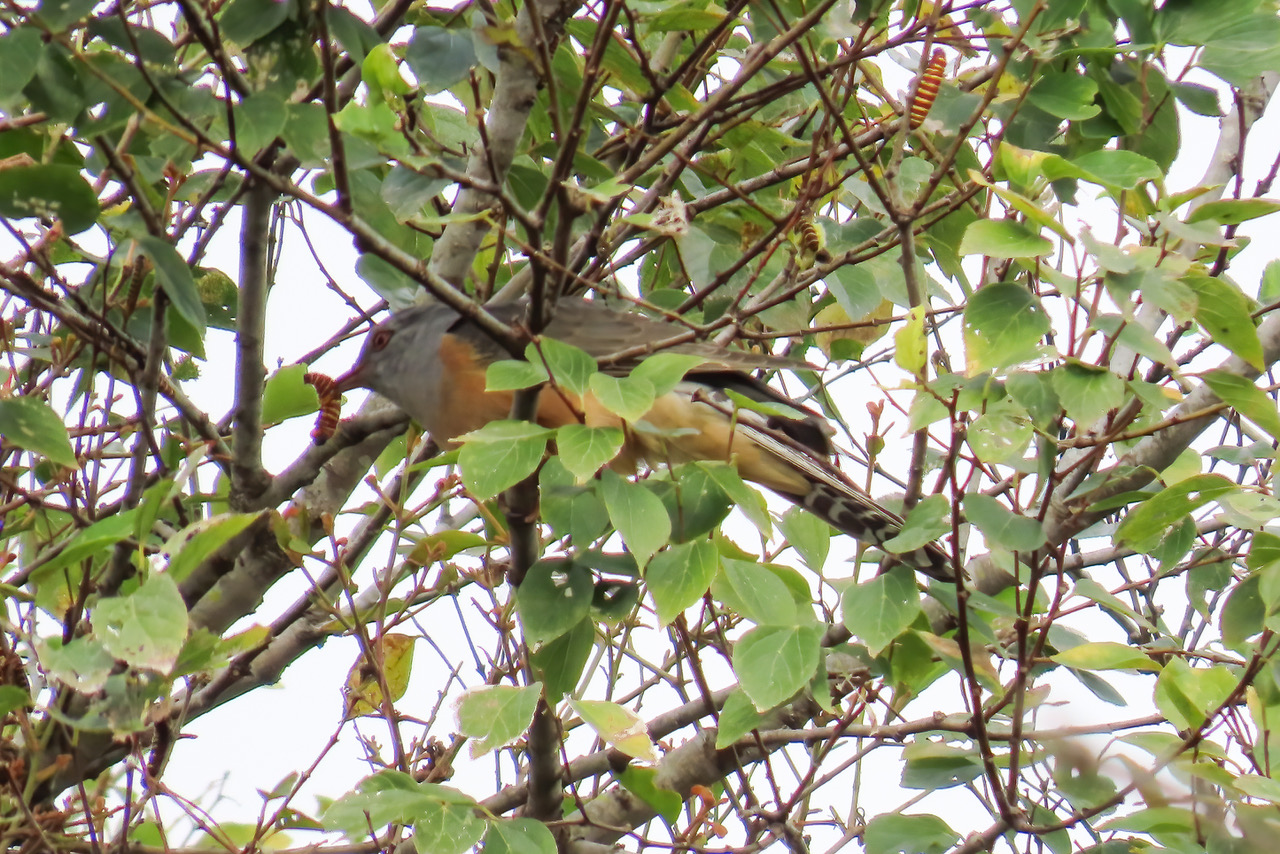
A Plaintive Cuckoo devours caterpillars in Hong Kong

AJP spotted this Plaintive Cuckoo (Cacomantis merulinus) in the New Territories of Hong Kong on Christmas Eve last year—an unusual sighting at that time of year. It was devouring caterpillars of the Red-based Jezebel (Delias pasithoe), a very common butterfly during the winter months.


The Lowe-Waldron Expeditions to the Gold Coast in 1933-34 and 1934-35


One of Fannie Waldron's photographs of the expeditions


In following up my tracking down of Fannie Waldron (1876-1959) as the person after whom Miss Waldron’s Red Colobus was named, I have obtained a copy—the only one I could find on sale—of Willoughby Lowe’s final book The End of the Trail. The expeditions in 1933-34 and 1934-35 with Fannie Waldron were Lowe’s last collecting trips and his account is the final chapter of the limited edition of 400 copies published in Exeter by the printers, James Townsend & Sons, in 1947.

Frontispiece from
The End of the Trail

The strange thing about this chapter is that Lowe does not refer to Fannie Waldron; she is always ‘my companion’. Indeed, the only clue that she was there at all is in the caption to the photographs: ‘Photo by F. Waldron’. Having mentioned her by name (wrongly as Fanny) in his earlier account of the birds they collected, the omission does seem odd. Did Fannie wish to arrange anonymous and was annoyed by the earlier public acknowledgement of her presence and funding? Had there been gossip about their travelling together as, for the time, an elderly spinster and a married man?

What does emerge from Lowe’s account are some of the jobs which Fannie undertook. However, there is no indication whether she worked as a collector of specimens per se, or did any of the arduous jobs of skinning, curing, pickling and preparing the specimens for shipping with them to London. Lowe comments on the time needed to prepare a monkey skin (the collected numerous individuals of seven species Goaso) and it would appear that he alone did the preparation:

…I was fully occupied attending to the preservation of these creatures [monkeys], and no one knows the amount of labour required, until they have tried, to preserve a monkey properly. The hands and feet are particularly troublesome as every finger must be turned back to the nails, the the skin is coated with a tough muscular fat as far as the digits, every particle of which must be removed with scissors, or the specimen will be ruined.

Museum staff praised Fannie for the collection of fish (caught by the locals in a fish trap and by poisoning a stretch of river) and I suspect she took on the job of preserving specimens in spirit.

We do know from Lowe’s account some of things Fannie did: she took the photographs; she raised a young Woodford’s Owl (fate unknown) and in London (Lowe lived in Exmouth, Devon) she delivered a lungfish cocooned in dried mud to London Zoo and blood samples from what was to become her eponymous monkey and the other species to the Wellcome Bureau for Scientific Research. Those blood sample proved important in the study of yellow fever as I shall describe in a further article.

On Miss Waldron’s Red Colobus, and other monkeys,  it would seem from reading his  account that some were shot for Lowe by the local hunters, partly because his large supply of cartridges had been held up by muddle at customs and they used their own cartridges until he could repay them in kind. Lowe though noted:

Never shall I forget hunting my first specimen [of Miss Waldron’s Red Colobus], when I waded and struggled nearly up to my waist in filthy decayed vegetable matter, tormented with insects, but luckily getting what I was after.

Lowe was greatly alarmed by the rate of destruction of the forests:

But there is yet another sad and serious view of these forests and their hidden secrets, their destruction. It is obvious to every traveller that vast forests in different parts of the world have been, and still are being, destroyed, and West Africa is no exception. Man with even crude axes, aided by fire, has done more to destroy once fertile lands than most people conceive.

We have already enough desert and arid areas in the world and it is high time those in authority should exercise their persuasive powers to prevent further destruction. Probably the forest region of West Africa is already more than half destroyed. Fires rage yearly from the dry northern regions through the savannah to the edges of the forest, into which it gradually creeps. The interior of the forest is cut, burnt and cultivated, and Forestry Officers told me they are in many places fighting in their last trench. With the destruction of the trees go the fauna and flora; and a hideous country, once beautiful and yielding fruit and products for mankind, is all that remains.

The second trip, a year later, concentrated on the northern parts of the Gold Coast. Lowe explained:

Contrary to our intentions we decided to make a second journey to Ashanti, and also to visit the Northern Territories of the Gold Coast. This decision was made because, after a cursory examination of our zoological collections, it was found that there were many animals and birds not represented, and others which could not be properly determined without more material. This being the case arrangements were immediately made to have the same servants and lorry, plus a trailer, and to travel through the extensive dry northern part which we had left untouched.

Travelling by lorry was not comfortable.

West Africa was not a healthy place. Even thirty years ago with most of the benefits of modern medicine I was told by somebody who worked there as a wildlife consultant that visitors who stayed for more than short periods often became ill, not from any specific recognised disease but just generally debilitude. It would seem that was the case 60 years earlier because Lowe noted how the Gold Coast took its toll on the District Officers and other expatriates involved in administration and commerce:

I feel I cannot refrain from some remarks on the term these men have to do under such trying conditions. West Africa used to be a nine-months’ tour, then it was raised to a year, only to be altered again to 18 months, and now there is talk of making it two years!

I myself have seen a little of the world and of varying climates and, I repeat what I have stated before, that no one should do more than a year’s work in really bad climates.

Lowe does not describe the work needed to prepare specimens for the museum. For that we have to rely on the Museum’s own Handbook of Instruction for Collectors which appeared in various editions over the years. One, from 1902—shortly after the discovery of the Okapi—can be found here I had, and still may have, a copy I bought in the Museum’s shop in the late 1950s which dated  from the early decades of the century. He does, though, describe the hard and frustrating life of the collector in a tropical forest, expressing thoughts not dissimilar to those of wildlife watchers of the 21st century:

The reader may exclaim-what an interesting and exciting place for work! And yet, though these and many other animals and birds exist, a naturalist's work in dense evergreen forests can be deeply disappointing and trying. Anything may exist, but to find it, even after years of experience, is terribly difficult. Sharp eyes are required, keen ears, and the matured field-craft of a lifetime, as well as the patience of Job, for almost every day seems a failure to get what you want and to find what you know is there.

People who have never tried to make a collection of natural history objects in such a place as the Ashanti forests little realize the difficulty in a piece of unspoilt jungle. The sweat, labour, discomfort, exhaustion, and the daily disappointment of seeing an unknown creature for the fraction of a second that may not be seen again for a generation. Think what it would mean to find it again, and perhaps get familiar with its life history. No! naturalists have plenty of work ahead of them.

I have plotted the places visited in the Gold Coast (Ghana) in the two expeditions. The map shows the coverage of the country they achieved.


Willoughby Lowe and Fannie Waldron spent a few days in Accra with the Governor before their ship left port for home. While there they visited Achimota College, now the University of Ghana. It struck Lowe that ‘the buildings and general lay-out seemed excellent’ but ‘it was all several centuries ahead of the times’. But it was to Achimota College and a tragic death that the story of Miss Waldron’s Red Colobus continues. And, as a preview, incidentally it was not Lowe and Waldron who first sent this monkey to the Natural History Museum in London, as they thought to be the case.


A photograph of Lowe taken
by Fannie Waldron


Sunday, 18 February 2024

Showing off in Hong Kong: a male Fork-tailed Sunbird displays his attributes

AJP spotted this Fork-tailed Sunbird (Aethopyga christinae) displaying to females and seeing off other males at Tai Po Kau last week.


It is difficult to believe that this common and widespread bird in Hong Kong was once uncommon. It was only first recorded in 1959, again at Tai Po Kau, which for years remained its stronghold. We were amazed when returning to Hong Kong on 1997 for the first time in 29 years to find a pair nesting outside our window at Robert Black College in the university compound. 

Monday, 12 February 2024

Sooty-headed Bulbul in the hills of Hong Kong

AJP took this photograph of a Sooty-headed Bulbul (Pycnonotus aurigaster) in Hong Kong a couple of weeks ago. This is  the third most common bulbul in Hong Kong and noticeably much less common than when we lived there in the 1960s. I think the clue is in its habitat: ‘scrubland and thinly wooded hillsides’. The hills certainly fitted that description in the 1960s following the gathering of anything for firewood during the Japanese occupation but since then the trees have grown considerably, thus reducing the suitability of the hillsides for this species—and also cutting off former familiar views for walkers on Hong Kong island, for example. The common name that used to be used in Hong Kong was Red-vented Bulbul, a name that also applies to another species, P. cafer, largely confined to the Indian subcontinent.