Friday, 11 February 2022

Black-faced Spoonbill in Hong Kong on New Year’s Day

These photographs were taken on 1 January by AJP in Hong Kong. Catch the tide right in winter at Tsim Bei Tsui overlooking Deep Bay and the entrance of the Shum Chun (Shenzhen) River and there are masses of waders and ducks to be seen.

One ‘special’ bird in Deep Bay in winter is the Black-faced Spoonbill (Platalea minor) since it was not that long ago it was in IUCN’s ‘Critically Endangered’ category. However, there appears to have been a genuine increase in the world population to over 2,000 adults in 2017 and over 4000 in 2020; the classification has been downgraded to ‘Endangered’ with further change in the offing.


The Black-faced Spoonbill breeds on islets off the west coast of the Korean Peninsula as well as north-east China. Birds have also been found nesting in Russia. In the winter it spreads to well-known sites including Deep Bay, Taiwan, South Korea and Japan. We have seen this species in winter in Kyushu, Japan, as well as in Hong Kong.


Black-faced Spoonbill, Hong Kong 1 January 2022 (AJP)


A view across Deep Bay with Shenzhen in the background


Avocets and other waders take advantage of the rising tide


When we lived in Hong Kong in the 1960s, the Black-faced Spoonbill (then called the Lesser Spoonbill) was considered an ‘occasional visitor’. The 1966 checklist continued: Probably regular in winter in the deep Bay marshes, especially near the mouth of the Sum Chun River, where up to eight birds have been seen on about twenty occasions since 1956’. Numbers increased with over 30 individuals being seen each year by the mid-1980s. At present the numbers in Deep Bay are in hundreds each year, a far cry from the 1960s. The are often joined by Eurasian Spoonbills (Platalea leucorodia), a bird not identified in Hong Kong until 1975. However, it is likely that it went unrecorded or misidentified before that date. Birdwatchers have much greater access to information on identification than they did in the middle decades of the 20th century as well as to the sites where they can be found. The number of birdwatchers has also increased dramatically. But while the numbers of spoonbills wintering in the Pearl River delta and the number of birdwatchers have increased, ‘development’ in Hong Kong itself and especially over the border in the ‘mainland’ (the city you can see in the photograph, Shenzhen, with over 17 million inhabitants, was the small border town of Shum Chun in the 1960s, habitat loss and industrial pollution continue to be a concern. The inner Deep Bay area in Hong Kong is listed as a Ramsar site.


Yellow-billed Grosbeaks (Eophona migratoria), other winter visitors to Hong Kong, were also at Tsim Bei Tsui


Thursday, 10 February 2022

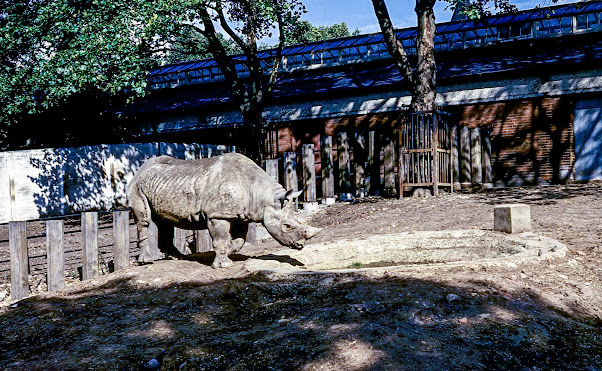
So that’s what they were. My 1958 photograph was of Northern White Rhinos at London Zoo

Only after I read an excellent new article which arrived in my inbox last night did I realise the significance of a photograph I had taken at London Zoo in summer 1958. This is the photograph:


The pair of White Rhinoceroses at London Zoo, Summer 1958


For the monthly magazine Keeper Contact (February 2022) Douglas Richardson has written A Missed Opportunity: how zoos failed to save the northern white rhinoceros. With only two old females of the northern form of the White Rhino alive, it is extinct in the wild and just about effectively so in captivity. As well as providing cogent reasons for the failed attempts to breed the last of these animals in captivity he related the history of White Rhinos (Ceratotherium simum)  kept in zoos and their origins. What I had not appreciated was that before 1962 all individuals of this species kept in captivity had been the northern form (or the subspecies cottoni if you really must). Only after 1962 did the southern form become relatively common in zoos as its numbers increased from very low levels in the wild and it bred freely in captivity.

The penny then dropped. The pair of White Rhinos I had taken a photograph of at London Zoo in 1958 were Northern White Rhinos. The northern form was found in southern Chad, Central African Republic, southern Sudan, north-east Democratic Republic of Congo  and Uganda. Douglas Richardson explained that the pair at London Zoo, the first ever in the U.K., had been captured by John Seago, one of the main dealers in East African mammals in the 1950s and 60s, in Uganda. They arrived at London Zoo on 25 July 1955. Few will now remember why they were given the names Bebe and Ben but the husband-and-wife stars of the immensely popular radio and, later, television sitcom Life with the Lyons were Bebe Daniels (1901-1971) and Ben Lyon (1901-1979) and the Zoo was never slow in attaching the names of celebrities to animals in order to attract the paying public.

In the 1950s, the Zoo’s rhinos were housed in the Deer and Cattle House; the White Rhinos were in the southern end paddock where they could be seen from the end and the side. What became known as the Cattle Sheds, built in 1869, were replaced in the early 1970s by the New Lion House and in turn by the ‘immersive’ Land of the Lions exhibit in 2016.

As well as the White Rhino, the grazing rhinoceros of Africa, there was a Black Rhino (Diceros bicornis), the browsing rhinoceros of Africa, in another photograph I took. It was housed further along the row of paddocks of the Deer and Cattle House, also with suitably reinforced fence lines and a rather pathetic concrete pond.


Black Rhinoceros, London Zoo, Summer 1958


Asked whether I have seen a White Rhinoceros in the wild I have to say no but then stop the conversation by continuing, ‘But I have been close enough to milk one’ which is what David Jones, then the vet at Whipsnade, the late Jim Linzell and I did. Indeed the mother in her stall was completely unconcerned by our presence and what we were doing.  Taking milk samples from a White Rhino was deemed safer than taking milk from many a dairy cow.

————————————


For those interested in photographic history, the film was Kodachrome which had the incredibly low speed of 12 ASA. The camera was the Kodak Bantam Colorsnap, made in U.K., which used 828 roll film with only 8 shots per roll. This was 35 mm film but had no sprocket holes, thereby allowing an image size of 40 x 28 mm compared with the 36 x 24 of 35 mm film in cassettes. An exposure calculator was remarkably accurate for a film little latitude. The film of course had to be sent to Kodak for processing. This was entry-level colour photography of the day.


Richardson D. 2022. A missed opportunity: how zoos failed to save the northern white rhinoceros. Keeper Contact, Number 180 (February 2022) 11-17. 

Tuesday, 8 February 2022

My First Wild Hummingbird: Berkeley, California in 1974 with Dorothy and Frank Pitelka

To those of us born and bred in northern Europe in the 1940s seeing a hummingbird in the wild seemed an impossible dream. So when I did see my first one in the wild I can remember where I was and what I was doing.

I had just arrived at Dorothy and Frank Pitelka’s* house on Hilgard Avenue in Berkeley, California. For reasons I will not go into further here I had been invited to the Department of Zoology and its Cancer Research Laboratory by Dorothy. I flew in after a meeting in Canada in late June 1974 After having been driven from San Francisco airport, past the ‘little boxes made of ticky-tacky’ and across the Golden Gate bridge around the bay to Berkeley we were talking when I noticed movement in the garden (‘yard’), a near vertical terraced affair full of flowers. And there was an Anna’s Hummingbird (Calypte anna) searching for and finding nectar. I had no idea they occurred so far north. My hosts were amused that I was so excited at seeing such a common—to them—bird. But I was.


Anna's Hummingbird
Robert McMorran, United States Fish and Wildlife Service

After dinner Frank drove the short distance to the Berkeley Hills and as we walked he described every bird he saw and recognised every song he heard. He was an ecologist and renowned ornithologist. I did not until recently know much more about his background (more in another post) but I have found that he actually wrote the account of the birds of the Berkeley Hills.

I found a photograph of the Pitelkas’ garden from when the house was last sold but noticeable for their absence in 2005 were the delphiniums. Frank was utterly enthralled by English delphiniums (and marmalade) when on sabbatical leave in Charles Elton’s Bureau of Animal Populations at Oxford in the mid-1950s. The garden always had delphiniums and the breakfast table had Oxford marmalade. Both were there, along with the hummingbirds, when I made a return visit for a couple of days in 1978.

Since then I have seen lots of hummingbirds of different sizes in many parts of Central and South America but it was the first that really sticks in the memory.

*Dorothy Riggs Pitelka 1920-1994; Frank Alois Pitelka 1916-2003


Sunday, 6 February 2022

A Blue-tailed Bee-eater

A few cold, wet days in a west of Scotland winter are sufficient reasons for thinking of warmer climes and their inhabitants.  This Blue-tailed Bee-eater (Merops philippinus) posed for us in Sigiriya, Sri Lanka in November 2013. During the winter they are a common winter visitor, migrating there after breeding in northern India, although I read that some some stay for the summer on the east coast of the island where they breed.

Bee-eaters brighten any day except for the large insects on which they prey.


Tuesday, 18 January 2022

The worm in the toad in the washing machine. Not the usual method of discovering a new species

Don’t leave your clothes on the floor in the tropics is a good maxim. It only takes a few cockroaches or venomous centipedes to run out in order to make the point. A couple returning to UK from Mauritius discovered they had a fellow traveller in their baggage. After emptying the contents of their suitcase into the washing machine and washing the clothes at what must have been a modest temperature, a toad—very much still alive—was found. Local herpetologists identified and housed the accidental migrant. It was a common African species, the Guttural Toad, Sclerophrys gutturalis, introduced into Mauritius in 1922 in an attempt to control the cane beetle.

A few days later, parasitic worms were found dead in the vivarium’s water bath, the ejection of which may have followed the shock of motion in the machine and/or the ingestion of detergent. The worms were preserved and were later identified as a new species of acanthocephalan. Acanthocephalans are gut parasites. They have a spiny proboscis which is used to pierce and hold the gut wall. Their life cycles are complex involving at least two hosts. The new species was named Pseudoacanthocephalus goodmani after one of the authors of the report who collected the toad from its accidental transcontinental carriers.

The toad, incidentally, grew and lived for another four years.

Oh…and tap your shoes or boots out before putting them on. That habit was instilled, as a necessary precaution against scorpions, into my wife as a young girl in Venezuela to the extent she still did it over a decade later in the depths of the 1963 freeze in Sheffield.


Allain SJR, Goodman MJ, Wilkinson JW. 2021. A series of unlikely events: from washing machine to new species. Herpetological Bulletin 156, 47-48 doi.org/10.33256/hb156.4748 


Thursday, 13 January 2022

Were the ancestors of mammals, birds and crocodylians warm-blooded? A new paper argues they were

Claud Bernard’s dictum, La fixité du milieu intérieur est la condition de la vie libre et indépendante…, developed in the latter half of the 19th century has dominated thinking on the importance of constancy of the internal environment and of the mechanisms used, homeostasis, to maintain it. The corollary in evolutionary terms is that in terms of temperature regulation mammals and birds are at the peak of physiological efficiency. They generate heat from metabolic processes and keep their body temperature within fine limits.

Anything less than the mammalian and avian perfection of maintaining a stable body temperature has been viewed as a liability. After all it is self evident that at lower temperatures the ‘cold-blooded’ or poikilothermic vertebrates which do not generate sufficient heat internally cannot move so quickly and avoid predation, for example. That is all a simple matter of the effects of temperature on chemical reactions. Therefore, extant reptiles and amphibians have been looked on as relics of an inferior system of temperature generation and control with many of them using behavioural means to garner heat from the sun.

The view that reptiles had never developed the ability to generate heat was challenged fifty years ago by the suggestion that dinosaurs were warm-blooded in that they could generate heat internally (endothermy) rather than rely on heat from the environment (exothermy). Arguments have continued on whether new bits of evidence from the fossil record supports ectothermy, endothermy or something in between.

The generally accepted view of the mechanism of endothermy is that it must have arisen independently in the the evolutionary lines that ended up as mammals and birds and involved different biochemical mechanisms and tissues; indeed it is often referred to as an example of parallel evolution. The new paper turns that view on its head. In their scheme the authors suggest that the precursors of mammals and birds, as well as other reptile groups, had developed endothermy and that mammals and birds generate heat by a similar ancestral mechanism.

I will not go further into the extensive arguments the authors have mustered in support of their hypothesis but it does extend to take into account the structure and function of the circulatory system in mammals, birds and reptiles, for example.

If endothermy was, as the authors suggest, the ancestral condition, the question that arises is why animals like modern crocodilians have become cold-blooded animals more recently. Ectothermy (poikilothermy in old money) is highly efficient in metabolic terms. Reptiles have much lower metabolic rates than mammals of the same size and therefore require much less food. For ambush predators with an intermittent food supply that could be of great selective advantage.


A Mugger (Crocodylus palustris) basking in the sun at Sigiriya, Sri Lanka in 2013


Another Mugger in Yala National Park, Sri Lanka, 2013


Again if the authors are correct, we have to stop thinking of reptiles as losers in the race to develop endothermy and therefore enjoy Claud Bernard’s la vie libre et indépendante. You need a lot of energy from food or fat stores to be an endotherm and when the going is tough, loss of endothermy and la vie libre could well have been the evolutionary trade-off.

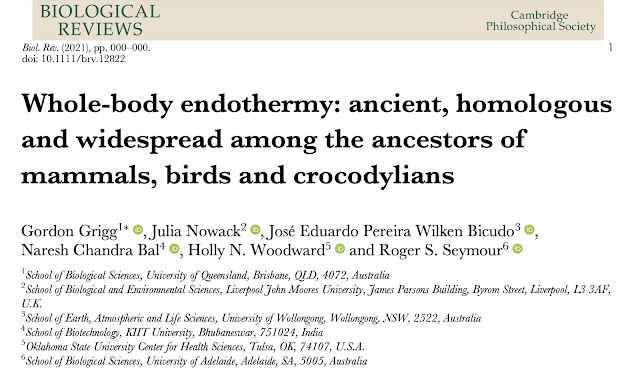
The paper by Gordon Grigg, Julia Nowack, José Eduardo Pereira Wilken Bicudo, Naresh Chandra Bal, Holly N. Woodward and Roger S. Seymour from universities in Australia, UK, India and the USA will promote a great deal of discussion across a wide range of disciplines. I think it is a case of watch this space.

Grigg G, Nowack J, Bicudo JEPW, Bal NC, Woodward HN, Seymour RS. 2021. Whole-body endothermy: ancient, homologous and widespread among the ancestors of mammals, birds and crocodylians. Biological Reviews  doi.org/10.1111/brv.12822


Wednesday, 5 January 2022

Joan Procter and Sir Peter Chalmers Mitchell at London Zoo: Barbary Apes and Innuendo

The relationship between Joan Beauchamp Procter, Curator of Reptiles at London Zoo until her death in 1931 and her boss, Sir Peter Chalmers Mitchell has intrigued historians as well as past fellows and employees of the Zoo.  I wrote in a previous article:

Rumours that Mitchell, who was at least distant and perhaps estranged from his wife for a time, and Procter were lovers were rife in the 1920s and 1930s; indeed they persisted at least until the 1990s whenever his name came up in conversation with people to whom the story had been passed down the line from the 1920s. But were the rumours based on fact?

Some have argued that her severe illness and series of operations would have prevented close contact but their travels together and sojourn in Spain certainly had tongues wagging in London. Procter, who was described by Mitchell as his 'dear friend, ward and colleague’, was seen by some (Mitchell and his friends on the Council of the Zoo) as a person who could do no wrong but to others, Solly Zuckerman for example, as a person who had a beguiling influence on some men but could do little right.


In 1950, nearly twenty years after Joan Procter’s death at the age of 34 and five years after the death of Mitchell, an article on Barbary Apes appeared in Zoo Life, the house magazine of the Zoological Society of London. The author, on whom more later, had in 1928 been the British army officer charged with the welfare of the apes on Gibraltar and their feeding from Colonial Office funds of £3 per month; an NCO had the job of recording happenings in the life of the apes on the Rock. These matters were taken seriously given the legend that if the apes die out Britain will lose Gibraltar.

One male ape went ape during the author’s tenure. ‘Jacko’ broke into Government House, broke crockery and removed the Governor’s hair brushes which were never recovered. The order was given for the animal to be shot but the ape avoided that fate by never presenting himself as a clear target. Impasse. The author continued:

It happened just at this time that the lady curator of the Reptile House of the London Zoological Gardens [i.e. Joan Procter] was staying at Malaga in the south of Spain, and was related to a certain Gunner captain then stationed at Gibraltar. The latter, thinking it would be of interest, wrote and told her the story, which she passed on to the Secretary of the Zoological Society [Mitchell]. He immediately wrote to the Governor saying that they had no Barbary Ape in the Society's collection and would be very grateful if the delinquent in question could be caught and sent to them instead of being killed. The Governor therefore caused an amendment to be issued to his first instruction, the gist of which, boiled down, said “for ‘shoot' read ‘catch’”…

After a considerable time of trying to entice Jacko into a trap and then to a cage for transport by sea, involving it would seem just about every member of the Royal Artillery in Gibraltar, the ape eventually arrived in London where he lived to the age of 21.

In the meantime, the author of the article moved on, was captured at the fall of Singapore and decided to write his part in the story of the apes on the Rock while a prisoner-of-war. However, he had to contact the keepers after the war to catch up with the story of Barbary Apes at the Zoo and with what had happened to Jacko:

"Joan" and "Peter," the two present incumbents, arrived at the Gardens from Gibraltar in 1942 and 1944 respectively. "Joan" was then four years old and twice the size of "Peter" who was only two and a half. In due course they were introduced and by virtue of her superior years and size “Joan"' for a time, the dominant female and “Peter” noticeably henpecked. Since then "Peter" has gradually outgrown his partner and is now twice her weight. With vivid recollections of earlier indignities, he has been able to pay back with interest all the chastisement he received until, eventually, the brow-beaten and lacerated "Joan"had, not long ago, to be removed to the sanitorium. While there she succeeded in opening her cage door and can thus claim the distinction of being one of the few animals to escape from the Gardens. She remained at large in the near vicinity for three days, was eventually enveloped in a coat on some scaffolding by a workman, netted and ignominiously returned to convalescence.

The author noted that ‘Joan’ and ‘Peter’ had failed to breed.

I think we can safely assume that the keepers at the Zoo, many of whom served for decades, had made their minds up on the nature of the Procter-Mitchell relationship. It is, therefore, of interest that the author added:

Author’s note.—None of the characters in this story is fictitious.

While the author was pointing out that he was well aware who the apes were named after, was he aware of the more salacious innuendo?

- - - - - - - - - - - - - - - - - - - - - - - - - - - - - - -

Who was Colonel Cecil Hunt, the author of the article and former subaltern i/c apes in Gibraltar?

Cecil Hunt (1899-1985) was a regular army officer, first, as during his time in Gibraltar, in the Royal Artillery and then, from 1934, in the Royal Army Ordnance Corps. He had the misfortune of being posted to Singapore as an Acting Colonel and Deputy Director of Ordnance Supply eleven weeks before the Japanese invasion in February 1942. A prisoner until the end of the war with Japan, his daughter recalled that he reached Southampton on 5 November 1945 on board R.M.S. Queen Elizabeth. In 1955 and by then a Brigadier, Cecil Hunt was ADC to the Queen until his retirement and appointment as CBE in 1956. In retirement he lived with his wife in Camberley, Surrey. In 1966 he is shown as attending the memorial service for Lieutenant-General Percival, the much but possibly unfairly criticised GOC Singapore at the time of its capture. Percival served as president of the Far East Prisoners of War Association and I suspect we can take it that Hunt approved of the actions of his former GOC in both rôles.

The ‘Gunner captain’ in Gibraltar with Hunt must have been Joan Procter’s cousin, John Ralph Willoughby Curtois (1897-1972). Awarded the Military Cross as a Lieutenant in the Royal Filed Artillery in the First World War, by the time he retired from the army in 1944 he had risen to Lieutenant-Colonel. His mother and Joan Procter’s father were siblings.


Hunt C. 1950. A Mediterranean Memory…Barbary Ape. Zoo Life 5 2( Summer 1950), 56-58.