Tuesday, 4 October 2016

Gwynne Vevers: Connecting Ailsa Craig, two Ayrshire families, the Bismarck, Ultra secrets, marine biology and London Zoo

Gwynne Vevers in 1981
When I mentioned to Gwynne Vevers at a Zoological Club dinner in 1978 that I was moving to Ayrshire he became very excited. ‘My granny was from Girvan’, he said, ’And I did the first wildlife survey of Ailsa Craig—surprisingly, there are slow-worms there’.

There was much more—very much more—to Gwynne Vevers than met the eye. An urbane, amiable and clubbable man he was from 1955 Curator of the Aquarium at London Zoo. He combined this job with being responsible for scientific meetings and publications at the Zoological Society of London. Although we all knew of his role, for which he was awarded a military MBE, in finding the German pocket battleship Bismarck during its breakout to reach the Atlantic, his more general and sustained activity in British intelligence only really became more common knowledge with the publication in 2004 of a short biography by Adrian Desmond in the Oxford Dictionary of National Biography.

When scanning a batch of Animal and Zoo Magazines, I was surprised and delighted to find a two-page map in the July 1938 issue describing the survey Gwynne had talked about. The text box on the map reads:


Bird Island
Animal map of Ailsa Craig compiled by H.G. Vevers and James Fisher and drawn by Ronald Lampitt
1
     Ailsa Craig is a great lump of granite that sticks up in the middle of the Firth of Clyde for more than 1,100 feet. It is only just over twice as broad as high, and is less than 2½ miles round.
     Every spring for the past three years we have visited the island to study its animals. This map is the result of our investigation in early April 1938. Our main task was to count the gannets, and we found that there were 5,387 breeding pairs. Ailsa Craig is one of the largest gannet colonies of the twenty or so in the world.
     As it is possible to walk round the whole of the coast at low tide and to climb the upper slopes, we mapped out many other inhabitants of the rock, though we could not make accurate counts of all.—H.G.V. and J.F.
The centre-page spread in Animal and Zoo Magazine, July 1938


Not only was his grandmother from Girvan, the nearest town on the mainland to Ailsa Craig, but Gwynne was born in Girvan in November 1917. He was, in fact, connected to Ayrshire families on both his mother’s and his father’s sides. His father, Geoffrey Marr Vevers (1890-1970) was the son of Henry Vevers (1822-1901) and Ada Mary Keay (1867-1913). Ada Mary Keay was the daughter of Robert Keay (1839-1904) and Amelia Kerr Milne Marr (1844-1922). Amelia was the brother of Charles Kerr Marr (1855-1919) who bequeathed his fortune made in the coal export business to further the education of the townspeople of Troon. Marr College, now a secondary comprehensive school, in Troon was  one outcome. The other was the C.K. Marr Educational Trust which still provides bursaries and grants for tertiary education and beyond to students resident in Troon nearly 100 years after his death.

But who was the ‘Granny from Girvan’? His father’s first marriage was to Catherine Rigby Andrews of Girvan. I am confused as to the time and place of this marriage. In the Scottish registers it is recorded as 23 November 1915 at St John’s Episcopal Church, Girvan. However, the marriage is also shown in the English registers, this time in Paddington, London, in the fourth quarter of 1914; a civil followed by a religious ceremony perhaps? Catherine Rigby Andrews (1889-1971) was born at Union Bank House, Girvan, the daughter of David Andrews, solicitor and bank agent, who had died shortly before the marriage in Scotland, aged 77. Catherine’s brother, Walter, a Captain in the Indian Army, also died in 1915 in Mesopotamia. Her mother, and Gwynne Vevers’s grandmother, was Catherine Rigby Wason; she died, aged 78, at 10.57 pm on 30 January 1932 at 2 Golf Course, Girvan. There is an additional note that her usual residence was Glenalty, or Glen Alty, a house in Barrhill, a village inland from Girvan, the home of the Andrews family since at least 1901.


Glen Alty, near Girvan

When he started the surveys on Ailsa Craig he was an undergraduate at Oxford; he graduated in 1938, the year of the final survey. However, during this period he also started working for British intelligence. He led undergraduate expeditions to the Faeroes in 1937 and Iceland in 1939. During both he reported to Admiralty intelligence on the German ships which were surveying deep-water channels. As a research student between 1938 and 1940 he began his research at Oxford on the control of coloration and growth of the feathers in Lady Amherst’s Pheasant. Interrupted by the war, he completed the analysis at Plymouth and was awarded the Oxford D.Phil in 1949.

He was, like a number of his Oxford contemporaries, both a field naturalist and a lab worker.

He was commissioned as a probationary Pilot Officer in the Administrative and Special Duties Branch of the Royal Air Force in January 1941. He must have got to work quickly because he organised aerial reconnaissance of the ice floes in the Denmark Strait to plot the deep-water channels. When Bismarck broke out to the Atlantic to attack convoys in May, Gwynne predicted the route she would take. The destruction of H.M.S. Hood in the Denmark Strait, the frantic pursuit as Bismarck made for Brest, her crippling by the Fleet Air Arm and eventual sinking by the big guns of the Royal Navy are embedded in naval history.

The only clue I had of his later work in the war came from his telling me that while in Germany he was not allowed to fly. He knew too much to risk being shot down over enemy-occupied territory. Only with Adrian Desmond’s biography did the reason become clearer: Gwynne was an ‘Ultra’ insider. He, with his boss, another zoologist, Wing Commander Frederick Stratton Russell FRS, handled the air intelligence from Bletchley Park. They assessed the significance of the decrypted messages and distributed the findings to the R.A.F. The obituaries of Gwynne by Solly Zuckerman, nor the Royal Society’s biographical memoir of Russell contain any clue as to their roles in ‘Ultra’.

His gift for languages including all those of Scandinavia, German and Russian (put to great use in the publishing world in later years) must have opened up roles for him in intelligence within Germany as the allies advanced. Desmond notes that near the end of the war he was hunting down Bernhard Rust Reichsminister for Science, Education and National Culture, who committed suicide a few hours before Vevers caught up with him. My guess is that he was more secret service (MI6) than R.A.F. There were rumours on his continuing role in intelligence and Desmond notes…’Vevers's covert intelligence gathering, which was to last for several decades. His roving life as a zoologist proved perfect cover; even as late as 1970 he was being debriefed after a zoological trip to Rangoon’.

At the end of the war, Russell (later Sir Frederick) was appointed Director of the Marine Biological Association in Plymouth. He took Gwynne Vevers with him to Plymouth as Bursar. This job seems to have been a mixed scientific/admin post, the latter mainly entailing the care of visiting scientists. In addition to completing his D.Phil thesis on material obtained before the war, he started research in marine biology, particularly on animal pigmentation. He also devised an underwater camera that was used to investigate marine life and the sea floor as well as to search for lost submarines by the U.S. Navy.

In 1955 he was recruited by Leo Harrison Matthews FRS, then scientific director as well as responsible for running both London and Whipsnade zoos, recruited Gwynne to run the aquarium at London and to run the scientific activities of the Zoological Society including its publications. This he did until retirement in 1981. He also kept a close eye on standards in the sadly defunct Fellows’ Restaurant. He tried to keep it in line with the top London restaurants and it was one of the places  in London to meet for lunch. He entertained those of us who were organising symposia for the Society there, and I remember ‘Gip’ (G.P. Wells FRS, son of H.G. on one adjacent table) and David Attenborough being entertained after presenting a Bell Bird, on another.

It was at Plymouth that he began to publish his own popular books beginning with The British Seashore. To these he added translations into English from eight languages on a variety of natural history subjects. In all, around one hundred books appeared for twenty-four publishers. Zuckerman wrote: ‘I never did fathom how Gwynne was able to discharge his duties to the Zoo, and also carry on writing and preparing radio and TV programmes’.

He kept his interest in animal coloration and published The Nature of Animal Colours with his friend Harold Munro Fox (London: Sidgwick & Jackson) in 1960.

A stalwart of the Savile Club he also served the Linnean Society as Zoological Secretary and as Vice-President.

I found it hard to imagine Gwynne, the amiable and urbane inhabitant of Regent’s Park and the Savile, as a field naturalist on Ailsa Craig or the Faeroes in the 1930s, let alone in the 1960s. But there he was, a member of Royal Society expeditions to the Cook and Solomon islands in 1965 and 1969.

Gwynne compartmentalised his life, perhaps an attribute of the perfect spy. Few knew of his succession of four wives (James Fisher, his fellow surveyor of Ailsa Craig, was best man at his first, in 1942) or, as Desmond put it, of ‘other, less formal liaisons’.

His laid back style could be deceptive. At first acquaintance (1968 in my case), he could seem semi-detached from the happenings around him but I soon fond that he missed nothing. His knowledge of the ins and outs of often vicious zoo politics stretched back to the times when his father was superintendent and he had the run of the place as a boy. By the time he retired in 1981 he knew where all the bodies were buried.

Gwynne Vevers died at his home in Bampton, Oxfordshire on 24 July 1988.

So, how did the survey of Ailsa Craig come to appear in Animal and Zoo Magazine in 1938? At that time James Fisher, Vevers’s friend and collaborator on Ailsa Craig, was Assistant Curator at the Zoo, put there by the Secretary, Julian Huxley, as part of his ill-fated attempt to reform the Zoological Society. As part of his job, Fisher was contributing articles, and the work on Ailsa Craig was a natural subject for the magazine.


Ailsa Craig from Culzean, 14 miles (22 km) away

These are Gwynne Vevers’s papers on Ailsa Craig:

Vevers HG. 1936. The land vegetation of Ailsa Craig. Journal of Ecology, 24, 424-445.
Vevers HG, Fisher J. 1936. A census of gannets on Ailsa Craig, with a new method of estimating breeding-cliff populations. Journal of Animal Ecology 5, 246-251.
Vevers HG, Fisher J., Hartley CH, Best AT. 1937. The 1937 Census of gannets on Ailsa Craig; with notes on their diurnal activity. Journal of Animal Ecology 6, 362-365.
Vevers HG, Fisher J. 1938. The 1938 census of gannets (Sula bassana) on Ailsa Craig. Journal of Animal Ecology 7, 303-304.
Fisher J, Vevers HG. 1943. The breeding distribution, history and population of the North Atlantic Gannet. Journal of Animal Ecology 12, 175-213.
Fisher J, Vevers HG. 1944. The breeding distribution, history and population of the North Atlantic Gannet Sula bassana. Journal of Animal Ecology 13:49–62.
Vevers HG. 1948. The natural history of Ailsa Craig. The New Naturalist. A Journal of British Natural History 1, 115-121.

------------------------
1Ronald George Lampitt (1906-1988) was a professional artist who worked for a number of magazines, illustrated many books and designed posters for railway companies.


Wednesday, 22 June 2016

The Case of the ‘Electric’ Chameleon

Chameleons never cease to fascinate and I have never been more fascinated than on one day in 1989. I was sitting with David Blatchford in his house. Bob Bustard called in on his way home and had with him a chameleon of the genus Rhampholeon. He showed us what happened when one gently touched the chameleon on the back. There was a tingling that felt like an electric current. We could not decide whether the tingling was the result of minute vibration of the scales or whether there really was some form of electrical discharge. Since the effect seemed to wear off with repeated touching and then, after a period of rest, return, we could not really rule out some electricity.

The next day I wrote to Richard Keynes FRS (1919-2010), my old boss and then Professor of Physiology at Cambridge, the world expert on bioelectricity from his work on electric eels, to see if he had come across such phenomena in a terrestrial animal; he hadn’t but told me what equipment I would need if I came across a Rhampholeon again. I didn’t, that is not until we we were walking back to camp from watching a family of Western Lowland Gorillas in the Republic of Congo in 2014 when our guide spotted this one on the path.

Rhampholeon spectrum. Republic of Congo 2014

Lacking a handy oscilloscope and knowing how much chameleons hate to be touched we left this one to go on its way.

Over the years I have kept and handled ten species of chameleon. In none of them nor in some wild ones in Madagascar did I encounter the same phenomenon. I have, though, kept it in the back of my mind and when I was looking through the excellent book, Mountain Dragons by Jan Stipala1 (2014) I realised that the phenomenon had been reported. In describing Rhampholeon boulengeri he wrote: ‘Known to produce vibrations as a defence mechanism when touched’.

A Google search then produced the following statement for each species of Rhampholeon and Rieppeleon (the latter genus was split recently from the former) in The Kenya Reptile Atlas: ‘Moves slowly, may sham death, if handled will produce a burst of vibrations, like an electric shock, caused by exhaling minute amounts of air’. Similarly, in Reptiles and Amphibians of Southern Africa8: Some species in this genus have a peculiar defensive strategy: when touched or restrained, the chameleon may suddenly vibrate. ‘This vibration is said to feel like a small electrical shock and is intended to startle a predator’. The owners of Lewa House north of Mount Kenya reported in the blog in 2013:
     
     A few days ago as Calum walked down to the Lewa House pool he noticed a stick on the path that seemed to “fall over” as he got near it – on closer inspection he realised it was a chameleon! The first one we (or anyone we know) has seen on Lewa?
     It’s called a Kenyan Pygmy-Chameleon (Rhampholeon kersteni) and has an interesting tactic of vibrating violently when picked up—something that Calum discovered when he handled it for the first time! It vibrates so much that a person who found one near the Kenyan coast thought that the chameleon had given them an electric shock?!
     In Somali folklore it is said that if a Camel touches one of these chameleons the vibrations will kill the camel! We released our camel slaying chameleon back in to the bush safe and sound. 

But who first described the phenomenon? in which chamaeleons does it occur? And is there any experimental evidence, as opposed to supposition, as to its adaptive significance?

The first reference I can find is to Edouard-Raoul Brygoo (1920-2016) in 19712. He, while working at the Pasteur Institute in Madagascar, observed in three species of Brookesia: ‘une certaine vibration perceptible au toucher mais pratiquement inaudible. Cette vibration n'a jamais été constatée avec des Chamaeleo’.
1-Photo-Brygoo-par-Bour-juin-2002
Edward-Raoul Brygoo

Dick Hillenius (1927-1987) of Amsterdam in a paper published in 19863 observed the same behaviour in Rhampholeon kersteni. Later, in describing a new species from Malawi (R. chapmani) Colin R. Tilbury described4 what happened when two adult males were placed in close proximity:

     When 2 of the adult males were placed in close proximity to each other, they dorso-laterally flattened their bodies to about 3 mm in width and gave a lateral display accompanied by a rhythmical swaying to and fro of the whole body. The head and neck regions of both males turned a pale powder blue and the eyelids a bright white. The rest of the body remained a drab grey brown. Off-white gular interstitial skin was exposed and one male gaped his jaws displaying yellow buccal membranes. In addition to this, both chameleons produced short bursts of a «buzzing» vibration that was easily felt through the twig on which they were perched. These vibrations appear to be generated by the chameleons exhaling minute amounts of air.

In describing other new species from Tanzania, Mariaux & Tilbury (2006)5 noted in R. viridis: ‘When handled these chameleons produced an easily felt “buzzing” vibration, particularly if touched lightly on the back’.

In addition to any possible rôle in deterring predators, another function for ‘vibration’ has been suggested. Kenneth Barnett, Reginald Cocroft and Leo Fleishman noted6 that when Veiled Chamaeleons, Chamaeleo calyptratus, were touched they produced a vibration emanating from the body anterior to the front legs. They suggested that, because these vibrations could be detected in the plants on which they were living and were produced by males in the presence of females, the vibrations could be vegetation-borne communication signals to other chamaeleons. They recorded the frequencies of the vibrations. However attractive a suggestion that may be, experimental evidence has not been produced to indicate that the putative receiver of the putative signal actually perceives the vibration in the vegetation or is influenced by it. Since C. calyptratus is the one species that is easy to keep and breed in captivity, such studies should be possible to do. It should also be possible to determine whether the vibration in this relatively large species is produced by the same means as that in the small Rhampholeons and Brookesias.

There are more recent reports of ‘vibration’ in some other species of chameleon7.

While I want to stress that there is a lack of experimental evidence for any of the suggestions of a function for the phenomenon, nor for the mechanism or mechanisms of its production, I want to return to Bob Bustard’s female Rhampholeon. We could see no sign of any movement of the skin nor could we hear any sound being emitted. If the skin were just vibrating with minute oscillations, then would the pointed scales invoke the same feeling in other animals as it did in our fingers? And can we completely discount the discharge of static electricity, possibly building up on scales as they rub together during respiration? There are experiments there waiting to be done.


1 Stipala J. 2014. Mountain Dragons. In Search of Chameleons in the Highlands of Kenya. Jan Stipala. ISBN 978-0-9928176-0-2.

2 Brygoo E-R. 1971. Reptiles Sauriens Chamaeleonidae, genre Chamaeleo. Faune de Madagascar 33, 1-318.

3 Hillenius D. 1986. The relationship of Brookesia, Rhampholeon and Chamaeleo (Chamaeleonidae, Reptilia). Bijdragen tot de Dierkunde 56, 29-38 

4 Tilbury CR. 1992. A new dwarf forest chameleon (Sauria: Rhampholeon Günther 1874) from Malawi, central Africa. Tropical Zoology 5, 1-9. http://dx.doi.org/10.1080/03946975.1992.10539176 

5 Mariaux J, Tilbury CR. 2006. The pygmy chameleons of the Eastern Arc range (Tanzania): Evolutionary relationships and the description of three new species of Rhampholeon (Sauria: Chamaeleonidae). Herpetological Journal 16, 315-331.

6 Barnett KE, Cocroft RB, Fleishman LJ, 1999. Possible communication by substrate vibration in a chameleon. Copeia 1999, 225-228.

7 Stuart-Fox D. 2014. Chameleon behavior and color change. In, The Biology of Chameleons, edited by Tolley KA & Herrel A, p 115-130. Berkeley: University of California Press.

8 Schmidt W. 2006. Reptiles and Amphibians of Southern Africa. Cape Town: Struik.

Tuesday, 14 June 2016

Friedrich Siebenrock and an eponymous genus

I noticed that Friedrich Siebenrock (1853-1925) the Austrian herpetologist, got mentioned in The Eponym Dictionary of Reptiles* for three species or subspecies named after him but not for the genus (originally with one but now with two, species) of freshwater chelonians named after him by Lindholm in 1929.

Friedrich Siebenrock

I kept a couple of the species then thought to be the only species in the genus, Siebenrockiella crassicollis—the Black Marsh Terrapin (in U.K. usage for freshwater chelonians) forty years ago. Why? Well, that’s a long story. But here are a couple of photographs of one of them, showing the white spots on the neck.


Now classified as ‘Vulnerable’ this species, like all those in south-east Asia, have been hammered by the trade for human food.

The shape of the jaws gives them a benign look and they are sometimes known as the ‘smiling terrapin’. The ones I had were of benign behaviour (although the Wikipedia article on them says they can bite severely when roughly handled) and would take food from the fingers.

Poor old Siebenrock died in 1925, in poverty after his retirement from the natural history museum in Vienna in 1920, according to all the information on him†, in 1925, four years before Lindholm erected the genus.


*Beolens B, Watkins M, Grayson M. 2011. The Eponym Dictionary of Reptiles. Baltimore: Johns Hopkins

†Adler K (editor). 2014. Contributions to the History of Herpetology. Volume 1 (revised and expanded). Society for the Study of Amphibians and Reptiles.

Sunday, 12 June 2016

A different house gecko in Hong Kong

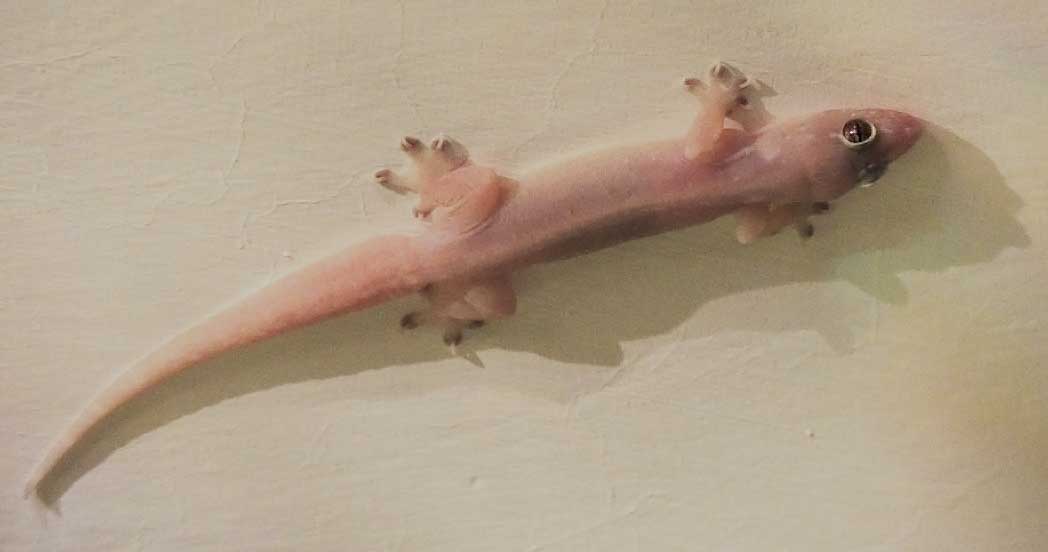
AJP in Hong Kong found this gecko in his flat last week (and heard its cheeps before he saw it). It is not the usual Hong Kong house gecko. It is the Four-clawed Gecko (Gehyra mutilata) considered as 'rather rare' in the HKU website.


Gehyra mutilata
The only house gecko we saw in Hong Kong in the 1960s was Hemidactylus bowringii, Bowring's or Oriental Leaf-toed Gecko. It was common in the buildings of the University Compound, around or in street lights, especially those still housing gas mantles. I photographed this one in 1966 using my new Ekakta Varex IIb, extension tubes and a blue flash bulb; measuring the distances and calculating the exposure for the extra lens extension and the flash took ages.

Hemidactylus bowringii
I took the following to show the structure of the pupil, part of the remarkable optical system that is now known to be even more remarkable.


Bowring's gecko was described by John Edward Gray at the British Museum in 1845. The Eponym Dictionary of Reptiles states that it is not known whether it was named for John Charles Browning (1820-1893) an amateur naturalist who became a partner in Jardine Matheson or for his father, Sir John Bowring FRS, who became British Consul in Canton in 1849 and was Governor of Hong Kong from 1854-59. 

Sunday, 5 June 2016

In Bhutan: a dead lizard and a live monkey

The only reptile or amphibian we saw in Bhutan in March this year was a dead one. This lizard, which looks like the agamid, Calotes versicolor, was found in the road south of Trongsa at an altitude of 2,204 metres (7.230 feet) while we were looking at Golden Langurs (Trachypithecus geei).

This lizard was killed by a vehicle

Golden Langur

The climate of Bhutan changes from sub-tropical at the border with India to the snow-capped Himalayan peaks in the north. The herpetofauna changes accordingly although I have been surprised to read that only in the last couple of decades have efforts been made to describe and catalogue what species have been found*.

*Wangyal JT. 2014. The status of herpetofauna of Bhutan. Journal of the Bhutan Ecological Society. 2014 Issue 1, 20-39.

Wednesday, 1 June 2016

Hong Kong urban wildlife of the rodent kind


Last week, AJP in Kong Kong spotted these animals in Haiphong Road, Tsim Sha Tsui. They had not been spotted by passing tourists or local commuters. They appear to be young Buff-breasted Rats, the taxonomy of which seems still uncertain. They are often called Rattus flavipectus or included in Rattus tanezumi, sometimes as a subspecies, Rattus tanezumi flavipectus. They used to be Rattus rattus flavipectus.

It is interesting that they do not appear to be Brown Rats (Rattus norvegicus). Both species occur in urban Hong Kong and the Urban Services Department used to have rat bins mounted on lamp posts for people to drop trapped dead rats in. They and the fleas they carried were examined for plague bacteria. Kong Kong had a major outbreak of plague in 1894, as part of the third pandemic. The last outbreak was in 1929. The causative organism of plague was, as is well known, discovered in Hong Kong by Alexandre Yersin during the 1894 outbreak.

Anybody familiar with Hong Kong will know that Haiphong Road runs between the old docks area to the west of Canton Road and Nathan Road. Hence the 1960s and earlier, Brown Rats might have been expected as the more likely sighting. However, Haiphong Road is adjacent to Kowloon Park, the site of the old Whitfield Barracks. In much of its range the Buff-breasted Rat is said to favour villages with surrounding countryside. Perhaps this rat population is centred on the park.

Mount Everest

I first saw Mount Everest in 1965—from a Qantas Boeing 707. In those days planes had to refuel several times during the 20-22 hour journey from London to Hong Kong so there were stops in Athens, Teheran and Delhi. On the Delhi to Hong Kong leg the pilot diverted north so that we could see Everest poking through the clouds. Such diversions do not happen these days and even day flights have cabins dimmed and window blinds down so that passengers can view inane movies (starring celebrities I have never heard of) rather than the real world below.

Over 50 years later, in March this year, we saw Everest again—this time from a Royal Bhutan Airways Airbus A320 flying from Delhi to Paro, and much closer.


Everest - centre left. March 2016

It is difficult to describe the effect of the first ascent of Everest on 29 May 1953 on the imagination of ten-year old schoolboys in 1953 or on the general public for that matter, with the news breaking on the morning of the Coronation on 2 June. The euphoria that ensued from Everest and talk of the existence of yetis was increased by Neville Duke breaking the airspeed record in a Hawker Hunter and then by Mike Lithgow breaking that record in a Supermarine Swift, both September 1953. Thus were set the topics of chatter in the school playground as we started our last year at primary school. The girls may have talked about other things though to which we boys were not privy. The excitement continued as we filed two-by-two to the Victory cinema to see the film of the ascent which was released some months later.

I then recall reading the book by the leader of the expedition when it appeared as a book club edition in 1954. What struck me as odd then was that the essence of success was confined to a series of appendices and I must have pestered my father with a whole series of ‘why’ questions that seemed obvious to an eleven year old. I recall two of them*: Why was Hunt, the leader, made a sir? Why was only one climber (Hilary) made a sir? I clearly held a dim view of administrators even then.

Fast forward to 16 January 1970, and Jim Linzell and I were walking into a meeting of the Physiological Society at the National Institute of Medical Research at Mill Hill when a man emerged from a room and without glancing at passers by took a turn off the corridor at speed. ‘That’, said Jim, ‘is the man who got them up Everest. He never got the praise he deserved’. It was Griffith Pugh—recognised by the scientific world as the man whose research had been vital but who was unknown to the general public.

Only three years ago was the record set straight. Pugh’s daughter, Harriet Tuckey, wrote her brilliant book, Everest The First Ascent. The Untold Story of Griffith Pugh, the Man Who Made it Possible . Sir John Hunt, later Lord Hunt, completely downplayed the work of Pugh leading up to the Everest expedition and the breadth of his contribution to success both in the book and in the film. Leadership and ‘the spirit of man’ were what counted. The last sentence of Hunt’s book leaves me with a feeling of nausea: There is no height, no depth, that the spirit of man, guided by a higher Spirit, cannot attain.

The old-school anti-science climbing fraternity and the gentlemen geographers emerge as the baddies in the whole story. The goodies were the scientists, some of whom were or had been climbers, like Sir Bryan Matthews, or who just saw the science and technology of survival at high altitudes was important, like Sir Peter Medawar, Pugh’s ultimate boss at Mill Hill in his years after Everest. The Medical Research Council, under the secretaryship of Sir Harold Himsworth, played a key role.

     We have been hearing a great deal this evening about the extraordinarily brilliant leadership provided by Sir John Hunt on the 1953 Everest expedition, but there have been eleven previous expeditions to Mount Everest many of which had excellent leaders and they failed.
     We have been hearing about the great skill of our climbers but there had been many skilled climbers on previous Everest expeditions yet they failed to get to the summit.
     We have been hearing about the brilliant logistics, but there had been other well organised, well planned expeditions which all failed.
     What I want to talk about tonight is the most important reason why the 1953 expedition to Mount Everest succeeded where all it predecessors failed, and that is the work of the unsung hero of Everest…Dr Griffith Pugh.

These are the words I was trying to remember as Everest appeared from behind the wing of the A320. They were spoken by the expedition doctor, Dr Michael Ward (1925-2005) at a gathering held by the Royal Geographical Society in May 1993 to celebrate the fortieth anniversary of the ‘conquest’ of Everest and they were ones that stimulated Harriet Tuckey to find out what her father’s contribution had been since his children were unaware of his true rôle.

Harriet Tuckey wrote a frank biography of her father with whom she and her siblings had a difficult relationship. He was clearly a difficult man—at home, in the lab but less so, I guess, up a mountain. Even for a physiologist of his time he was perhaps slightly beyond, but not that far beyond, ‘normal for a physiologist’. 


*My father worked for Everest Furniture in Long Eaton, Derbyshire. I had assumed that the name referred to the comfort of its products as in ‘perpetual relaxation’. However, I have just found that the company was formed by W.H. Hassall in 1924, the year of the earlier British expedition and the one in which Mallory and Irvine disappeared. Now I wonder whether Hassall chose the name on that surge of public attention to Everest.