The last wild mammal we saw before leaving in Sichuan in November was a Black Rat (Rattus rattus). It was moving on a grating over a drain at a service station on a motorway near Chengdu. For some reason the overhead artificial lighting late on a winter’s afternoon played havoc with my video. However. Tim Melling took still photographs and this is one of them:
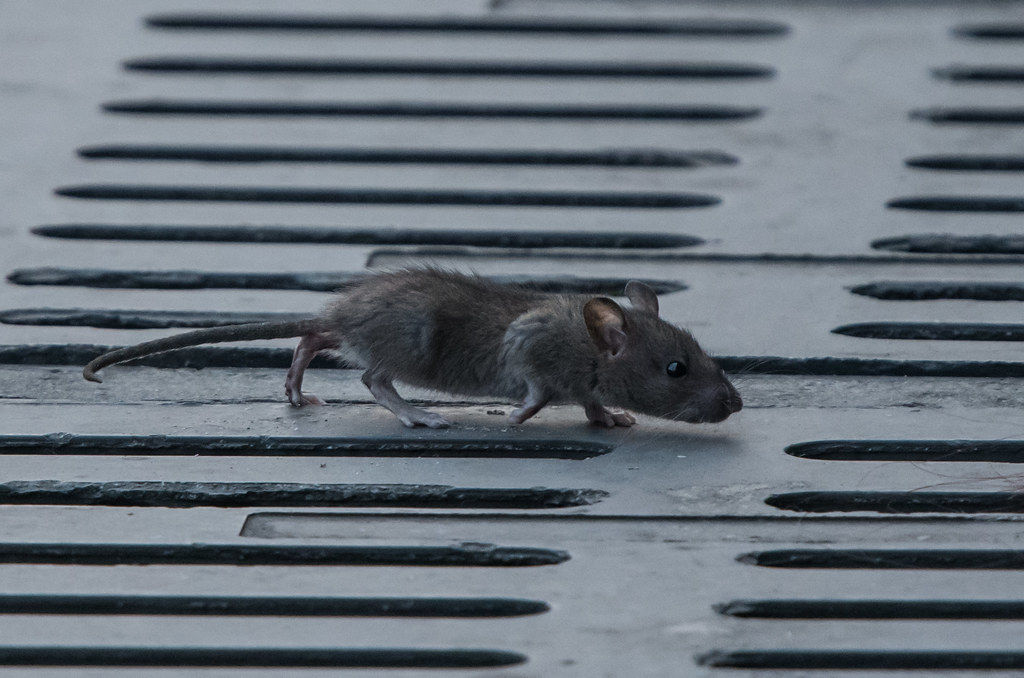
Black Rats, originally from India and south-east Asia, arrived in Britain in Roman times. Of lighter build than the Brown Rat (Rattus norvegicus) which arrived in the 18th Century, they have a less shaggy coat, larger ears and a relatively longer and narrower tapering tail which has been described as semi-prehensile. They were once common and widespread in sea ports although the Brown Rat, once introduced, would fight and kill them. In and around ports, where arriving ships topped up the supply, they lived in buildings, usually in the roof where they could invade other buildings by climbing across cables or through attics. Black Rats were also known as Roof Rats. A building could be infested with Black Rats living in the roof and Brown rats living at or below ground level.
There was a massive decline in Black Rat numbers in Britain during the latter half of the 20th Century. Intensive reporting of infestations by local authority medical officers and the laying of poison baits coupled with statutory requirements for owners of buildings to free them of rats and for ships to be treated as buildings in that respect. The construction of rat-proof ships also helped but there were still reports twenty-five years ago of Black-Rat-infested ships turning up in British docks; in Hull in 1992 the Russian factory ships known as Klondikers were of particular concern.
By the 21st Century Black Rat in Britain were only being reported from the islands of Lundy in the Bristol Channel, the Shiant Islands in the Outer Hebrides and a small island in the Firth of Forth. Shipwrecks or visits by sailors in ships’ boats are thought to have been responsible for introducing the species and/or the Brown Rat to these islands. Because of the devastating effects on breeding seabirds, extermination programmes have wiped out the rats on Lundy, Ailsa Craig (although I do not know whether the rats there were Black or Brown, or both) to the enormous benefit of nesting seabirds. Now I read a similar programme on the Shiants in 2015-16 has been successful.
A black rat in Troon—a Black Rat or a black Brown Rat?
Rats have loomed large in my life recently. The well-spaced fairways and very rough and tough ‘rough’ of Royal Troon Golf Course make it a haven for local wildlife but also a killing field. The foxes, stoats and birds of prey ensure the course is littered with body parts of birds (mainly gulls) and rabbits. A couple of weeks ago I was surprised to find the partial remains of a rat on one of the fairways. I, nor my playing partners, could remember having seen the remains of a dead rat before. But what was surprising was that the fur on the remaining skin was black and the tail in the light of what passes for dawn in January in Scotland seemed long. First I checked that the hair was not just wet and simply looked black; it was black. My thought was that this could either be a black (i.e. melanistic) Black Rat or that there was an outside chance this could be a Black Rat, especially since the port of Troon is at the other end of the town from the course. Fortunately, a fellow player in our two-ball foursome had his new phone with him and we managed a photograph in the very poor light.
The photograph suggested that the shape of the tail seemed more Brown-Rat like than Black. While experts on these non-native British rats had a look at the photograph and concluded that it was a black Brown Rat—probably—I found that Black Rats once did occur in Ayrshire with five or fewer than five infestations being reported for the old County of Ayr in 1951. Specifically excluded were the burghs of Ayr and Kilmarnock, which suggests the Black Rat, if not that common, was present in the seaports along the Ayrshire coast. In 1956 when numbers of Black Rats throughout Britain had declined markedly, there were still reports of individual Black Rats for the County of Ayr.

In the London docks, the incidence of black Brown Rats was 1.66 per cent in the 1940s. Is that still the case in present-day populations in Britain? The evidence I have read suggests that the population is dimorphic (rather than black ones appearing by frequent mutation) and that black form is not uncommon. However, a low proportion surely suggests a strong selection pressure against black. Are they more easily seen by predators if they are short of food and have to forage by day? Whatever the explanation, the remains of melanistic Brown Rat appeared at my feet as I approached my ball. What happened next—to my ball, that is? Politer not to ask.
Bentley EW. 1959. The distribution and status of Rattus rattus L in the United Kingdom in 1951 and 1956. Journal of Animal Ecology 28, 299-308.
Lock J. 2006. Eradication of brown rats Rattus norvegicus and black rats Rattus rattus to restore breeding seabird populations on Lundy Island, Devon, England. Conservation Evidence 3, 111-113.

