Showing posts with label Aquarium. Show all posts

Sunday, 2 February 2020

Clifford Emmens: Aquarist, Endocrinologist and the Natural History of Bombing

Clifford Walter Emmens
(from Biographical Memoir, AAS)
To anybody keeping and breeding tropical fish from the 1950s until the 1990s, the name C.W. Emmens would have been familiar as the author of a number of the better books on the subject. Few amateur aquarists would have realised that Emmens was professor of veterinary physiology in the University of Sydney and even fewer that he had an important rôle in one of the key developments of the Second World War.

Clifford Walter Emmens (1913-1999) was a member of Solly (later Lord) Zuckerman’s famous Oxford unit studying the effect of bombing on the civilian population. From studies on damage to industrial effectiveness and civilian morale after German attacks on British cities, Zuckerman and his team turned their conclusions around to consider what Allied attacks on German cities would achieve. The conclusion—very little—was anathema to the 'Air Barons' in the Royal Air Force and U.S. Army Air Force (the latter being desperate to become independent of the army) who had convinced themselves as well as powerful figures in and around Winston Churchill that Germany could be brought to submission by ‘strategic’, in other words, area-bombing. The story is now well known even though Zuckerman exposed later attempts to whitewash the failings of the senior officers of Bomber Command in reports and official histories. Throughout of course there had been the snide comments of the ‘what do a bunch of biologists think they can tell us about air warfare’ type, a view even promulgated by Churchill’s personal friend and scientific adviser, the physicist, Frederick Lindemann, Lord Cherwell, who was a firm believer in strategic bombing—an example of the many things he got completely wrong.

Emmen’s job in Zuckerman’s unit and how be escaped the National Institute of Medical Research in order to take a more active rôle in the war effort is told in his biographical memoir for the Australian Academy of Science and by Zuckerman in the first part of his autobiography.

After tackling the problem of assessing the effect of bombing on the civilian population in Germany, Emmens joined Zuckerman and other members of the unit for bombing surveys after the invasion of Sicily. This detailed work informed the bombing plans for the run-up to the D-Day landings in June 1944. Those plans resulted in the now well-known confrontations with ‘Bomber’ Harris and his acolytes of Bomber Command—and with Lindemann—on using the heavy bombers to destroy rail communication hubs and their associated repair shops, rather than for attacking the ‘strategic’ targets by area-bombing German cities which Harris et al. believed would lead to the capitulation of the enemy. Zuckerman’s prediction based on results of the bombing surveys that such disruption to the movement of men and materiél was the way to success received the solid support of Arthur Tedder with whom Zuckerman had worked closely in the Mediterranean and who was by then Deputy Commander of the Allied Expeditionary Force. Tedder, in turn, convinced Eisenhower, the supremo of the Expeditionary Force.

Emmens was then involved in the analysis of bombing in support of the breakout from Normandy and the advance through France into Germany. One job, assigned to him by Zuckerman, was to assess the destruction of the bridges over the River Seine in impeding the escape of German forces from the Falaise Pocket. ‘Bridge interdiction’ was in favour, particularly by the U.S. Army Air Force, arguing that it would reduce troop and supply movements drastically. Zuckerman and his team were not convinced. With USAAF and RAF Bomber Command represented in Emmens’s small team, they found, after considerable work, that 90% of vehicles, 70% of tanks and at least 95% of the men who reached the Seine succeeded in crossing the river, despite the blown bridges.

Emmens was in charge of the post-war survey of town bombing—as a member of the newly named British Bombing Survey Unit. By then it was possible to compare the various estimates of the effects of the bombing on German cities, estimates including those made by Bomber Command, the scientists acting on the results of the surveys, as well as the real information from German sources. As his biography reports:

According to Emmens, the scientists came out of it very well and were nearer to the truth than any others, whose estimates were in general excessive. He was in charge of the survey of town bombing, which made it clear that until the chaos in Germany right at the end of the war, the Allied offensive had had little effect on either morale or production. Concentration on communications or fuel at an earlier stage would have been much more useful. At the start of the war, towns were about all that could be hit but, according to Emmens, rigorous training for greater accuracy and a switch to other targets should have followed.

Emmens (front row left). From Zuckerman 1978
Although civilians, members of the survey were given honorary commissions in the Royal Air Force


From the Natural History of Bombing and the heart of the scientific analysis of military operations, Emmens returned to the National Institute of Medical Research. His statistical nous was such that he became involved in a number of activities that used those talents in addition to working on deep-freezing spermatozoa with Alan (later Sir Alan) Parkes. Emmens had first got a job in Parkes’s laboratory in 1937. He had graduated in Zoology with Physiology as a subsidiary subject (having swapped Agriculture at Wye College for Zoology at University College London. He had then worked as a research student with J.B.S. Haldane on biometry but gave up that studentship when he was offered a permanent job with Parkes. His job was to establish biological assays for human sex steroids and gonadotrophins, biological assays because no other methods were available for these substances, often of unknown chemical composition, at the very low concentrations present in blood and urine. Defining the dose or concentration of a hormone by its biological activity was essential and required considerable statistical input. Emmens, in the then burgeoning field of endocrinology, also began work on the biological effects of oestrogens.

In 1947, Emmens was invited to join the new department of veterinary physiology in the University of Sydney. He accepted and sailed for Australia in March 1948 with his wife and family.


From Centaur (Journal of the Sydney University Veterinary Society) 1948

In Sydney, he had a hard time from some members of the veterinary profession in the vet school: ‘Emmens was not a vet, was not a blood and guts physiologist, was not even a physiologist’. So entrenched in view were these vets—echoing it has to be said their counterparts in the U.K.—that I have been told stories of their anti-Emmens antics by former members of staff and by former veterinary students. Many of the latter, I became aware, thought Emmens and his departmental staff from several science disciplines, a breath of fresh air. The research output of his very small department exceeded that of all the rest of the veterinary school.

Emmens was highly active in Australian and international science, continuing for some time his own interests in bioassays and biological standards and in the actions of oestrogens and anti-oestrogenic compounds. He is remembered as always in a hurry, not to suffer fools gladly, and of ‘incandescent temper’. Present-day university ‘managements’, spouting HR platitudes from every orifice, would be horrified—and wrong.


Although his biographers report that he first became interested in pond life at the age of 10. He then started to keep freshwater species while at school and tried to keep marine species collected during family holidays to the coast. It was on his move to Sydney that he began fishkeeping in earnest. He bought a large house by the shore of Sydney Harbour. The basement he filled with over 70 tanks ranging from 20 to 450 litres. As he became successful in keeping and breeding fish* he began writing about them in magazines for aquarists. His first book, published in 1953, was entitled Keeping and Breeding Aquarium Fishes. It was published by Academic Press in New York (not as stated in his biographical memoir). Thereafter his books were published by TFH Publications, owned by the later disgraced and infamous Herbert Axelrod who was sometimes Emmens’s co-author, with an increased number appearing after his retirement from the university. These book covered freshwater and marine aquaria. Axelrod is described as Emmens’s friend by the latter’s biographers. If that was so, then perhaps stories of Axelrod’s dubious business methods and nomenclatural shenanigans over the naming of the Cardinal Tetra, Paracheirodon axelrodi, had not spread from the U.S.A. to Australia.

As far as I can ascertain it was Emmens who suggested in 1958 that ‘lactation’ in Discus fish, where the young feed on a skin secretion produced by the adults, was likely to be controlled by the hormone, prolactin, like milk secretion in mammals and crop ‘milk’ in pigeons. That suggestion was borne out by subsequent experimental work in Japan and Germany.

Clifford Emmens died in Sydney on 18 June 1999. An obituary in Tropical Fish Hobbyist, the magazine then owned by Herbert Axelrod, described Emmens as “scientist, teacher, author, aquarist, judo black belt, ballroom dancer” His biographers considered that ‘an apt summary of this complex and remarkable man. What could have been added is that he was a much respected and admired colleague’.


*For a long time I thought Emmens had been solely concerned with keeping and breeding fishes. However, I found an article he had written for the old Water Life magazine in the UK in 1955. It was on keeping the small Australian frogs (or ‘toadlets’) of the genus Pseudophryne. Some of these species are now classed as ‘critically endangered’ or ‘endangered’. Emmens photographed P. corroboree (the Southern Corroboree Frog) for his article. It is ‘Critically Endangered’ with only tens of adults being recorded now being recorded in the wild.


Stone GM, Wales RG. 2004. Clifford Walter Emmens, 1913-1999. Historical Records of Australian Science, vol.15, no.1, 2004 (see here for the version as a biographical memoir).

Zuckerman S. 1978. From Apes to Warlords. London: Hamish Hamilton.


Friday, 16 November 2018

London Zoo’s Aquarium: The End

The news came in an email to Fellows: announcement of the inevitable end—after 96 years—of London Zoo’s Aquarium. Opened in 1924, it was then state of the art but for decades now it has been realised that the aquarium had reached the end of its useful life. It has been ‘refreshed’ a number of times, sometimes cosmetically—the entrance for example—sometimes structurally. The original large tanks were made of slate which sometimes split to spectacular and dangerous effect. Their concrete replacements were slowly affected by movement of the ground. The huge storage and filtration system for sea water (bought by ship and road tanker) has aged and better systems are now used. Forty years ago or more, Gwynne Vevers, Curator of the Aquarium (among the many jobs he did at the Zoo) told me the Aquarium needed to be replaced.

Edward George Boulenger (1888-1946) then Curator of Reptiles, prepared the outline plan after visits to large aquaria in continental Europe and became Director of the Aquarium when it was finished. John James Joass was the architect, as he was for the Mappin Terraces. The engineering of the water circulation, filtration and electrical systems was the key to success and was undertaken by Alexander Gibb and Partners. There was no plastic then and the piping for the sea water system was lined with glass since copper is lethal to marine invertebrates.

The Society failed to raise enough money to build a new Aquarium outside the Zoo but in London, while the commercial large aquarium opened in the old County Hall and in an ideal spot to attract tourists. I see the plan is now to have some sort of coral reef exhibit in the relatively new insect house and a freshwater exhibit at Whipsnade.

Even when the Aquarium was new there were others, around the coast of Britain attracting visitors However, the number of large public aquaria worldwide, most in the private sector, has led traditional zoos unable to compete. Huge heavily stocked tanks and underwater tunnels have been, and are, the order of the day for exhibition purposes, even if unsuitable for many of the inhabitants.

For those readers who have never been to London Zoo, the Aquarium was incorporated into the bottom of the Mappin Terraces, a naturalistic Hagenbeck-inspired, artificial rock edifice that rises 21 metres above Regent’s Park. When the Mappins were built in 1913-14, space was left for an aquarium underneath. Unable to proceed with the work because of the First World War, construction of the aquarium had to be delayed until the 1920s.

The whole arrangement of storage tanks high under the peaks of the Mappins, filtration system and access to the tanks for servicing was all very cleverly arranged. The only signs of the overlying structure are the wide columns in the public area. There are three halls within the structure; one freshwater; one sea water and one tropical. extending curvilinearly for 136 metres. A corner tank in the tropical hall once housed a manatee.

The famous diagram of the Aquarium showing how it fits beneath the Mappin Terraces

In the 1950s the Aquarium was often quiet with few visitors. This is because there was a charge to enter; the zoo ticket did not include access to the Aquarium. The public space was very dark and even the light from the tanks did not reach all corners. When considering the future of the Aquarium in the early 1990s I was told there were those who visited the Aquarium for activities other than making the acquaintance of its non-human inhabitants.

The type of animal accommodation provided on the lower and middle ranges of the Mappin Terraces (for bears, for example) have long been out of favour. The structure, like so many of the obsolete buildings are Grade II listed and efforts have been made to give it some use in housing animals. It is not generally realised that the concrete structure is a skin formed on wire-netting held in place and stretched between reinforced concrete framework. Erosion of the skin, particularly on the peaks, has needed costly repairs. Now, with the Aquarium gone, the Zoo has a considerable problem on its hands, one that has recurred since the 1980s—what to do with Mappins, underneath as well as on top.

I took this photograph of the Mappin Terraces in 1958


Guillery P. 1993. The Buildings of London Zoo. London: Royal Commission on the Historical Monuments of England.

Vevers HG. 1976. Management of a public aquarium. Symposia of the Zoological Society of London 40, 105-108.

Thursday, 28 April 2016

Are all aquarium fishes equal?

There is a branch of a nationwide pet store in town that sells aquarium fish. Well, sell is not quite the word. It will only sell to those who have bought and set up what the store considers to be a suitable aquarium—one that includes mechanical filtration and aeration. That seems to be ticking all the right boxes for concern over the welfare of the animals they sell. The cynic might also notice that selling relatively expensive filtration equipment is also good for profits. On seeing the store’s policy, I did query it with the assistant tending the fish. I pointed out that some of the fish for sale were those from still waters and were not subjected had they ever seen the wild, rather than a Singapore fish farm, to the constant noise from motors thrashing water and strong water currents hitting them from all directions. Might they not be better housed in the good old fashioned way, with no water circulation and, where appropriate, lots of growing plants? But, no, the  company’s policy had to be adhered to with all their fish. I withdrew, bemused but annoyed at the same time by such stupidity.

Last week this episode at the eppier end of epizoology was brought to mind while searching some newly acquired magazines from the 1950s for my other blog site. Water Life (December 1951-January 1952) contained a report on fish keeping in Holland by W.J. van der Kolk. Most aquarium fish were then wild caught and I dare say that modern aquarium fish are  better adapted to environmental insult. However, the results he reported were dramatic in comparing what happened to Dwarf Gouramis (then Colisa lalia, now Trichogaster lalius) kept in noisy or quiet aquaria. Dwarf gouramis live in still or slowly moving water in the Indian subcontinent:

     Two identical aquaria were set up, and in each was placed 50 dwarf gouramis. One tank was left undisturbed apart from the movements necessary at feeding and cleaning times. The other tanks was deliberately disturbed (the glass sides were tapped several times a day). After two and a half years the population in the “quiet tank” was 47 fishes; in the disturbed aquarium only five fishes remained of the original 50*.

Need I say more?


Colisa lalia-Male and Female
Male and Female Dwarf Gouramis. Photograph by Felix Gertz

*for the statistically minded 𝛸2=70.7 with p<0.01, a result many a PhD student would be delighted to obtain.

Tuesday, 2 June 2015

Aquarists and Fish-keeping in the 20th Century. Part 6: Charles Schiller and the Hispaniola at Scarborough

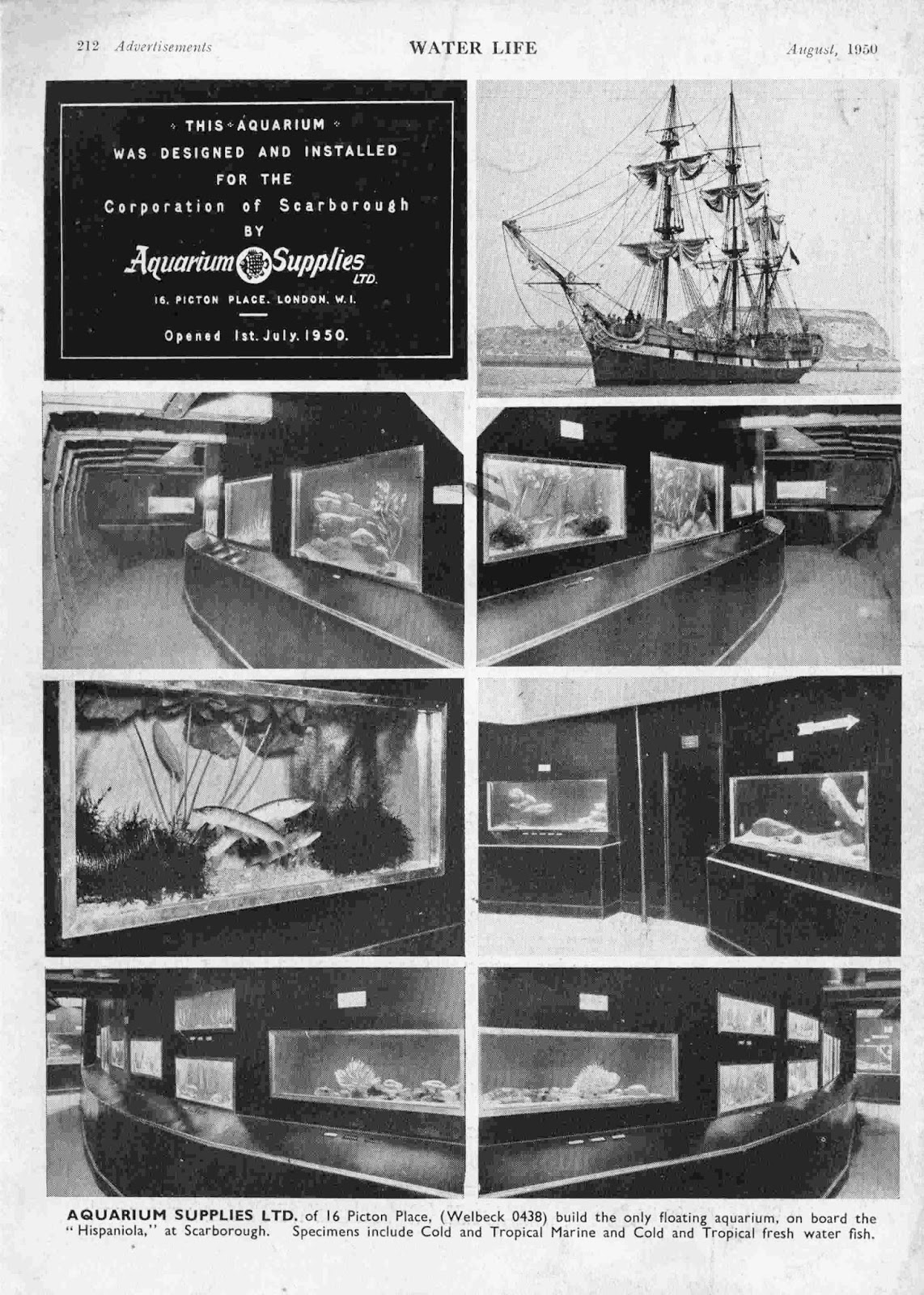
British seaside towns in the 1950s were in the business of attracting holidaymakers and animal exhibits of one kind or another often filled the bill. Aquariums were (and still are popular) especially on wet days in towns where boarding house landladies turfed their inmates out after breakfast and locked the door until 'tea' time, sometime after 5 pm. Scarborough, a Yorkshire town on the east coast of England, always competed hard to attract the holiday pound. In 1949, the town corporation had built a boat with a pirate crew to sail across the freshwater mere to an islet covered in sand from the beach. Once there the children carried with their parents could dig for buried treasure. How do I know this? Well, I was one of the children but I apparently refused to dig for treasure; I was not going to be shouted at by some piratical slavedriver and join a bunch of thugs throwing sand everywhere. So, with the full dignity of a five-year old I withdrew my labour. The whole venture was an enormous success for Scarborough, if not for me, and ran in the holiday season for many years. The pirate 'ship' was called the Hispaniola. However, Scarborough then acquired another Hispaniola, an ocean-going vessel built in the 1880s and named Ryelands that had starred in the 1950 Disney film Treasure Island. This one was moored in the harbour and this is where Charles Schiller appears in the story.

Charles Schiller's company, Aquarium Supplies, built a public aquarium in this second Scarborough Hispaniola in 1950. This is from Water Life and Aquaria World of August-September 1950:

...Internally, the ship's structure has been considerably altered to accommodate the large tanks in which fish from all parts can be seen in surroundings made to represent as near as is possible their natural haunts.
     Largely responsible for the co-ordination of the work of setting up the tanks is Miss Joyce Noble who comes from Durban, South Africa and who, with the advice given by technologists from laboratories and research stations, took steps to ensure that the correct effect was achieved in each separate section. The photograph below shows her on the deck of the vessel where only a short while ago fierce mock fights and walking the plank episodes were undertaken. Miss Noble was carrying out the more peaceful task of selecting samples of rockwork and is seen holding a particularly fine piece of pure white coral from the Great Barrier Reef, presented by the local museum. The other picture shows that Miss Noble herself gets into appropriate dress to seek out suitable material from stretches of the coast.
     From what I hear of the project, I think that the Scarborough authorities are to be congratulated on the venture and Aquarium Supplies, Ltd, on the way they have made a first-class job of the conversion and setting-up. I have no doubt that aquarist's [sic] societies from all over the country will be keen to arrange day outings to this well-known Yorkshire seaside resort and to make a visit to the Hispaniola the chief event of the day.
     For those unable to make a trip there for the time being, I am hoping to be able to give a description of the aquarium in a later issue, detailing the construction of the tanks and listing the creatures to be seen.
     Incidentally, whilst mentioning Aquarium Supplies, Ltd. it was this firm which set up the aquarium in the Ideal Homes Exhibition, Berg House illustrated in the last issue.
     Mr. Schiller, assisted by Miss Joyce Noble, was responsible for designing the layout of aquariums in the homes of a number of well-known people, including Lord Rothermere, Miss Gracie Fields, and the Western Brothers. Another achievement of the firm was to secure the commission to install a tank in Buckingham Palace.

It is not surprising that Charles Schiller had a full-page back-cover advertisement in the same issue:


The floating aquarium was called the Hispanioquarium. The ship then apparently soon moved to appear as Moby Dick to Morecambe, another town trying to attract holidaymakers, but was destroyed by fire in 1970. There is no mention of the aquarium still being present.