Tuesday, 30 July 2019

The Golden Takin: who, what and when

In previous posts I have described collecting and game shooting trips into the mountains of central China from which specimens were sent to the Natural History Museum in London in the years before the First World War. As a result of the first Oldfield Thomas at the Museum named as a new species a Takin, now known as the Golden Takin. I will return to the question of whether it is a ‘good’ species later. The first specimens, two females and a male, to reach London were from the later phases of the Duke of Bedford’s Exploration, almost immediately followed by George Fenwick-Owen’s travels with his companions over much of the same ground.


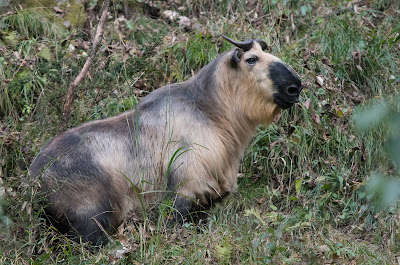
Golden Takin photographed in Shanghai Zoo by
J Patrick Fischer in 2011
(shown on Wikipedia)

In China

The leader of the Exploration, Malcolm Playfair Anderson, had an article published posthumously in which he described how he and his party, Frank Kingdon Ward and Dr Jack Smith, had obtained the skins and skulls in January 1910. They were in the Qinling Mountains, west-south-west of Xi’An when they heard reports of a strange animal called a ‘pan-yang’. Being busy with collecting small mammals and birds they hired a local hunter to shoot specimens. This the hunter did and sent a messenger with the news that two females were ready to be skinned. The next day Anderson, Ward and Smith along with porters set off on the steep, ice-bound climb. A village blacksmith had made some heavy iron crampons and these they needed. Ward could not keep up and eventually after a very cold night made his way back down. Anderson and Smith continued. By this time they had climbed from the village at 3,000 feet to above the tree-line at 10,000 feet. They stayed the night with sawyers who gave them food since Ward had been carrying all the provisions. The next day they reached the hunter and the animals. Anderson had no idea what the animals were, with Smith guessing a muskox. The cadavers were in thick ‘bamboo-grass’ on a steep slope and being frozen took a long time to skin. The party then retreated leaving the hunter to bring down the skins and skulls the following day. The descent was difficult in the freezing cold and high wind but a full moon enabled them to continue:

To right and left rose snowy peaks, at our feet was a precipice, and far below us lay vast caƱons filled with dark forest. By daylight it would not have appeared an unusual mountain scene, but in this enchanted light it was indescribably majestic. We paused awhile, forgetting that we were tired, shivering, and famished. 

They reached the inn in the village at midnight.

Anderson, Ward and Smith also, said Anderson, attempted to hunt for specimens themselves with the assistance of local hunters. They slept in a cave, more an overhanging rock, which is clearly the cave which Fenwick-Owen, Wallace and Smith occupied in considerable discomfort on their trip in 1911. The party did see takins and got within range for Anderson to have a number of shots shots. However, he missed. Then the hunter appeared to announce he had shot a male just below their ‘cave’. That was the third specimen to reach London.

From the dates in the accounts it would seem that Anderson reversed the order of the two occasions for his magazine article. He states that the party set off to shoot a Takin themselves on 8 January. In his description of the type specimen, one of the females, Thomas  gives the date it was shot as 15 January 1910. To add to the confusion, Wallace in describing the other ‘sportsmen’ who had shot takins in China notes that Smith, ‘our companion’, killed one in Shensi in 1910. So were takins, in addition to those sent to Thomas in London, collected during the Duke of Bedford’s Exploration?


The 'cave' in the Qinling Mountains used by both expeditions
(From Wallace's book)

In London

Oldfield Thomas was obviously delighted with the skins and skulls received from Anderson.

Of the majority of the Shen-si specimens there is little new to record, as Mr. Anderson had obtained the same species on his previous visit to the more northern part of the province. But in any case their interest is dwarfed by the discovery on Tai-pei-san of a magnificent species of Takin, quite different from the known W. Chinese species Budorcas tibetanus, and both in interest and beauty one of the most striking mammals that it has ever been my good fortune to describe. 

He first described it to the Zoological Society of London which was published as an abstract on 2 May 1911. Then in a fuller paper he described the specimens more fully. The type specimen for his new species, Budorcas bedfordi,  was one of the females. He went on:

The discovery of this splendid animal, whose golden-buffy colour renders it by far the most beautiful of its genus, is of the highest interest, and it is with great pleasure that I name the species in honour of the Society's President, during whose exploration of Eastern Asia it has been obtained. Mr. Anderson himself seems to have thought the occurrence of Takin on Tai-pei-san of special interest, and believed that they would probably prove to be new. He says: "The herds on Tai-pei-san are isolated by some hundreds of miles from the nearest others we could hear of, and as I could not learn that any other foreigner has hunted them on Tai-pei, I believe the chance for a new species is good.”
As a matter of fact, however, specimens had previously been obtained and had passed into the possession of the American Museum of Natural History at NewYork. But these were quite young, and showed, as it was not unnatural that the young should show, more or less of the normal coloration of the group, with blackish muzzle and extremities, and therefore in recording them Dr. Allen saw no reason to suppose them different from B. tibetanus. The practically unicolor condition of B. bedfordi proves therefore to be a characteristic of the adult, a fact which, in view of the peculiar specialization of such a colour, is not at all surprising.

Wallace writing in 1913, stated that the New York specimens had been purchased from a local hunter.

Is the Golden Takin a separate species?

The Golden Takin since its description by Oldfield Thomas has been lumped or split according to the views, whims or philosophies of taxonomists over the past century. Thus all the forms of takin, from the Himalayas in the west to the Qinling Mountains of China in the west have been lumped into one species, Budorcas taxicolor. Alternatively, the subspecies, for example B. t. tibetana (from the mountains of Sichuan) and B. t. bedfordi have been regarded as full species, as Thomas maintained. Generally, the lumpers held sway, the differences between the geographical forms being in coloration. The Takin appears as one species, for example, in the 4th edition of Walker’s Mammals of the World from 1983 and in A Guide to the Mammals of China from 2008. Recently however, those adhering to the phylogenetic species concept (PSC) have all the forms split as four species, with B. bedfordi resurrected, for example, in Volume 2 of Handbook of the Mammals of the World. Readers may be aware that I regard those who adhere to the PSC and not the biological species concept as akin to the man searching for his keys under the street light even though he did not lose them there on the grounds that is the only place where he can see. So, yes, you can take it that I see no reason to regard the Golden Takin as a ‘good’ biological species.

I cannot help wondering if Oldfield Thomas may have just got carried away when he erected the golden-coloured takin as a full species. After all, what better way than to recognise a benefactor, whose funding had really pushed forward knowledge on the mammals of China, by naming a most spectacular animal after him?


Takin distribution from IUCN's Red Data List (here). The RED line shows the approximate site of collection of
specimens by the Duke of Bedford's Exploration in January 1910. The BLUE Line shows the approximate site of Tangjiahe in Sichuan where the videos and photographs were taken in November 2017


What is a Takin?

The Takin is undoubtedly a strange looking animal. For years it was thought to be closely related to the Muskox. However, it was eventually realised—and recently confirmed by analysis of the entire mitochondrial genome—that the Takin belongs to the sheep and goats tribe, the Caprini (or the subfamily Caprinae, if following that scheme of classification) sharing immediate common ancestry with the true goats (Capra) and blue ‘sheep’ (Pseudois).

————————————————

Takins are animals of the mountains, moving up and down steep forested slopes with ease. In the summer they are most active at dusk and dawn but in winter may feed all day. Similarly, they move to higher altitudes in summer but in winter can be found in the valleys. They are mostly browsers. I have written about our encounters with Takins at Tangjiahe National Reserve in Sichuan previously (link here). The Takin here is usually referred to, not surprisingly, as the Sichuan Takin, Budorcas taxicolor tibetana, or by PSC devotees as B. tibetana. That article has a link to one of my videos. Another, showing Takins at night as well as by day is below. Clearly, as you will see, fallen, ripe persimmons are irresistible.


I have heard but seen little written that Takins are the most dangerous wild animal in China in terms of loss of human life and limb. They will certainly charge at perceived danger. When we tried to see the Takins in the the park in Thimpu, Bhutan, where a number are kept, we could not. The park was closed because one of the males was so aggressive that it had been charging at visitors through the wire fence to the detriment of the fence.

Finally, some photographs by Tim Melling of the same animals I videoed in Sichuan in November 2017. They can also be seen on Flickr along with Tim’s other photographs.



Links to previous articles:

Oldfield Thomas here
Duke of Bedford’s Exploration here, here, and here
Fenwick-Owen’s Expedition here

Anderson MP. 1920. The discovery of the Chinese Takin. Natural History 20. 428-433.

Nowak RM, Paradiso JL. 1983. Walker’s Mammals of the World. 4th edition. Baltimore: Johns Hopkins University Press.

Smith AT, Xie Y (editors). 2008. A Guide to the Mammals of China. Princeton: Princeton University Press.

Thomas O. 1911. The Duke of Bedford’s zoological exploration of eastern Asia.—XIV. On mammals from southern Shen-si, Central China. Proceedings of the Zoological Society of London 1911, 687-695.

Wallace HF, 1913. The Big Game of Central and Western China. Being an Account of a Journey from Shanghai to London Overland Across the Gobi Desert. London: John Murray

Zhou M, Yu J, Li B, Ouyang B, Yang J. 2019. The complete mitochondrial genome of Budorcas taxicolor tibetana (Artiodactyla: Bovidae) and comparison with other Caprinae species: Insight into the phylogeny of the genus Budorcas. International Journal of Biological Macromolecules 121, 223-232.

Thursday, 25 July 2019

To Shoot a Golden Takin. George Fenwick-Owen’s big-game and zoological collecting expedition across China, 1911-1912

In my article of 15 May 2019 I described Dr Jack Smith’s part in an expedition led and paid for by George Fenwick-Owen in China in 1911-12. Smith was hired as interpreter but, as might be expected, his medical and diplomatic skills were called upon as well. The trip was written up and illustrated by Harold Frank Wallace (1881-1962) and it is not surprising that Wallace is sometimes referred to as its instigator and leader; he was not, he makes it clear that he had been asked by Fenwick-Owen to participate.

Fenwick-Owen and Wallace left Liverpool on 19 May 1911 on board Canadian Pacific’s Empress of Ireland. They then travelled across Canada and then by sea to Shanghai. They arrived back in England in April 1912.

The actual hunting in the Qinling and Min (Minshan) mountains west of Xi’an (with the relevant parts of the various corpses prepared for the Natural History Museum in London) occupied a relatively small part of the journey as did Smith’s collection of small mammals also destined for the museum, although gazelles and birds were shot for food during the long journey to Russia. As the revolution in China that overthrew the Qing Dynasty got underway the party decided it unsafe to head back to Shanghai from Xi’An via Sichuan and the Yangtse valley as planned. Instead they headed across the Gobi Desert for the Russian border—a distance of approximately 2,400 km.


The route across China can be followed on a modern map. Sianfu is Xi'an


The London press had a number of reviews of Wallace’s book and I can no better than to quote here the article in the Illustrated London News (17 May 1913) by Professor John McKendrick FRS (1841-1926), Professor of Physiology in the University of Glasgow from 1876 until 1906:

Big-Game in China. Mr. Harold Frank Wallace has given a rather mislead­ing title to his account of a sporting journey from Shanghai to Omsk across the Gobi Desert. To call it. as he does, “The Big Game of Central and Western China“ (John Murray) is to suggest that the volume deals only' with natural history and sport, while, in point of fact, the first seventy pages deal with travel, and, after fifteen pages of sport, there arc perhaps forty dealing with other matters. Happily Mr. Wallace tells the travel story well; he was in a part of the world known to few Europeans, save missionaries, who appear to be labouring in a rather stony vineyard. The takin (Budorcos bedfordi) was the special object of the expedition : it is a near relative to the musk ox, and is found in Shensi; others of its family being found elsewhere. It is known as the rock-goat in Shensi, and as the wild ox in Kansu. Other big game secured by the author and Mr. George Fenwick-Owen, whose guest he was, include roe-deer (Capreolus bedfordi), burhel (precipice sheep), white-maned serow, “a strange beast with enormous ears like those of a roan antelope...and a long mane"; bear, and wapiti. 
The country covered proved to be interesting, and the primitive people were friendly, although the revolu­tionary movement was about to affect several districts through which the author and his friend passed. 
Dr. J. A. C. Smith, of Shanghai, who accompanied the party, was asked by the people if, when he reached home, he brought back to life the birds he was stuffing! Cer­tain pheasants, known as machi, are trapped and reared to provide a dozen tail feathers per annum for hats; but, as a rule, the people show little inclination to preserve, and are quite content to destroy — the fate of the forests being accountable for much of the poverty that pre­vails in a country where peaches and eggs may be bought at the modest rate of sixteen for a penny! The revolution in China broke up the programme and brought Mr. Wallace and his friend home by way of Tibet and Asiatic Russia; but Mr. Fen­wick-Owen's collection of small mammals, prepared by Dr. Smith. and consisting of sixty-eight specimens, includes seven new species, and is described by the British Museum authorities as "a most valuable supplement to the series obtained by Mr. Anderson during the Duke of Bedford’s exploration of Eastern Asia.” Certainly the story of the expedition provides good reading for, quite apart from the author’s distinct gift, it deals with an unknown country, and animals about which we have had little precise information hitherto. Photographs, drawings, maps, and appendices add to the value of the book. The cost of a six-months’ trip, starting from Shanghai, for two sportsmen, a white interpreter, and boys, is set down at £816. 

Travel was by boat (up the Yangtse), train and, uncomfortably, by mule- or horse-drawn cart. Wallace’s book contains many observations on rural and urban China. Anybody who visited the old Tiger Balm Gardens in Hong Kong and saw the plaster models depicting methods of torture and execution will not be surprised at what the travellers saw as everyday occurrences or of the atrocities inflicted on the Manchus as any semblance of structure broke down at the start of the revolution. One governor was killed by being fed feet-first into a straw chopping machine. Two days before their arrival in Liangchow (now Wuwei) ‘three men—a Szechuanese and two natives—went to a big farm 40 li from the city and told the proprietor that they were revolutionaries. They said that a large body of troops was arriving on the following day who were to encamp near his farm, but that, if he would provide them with three horses and guns, they would see that he suffered no further loss. The farmer provided them with the horses and guns, but would not allow them to leave. Next day, no sign of a revolutionary army! Down came the farmer and his friends on the three impostors and marched them off to the official at Liangchow, who was a man of prompt action. Consequently, on our arrival, to parody Charles Kingsley, "three corpses lay out in the muddy streets”…

Wallace continued: ‘A favourite pastime of the district was the chopping down of telegraph poles, these being a convenient form of fuel. Ten miles of these useful articles having been demolished outside the city, telegrams were forwarded over this distance in a more or less unreadable condition by mounted messengers. Two or three men had been executed at Kanchow [Zhangye], this being the only effective deterrent. We saw one head nailed up in a wooden cage outside the walls’.


Wallace’s theme for the book was its intention to guide fellow hunters on the pro and cons of China as a place to shoot big game and of how to go about it in terms of the sort of guide to employ (i.e. Smith) and the costs involved. However, it is clear that all three participants were very keen naturalists and antiquarians as well as people watchers. Wallace’s approach took me back to early 1959 and ‘O’ level English Language. We had to prĆ©cis a passage and either in the ‘mock’ or the real examination the passage were were given argued that natural history as pursued by observation and collection is really a substitute for the hunting that once perforce occupied our ancestors. Indeed as madly keen birders walk and stalk with binoculars, telescopes and cameras, the words ‘prey’ and ‘quarry’ spring instantly to mind.


The finances of the trip make interesting reading. Wallace included them as a guide to anybody wishing to undertake a hunting trip to the mountains of central and north China. The total expenditure was £816 of which £360 was paid to Smith (£60 per month for six months). The average pay of a medical practitioner in Britain in 1911 was £272 so I think it can be said that Smith did alright In today’s money, calculated from the Retail Price Index, Smith received £32,000 for his six months. However, because pay has risen to a greater extent than prices, a higher estimate is £135,000.


Crossing the Gobi Desert


Harold Frank Wallace


Wallace was born in Yorkshire on 21 March 1881, the son of a physician. At the 1891 Census the family was living in Inverness-shire; he described himself as Scottish and clearly spent a great deal of time stalking Red Deer. In 1901 the family was in Chelsea. He was educated at Eton and Christ Church, Oxford. He was a barrister by profession but it seems unlikely he spent much time at the bar. His life seems to have been devoted to hunting (a two-year trip round the world before the expedition to China with Fenwick-Owen), writing about hunting and travel, and painting Scottish highland scenes containing deer. His work appears regularly on the art market. After his return from China he married Elizabeth Anne Macpherson on 11 July, an occasion described at very great length by the Staffordshire Advertiser. He served in the Royal Navy Volunteer Reserve in the First World War. There is a photograph of him from 1917 or 1918 (he was commissioned sub-lieutenant in April 1917, having served as an Able Seaman and Petty Officer) in the Imperial War Museum.

His wife inherited Little Wyrley Hall at Pelsall in Staffordshire and they lived there from 1927 until his death. He served as a local magistrate from 1934. The house, over 400 years old, has appeared on television and in magazines not because of its elegance and antiquity but because of its surroundings. It is in the middle of a coalfield and the resultant workings. Country Life reported on a visit to the Wallaces in 1952: ‘The prospect westwards from the front door is terminated in the middle distance by a monumental slag-heap. Colliery workings have encroached to within a few hundred feet of the east side of the house’.

He acquired a dubious honour but one to be dined-out on. On 25 April 1938, the Aberdeen Press and Journal reported under the headline, ‘Hitler Decorates Three Britons’:

Herr Hitler has decorated three Britons with the order of the German Eagle of the Third Class in connection with the recent hunting exhibition in Berlin. They are…and Mr Harold Frank Wallace, author, artist and big game hunter.

Wallace was the Deer Controller Officer for Scotland during the Second World War.

Harold Frank Wallace died on 16 September 1962 at Wyrley Hall. Reporting his death, the Birmingham Post of 18 September recalled his visit to Berlin in 1937: ‘He recalled lunching…with Goering whose elaborate hunting costume reminded him of a little boy “playing at Robin Hood”. The article ends:

A tithe barn at his home was converted to hold a collection of nearly 200 trophy heads. There could be found one of his rarest specimens, a takin, which is a large mountain animal from Tibet, ibex, wapiti and boar. His son, Mr Hamish Wallace, said last night: ‘The trophies have become a part of Wyrley and there is no question of removing them.’ Mr Wallace said that in the past few years, who had shot many hundreds of animals, was very concerned with the preservation of wildlife, particularly in Africa. ‘He told me “I would not be interested in shotting now that so many herds have dwindled”.’

Does anybody know what happened to the Takin and other material collected in China? (Fenwick-Owen’s went to the Natural History Museum.) Are they still at Wyrley Hall?

Finally, who was George Fenwick-Owen?


Wallace in his book helpfully reproduced a whole paper by Oldfield Thomas on the mammals collected. As a result we know that Fenwick-Owen had previously donated specimens to the natural history museum from ‘French Gambia’, presumably Senegal. Thomas named a mole discovered in the montane forests by the expedition for Fenwick-Owen—Scapanulus oweni, the Gansu Mole. This mole is still the only member of its genus; it occurs only in Central China.

I suspect this is a photograph
of Fenwick-Owen since he shot
the Serow
Fenwick-Owen appears in The Eponym Dictionary of Mammals under ‘Owen’. The Golden Takin collected is mentioned as is the type specimen of a peony and some antiquities. However, no dates of birth and death had been found. As a result of my digging around the usual sources, I can now add those dates.

George Fenwick-Owen was born on 28 December 1882. He was the son of Francis Fenwick, a banker, and Mary Matilda Owen. A note on a genealogy reads ‘Name “assumed by his mother’s royal warrant”. I have no idea what they statement means but it is possible that his name was changed to the double-barrelled Fenwick-Owen by royal licence, a common method at the time. Records show that he was schooled at Eton, leaving in 1902, and then matriculating at Exeter College, Oxford, in 1903.

When he set off for his Chinese expedition in 1911 he was 28. I have found no record of any other collecting activities after his return in 1913. In March 1914 he was married to Marion Bettina Maud Rawnsley*. The honeymoon was in Japan.

There is an interesting connexion with the world of natural history on his wife’s side. The wedding reception was held at 45 Pont Street, London, ‘lent’, the report in The Times states, ‘by Mr & Mrs F du Cane Godman’. The bride’s cousin, Eva Godman, was a bridesmaid. Frederick du Cane Godman FRS (1834-1919) was ornithological aristocracy, a founder of the British Ornithologists’ Union and still commemorated by the Godman-Salvin medal. Whether George Fenwick-Owen had any introduction to the upper reaches of natural history through the Godman connexion, to Oldfield Thomas, for example, before his marriage, i.e. at the time of his expedition to China, I do not know but it does seem possible.

On 1 October 1914, war having been declared on 28 July, he was commissioned as a subaltern in the Norfolk Yeomanry. Promotion to 1st Lieutenant followed in May 1915 and to Captain in December 1915. He was awarded the Military Cross when attached to the 12th Battalion Norfolk Regiment in Palestine. He was wounded twice, in Egypt and in the Gallipoli Campaign. The citation for his M.C. reads:

Capt. George Fenwick-Owen, Yeo. For conspicuous gallantry and devotion to duty during an engagement. He contributed largely by his promptness and sound judgement to the success of the operation. His initiative, courage, and good leadership undoubtedly saved many casualties among his men.

By 1924, the Fenwick-Owens were living in Knightsbridge, London but The Times of 26 February 1929 announced, ‘Captain and Mrs Fenwick-Owen have taken [i.e. are renting] Rempstone Hall, Corfe Castle Dorset, which will be their address in future’. However, the Fenwick-Owens were divorced in 1932, the year in which he married Zella Evelyn Oxley.

In July 1931 there were press reports of a gift to the Natural History Museum of specimens of two skins and a skull from bears which must have been retained when he donated the rest of his collection from China in 1912. The bear, mentioned in Wallace’s book, was said to be the ‘Blue Bear’ or Tibetan Bear usually now considered as an extremely rare subspecies of the Brown Bear (Ursus arctos pruinosus).

He may have been living in Dorset, if not at Rempstone Hall, after his divorce because he is shown as lending pictures for an exhibition in Dorchester in 1934. After another divorce in 1940 he married Denise Margaret Louise Cash (born 1914) in Suffolk in the same year.

George Fenwick-Owen died on 21 November 1971 at Woodbridge in Suffolk, leaving £1,472.

Therefore, we can the dates to the entry in the Eponym Dictionary of Mammals: 1882-1971.


*His son from this marriage was Roderic Fenwick Owen (1921-2011); obituary in The Independent here.

Wallace HF, 1913. The Big Game of Central and Western China. Being an Account of a Journey from Shanghai to London Overland Across the Gobi Desert. London: John Murray


Monday, 15 July 2019

“…we must put down to pure Irish whimsy his decision to write a book on life”. A 1950s Spat Between Two Famous Scientists on the Origins of Life: Pirie versus Bernal

Penguin’s New Biology in 1952 contained a war of words between former and possibly continuing friends. For those of us encouraged as schoolboys* to read past volumes for ‘A’ levels and especially the old ’S’ or Scholarship level, the mutual slagging off by two eminent scientists was a useful introduction to the cut-throat world of research and scholarship.

The spat started with a review of a book written by John Desmond Bernal FRS (1901-1971) the ‘Sage of Science’ on the origins of life. Norman Wingate (‘Bill’) Pirie FRS (1907-1997) was the reviewer. After seven excoriating pages, headed ‘Vital Blarney’ he ended:

This little book, therefore, is unsatisfactory. It has been compared to Schrodinger’s book What is Life, but it is not as bad as that; it is at least, for the most part, about its sensible subject and Professor Bernal knows something of the matter. But he does not know enough to contribute usefully. This criticism may be looked on as simple example of he old injunction to stick to his last. To some extent it is. But such an injunction would not unreasonably restrict Professor Bernal. He would need as many arms at Briareus to attend adequately to all the lasts he is qualified to do some banging on. There are so many subject—crystallography, politics, building, bomb-damage, ethics, history, etc.—on which he writes authoritatively and convincingly that we must put down to pure Irish whimsy his decision to write a book on life. So much already has already been written on the subject that impatience is justified at a contribution made up so largely of blarney.

In the next issue, Bernal wrote a defence under the title ‘Keep off the Grass’. It began:

One of these days I will see a review by N. W. Pirie of a scientific work of which he thoroughly approves. It will no doubt be a study by an expert in the field which explores, very precisely and with every reasonable precaution, a circumscribed subject and expresses the results in an orderly way with due allowance for any possible foreseen or unforeseen error. It will certainly never be anything I write. To be criticized by Pirie therefore does not surprise me and is no mark of distinction. However, in his delight in castigating the impudence of anyone—not even a biochemist—who pretends to knowledge about the origin of something that does not exist, he has allowed himself to express opinions of his own of an extravagance of scepticism that far exceeds anything he charges against me, and it is these rather than his criticisms of my efforts that require to be answered. The burden of Pirie’s review was that firstly I had said nothing new, or even nearly new, for what I had said had been better said fifty to a hundred years ago, further, that insofar as I had said anything else it was unproven or wrong, and lastly, that not being a professional biochemist I had no right to say anything at all on the subject.

and ended:

Pirie chides me for knowing too little of our ignorance. I would wish him in return not to ignore so much of our knowledge.

Bernal (left) and Pirie
from their respective Biographical Memoirs

The whole history of Bernal’s interest in the origin of life or, perhaps, more accurately, the origin of organic compounds found in living organisms, and the background to this then famous spat have been explained by Andrew Brown in his biography of Bernal. The latter’s book arose from a lecture he gave. Pirie then wrote a criticism of the lecture and sent it to Bernal who incorporated it as an appendix to the book without checking with Pirie that he had no objection to its publication. But Pirie did object. Pirie was a stickler on the correct use of English and was concerned that he had written the criticism in a hurry, possibly while ‘tight’, and may have committed solecisms he condemned in others, the ‘others’ including Bernal!

Bernal wrote a not-so-grovelling apology in a letter to ‘Dear Bill’:

It never occurred to me that you were tight, or, even if you were, you could ever have forgotten yourself so far as not to express yourself in perfect English!…I should have asked you and I am very sorry now that I did not because you might have produced longer and even more controversial comments.

Pirie’s revenge was the review of the book.


Pirie NW. 1952. Vital Blarney (Review by N.W. Pirie of The Physical Basis of Life. J.D. Bernal. 80 pp, 1951. Routledge and Kegan Paul. 6s). New Biology 12, 106-112.

Bernal JD. 1952. Keep off the grass. A review of a review. New Biology 13, 120-126.

Brown A. 2005. J.D. Bernal. The Sage of Science. Oxford University Press.

Hodgkin DMC. 1980. John Desmond Bernal 10 May 1901-16 September 1971. Biographical Memoirs of Fellows of the Royal Society 26, 17-84.

Pierpoint WS. 1999. Norman Wingate Pirie. 1 July 1907-29 March 1997. Biographical Memoirs of Fellows of the Royal Society 45, 397-415. 

*When did the use of ‘student’ creep into use as a term for school pupils?

Thursday, 11 July 2019

More Hong Kong Porcupines

More photographs from our Hong Kong correspondent of porcupines (Hystrix brachyura) on Hong Kong Island last week:


They now forage very close to the pedestrians and cyclists on the path across the hillside.

Saturday, 29 June 2019

Feathers Fly in London. Why on earth was Chalmers Mitchell of London Zoo on the wrong side of a conservation battle of the early 1900s?

Peter Chalmers Mitchell
I have never been able to make up my mind about Sir Peter Chalmers Mitchell FRS (1864-1945). At the Zoological Society he was treated as a god; icons of his reign as Secretary between 1903 and 1935 were still around the offices in the 1990s. His biographers and obituarists concentrated almost entirely on his work running the Zoo and in his life in Spain during the civil war rather than as a scientist or writer on biological questions of his day.

The more I read about Mitchell (he adopted his second first name, his mother’s surname, to make a non-hyphenated double-barrelled surname in the Scottish style) I realised he was a skilful political manipulator and self-publicist with modest scientific credentials, even by the standards of the times.

What I did not know was his involvement—clearly on the wrong side—in a major bird protection and conservation measure of the early 20th century. Only when I read William T. Stearn’s (1911-2001) 1981 book on the history of the Natural History Museum a few years ago did I come across the story.

Sir William Flower when Director of the Natural History Museum became concerned at the vast numbers of birds being killed around the world to satisfy the fashion of adorning women’s hats with feathers, wings and even the skins of whole birds. A Bill to prohibit the importation of skins and feathers passed through the Lords but was rejected by the House of Commons in 1908. And the numbers really were vast—millions of birds each year.

Six years later, in 1914, the Trustees of the Museum supported another Bill to suppress the plumage trade on the grounds of protection (the killing of adult birds with young left to die in the nest) and conservation. However, the trade was highly profitable and trade organisations galvanised their supporters against the Society of Protection of Birds, formed specifically to lobby for abolition. A major supporter of the trade was, amazingly, the Selborne Society, named for Gilbert White and Britain’s first national conservation organisation, dedicated to the ‘preservation of birds, plants and pleasant places’. Equally amazingly, Mitchell was fielded by the group formed by the trade to oppose the proposed legislation. Instead he and many of the great and good who were members of the Selborne Society argued in favour of the trade and argued it could be supported by captive breeding: 

…to consider and suggest to those interested the best means to protect, maintain and encourage the increase of all useful species including those used in the feather trade, so as to ensure a regular supply without endangering any.

Stearn takes up the story:

The opponents of the Plumage Bill, then before Parliament, accordingly convened a meeting at Burlington House, Piccadilly, against the proposed legislation. At this meeting C.E. Fagan, Assistant Secretary of the Natural History Museum, Sidney Harmer and Ogilvie-Grant represented the Museum’s Trustees in their attempt to prohibit the import of feathers. Rather surprisingly, Dr (later Sir) Peter Chalmers Mitchell (1864-1945), Secretary of the Zoological Society of London, chose to appear on the platform in support of the plumage traders and, by reason of his office, thereby implied that the Zoological Society likewise supported them against the Natural History Museum and the bird protectionists. Fagan therefore requested Mitchell to state publicly before he addressed the meeting whether he was about to speak in his official capacity as representing the views of the Zoological Society’s Council in opposition to the Bill, or whether he was about to express his own personal opinion. Being pressed for a definite and unequivocal reply, he was forced to admit that he had no mandate from the Zoological Society and attended merely in a private capacity. This was all the Museum representatives wanted. An eye-witness recorded that ‘after the meeting Mitchell, livid with rage, stepped down from the platform and, coming up to where we were sitting, stopped in front of Fagan and positively hissed out “I demand of you a public apology!” He got an appropriate reply but no apology, public or private’. Thereafter Mitchell refused to shake hands or even to speak to Fagan. The retirement of Fletcher in 1919 as Director [of the Museum] provided the opportunity of revenge. The Plumage Bill did not, however, receive royal assent until 1921 and not until 1922 did it become operative.

Fellows of the Zoological Society were clearly disturbed by Mitchell’s behaviour and they found a spokesman in Sir Harry Johnston (1858-1927)--of Okapi fame—who wrote several letters to The Times. One, 18 February 1914, concluded:

It was further announced with some emphasis that an address on the economic preservation of birds by Mr. S. L. Bensusan, presided over by the Countess of Warwick and supported by Dr. Chalmers Mitchell, F. R. S., would take place on February 16. From the brief Press notices of the meeting published to-day, I can discern no reason why bird-lovers should abate their hostility to the unreasonable developments of the plumage trade. Dr. Chalmers Mitchell, a very distinguished biologist and the Secretary of the Zoological Society, is president of the Committee for the Economic Preservation of Birds. But unless he disavows the statement made in the pages of the Selborne Magazine that his committee deprecates legislation for tho protection of birds or would postpone it to some vague future period, he is not acting fairly towards the numerous Fellowship of the Zoological Society; for there are, I am convinced, in that society a great many persons besides myself who consider that, if the Zoological Society Is to intervene in the question at all, it should be to range itself on, the side of the Government and of the advisers of tho Government in the Natural History Museum, and assist in bringing forward as soon as possible a measure which shall on behalf of Great Britain close the now open market for the traffic in the skins of rare, beautiful, or useful wild birds.

The Countess of Warwick, incidentally, was Daisy, mistress of the Prince of Wales (Edward VII) and others.

The eventual outcome of the plumage Bill was that the Selborne Society, the first on the scene for conservation in England, was completely eclipsed by the (later Royal) Society for the Protection of Birds which now has more than one million members.

Five years later, in 1919, Mitchell certainly did have his revenge on the staff of the Museum who were sent by the Trustees to oppose him and who challenged his representation of the Zoological Society in 1914. Fagan, an able administrator, had effectively run the Museum under the less than effective efforts of two Directors. However, his pay was low. The Trustees therefore proposed with the the support of scientists in the museum to appoint Fagan as Director for a couple of years until his statutory retirement and the appointment of another scientist to the job. Mitchell organised a protest from the Royal Society and a letter to The Times signed by 20 FRSs. It would have been an easy matter to get them to sign. Here was a proposal to appoint an administrator, who was described as a ‘member of the clerical staff’ to a scientist’s job. The Trustees had to back down but they did appoint Sidney Frederic Harmer—a member of the team opposing Mitchell over the plumage Bill. Harmer, already a strong candidate, had written to Nature in support of Fagan taking over for a few years and had stated that he would not run against him. William Robert Ogilvie-Grant (1863-1924), Curator of Birds at the Museum and the other representative of the Museum who opposed Mitchell wrote to the Times:

[The Trustees] might certainly be supposed to know better what is for the benefit of the Museum than a number of university professors who, however individually able, deal with a side of natural history which has little or no connexion with the making and improvement of museum collections...I served under Owen, Flower, Lankester, and Fletcher, and have had more than thirty years’ experience of Mr Fagan as an enthusiast for the Museum, an encourager of scientific work, and as an administrator, and I should most warmly welcome his promotion to the post of which he has already done so much of the work.

Two hours before he retired the very ill Director, Sir Lazarus Fletcher FRS, in a letter wrote:

The present agitation is probably being stirred by Chalmers Mitchell who is very skilled in the memorialistic method and knows by experience and success all its possibilities. He got his own post by a successful use of the method. Nearly all the signatories have attacked the Trustees in the same way again and again…I have been a Fellow of the Royal Society for thirty years and know the line the Fellows will take.

Despite the open hostility of a number of Fellows of the Zoological Society during the feather war of 1914, Chalmers Mitchell survived as Secretary—he was skilled in packing the Council with supporters—and sailed on. Here indeed was a Scotsman on the make. 


Clarke R. 2005. Informal adult education between the wars. The curious case of the Selborne Lecture Bureau. Birkbeck College, Faculty of Continuing Education Occasional Papers No. 6

Stearn WT. 1981. The Natural History Museum at South Kensington. London: Heinemann