Tuesday, 30 April 2024

A Chameleon (and egg tarts) in Portugal

Chamaeleo chamaeleon

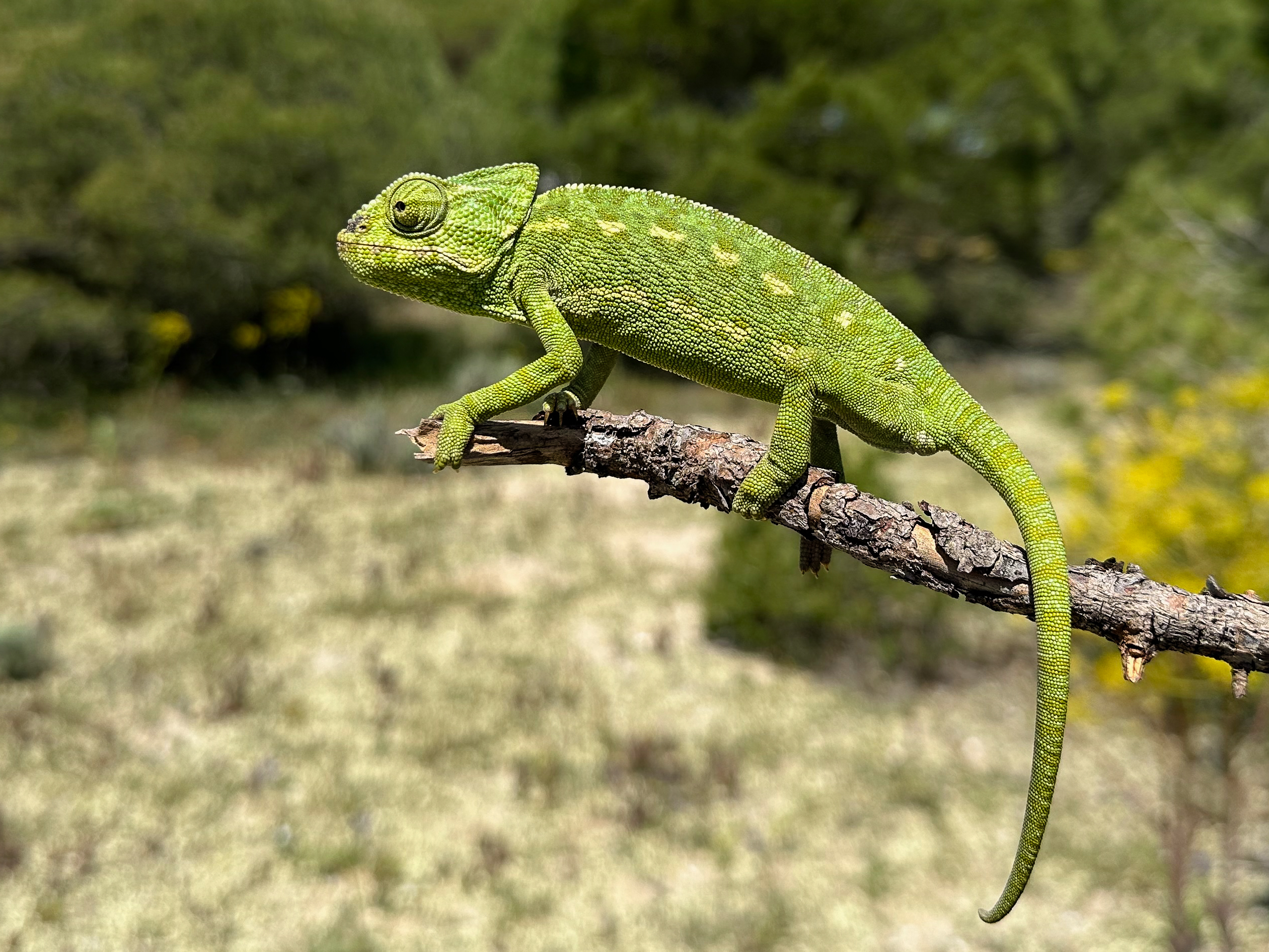
I have always wanted to see a Common Chameleon (Chamaeleo chamaeleon). Only once having visited a place within the range where they might have been found in the past (Crete) that is not surprising. So this one found in southern Portugal between a golf course and a tidal lagoon during a Naturetrek* trip earlier this month was a delight.

The chameleons live in low pine trees on sandy soil along the southern coast of Portugal and Spain. The breeding season comes much later in the year. Then males take to the ground in order  to search for females which they will guard. Eggs are laid in soft sandy soil. Growth of the young is rapid.

Chameleons in general are interesting in that they have widely different lifespans. Some are effectively an ‘annual’, all the preceding generation dying before their eggs have hatched. At the other extreme, some species live for ten or more years. The Common Chameleon is at the low end of the range: 2-3 years.

The Common Chameleon occurs along the coastal region of North Africa, the Middle East and Turkey and then down the eastern side of the Red Sea. To those of us of a certain age, tales of chameleons in North Africa were brought back by those who had served in the British Eighth and First Armies or in RAF bases in Egypt. The swivelling eyes, the tongue, the colour changes and their deliberate movement along branches were recounted to the extent that it seemed the whole population knew of chameleons and their habits. For some soldiers encounters with wildlife (sometimes, like jerboas and fennec foxes—and chameleons—reared and kept as pets) were their only experiences of war shared with their families. Herpetologists on both sides were known to have studied the animals encountered in North Africa and I dare say that tales of the chameleons also reached the children in Germany.

Recently, it has been argued that the chameleon was introduced into southern Spain and Portugal but with widely differing dates. The distribution map in IUCN’s Red List shows that part of the range as such. I am skeptical. After all the ranges of other species of reptile span the Straits of Gibraltar.

A chameleon and Portuguese Egg Tarts—who could want for more?


*Naturetrek’s Spring in Southern Portugal brilliantly led by Lara Broom (who knows how to spot a chameleon) and Glyn Evans.

Friday, 26 April 2024

Great Barbet Nesting in Hong Kong

AJP spotted Great Barbets (Psilopogon virens) in the New Territories of Hong Kong last week. They are uncommon residents, living in mature secondary broadleaf forests. They are also difficult to spot in the canopy. He later spotted a nest hole, high in a tree.


The Great Barbet is now only to be found in the New Territories but Herklots in his Hong Kong Birds of 1953 noted that in the early decades of the 20th century they were on Hong Kong island, even nesting in the Botanic Gardens in 1929. Herklots wrote:

I have never seen an adult near the nest; my collectors say that the adult bird comes quickly with a dash, i the usual manner with much noise, to feed its young, stays a few seconds and then dashes away in its normal undulating flight.

You can see the speed at which the adults leave and enter the nest in the short video.


Herklots also noted that the birds were often heard, with the call of the male ‘going on and on’, but seldom seen. ‘This bird never comes to the ground and spends its life in the dense fung shui woods of the valleys’. He regarded the population as a small number of year-round residents augmented by summer visitors.

One of Hong Kong's most impressive birds.


Wednesday, 24 April 2024

Elke Zimmermann 1958-2019. Herpetologist and Primatologist

Elke Zimmermann
from here

A few weeks ago while working on a different topic I came across the sad news that Elke Zimmermann had died in 2019 at the age of 61. Her book, Breeding Terrarium Animals, the English-language version of which appeared in 1986, drew on the major and then novel  advances being made in Germany on the breeding of amphibians and reptiles. Elke and her father Helmut (b 1926), an architect in Stuttgart, were very much part of the group of German herpetologists at the forefront of breeding tropical frogs and toads. The book was highly influential across the English-speaking world since it was part of a new wave of herpetology—the successful and reliable breeding of amphibians and reptiles in captivity—that was spreading across the world in the 1970s and 80s. The German-language version, Das Zuchten von Terrarienteren, was published in 1983 when Elke was 25. The publisher’s blurb, as this translation shows, makes the point about that new wave:

The breeding of amphibians and reptiles was considered difficult for a long time; almost only accidental breedings were known. Only in recent years has there been increased effort not only to keep these animals in captivity for as long as possible, but also to breed them. In this book, the author describes the reproduction and breeding of more than 300 species of amphibians and reptiles, with a large proportion of the animal species discussed in more detail being bred in the Zimmermann terrariums…


I have not seen the German edition of the book, published in 1983 when Elke Zimmermann was 25,  but the English-language version, published by the notorious Herbert Axelrod (1927-2017) under his TFH company, was said to contain new material as well more photographs, i.e  in the TFH house style.

Father, Helmut, and daughter, Elke, kept an array of animals at home. She became particularly interested in the vocal communication of dart frogs during their complex breeding behaviour. She continued through university and developed her interest in this field, particularly in primates. She went on to work extensively in Madagascar, particularly on the small lemurs, where her father was a leading light in conservation, but had wide interests and established breeding colonies of several species back in Germany, thereby combining field and laboratory studies


From 1996 until her death Elke Zimmermann was Professor in the Institute of Zoology in the University of Veterinary Medicine, Hannover.

To commemorate her life colleagues in primatology contributed to a special issue of International Journal of Primatology which covered her main interests. That volume also offers a glimpse of her early life (references omitted): 

Encouraged by her father, Elke became interested in zoology very early in life. She published her first article when she was 16 years old on an inventory of reptiles, which she had observed during an excursion with her family in Southern Spain. Her first article on primates followed 2 years later, in which, together with her father, she assembled recommendations for the housing of lorises (Nycticebus spp.), squirrel monkeys (Saimiri spp.), and talapoin monkeys (Miopithecus spp. At that time, all these species were housed in her family’s house and garden. She continued to publish on the biology of primates, amphibians, and reptiles while she studied biology at the University of Hohenheim. Although she wrote her dissertation on the neurobiological basis of acoustic communication in frogs and regularly published on amphibians until 1994, primates became her main interest after her PhD and during her career. She was interested in the evolution of primates, but in contrast to most researchers who focused on haplorrhine primates, Elke investigated the roots of the primate order and specialized on strepsirrhine primates…

I only realised years after the event  that in 2003 we had stayed in the accommodation Elke and her colleagues used at Ampijoroa in Madagascar. Then, there was no tourist accommodation (there is now) serving the Ankarafantsika National Park and groups picked up camping equipment at Mahajanga before driving the 70-odd miles to Ampijoroa. When it was discovered that two double rooms at the field station were unoccupied, the two oldest couples were allocated those. Initially thankful for being war babies, we had two uncomfortable nights, not helped by the swarms of mosquitos that danced above the open drains which ran round the entire block. Ampijoroa is an amazing site. A plethora of lemurs, other mammals, birds and reptiles was around every corner. But one species in particular is relevant to this discussion.

One evening on a walk on the lake side of the field station we had definite sightings of a species of mouse lemur only described a few years earlier.  It was the Golden-brown Mouse Lemur, Microcebus ravelobensis, named for Lake Ravelobe at Ampijoroa. Elke Zimmermann was first author of paper which described and named the new species in 1998. Notices warning of crocodiles in Lake Ravelobe have to be taken very seriously. Before our visit the local bird guide had been killed by the Nile Crocodiles found there—a fact not mentioned by the tour companies these days. When we walked along the shore, we saw the screens in the water behind which the local women could still wash the clothes. The danger was so great, we were told, even the men had started to do the washing.

While Elke Zimmermann is remembered by her scientific colleagues for her more recent research on primates, herpetologists will remember her earlier studies on, and breeding of, amphibians and reptiles with fondness and great admiration.


Golden-brown Mouse Lemur
From a low-resolution video
Ampijoroa, 7 November 2003


Radespiel U, Scheumann M, Schmidtke D. 2019. Prof. Dr. rer. nat. Elke Zimmermann. International Journal of Primatology 40, 589–591 https://doi.org/10.1007/s10764-019-00108-8

Radespiel U, Scheumann M. 2022.  Introduction to the special Issue celebrating the life and work of Elke Zimmermann. International Journal of Primatology 43, 539- 558 https://doi.org/10.1007/s10764-022-00307-w

Zimmermann, E. 1983. Das Züchten von Terrarientieren. Stuttgart : Franckh. Kosmos Verlag

Zimmermann, E. 1986. Breeding Terrarium Animals. Neptune, New Jersey: TFH Publications.

Zimmermann, E., Cepok, S., Rakotoarison, N., Zietemann, V., & Radespiel, U. (1998). Sympatric mouse lemurs in north-west Madagascar: A new rufous mouse lemur species (Microcebus ravelobensis). Folia Primatologica, 69(2), 106–114. https://doi.org/10.1159/000021571

Sunday, 31 March 2024

Pallas’s Squirrel on the Peak, Hong Kong

AJP photographed this squirrel on the Peak, Hong Kong island last week. I have written about Pallas’s Squirrel (Callosciurus erythraeus) in Hong Kong before, including its origins as an escapee from the pet trade, and the possibility that some are natural re-introductions from across the border. This one, with the light tip to the tail is typical of the ones found on Hong Kong island. Compare this with one he photographed in the New Territories (here) with the black ‘spot’ in the tip of the tail. The red belly—often not that easy to see from the side—which is not a constant feature, can be seen in this one.

It has been argued that those in the New Territories are the subspecies C. e. styani and those on Hong Kong island are C. e. thai.


Thursday, 28 March 2024

Günther's Frogs in Hong Kong. Start of the breeding season

 I have shown photographs of Günther's Frogs (Sylvirana guentheri) before but I could not resist these AJP photographed a few days ago at Tai Po Kau. I do not know why some individuals have the reddish back.


Wednesday, 27 March 2024

Australian Grass Parakeets: a colour plate from 1952

In the days when colour printing was extremely expensive, the Avicultural Society had special appeals for funds to support the appearance in Avicultural Magazine of the occasional colour plate. A well-known bird artist was then commissioned. Although the whole run of the Society’s magazines can be found online, the plates rarely see the light of day. Therefore I decided to show one, now and again, on this site. This is the 18th in the series.

– – – – – – – – – –


The artist of this plate was Neville William Cayley (1886–1950) well known in Australia for having produced the first full field guide to the birds of that country, What Bird is That ?, in 1931.

The accompanying note was written by Edward Jeffrey Boosey (1902-1969) who proceeded to tear the plate apart:

As is often the case with very prolific painters, however, his work as a bird artist tended to be of uneven quality, and I personally consider the accompanying colour plate one of his less successful efforts, as it cannot be called an accurate portrayal of either of the birds it depicts.

While I should hate to appear in the role of a carping critic, I do think the mistakes in the plate should be pointed out, as there has always appeared to exist a certain amount of confusion in people's minds when it comes to identifying the various species of Grass Parrakeets*….

Edward Jeffrey Boosey (a Boosey of the Boosey & Hawkes, music publishers) was a well known aviculturist. He and Alec Grantham Sagar-Musgrave-Brooksbank MC (1898-1967), known as Alec G. Brooksbank, had established Keston Foreign Bird Farm in Kent in 1927. Parakeets (stupidly now often called just ‘parrots’ by those who decide the common names of birds) and their breeding were a major interest.

Boosey described his experience of the Elegant Parakeet (Neophema elegans):

Elegants are among the most satisfactory of the Grass Parrakeets in confinement. I have kept and bred them regularly for the last sixteen years or so, and they were the only species of Grass Parrakeet we managed to keep going at Keston all through the war. They are also the only member of the Grass Parrakeet family to have become sufficiently well-established in a few people’s aviaries in this country for one to see young ones offered for sale at fairly regular intervals.

He had kept only one pair of Rock Parakeets (Neophila petrophila). Both became obese and produced only infertile eggs.

Judging by photographs online (I have seen neither species in the wild), Boosey was right. But then why did the Avicultural Magazine use the scarce resources available for printing colour plates  publish this plate?

Avicultural Magazine 58, 1952

*’Parrakeet’ was used by Avicultural Magazine but at some time must have changed to the now much more familiar ‘parakeet’. 


Tuesday, 26 March 2024

Miss Waldron's Red Colobus: Any photographs or further information on Fannie Waldron?

 Having started this series with finding out who Miss Waldron was, I shall end it with a request.

I have come across no photographs of Fannie Waldron nor of any that she took, other than the few shown in Willoughby Lowe’s book. Does anybody have photographs or know if they still exist?

Robert William Hayman in his paper which named the monkey for Miss Waldron, states that she retained two skins of the African Golden Cat (now Caracal aurata), one of the grey (from Mampong) and one of the red (from Goaso) colour morphs. I winder what happened to them.

Hayman also saw a Gambian Sun Squirrel (Heliosciurus gambianus) from Pong, Tamale, in the north of what is now Ghana. That was brought back alive and kept by Fannie Waldron. I wonder if anybody who worked for Fannie Waldron left tales of her keeping animals that she brought back?

Finally, having done two collecting trips with Willoughby Lowe why did she not carry on, perhaps attached to another collector? Lowe, as the last chapter covering the 1933-34 and 1934-35 expeditions in his book, The End of the Trail, shows had really reached the end of the trail. Did she try? Or was two a sufficiency?

I just end this series of articles, as so many others, with many unanswered questions.


 Clifford Lees’s Illustration of a Gambian Sun Squirrel for
Angus Booth’s Small Mammals of West Africa.
Longmans 1960.