Tuesday, 19 December 2023

Newting in Hong Kong

Nearly three weeks ago we had a walk through Tai Po Kau Nature Reserve in Hong Kong. On our usual walk (starting on the Yellow and ending on the Red routes) we were noticing the damage to the paths and rails done by the massive downpour caused by the remnants of Typhoon Haikui in September. Essentially that route goes up one side of a hillstream and down the other. We noticed a side pond off the main stream. A quick look showed a Hong Kong Newt (Paramesotriton hongkongensis) on a submerged branch. And then we realised there were around eight newts in there, clambering in the roots and branches, resting on the gravel or walking across the floor. It is in the winter months that the newts can be seen in the streams and ponds. They breed there, laying their eggs singly on submerged plants, and it may be that is what some of the newts we could see were doing. I fact, is that an egg I can see half-encirciled by the tail in the first photograph?

Totally hidden was their ventral coloration of orange-red blotches. Previously, including our time in Hong Kong they were collected and sold on roadside goldfish stalls (which is how we obtained the one I photographed in 1966). They are now protected.

Curious passers by were told what we were doing staring with binoculars into the bottom of pond as the newts went about being newts. Could we have started newting as a trendy fashion?. ‘Birding is soo over’, said AJP, as we carried on and the mixed flocks of birds failed to materialise.


Looks like a newt egg to me

Finally one from 1966 to show the ventral coloration:


Sunday, 17 December 2023

Manakins from Ecuador: a colour plate from 1969

In the days when colour printing was extremely expensive, the Avicultural Society had special appeals for funds to support the appearance in Avicultural Magazine of the occasional colour plate. A well-known bird artist was then commissioned. Although the whole run of the Society’s magazines can be found online, the plates rarely see the light of day. Therefore I decided to show one, now and again, on this site. This is the 15th in the series.

– – – – – – – – – –


The plate was the work of John Raymond Quinn (1938-2012). He was staff artist at the Academy of Natural Sciences of Philadelphia.

The article accompanying this plate was written by Jan Roger van Ooosten (1934-2005) who described his efforts to keep the two species of manakin in captivity after trapping them in Ecuador. An amateur aviculturalist he became director of Woodland Park Zoo in Seattle in 1971-1974 after working for Texaco. He developed a particular interest in Amazon parrots.

The Golden-headed manakin (now Ceratopipra erythrocephala) and Golden-winged Manakin (Masius chrysopterus), like the rest of the family, are known for their displays during lekking. We saw around five males of the former species in Guyana in 2006, making some effort at a display but not the full-blown spectacle.

Avicultural Magazine Vol 75, 1969 

Sunday, 10 December 2023

The Sex Ratio at Birth. A new reminder of who described the ‘rarer-sex effect’ in evolutionary biology: John Austin Cobb

Everybody knows it was Sir Ronald Aylmer Fisher (1890 –1962) who explained the basis of the 1:1 sex ratio at birth. The account came from his book on natural selection written in 1930. If males are produced in excess then females become more desirable; if females are produced in excess then it pays for parents to produce males, all things being equal. Over time the sex ratio must settle at 1:1. What I will not deal with here are circumstances in which all other things are not equal and the sex ratio may be modified in some species between conception and birth.

Fisher’s explanation of the sex ratio, the ‘rarer-sex effect’ is a famous principle of evolutionary biology. Except it was not Fisher’s. Andy Gardner of the University of St Andrews has recently published reminders that the first person to get the explanation right was John Austin Cobb in 1914. Gardner has also demonstrated that Fisher knew of Cobb’s earlier work and quoted it in another publication but did not name Cobb in his 1930 book. In those days scientific books were far more personal commentaries on the state of play in a particular field rather than the annotated bibliographies that many have become. Fisher wrote his book in the manner of the time, as an advanced textbook, stating his views across the whole field. Cobb was not omitted by design or oversight for the simple reason that there are very few references to the work of others—or to Fisher himself—anywhere in the book.

That Cobb and not Fisher was responsible for the ‘rarer-sex effect’ was uncovered in the late 1990s by A.W.F. Edwards in Cambridge. However, major reviews and books published since then have continued to overlook Cobb, continuing to credit Fisher for the insight.

In his paper Cobb clearly lays out the argument:

If we take the sex-ratio at birth it appears at first sight that the numbers of the sexes born will become equal. For if there are more born of one sex, say, the male, a female will have a greater chance of finding a mate than a male. There will be more matings, therefore, among the descendants of mothers of females than amongst the descendant of mothers of males. The mothers of females will therefore be better тергеsented in the third generation, and as their characteristic is assumed to be inherited, there will be a tendency for the sex-ratio to diminish until it reaches equality in numbers between the sexes at birth.

But who was John Austin Cobb? Cobb was a man in that enviable category of ‘gentleman scientist’. He had sufficient money not to have to work for a living. Edwards and Gardner found something of Cobb and his life, and I have managed to add a little more but we only have an outline of his life and the papers he wrote but little else to explain how he became interested in statistics and the mathematical treatment of evolution and other matters.

John Austin Cobb was born in the village of Sheldwich, Kent on 27 November 1866, the son of a farmer. He was educated at Haileybury (1879-1884) taking the intermediate examination for admission as a solicitor in 1884. In January 1885 he matriculated in the University of London but there appears to be no indication that he completed his studies, nor of for how long he was a member of the university or the subjects he took. In 1889 he qualified as a solicitor. In 1891 he married Helen Isabel Marrs in Minneapolis. Why he had gone to the USA and what he did while there are not known but the family appeared to move between England and the USA for a time in the 1890s. For example, the first child was born in Surrey in 1892, the second in Minneapolis in 1896 and the third and fourth in Surrey in 1898 and 1899. From Minneapolis in 1896 he published a paper in Nature.


Only photographs of John Austin Cobb
as a boy appear to be in circulation.
The one shown here taken in 1880
at the age of 14 is also in Gardner's paper

The family lived at 108 Church Road, Richmond, including, in the 1901 Census, Cobb’s American mother-in-law. The house (which can be seen on Google Earth) is a substantial one, now divided into flats and he is shown as employing four domestic servants. He is shown in the 1901 and 1911 censuses as living on ‘private means’ which indicates he was not working for a living in any capacity.

I do not know whether Cobb ever worked. In the marriage certificate of one daughter he is described as ‘manufacturer (deceased)’ but since that was the occupation of the groom’s father, it is possible there was some confusion. In a translation from the German of his daughter’s death certificate he is described as a ‘barrister’, a misinterpretation of the word for lawyer in German.

John Austin Cobb died on 23 October 1920, aged 53, at ‘Hotel Messena, 11 Rue Bachaumont, France’ (an address in Paris). His address in London was given as Portland Hotel, Great Portland Street, formerly of Richmond.

Gardner lists the following publications by Cobb:

Cobb JA. 1896. Measurement of crabs. Nature 55, 155. doi:10.1038/055155b0


Cobb JA. 1905. Halation. Nature 73, 54. doi:10.1038/073054c0 [an exploration of the phenomenon caused by light reflecting back through a film layer onto photographic emulsion, suggesting Cobb had an interest in photography.]


Cobb JA. 1908. The effect of errors of observation upon the correlation coefficient. Biometrika 6, 109 doi:10.2307/2331561


Cobb JA. 1913. Human fertility. Eugenics Review 4, 379–382.

Cobb JA.. 1914. The problem of the sex-ratio. Eugenics Review 6, 157–163. 


Cobb JA. 1914. Sex ratio. Review of Reviews 50, 128.

Cobb JA. 1914. The alleged inferiority of the first-born. Eugenics Review 5, 357-359.


Cobb became well-known in the eugenics world for his paper on differences in fertility (actually fecundity) between classes and its implications for future generations. It all made perfect sense but only if fecundity and intelligence were determined entirely genetically—the downfall of eugenics in most of its many manifestations. Poor Cobb would now have been ‘cancelled’ by the misguided zealots who bathe in wilful ignorance.

I have been unable to find any publications by Cobb after 1914. He suffered two family disasters around this time. His daughter, Sybil Josephine, died while at school in Dresden, Germany, in 1913, aged 14. His son, John Eldridge, an observer in 21 Squadron, Royal Flying Corps, was killed near Ypres in 1917 when his aircraft suffered engine failure on take off.

Cobb had two other children. Mildred Isabel (1892-1981) married an American lawyer in England and then lived in the U.S.A. They had three daughters. Roland Marrs Cobb (1898-1948) was a Royal Navy officer who served at the Battle of Jutland; he retired as a Commander. He married in 1930 and had a son, Dudley Marrs Cobb in 1931.

There is a chance that more information on Cobb will emerge and shed light on how he acquired his interests and statistical expertise. In the latter respect, he impressed Karl Pearson, by his note showing how errors in x and y affect the correlation coefficient—a point I heard discussed at a symposium just before covid.

In conclusion, Andy Gardner writes highly of Cobb’s contributions to the ‘rarer-sex effect’. It is certainly time to recognise the seminal contributions of this unaffiliated gifted amateur of the early 20th century.


Edwards AWF. 1997. The Galton Lecture: The Eugenics Society and the development of biometry. In Essays in the history of eugenics (ed. RA Peel), pp. 156–172. London: Galton Institute. 


Edwards AWF. 1998. Natural selection and the sex ratio: Fisher’s sources. American Naturalist 151, 564–569 doi:10.1086/286141


Fisher RA. 1930. The Genetical Theory of Natural Selection Oxford: Clarendon Press.

Gardner A. 2023. The rarer-sex effect. Philosophical Transactions of the Royal Society B 378, 20210500. https://doi.org/10.1098/rstb.2021.0500

Gardner A. 2023. R.A. Fisher on J.A. Cobb’s The Problem of the Sex Ratio. Notes and Records of the Royal Society doi:10.1098/rsnr.2023.0067 


Thursday, 7 December 2023

TADPOLE HUNTER by Arnold Cooke

Tadpole Hunter: A Personal History of Amphibian Conservation and Research by Arnold Cooke. Lodon: Pelagic Publishing. 2023.


I have enjoyed reading this book. Arnold Cooke describes his own work in studying amphibians and their conservation in the wild over the decades from the late 1960s. In doing so he draws in the people he has met and worked with on the way. He pioneered methods to study local amphibian populations and stuck at it in his spare time as he moved from job to job in Britain’s ever-shifting landscape of official conservation bodies and of his responsibilities for different species. His accounts of studies and their conclusions are well illustrated by graphs, tables, charts, maps and photographs.

His long-term monitoring, observations and conservation measures were started at a time when amphibian populations were in serious decline and while dealing with species like the Natterjack Toad which have particular requirements, most of his work was on the more common species that inhabit or did inhabit broad swathes of the country. And that is where my enjoyment of the book and admiration for the author was tinged by sadness. He describes ponds and wet areas of eastern England as study sites that have simply disappeared or have become so overgrown and degraded that they no longer support populations of frogs, toads or newts; even habitats established for amphibian conservation and had thriving populations have since been neglected. The pressures of ‘development’ to house an increasing human population, rather than—but in some cases as well as—agricultural practices, are still causing loss of natural habitat. He found that the simple garden pond is an important resource in urban areas.

It is also clear that we still do not understand the ecophysiological factors that determine whether, for example, a Common Frog will choose to breed in a particular pond and what external factors determine the timing of egg laying. There are some clues in relation to temperature and rainfall but few definitive answers. One personal example is that until local yobs destroyed the lining of the pond in our front garden a few years ago, the healthy population of Common Frogs first produced eggs on or up to 2 days before 15 March for over 20 years despite the vagaries of the weather and possible changes in climate on the Ayrshire coast.

My reading was also tinged by anger at the changes which destroyed and balkanised institutions involved in understanding and conserving the natural environment. Arnold Cooke started work at Monks Wood Experimental Station in 1968: ‘There was a great deal of freedom afforded to scientists at Monks Wood in the heady days of the 1960s and early 1970s’. Subsequent reorganisations involving the splitting of research from practical conservation in the field were devastatingly bad for the environment, for science and the scientists involved. Arnold, whom I met while he was involved in research on eggshell thinning by pesticides in 1973, moved over to the Nature Conservancy side, the organisation given the job of practical conservation until further reorganisation, balkanisation and retitling.

Arnold Cooke touches on some of the difficulties that he observed between the individuals and organisations involved in the conservation of reptiles and amphibians in Britain during the 1970s and 80s. Interest and enthusiasm developed in some cases into zealotry and the personality clashes I saw from a distance while editing the British Journal of Herpetology (now the Herpetological Journal) in the late 1970s. He seems to have sailed through, possibly, as he says, as the only professional and official conservationist in the room, making friends and colleagues in the process.

The text, divided into case studies for particular species and particular sites, shows how knowledge and practical conservation the field have developed over the past 50-odd years—a valuable and important source for anybody entering the field as a professional or amateur. In addition, the extensive list of references provides a valuable resource for all those interested in the life of amphibians and their conservation.

Highly recommended.


Thursday, 16 November 2023

A Daurian Redstart -Winter Visitor in Hong Kong

The Daurian Redstart (Phoenicurus auroreus) is a common winter visitor to Hong Kong. AJP photographed this one recenty on the island of Lantau. This is a male.


Tuesday, 14 November 2023

The Tawny Rajah in Hong Kong

AJP sent these photographs from Hong Kong a couple of weeks ago. The Tawny Rajah (Charaxes bernardus) is a large and fast flying butterfly. Uncommon in Hong Kong, he saw a number flitting around behind Pak Lap Wan beach on High Island. A female actually settled very close for a frame-filling photograph.


Monday, 13 November 2023

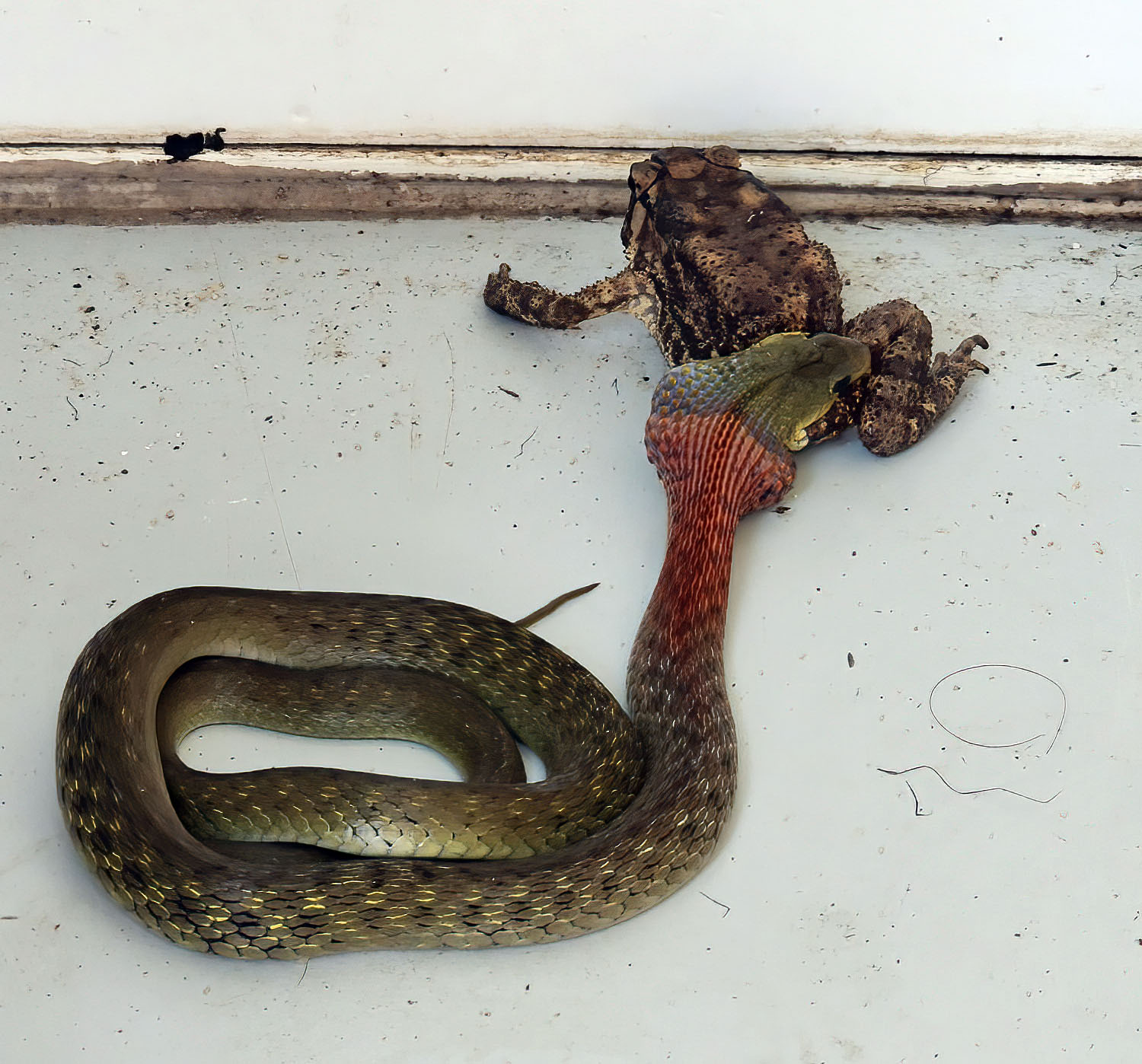
Red-necked Keelback. A snake caught in the act of being venomous AND poisonous in Hong Kong


My daughter-in-law and grand-daughter were treated to this sighting in the ladies’ lavatory of an outdoor play centre in the New Territories of Hong Kong last weekend. This a is a Red-necked Keelback, a snake that is both venomous and poisonous, but one which was thought to be neither for decades.

The species, now  Rhabdophis subminiatus, was lumped in with our Grass Snake in the genus Natrix as harmless colubrid snakes. It is now known that it is a rear-fanged, venomous snake. There has been at least one fatality and a number of cases of severe haemorrhage after people have been bitten. Then it was discovered that the snake is not only venomous, it is, like all members of the genus, poisonous too. It accumulates toxins from the toads it eats and stores them in glands in the neck, the nuchal glands. Any attack or approach by a predator is met by the snake adopting one of three defensive posture in which the neck is pointed towards or moved to contact the predator. For example, the mouth is pointed downwards with the neck arched upwards.

The nuchal glands were discovered in a Japanese species of the genus by Nakamura in 1935. Nakamura also realised the glands, which lie just under the skin, produce something noxious. He was sprayed in the eye with yellow droplets as he decapitated the snake. He could not fail to notice the great pain. Others, previously, had noticed sore eyes after handling these snakes. Malcolm Smith (1875-1958), after he retired as house physician to the royal household of Siam, studied the nuchal glands in a number of species. They are paired structures which in some species extend the length of the back as well as the neck.

The glands are unusual in that they have no lumen for secretion to accumulate nor a duct to the exterior. The yellow, foul-smelling secretion is formed by breakdown of the secretory cells and also contains lymphatic and pigment cells. It is easy to see how a predatory bird grasping the snake by the neck break the skin and be confronted, in effect, by toad toxins. However, breaking the skin and damaging the nuchal glands may not be the only way for the secretion to be released.

In 2011 Kevin Messenger, Daniel Rosenberg, Kevin Caldwell and William Sargent came across a Red-necked Keelback in a hole on the side of a water catchment on Lantau island in Hong Kong. The snake after it had been caught, but not by the neck, arched its neck against a glove and then secretion began to ooze from the region of the nuchal glands. How, without ducts to the exterior this was accomplished is not known. Would contraction of the neck muscles suffice? Is there a myoepithelium surrounding the glands which might contract? Is there a mechanically weak pathway to the exterior for the secretion to reach the surface? What are the mechanisms providing defence against, and transport from the gut to the glands, of toad toxins? Much remains to be discovered about the Red-necked Keelback and others of its genus.

My grand-daughter was very lucky to see the scenario of killing, feeding and getting hold of defensive toxins. The toad, Duttaphrynus melanostictus, was not so lucky.

Messenger KR, Rosenberg D, Caldwell KK, Sargent WL. 2012. Rhabdophis subminiatus helleri (Red-necked Keelback). Defensive Behavior. Herpetological Review 43, 497.

Mori A, Burghardt GM, Savitzky AH, Roberts KA, Hutchinson DA, Goris RC. 2012. Nuchal glands: a novel defensive system in snakes. Chemoecology 22, 187-198 DOI 10.1007/s00049-011-0086-2