Sunday, 30 July 2023

Red-bellied Conure or Maroon-bellied Parakeet: a colour plate from 1954

In the days when colour printing was extremely expensive, the Avicultural Society had special appeals for funds to support the appearance in Avicultural Magazine of the occasional colour plate. A well-known bird artist was then commissioned. Although the whole run of the Society’s magazines can be found online, the plates rarely see the light of day. Therefore I decided to show one, now and again, on this site. This is the 9th in the series.

– – – – – – – – – –


The committee that drew up the common names for birds did a terrible job on the parrots. Just about every small parrot with a long tale was called a parakeet from whatever part of the world it occurs. The word ‘conure’ for most of the South American species seems to have been dumped. Thus what was known as the Red-bellied Conure is now the Maroon-bellied Parakeet. Other common names, Brown-eared Conure, for example were commonly used by people who kept and bred the species—Pyrrhura frontalis. The species is found from southeastern Brazil to north-eastern Argentina, including eastern parts of Paraguay and Uruguay.

The article accompanying this plate was written by Arthur Alfred Prestwich (1903-1987) who was for many years Secretary of the Avicultural Society. He devoted a great deal of his time researching the history and first breeding of various species, but especially parrots, in captivity.

The plate was the work David Morrison Reid Henry (1919-1977) in 1955. He signed his work as D.M. Henry and was an artist favoured by the Avicultural Society for the plates published in this period.

Avicultural Magazine 60, 1954


Saturday, 29 July 2023

The Curious Case of the Thirteen-lined Ground Squirrel: Digging in the History of Endocrinology


In a previous article I described my delight at seeing Thirteen-lined Ground Squirrels for the first time in the wild. These animals are a common sight in the grasslands and prairies of north America. My first encounter with this species was 58 years earlier. Before I joined him as a PhD student John Phillips (1933-1987) was back in Sheffield on his first long leave from the University of Hong Kong where he was Professor of Zoology, having been appointed three years earlier at the age of 29. In those days expat terms were such that after two years and seven months ‘home’ leave of five months was taken—an ideal arrangement for those wishing to do research. I found him in the attic, used as an animal house. He was concerned that a group of ground squirrels - kept together—was not thriving. I could see they were being fed on standard rat lab pellets plus the usual mixture of seeds, biscuit etc given to hamsters. I immediately suggested giving them more protein since I had kept a related species and knew that they ate insects and other invertebrates in addition to the typically rodent diet. The technician in charge  could not believe I was right but went off to collect a handful of mealworms which were thrown into the floor cage. The ground squirrels fell upon them and had soon scoffed the lot. With the problem of feeding solved, John finished his work on them and returned to Hong Kong. I assumed that the work had been published since in his report to the Nuffield Foundation in 1967, which funded his work in comparative endocrinology to the extent of pay, equipment and consumables for a research unit in Hong Kong, he listed among the publications one on the Thirteen-lined Ground Squirrel which was in preparation for submission to the Journal of Endocrinology. However, when I searched all his publications while researching this article I could not find it and only this week have I found that the work was never published and realised why it was never published

In the early decades of the 20th century, endocrinology was in its infancy and there was still argument, dating from the 1850s, of whether or not the adrenal glands are essential for life. The Thirteen-lined Ground Squirrel (now Ictidomys tridecemlineatus but then included in the genus Citellus and later Spermophilus) achieved its fame as an oddity in comparative endocrinology because it can consistently survive removal of the adrenal glands by virtue of the growth of adrenocortical tissue in the ovary. Richard Arnold Groat (1915-1994) was a PhD student in the Department of Anatomy at the University of Wisconsin when he published his findings in 1943 and 1944. Groat went on to work in a number of medical schools and in private practice as a pathologist in North Carolina.

Groat showed that in common with a number of other species, Thirteen-lined Ground Squirrels only survive after adrenalectomy if given 1% sodium chloride to drink. With that treatment the animals continue to feed. However, unlike in other species, Groat found that the salt water can be removed after a minimum of 15 days and that the ground squirrels can withstand a fast after 3-4 months. He then showed that adrenocortical-like tissue appeared in the ovaries after complete removal of the adrenal glands strongly indicating that adrenal steroid hormones were being produced by the ovary in quantities sufficient for normal life.

I do not know how Ian Chester Jones (1916-1996) heard of Groat’s work. There was no mention of it in his seminal monograph on the adrenal cortex which was published in 1957. However, he became sufficiently interested to start this work in 1961 at Harvard. He was again working as a visitor in Roy Orval Greep’s (1905-1997); he had spent a couple of years there in the 1950s on a Fellowship of the Commonwealth Fund of New York (later to become Harkness Fellowships). Ian Henderson, then a PhD student in Sheffield (1941-2019) was the second author of the paper published in 1963. They explained their interest in Groat’s work:

His [Groat’s] findings have always been open to the suspicion that they are merely manifestations of adrenal rests which showed particular responsiveness in this species. On the other hand, his work may indicate the capacity of ovarian tissue to change into a new type which may be adrenocortical both in form and function. Should this be so, then a question of fundamental importance is raised. It may be, for example, that the ground squirrel displays, in intensified fashion, a property that exists in mammals generally. For these reasons, this paper presents a re-examination of the problem.

In modern terms, there is another possible explanation: a population of pluripotent stem cells or partially differentiated cells in the ovary stimulated by ACTH from the pituitary to divide and differentiate into cells typical of the adrenal cortex rather than of the ovary, the ovary and adrenal cortex being of similar embryonic derivation. With the negative feedback between concentrations of adrenal steroid hormones and ACTH secretion, the concentrations of ACTH in the blood would have been sky high in the adrenalectomized animals.

Essentially Chester Jones & Henderson confirmed Groat’s findings. As with Groat, they were unable to find adrenal rests—small isolated clumps of adrenocortical tissue outwith the adrenal gland—in the normal adrenal. These occur in various locations including the ovary and testis in mammals.

The implication of the observations would be that with the apparent absence of adrenal rests, the ovary of the intact ground squirrel would not be producing adrenal steroid hormones. However, Gavin Vinson (1939-2021) then also working with Chester Jones in Sheffield found that ovarian tissue could convert progesterone to the adrenal steroid hormones, corticosterone. In his paper of 1965 he wrote (references omitted):

It is particularly interesting that the ovary has the capacity to convert progesterone to corticosterone. While this might be ascribed to adrenal rests, Groat (1943, 1944) and Chester Jones & Henderson (1963) were unable to find adrenocortical tissue in the ovaries and adnexia of normal ground squirrels. Another possibility is that ovarian cells, possibly the interstitium, of the ground squirrel are able to produce both sex and adrenocortical steroids. An attractive hypothesis is that, as the ovary shares a common embryological origin with the adrenal cortex, throughout the vertebrates both tissues are able (to a greater or lesser degree) to manufacture both oestrogens and corticosteroids.

While there is current molecular evidence against the latter in the latter explanation in mammals, I suspect the explanation possibly lies in a small population of partially differentiated adrenocortical cells in the ovary of the ground squirrel, i.e. cryptic and widely spread adrenal rests with the potential to grow into clumps of adrenocortical tissue.

William George Henry Seliger (1922-2016), A James Blair and Harland Winfield Mossman (1898-1991) followed up Groat’s work in 1966; they were in the same department as Groat in the University of Wisconsin and I suspect Groat may have been Mossman's student. They showed that the cells characteristic of the adrenal cortex which appear in the ovary are in close relationship to the epithelial remnants of the rete ovarii and the medullary cords. Identical cells were found around the efferent ductules of the testis in adrenalectomized males. Histochemical tests indicated the cells were identical to normal adrenocortical cells. In vitro, the areas of the ovary with the adrenal-like cells converted progesterone to adrenal steroid hormones identified as corticosterone and desoxycorticosterone (11-deoxycorticosterone)* the combination providing both glucocorticoid and mineralocorticoid activity. Confirmation of the vital role of the ovaries and testes in adrenalectomized ground squirrels was obtained:

Male and female animals adrenalectomized a year before and maintained on tap water died within four days when the gonads and adnexa were removed. Male animals adrenalectomized a year before and maintained on tap water survived actively for two weeks when the testicles were removed, provided that the efferent ductules and surrounding adrenal cortex-like cells were left in place. These animals died within four days after the adnexa were removed.

To return to the paper by Phillips and Chester Jones that was never published, the chronology suggests that the work they were doing in September/October 1965 produced results indistinguishable from those published by Seliger, Blair and Mossman in 1966. In short, they had been scooped.

Since the 1960s there has been little to add to the story. It would seem that cells with the potential  to become adrenal cortical cells can be retained during embryonic development in the ovaries and testes in the ground squirrel. In that respect there is nothing new—adrenal tissue has been found after adrenalectomy in similar locations of mesodermal origin in other mammals. In the rat a report from the 1920s indicated an incidence of 19%. Similarly, some human patients show accessory adrenal tissue after adrenalectomy. However, what makes the Thirteen-lined Ground Squirrel special is the extent and consistency of formation of adrenocortical tissue in the ovary and testis. The finding in 1967 of similar structures in the ovary after adrenalectomy of the Northern or Five-striped Palm Squirrel (Funambulus pennantii) by Seth and Prasad of the University of Delhi, suggests that sciurid rodents may all show the phenomenon.

The question remains of whether the ability to form new adrenocortical tissue has any functional significance. In other words, has the retention of mesodermal remnants capable of forming adrenocortical cells been subject to positive natural selection in some mammals—or are they simply vestiges that only assume a physiological significance under laboratory and clinical conditions that never occur in normal life?

A possible clue to some functional role of adrenocortical cells in the ovary comes from the rabbit. In 1974 Hiroshi Mori and Keishi Matsumoto reported:

Adrenocortex-like cells were consistently found in the mesovarium or in the hilus of the ovary of rabbits less than three months old. The adrenocortex-like cells occurred usually in the form of nodules among or near the mesonephric tubules. But they sometimes appeared within the rete ovarii either in direct contact with the epithelial cells or scattered in the stroma.

Histochemical studies indicated they were adrenocortical cells. Moreover, ovarian plus mesovarium tissue in vitro was able to convert progesterone to corticosterone. These studies, now 50 years old, raise another question: what is the role of adrenocortical hormones in the ovary of young rabbits?

If something similar obtains in the ovary of other mammals in early life, is is then possible that the squirrels have had functional adrenocortical cells in the ovary and/or testis earlier in life and that adrenalectomy simply stimulates the remaining population of dormant stem cells? Has anybody had a look?

*While the methods used to identify steroid hormones in the 1960s do not satisfy modern criteria, there is no reason to suspect they were not as stated by the various authors of the time.


Chester Jones I, Henderson IW. 1963. The ovary of the 13-lined Ground Squirrel (Citellus tridecemlineatus Mitchell) after adrenalectomy. Journal of Endocrinology 26, 265-262 doi:10.1677/joe.0.0260265

Groat RA. 1943). Adrenocortical-like tissue in the ovaries of adrenalectomized ground squirrel (Citellus tridecemlineatus). Endocrinology 32, 488-492 doi:10.1210/endo-32-6-488

Groat RA. 1944. Formation and growth of adrenocortical-like tissue in the ovaries of adrenalectomized ground squirrel. Anatomical Record 89, 33-41 doi:10.1002/ar.1090890104

MacFarland WE. 1945. The vital necessity of adrenal cortical tissue in a mammal and the effects of proliferation of cortical cells from dormant coelomic mesothelium. Anatomical Record 93, 233-249 doi:10.1002/ar.1090930303

Mori H, Matsumoto K. 1974. Constant occurrence of adrenocortical tissue in the juvenile rabbit ovary. American Journal of Anatomy 141, 73-89 doi:10.1002/aja.1001410105

Seliger W, Blair AJ, Mossman HW. 1966. Differentiation of adrenal cortex-like tissue at the hilum of the gonads in response to adrenalectomy. American Journal of Anatomy 118, 615-629 doi:10.1002/aja.1001180217

Seth P, Prasad MRN. 1967. Effect of bilateral adrenalectomy on the ovary of the five striped Indian palm squirrel, Funambulus pennanti (Wroughton). General and Comparative Endocrinology 8. 157-162. doi:10.1016/0016-6480(67)90124-4

Vinson GP. 1965. Steroid production in vitro by the ovaries and adrenal glands of the thirteen-lined ground squirrel (Citellus tridecemlineatus Mitchell). Jourbnal of Endocrinology 32, 401-402 doi:10.1677/joe.0.0320401

Wilson JB, Zopey M, Augustine J, Schaffer R, Chiang M, Friedman TC. 2021. High prevalence of adrenal remnant tissue in patients undergoing bilateral adrenalectomy for Cushing's disease. Hormones and Metabolic Research 53, 161-168 doi: 10.1055/a-1253-2854


Saturday, 8 July 2023

Thirteen-lined Ground Squirrel

Never having seen the species in the wild I was delighted we had good views of a Thirteen-lined Ground Squirrel (Ictidomys tridecemlineatus) as it ventured out of its burrow to eat dandelion heads. We were in Des Lacs National Wildlife Refuge in North Dakota at the end of May.

Widely distributed in the grasslands and prairies, from Canada south to Texas, this ground squirrel was also known by a number of common names including Striped Gopher and Leopard Ground Squirrel. It is omnivorous taking insects and, apparently, even mice and shrews. I will return to its dietary requirements in another article since my knowledge of its omnivory apparently saved an experiment in the mid-1960s, earning a few soon-forgotten brownie points. These still images were taken from 4K video and processed in Photoshop and Topaz DeNoise AI.


Friday, 7 July 2023

Flatters and Garnett Ltd. Microscopy and Biological Suppliers 1901-1967

I was surprised when I was looking up what had happened to Flatters & Garnett, the Manchester biological supplies firm that equipped school and elementary laboratories, as well as amateur microscopists, entomologists and botanists, in the first seven decades of the 20th century. I thought they must have been taken over as laboratory supply companies consolidated by mergers and takeovers. I was wrong. Flatters & Garnett went into liquidation in 1967 after what the Science Museum website described as ‘financial problems’.

Abraham Flatters (see my previous article here) was joined by Charles Garnett to form their partnership in 1901. The Garnett family after ‘a serious rift’ bought out Flatters in 1909 so Flatters & Garnett while retaining the name continued without Flatters.

Unfortunately, the Science Museum’s website does not state the sources of its information on Flatters & Garnett. Therefore I will try to flesh out some of the information provided.

Charles Garnett was born on 30 May 1842 at Latchford near Warrington, Cheshire, the son of a blacksmith. According to the Science Museum he became apprenticed to a grocer ‘but, at the age of 21, emigrated to New Zealand. There, he became interested in natural history and made a collection of the ferns found on South Island. In 1873, he returned to Manchester and opened a restaurant in Cateaton Street’. However, in the 1881 Census he is shown as a confectioner employing 3 girls and 1 boy. The same occupation is shown in 1891. Only in 1901 is he shown as ‘confectioner and restaurant keeper’. He had married in January 1876 in Manchester; his wife was born in Adelaide, South Australia. By 1911 he is just ‘confectioner’; there is no mention of his involvement with Flatters & Garnett. Also present were his wife, a son (a jeweller), his brother (retired blacksmith) and two servants. Charles Garnett died on 12 January 1921. He left £12,042 His executor was his son, John Benbow Garnett who was closely involved in Flatters & Garnett from the start.

John Benbow Garnett was born on 4 February 1877. He was educated at Ackworth, a Quaker school. In the 1901 Census he was living at home with his occupation shown as ‘pharmaceutical chemist’. He then joined Flatters in Flatters & Garnett and my guess is that his father provided the money while John worked with Flatters in the business. In the 1911 Census, John described himself as a ‘preparer of natural history objects and lantern slides’ work that was also being done by Flatters. Was it a clash between John and Abraham Flatters that led to the latter’s departure.

Advertisements from Flatters & Garnett in its first ten years show an emphasis first on the pharmacy and photographic activities. An advertisement ran in the Manchester City News (this one is from 1902) soon after Flatters & Garnett was founded:

Flatters & Garnett Ltd. Dispensing & Photographic Chemists, make a speciality of dispensing physicians’ prescriptions. “Neroline,” an emollient cream for chapped hands, 1s. and 1s.9Id. per bottle.-.48, Deansgate (one door from Blackfriars-st.).

By 1910, advertisements were appearing which emphasised a particular aspect of the business but by this time the pharmacy was not being mentioned.

Flatters & Garnett Ltd. Specialists in Photographic Work. 32 Dover Street (close to the University) Manchester S.E. Send for revised Price List, just issued. Developing Printing Enlarging. N.B.-No connection with any other firm.

This was in Manchester City News of 28 May 1910. The no connection with any other firm was of course to Abraham Flatters’s breakaway company that was subject to successful legal action by Flatters & Garnett in the same year.

The wording on 31 December 1910 was:

Lantern Slides. Large stock for sale or hire, or made to order from negatives, prints, drawings &c by experts.

For microscopy, this one appeared on 22 October 1910:

Microscopes, slides and accessories, for textile and other fibre examination, for serious work or recreation


By the time of the 1921 Census, John Benbow Garnett described himself as a pharmacist and Managing Director of Flatters & Garnett Ltd, scientific instrument makers. He led the expansion of the company and its establishment as a leading player in biological supplies.

This is from the Science Museum’s website:

Flatters and Garnett Ltd moved in 1913 to larger premises at 309 Oxford Road, opposite the University. About a year later, the company developed Mersol, an immersion oil for use with high power microscope objectives which became very popular and sold well for many years.

Flatters & Garnett Ltd expanded its business steadily during the 1920s. The company increased the range of instruments it produced, including dissecting microscopes and the Precision microprojector. The company won a reputation for producing well-designed, reliable instruments and sold its products all over the world. In 1932, the firm acquired a large Victorian house on Wynnstay Grove in Fallowfield where it moved the microslide, specimen, photographic and chemical departments. Here the staff could have more space and less disturbance from noise and dirt than on Oxford Road. In 1950, the company introduced the Mikrops industrial projector. This replaced the microscope for routine examination in many laboratories.

On 1 January 1938, Nature contained the following report:

A serious fire occurred on Sunday morning, December 19, at the laboratories of Messrs. Flatters and Garnett, Ltd., the well-known Manchester firm of microscopists. The chemical and microscopical laboratories were completely burnt out, but a considerable number of mounted slides were saved. The photographic and lantern slide department was only slightly involved and the new instrument workshop, for manufacturing microscopes, micro-projectors, etc., escaped entirely. All the staff is being retained, and work has already been resumed in temporary laboratories. Stocks of most of the firm's chemical specialities are held at the head office, 309 Oxford Road, Manchester, 13, which is two miles from the laboratories. 

Microscope Slide Label

The company continued to exhibit at the Manchester Microscopical Society. In 1949, for example, they demonstrated the ‘latest advances in microscopy’ at the annual public exhibition.

It seems likely that at some time John Benbow Garnett handed over the reins to his son, Wilfred John. On a sea trip to Australia in 1958-59 John Benbow is described as ‘microscopist’ which gives no real indication of whether he had retired or not.

John Benbow Garnett died on 10 January 1973, leaving £26,600. He had been living near Coleraine in Northern Ireland.

Wilfred John Garnett was born on 16 July 1914. In the 1939 Register, the emergency census, he was living at home and described as ‘Degree Biologist, Director of Laboratory’. It was Wilfred John who signed on 22 June the formal notice to wind up the company and to appoint liquidators:

…on Wednesday, the 14th day of June 1967, the following Extraordinary Resolution was duly passed: "That it has been proved to the satisfaction of this Meeting that the Company cannot by reason of its liabilities, continue its business, and that it is advisable to wind up the same and that the Company be wound up voluntarily…”

I wonder what had gone wrong. 

But that was not quite the end of the products. ‘A 1970 report of the Scottish Education Department on the school biology curriculum, stated: The transparencies of Marine Life taken by Dr. D.P. Wilson which were obtainable from Flatters and Garnett can now be purchased through W.J. Garnett, Breezemount, Ringrash, Macosquin, Coleraine, N.Ireland’. The address given was that occupied by Wilfred’s father at the time of his death.

Wilfred John Garnett died on 13 June 1988 in Bristol.

Flatters & Garnett Ltd produced a large number of catalogues throughout its existence. A number covered specific products, like stains or prepared microscope slides. The extent of their lantern slides stocks can be found in the catalogue which can be seen online here. The Second World War obviously left the company in some difficulty. Well into the 1950s the main catalogues had not been reprinted and an Interim Price List was published in 1951 and reprinted in 1954. Even then prices were not given; an accompanying leaflet did that.

As well selling as their own products, F&G were agents for Baker, Beck, Prior, Swift and Watson microscopes, for example.

The Science Museum in London contains a number of items made by Flatters & Garnett; see here.

Does any of the equipment and specimens supplied by Flatters & Garnett still survive in British schools? Microscope slides should have but I doubt they have. Do amateur entomologists still have F&G items still in use? Items do find their way onto eBay and into auction houses where the descriptions can provide great amusement. For example, a dissection kit is described as a ‘field surgical kit’ or a vasculum for botanists as a ‘metal satchel’. Amongst a number of cut-throat razors is one purportedly by Flatters & Garnett. I itch to tell the vendor that the F&G version was indeed a cut throat razor but only one side of the blade was hollow-ground (i.e. concave). Try shaving with a razor designed to cut sections of plant stems and the like by hand.


Flatters & Garnett Projection Microscope
From Micscape Magazine June 2002
see Microscopy-UK website
I have seen one of these lying around but
I cannot remember where

A Flatters & Garnett microscope for
sale on eBay at present

1954 reprint of 1951 catalogue


Microscope slide cabinet

Vasculum for plant collectors - to keep specimens
fresh. Completely replaced by the polythene bag


Friday, 30 June 2023

Ceylon or Sri Lanka Spurfowl: a colour plate from 1960

In the days when colour printing was extremely expensive, the Avicultural Society had special appeals for funds to support the appearance in Avicultural Magazine of the occasional colour plate. A well-known bird artist was then commissioned. Although the whole run of the Society’s magazines can be found online, the plates rarely see the light of day. Therefore I decided to show one, now and again, on this site. This is the 8th in the series.

 – – – – – – – – – –


This plate illustrates an article by the artist, George Morrison Reid Henry (1891-1983). He published and signed his work ‘G.M. Henry’. One of eleven children, his father was manager of tea estates in what was then Ceylon. He was educated at home by his older sisters. After working as a laboratory assistant he was taken on as a draughtsman by the Colombo Museum. He worked his way up and in 1913 was appointed to a new post of Assistant in Systematic Entomology. He stayed in in that post until he retired in 1946. His son, David Morrison Reid Henry (1919-1977) was also a bird painter.

The Sri Lanka spurfowl (Galloperdix bicalcarata) is endemic to Sri Lanka where it is relatively common in the lush forests but less commonly seen. It skulks in forests and Henry wrote ‘that with the possible exception of some of the rails, the most difficult to observe in Nature of any of the Island’s birds; such contacts as are made with it being generally confined to a brief glimpse as it dashes into cover when suddenly come upon some jungle path’. We saw it at Sinharaja Forest Reserve in 2013.


Avicultural Magazine 66, 1960

Thursday, 29 June 2023

Microscopy in Manchester. Abraham Flatters: the Flatters in Flatters & Garnett

Anybody studying for ‘A’ levels in English grammar schools in the 1950s and 60s cannot have failed to notice the supplier of the microscope slides and other equipment for microscopy and dissection. The name Flatters & Garnett with an address in Manchester was displayed at the end of many of those microscope slides we had to look at and draw.

In finding material for my article on Herbert Womersley, I came across the fact that he attended lectures on microscopy by Abraham Flatters at Manchester Technical School (which, after a number of mergers, and renamings, emerged as part of the University of Manchester). Abraham Flatters was one of the founders of the eponymous company, Flatters & Garnett, although he fell out with his partner and then set up shop in opposition.
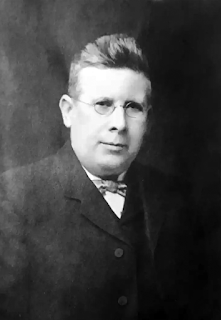
Abraham Flatters

Abraham Flatters had a remarkable climb in life in Victorian Britain. He was born on 1 March 1849. Some published accounts state that he was born in Lincolnshire. That is because his birth was registered in the Gainsborough district. That registration office covers parts of two counties and in fact Flatters was born in the Nottinghamshire village of West Stockwith on the western banks of the River Trent. His father, Joseph, was, in 1851, a farm labourer; in later censuses he is described as a groom or gardener.

In the 1861 Census, Abraham, aged 12, was employed on ‘farmer’s work’. We then know that sometime between 1861 and 1871 he moved to Manchester. Although there is no trace of him in the 1871 Census, on his marriage to Sarah Hannah Rogerson, a cotton weaver, on 29 May 1871 his occupation is given as ‘velvet finisher’. There is also a record of his working for the Manchester, Sheffield and Lincolnshire Railway between 1874 and 1878 first as a porter and then as a messenger; he was paid 17 shillings and 6 pence per week. In 1881 he appears as a ‘railway signalman’, perhaps working for one of the other railway companies that passed through Manchester. Abraham and Sarah were then living  at 25 Gill Street. But then the 1891 Census shows he was working as a ‘lamplighter (gas)’ living at 54 Croft Street.

The Science Museum website states:

He came to Manchester at an early age and had a succession of jobs and had an interest in natural history. In 1886 he attended a course of lectures on zoology given by Professor Milnes Marshall of Owens college. It was as a result of Marshalls suggestion that he join the the Manchester Microscopical Society, which he did in 1886. 

His working life began at a biological station at St Helier, Jersey. He worked there for several years before returning to Manchester in 1895 and set up his own business making lantern slides, microscopic slides and microscopic preparations. He also became a lecturer in microscopy at the Municipal School of Technology. 

With the help of an article by Brian Stevenson on the website Historical Makers of Microscopes and Microscope Slides, it can be seen that the Jersey Biological Station was run by Joseph Sinel and James Hornell from 1893. Sinel before he went into partnership with Hornell was already selling specimens and prepared microscope slides under his own name and it would seem that Flatters both learned a lot of his trade there and realised that he could also make a business out of what was his former hobby. The partnership broke up in the winter of 1894-95 and although production continued under Hornell it must have been at this time that Flatters returned to Manchester to set up his own business. Whether the job of lecturing at the Municipal School of Technology came first or later I do not know.

By 1901, Flatters describes himself as ‘microscopist and photographer (natural history)’ living at 16 Church Road, Longsight (one of the numerous districts of the city)—quite a change from being a lamplighter in 1891. However, I wonder if he chose the latter job in order to pursue his studies and interests in microscopy. After all, the work would be for a relatively short period at dusk and then again at dawn; the rest of the day would have been free.

After Abraham went into partnership with Charles Garnett in 1901, Sarah killed herself in bizarre and what would have been agonising circumstances. This is how the Manchester Evening News of Tuesday 28 April 1903 reported it:

A remarkable story of the suicide of an elderly lady [she was 53!] named Sarah Ann Flatters, of 20, Church Rond, Longsight, was told before Mr. L J. Altken, acting city coroner, this afternoon.

     According to the evidence, Mrs. Flatters has suffered for about 15 years from melancholia and nervous depression. On Saturday morning her husband, Mr. Abraham Flatters, who, as a microscopist, uses many different poisons, had left a bottle of nitric acid, properly labelled, on his laboratory table, and afterwards gone out. During the afternoon, the old lady gained access to the room, and shortly afterwards told the housekeeper she was going out for a short walk. When she did not return, her husband made a vain search for her until Sunday, when he received word that his wife was an inmate of the Manchester Infirmary, suffering from the effects of corrosive poison. There she died on Monday [27 April].

     Mr. Flatters informed the Coroner that his wife told him on Sunday that she had taken a drink out of the nitric acid bottle, believing it was brandy, that she had tried to spit it out on discovaring her mistake, and had gone out to so if her throat would got any better. She had walked about Birch Lane for five hours, and then hailed a cab to take her to the Infirmary.

     In answer to the coroner Mr. Flatters said that nitric acid could hardly be mistaken for brandy, as it was more like gin or water. As soon as the stopper was removed there would be fumes from the neck and a nasty smell. The pain suffered by Mrs. Flatters must have been terrible as one drop of nitric would burn a hole through a piece of wood. Looking at all the facts he was bound to disbelieve his wife’s story, and his opinion was that it was a determined action on her part.

     The Coroner expressed his concurrence, and the jury returned a verdict of suicide whilst insane.

Later that year Flatters remarried. His second wife was Emma Bamber.

I can only quote second-hand the accounts of what happened to the business, from the Science Museum website for example. I have been unable to find the original sources. In 1897, Charles Garnett, a confectioner and restaurant owner, joined the Manchester Microscopical Society and met Flatters. By 1901 Flatters was having financial problems. That is when Flatters and Garnett formed their eponymous partnership. Flatters & Garnett Ltd.  Garnett’s son, a pharmacist was also involved and they opened a chemists shop on Deansgate, Manchester where they displayed, microscopes, slides and  and lantern slides of natural history subjects. Flatters apparently made the slides, both microscope and lantern, at his house in Church Road. All went well and the business grew. By 1906 12 people were employed. They moved to Dover Street, near the University, where they hired out and sold large numbers of lantern slides for personal collections and educational establishments. However, in 1909 Flatters fell out with the Garnetts and the latter bought out his share. Flatters was no longer part of Flatters & Garnett Ltd.

Then Flatters set up another business, taking with him some of the employees of Flatters & Garnett. That second business was  Flatters, Milborne & McKechnie with premises on Church Road (16, 18 and 20) which would seem to have been houses/shops in the terrace around his residence.  

Flatters fell foul of a 'no-compete' agreement with Flatter & Garnett. The Manchester City News of 5 March 1910 reported:

At a recent sitting of the County Palatine Chancery Court, Vice Chancellor Leigh-Clare had before him the action brought by Flatters and Garnett Limited, of Dover-street, Manchester against, Mr. Abraham Flatters, whose microscopical and photographic business plaintiffs purchased in 1901. The court was informed that the parties had come to an arrangement whereby Mr. Flatters undertook not to solicit orders from persons who had been customers of the business sold by him to the plaintiffs prior to such sale. Mr. Flatters agreed to submit to a perpetual injunction restraining him from representing that the business of Flatters, Milborne and M'Kechnie Limited is the same as, or in any way connected with, the business of Flatters and Garnett Limited. The Vice Chancellor made an order in these terms, and defendant agreed to pay the costs of the action.

Ouch.
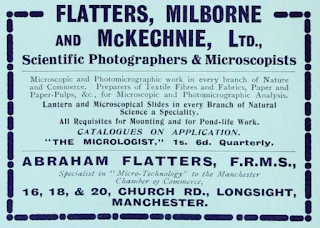
From Knowledge magazine, December 1910

Throughout the period of self-employment, being part of Flatters & Garnett and then of Flatters, Milborne & McKechnie, as well as lecturing in Manchester, Abraham Flatters became well-known in professional and amateur microscopical circles. His name appeared in the Manchester newspapers which reported his activities in the Manchester Microscopical Society (which is still in existence). There were over 200 members and comprised various sections. The following is from the Manchester City News of 20 January 1906:

The annual meeting of the Mounting Section of the Manchester Microscopical Society took place on Thursday night. The election of officers for the year resulted as follows: Chairman, Mr. Abraham Flatters, F.R.M.S.: vice-chairman Mr. William Buckley; secretary and treasurer, Mr. Emil Watzlaff; auditor, Mr. William Hart; committee, Messrs. Charles Turner, F.C.S., P. Bradshaw, J. E. Storey, J. L. W. Miles, J. R. Wilson, and Charles Camp. The subjects of the demonstrations and lectures to be given include ringing and finishing slide, and measurement of microscopic objects; dry mounting and plant structure; diatomaceae collecting, preparing, and mounting; mounting in fluids, stains and their characteristics, mounting objects glycerine jelly, botanical dissection, photo-micrography, mounting in balsam on cavity slips, and zoological dissection.

Sometime before 1906 he was elected a Fellow of the Royal Microscopical Society. He attended meetings in London. The Field magazine of 20 June 1908 gave an account of a meeting at 20 Hanover Square which included:

Mr Abraham Flatters, of Manchester, had an interesting exhibition of microscopic slides, exemplifying the development of a chick at various stages from twenty hours to four and a half days, and constituting a typical set for teaching purposes. The technique of the slides was all that could be desired, and showed how far we have travelled in the art of section cutting since Kitchen Parker [*] did his famous work on the early stages of the tadpole and the chick.

Flatters was also a member of the Manchester Geological Society.
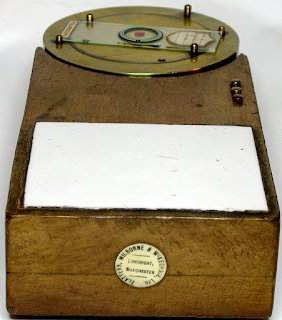
A slide ringing table sold by Flatters, Milborne
& McKechnie. Did they manufacture them or
rebadging from a generic manufacturer?
From here

The advertisements and publications from Flatters, Milborne & McKechnie suggest Flatters was a consultant to the cotton industry in Manchester on microscopical examination of their raw material. He wrote a book on the cotton plant and in its preface described himself as ‘Specialist in Micro-Technology to the Manchester Chamber of Commerce’. He may have found some demand for such services. Imports of raw cotton peaked in 1914 at almost a billion tonnes.

This article began with the lectures on microscopy given by Abraham at the Municipal School of Technology in Manchester. He is variously described as teacher, lecturer and demonstrator. I have been unable to find out how much of his time these activities occupied or for how long he was thus employed.

He produced three books: Methods in Microscopical Research; 1905. Published by Sherratt & Hughes, Manchester; The Cotton Plant. Its Development and Structure, and the Evolution and Structure of the Cotton Fibre. 1907. Sherratt & Hughes; Photomicrographs of Botanical Studies. Not dated. Flatters, Milborne & McKechnie Ltd.

Flatters produced a vast array of microscope slides from many different organisms. I can only assume that he had a network of people who provided him with the material and the background information to label the slides. With thin sections very little original material is needed and I wonder if he kept paraffin wax-embedded blocks ready for cutting in order to fulfil individual orders or if he made and stained a batch of sections which he could keep in stock.
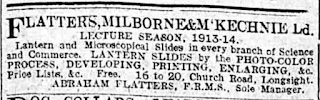
Manchester City News 14 January 1914

There are large number of old lantern slides available on the antiques market made by Flatters & Garnett or by Flatters, Milborne & McKechnie. Did he take all the photographs, including, for example, ones in mines, or did he also provide a lantern slide making service to those (of which there would have been many) who have lectures at the many natural history, geological, geographical and historical societies that flourished in Victorian and Edwardian England? My guess from reading his advertisements is that he did make lantern slides—a far more specialist job in those days—from other people’s negatives. A newspaper advertisement from 1914 shows that the photographic side of the business (developing, printing etc) was a major activity.

Abraham and Emma moved to the outer suburbs of Manchester, Syddal Cottage in Bramhall sometime in the 1910s. The 1911 Census shows Abraham as ‘microscopist and science teacher’ employing a resident domestic servant. Installed as caretaker for Flatters, Milborne & McKechnie at 20 Church Road was Abraham’s brother, John Reid Flatters. John, four years older than Abraham, also worked on the railway in Manchester. The 1921 Census has Abraham down as ‘microscopist and photographer’ and managing-director of the company; again they had had a domestic servant.

Syddal Cottage remained their home, certainly in 1923 but at their deaths 6 Blackthorn Avenue, Burnage, another Manchester suburb, is shown as their address. 

The company appeared to continue in business until three years before Abraham’s death; it was formally dissolved on 4 July 1926, the application having been made in March. However, according to the 1926 rates records for Manchester, it did continue under the name of ‘Abraham Flatters’ but owned by a Thomas Wyatt who also had bought 16 and 18 Church Road, leaving 20 occupied by John Flatters but owned by a third party. How long Wyatt kept the ‘Abraham Flatters’ business going I have been unable to find out.

Flatters must have been a thorn in the side of Flatters & Garnett from his departure until his death. I will return to the rise and fall of Flatters & Garnett in a future article.

Abraham died on 2 March 1929, leaving £829 (the date shown in a family tree on ancetry.com is incorrect). Emma died on 15 May 1932, leaving £609.

The life and accomplishments of Abraham Flatters illustrate how efforts to provide education for the working man in Victorian England could enable somebody with just primary schooling to gain knowledge and become a skilled and knowledgable technician. It was an age in which there was a thirst for knowledge. There were numerous natural history societies and microscopy clubs in Manchester alone. Microscopy, including the preparatioon of specimens, was a major hobby for those who could afford to buy the equipment. What a difference to today’s Age of Wilful Ignorance.

*William Kitchen Parker FRS (1823 – 1890)


Microscope Slide Labels

I have found three types of miscroscope labels which identify these slides as made by Abraham Flatters (in addition to ones made by Flatters & Garnett). It is possible that some were made before his partnership with Garnett, others while with Flatters, Milborne & McKechnie while others could have been when Wyatt owned the business but traded under Flatter's name.

In the collection of the
Manchester Microscopical Society


Wednesday, 17 May 2023

Ceylon or Sri Lankan Junglefowl: a colour plate from 1959

In the days when colour printing was extremely expensive, the Avicultural Society had special appeals for funds to support the appearance in Avicultural Magazine of the occasional colour plate. A well-known bird artist was then commissioned. Although the whole run of the Society’s magazines can be found online, the plates rarely see the light of day. Therefore I decided to show one, now and again, on this site. This is the 7th in the series.

 – – – – – – – – – –


This plate illustrates an article by the artist, George Morrison Reid Henry (1891-1983). He published and signed his work ‘G.M. Henry’. One of eleven children, his father was manager of tea estates in what was then Ceylon. He was educated at home by his older sisters. After working as a laboratory assistant he was taken on as a draughtsman by the Colombo Museum. He worked his way up and in 1913 was appointed to a new post of Assistant in Systematic Entomology. He stayed in in that post until he retired in 1946. His son, David Morrison Reid Henry (1919-1977) was also a bird painter.

The bird, Gallus lafayettii, is endemic to Sri Lanka where it is common. Henry, in the article, descrbed his observations on the birds in the wild.

Avicultural Magazine 65, 1959