Friday, 30 June 2023

Ceylon or Sri Lanka Spurfowl: a colour plate from 1960

In the days when colour printing was extremely expensive, the Avicultural Society had special appeals for funds to support the appearance in Avicultural Magazine of the occasional colour plate. A well-known bird artist was then commissioned. Although the whole run of the Society’s magazines can be found online, the plates rarely see the light of day. Therefore I decided to show one, now and again, on this site. This is the 8th in the series.

 – – – – – – – – – –


This plate illustrates an article by the artist, George Morrison Reid Henry (1891-1983). He published and signed his work ‘G.M. Henry’. One of eleven children, his father was manager of tea estates in what was then Ceylon. He was educated at home by his older sisters. After working as a laboratory assistant he was taken on as a draughtsman by the Colombo Museum. He worked his way up and in 1913 was appointed to a new post of Assistant in Systematic Entomology. He stayed in in that post until he retired in 1946. His son, David Morrison Reid Henry (1919-1977) was also a bird painter.

The Sri Lanka spurfowl (Galloperdix bicalcarata) is endemic to Sri Lanka where it is relatively common in the lush forests but less commonly seen. It skulks in forests and Henry wrote ‘that with the possible exception of some of the rails, the most difficult to observe in Nature of any of the Island’s birds; such contacts as are made with it being generally confined to a brief glimpse as it dashes into cover when suddenly come upon some jungle path’. We saw it at Sinharaja Forest Reserve in 2013.


Avicultural Magazine 66, 1960

Thursday, 29 June 2023

Microscopy in Manchester. Abraham Flatters: the Flatters in Flatters & Garnett

Anybody studying for ‘A’ levels in English grammar schools in the 1950s and 60s cannot have failed to notice the supplier of the microscope slides and other equipment for microscopy and dissection. The name Flatters & Garnett with an address in Manchester was displayed at the end of many of those microscope slides we had to look at and draw.

In finding material for my article on Herbert Womersley, I came across the fact that he attended lectures on microscopy by Abraham Flatters at Manchester Technical School (which, after a number of mergers, and renamings, emerged as part of the University of Manchester). Abraham Flatters was one of the founders of the eponymous company, Flatters & Garnett, although he fell out with his partner and then set up shop in opposition.
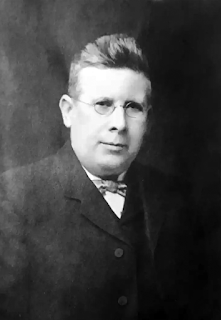
Abraham Flatters

Abraham Flatters had a remarkable climb in life in Victorian Britain. He was born on 1 March 1849. Some published accounts state that he was born in Lincolnshire. That is because his birth was registered in the Gainsborough district. That registration office covers parts of two counties and in fact Flatters was born in the Nottinghamshire village of West Stockwith on the western banks of the River Trent. His father, Joseph, was, in 1851, a farm labourer; in later censuses he is described as a groom or gardener.

In the 1861 Census, Abraham, aged 12, was employed on ‘farmer’s work’. We then know that sometime between 1861 and 1871 he moved to Manchester. Although there is no trace of him in the 1871 Census, on his marriage to Sarah Hannah Rogerson, a cotton weaver, on 29 May 1871 his occupation is given as ‘velvet finisher’. There is also a record of his working for the Manchester, Sheffield and Lincolnshire Railway between 1874 and 1878 first as a porter and then as a messenger; he was paid 17 shillings and 6 pence per week. In 1881 he appears as a ‘railway signalman’, perhaps working for one of the other railway companies that passed through Manchester. Abraham and Sarah were then living  at 25 Gill Street. But then the 1891 Census shows he was working as a ‘lamplighter (gas)’ living at 54 Croft Street.

The Science Museum website states:

He came to Manchester at an early age and had a succession of jobs and had an interest in natural history. In 1886 he attended a course of lectures on zoology given by Professor Milnes Marshall of Owens college. It was as a result of Marshalls suggestion that he join the the Manchester Microscopical Society, which he did in 1886. 

His working life began at a biological station at St Helier, Jersey. He worked there for several years before returning to Manchester in 1895 and set up his own business making lantern slides, microscopic slides and microscopic preparations. He also became a lecturer in microscopy at the Municipal School of Technology. 

With the help of an article by Brian Stevenson on the website Historical Makers of Microscopes and Microscope Slides, it can be seen that the Jersey Biological Station was run by Joseph Sinel and James Hornell from 1893. Sinel before he went into partnership with Hornell was already selling specimens and prepared microscope slides under his own name and it would seem that Flatters both learned a lot of his trade there and realised that he could also make a business out of what was his former hobby. The partnership broke up in the winter of 1894-95 and although production continued under Hornell it must have been at this time that Flatters returned to Manchester to set up his own business. Whether the job of lecturing at the Municipal School of Technology came first or later I do not know.

By 1901, Flatters describes himself as ‘microscopist and photographer (natural history)’ living at 16 Church Road, Longsight (one of the numerous districts of the city)—quite a change from being a lamplighter in 1891. However, I wonder if he chose the latter job in order to pursue his studies and interests in microscopy. After all, the work would be for a relatively short period at dusk and then again at dawn; the rest of the day would have been free.

After Abraham went into partnership with Charles Garnett in 1901, Sarah killed herself in bizarre and what would have been agonising circumstances. This is how the Manchester Evening News of Tuesday 28 April 1903 reported it:

A remarkable story of the suicide of an elderly lady [she was 53!] named Sarah Ann Flatters, of 20, Church Rond, Longsight, was told before Mr. L J. Altken, acting city coroner, this afternoon.

     According to the evidence, Mrs. Flatters has suffered for about 15 years from melancholia and nervous depression. On Saturday morning her husband, Mr. Abraham Flatters, who, as a microscopist, uses many different poisons, had left a bottle of nitric acid, properly labelled, on his laboratory table, and afterwards gone out. During the afternoon, the old lady gained access to the room, and shortly afterwards told the housekeeper she was going out for a short walk. When she did not return, her husband made a vain search for her until Sunday, when he received word that his wife was an inmate of the Manchester Infirmary, suffering from the effects of corrosive poison. There she died on Monday [27 April].

     Mr. Flatters informed the Coroner that his wife told him on Sunday that she had taken a drink out of the nitric acid bottle, believing it was brandy, that she had tried to spit it out on discovaring her mistake, and had gone out to so if her throat would got any better. She had walked about Birch Lane for five hours, and then hailed a cab to take her to the Infirmary.

     In answer to the coroner Mr. Flatters said that nitric acid could hardly be mistaken for brandy, as it was more like gin or water. As soon as the stopper was removed there would be fumes from the neck and a nasty smell. The pain suffered by Mrs. Flatters must have been terrible as one drop of nitric would burn a hole through a piece of wood. Looking at all the facts he was bound to disbelieve his wife’s story, and his opinion was that it was a determined action on her part.

     The Coroner expressed his concurrence, and the jury returned a verdict of suicide whilst insane.

Later that year Flatters remarried. His second wife was Emma Bamber.

I can only quote second-hand the accounts of what happened to the business, from the Science Museum website for example. I have been unable to find the original sources. In 1897, Charles Garnett, a confectioner and restaurant owner, joined the Manchester Microscopical Society and met Flatters. By 1901 Flatters was having financial problems. That is when Flatters and Garnett formed their eponymous partnership. Flatters & Garnett Ltd.  Garnett’s son, a pharmacist was also involved and they opened a chemists shop on Deansgate, Manchester where they displayed, microscopes, slides and  and lantern slides of natural history subjects. Flatters apparently made the slides, both microscope and lantern, at his house in Church Road. All went well and the business grew. By 1906 12 people were employed. They moved to Dover Street, near the University, where they hired out and sold large numbers of lantern slides for personal collections and educational establishments. However, in 1909 Flatters fell out with the Garnetts and the latter bought out his share. Flatters was no longer part of Flatters & Garnett Ltd.

Then Flatters set up another business, taking with him some of the employees of Flatters & Garnett. That second business was  Flatters, Milborne & McKechnie with premises on Church Road (16, 18 and 20) which would seem to have been houses/shops in the terrace around his residence.  

Flatters fell foul of a 'no-compete' agreement with Flatter & Garnett. The Manchester City News of 5 March 1910 reported:

At a recent sitting of the County Palatine Chancery Court, Vice Chancellor Leigh-Clare had before him the action brought by Flatters and Garnett Limited, of Dover-street, Manchester against, Mr. Abraham Flatters, whose microscopical and photographic business plaintiffs purchased in 1901. The court was informed that the parties had come to an arrangement whereby Mr. Flatters undertook not to solicit orders from persons who had been customers of the business sold by him to the plaintiffs prior to such sale. Mr. Flatters agreed to submit to a perpetual injunction restraining him from representing that the business of Flatters, Milborne and M'Kechnie Limited is the same as, or in any way connected with, the business of Flatters and Garnett Limited. The Vice Chancellor made an order in these terms, and defendant agreed to pay the costs of the action.

Ouch.
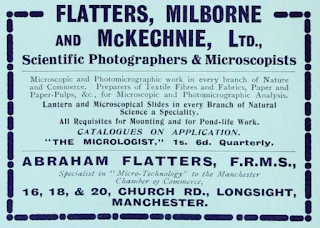
From Knowledge magazine, December 1910

Throughout the period of self-employment, being part of Flatters & Garnett and then of Flatters, Milborne & McKechnie, as well as lecturing in Manchester, Abraham Flatters became well-known in professional and amateur microscopical circles. His name appeared in the Manchester newspapers which reported his activities in the Manchester Microscopical Society (which is still in existence). There were over 200 members and comprised various sections. The following is from the Manchester City News of 20 January 1906:

The annual meeting of the Mounting Section of the Manchester Microscopical Society took place on Thursday night. The election of officers for the year resulted as follows: Chairman, Mr. Abraham Flatters, F.R.M.S.: vice-chairman Mr. William Buckley; secretary and treasurer, Mr. Emil Watzlaff; auditor, Mr. William Hart; committee, Messrs. Charles Turner, F.C.S., P. Bradshaw, J. E. Storey, J. L. W. Miles, J. R. Wilson, and Charles Camp. The subjects of the demonstrations and lectures to be given include ringing and finishing slide, and measurement of microscopic objects; dry mounting and plant structure; diatomaceae collecting, preparing, and mounting; mounting in fluids, stains and their characteristics, mounting objects glycerine jelly, botanical dissection, photo-micrography, mounting in balsam on cavity slips, and zoological dissection.

Sometime before 1906 he was elected a Fellow of the Royal Microscopical Society. He attended meetings in London. The Field magazine of 20 June 1908 gave an account of a meeting at 20 Hanover Square which included:

Mr Abraham Flatters, of Manchester, had an interesting exhibition of microscopic slides, exemplifying the development of a chick at various stages from twenty hours to four and a half days, and constituting a typical set for teaching purposes. The technique of the slides was all that could be desired, and showed how far we have travelled in the art of section cutting since Kitchen Parker [*] did his famous work on the early stages of the tadpole and the chick.

Flatters was also a member of the Manchester Geological Society.
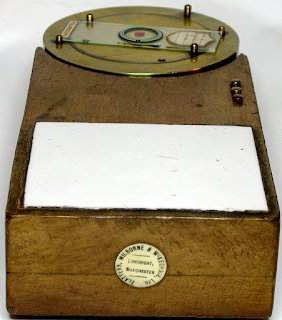
A slide ringing table sold by Flatters, Milborne
& McKechnie. Did they manufacture them or
rebadging from a generic manufacturer?
From here

The advertisements and publications from Flatters, Milborne & McKechnie suggest Flatters was a consultant to the cotton industry in Manchester on microscopical examination of their raw material. He wrote a book on the cotton plant and in its preface described himself as ‘Specialist in Micro-Technology to the Manchester Chamber of Commerce’. He may have found some demand for such services. Imports of raw cotton peaked in 1914 at almost a billion tonnes.

This article began with the lectures on microscopy given by Abraham at the Municipal School of Technology in Manchester. He is variously described as teacher, lecturer and demonstrator. I have been unable to find out how much of his time these activities occupied or for how long he was thus employed.

He produced three books: Methods in Microscopical Research; 1905. Published by Sherratt & Hughes, Manchester; The Cotton Plant. Its Development and Structure, and the Evolution and Structure of the Cotton Fibre. 1907. Sherratt & Hughes; Photomicrographs of Botanical Studies. Not dated. Flatters, Milborne & McKechnie Ltd.

Flatters produced a vast array of microscope slides from many different organisms. I can only assume that he had a network of people who provided him with the material and the background information to label the slides. With thin sections very little original material is needed and I wonder if he kept paraffin wax-embedded blocks ready for cutting in order to fulfil individual orders or if he made and stained a batch of sections which he could keep in stock.
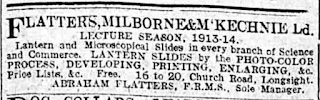
Manchester City News 14 January 1914

There are large number of old lantern slides available on the antiques market made by Flatters & Garnett or by Flatters, Milborne & McKechnie. Did he take all the photographs, including, for example, ones in mines, or did he also provide a lantern slide making service to those (of which there would have been many) who have lectures at the many natural history, geological, geographical and historical societies that flourished in Victorian and Edwardian England? My guess from reading his advertisements is that he did make lantern slides—a far more specialist job in those days—from other people’s negatives. A newspaper advertisement from 1914 shows that the photographic side of the business (developing, printing etc) was a major activity.

Abraham and Emma moved to the outer suburbs of Manchester, Syddal Cottage in Bramhall sometime in the 1910s. The 1911 Census shows Abraham as ‘microscopist and science teacher’ employing a resident domestic servant. Installed as caretaker for Flatters, Milborne & McKechnie at 20 Church Road was Abraham’s brother, John Reid Flatters. John, four years older than Abraham, also worked on the railway in Manchester. The 1921 Census has Abraham down as ‘microscopist and photographer’ and managing-director of the company; again they had had a domestic servant.

Syddal Cottage remained their home, certainly in 1923 but at their deaths 6 Blackthorn Avenue, Burnage, another Manchester suburb, is shown as their address. 

The company appeared to continue in business until three years before Abraham’s death; it was formally dissolved on 4 July 1926, the application having been made in March. However, according to the 1926 rates records for Manchester, it did continue under the name of ‘Abraham Flatters’ but owned by a Thomas Wyatt who also had bought 16 and 18 Church Road, leaving 20 occupied by John Flatters but owned by a third party. How long Wyatt kept the ‘Abraham Flatters’ business going I have been unable to find out.

Flatters must have been a thorn in the side of Flatters & Garnett from his departure until his death. I will return to the rise and fall of Flatters & Garnett in a future article.

Abraham died on 2 March 1929, leaving £829 (the date shown in a family tree on ancetry.com is incorrect). Emma died on 15 May 1932, leaving £609.

The life and accomplishments of Abraham Flatters illustrate how efforts to provide education for the working man in Victorian England could enable somebody with just primary schooling to gain knowledge and become a skilled and knowledgable technician. It was an age in which there was a thirst for knowledge. There were numerous natural history societies and microscopy clubs in Manchester alone. Microscopy, including the preparatioon of specimens, was a major hobby for those who could afford to buy the equipment. What a difference to today’s Age of Wilful Ignorance.

*William Kitchen Parker FRS (1823 – 1890)


Microscope Slide Labels

I have found three types of miscroscope labels which identify these slides as made by Abraham Flatters (in addition to ones made by Flatters & Garnett). It is possible that some were made before his partnership with Garnett, others while with Flatters, Milborne & McKechnie while others could have been when Wyatt owned the business but traded under Flatter's name.

In the collection of the
Manchester Microscopical Society


Wednesday, 17 May 2023

Ceylon or Sri Lankan Junglefowl: a colour plate from 1959

In the days when colour printing was extremely expensive, the Avicultural Society had special appeals for funds to support the appearance in Avicultural Magazine of the occasional colour plate. A well-known bird artist was then commissioned. Although the whole run of the Society’s magazines can be found online, the plates rarely see the light of day. Therefore I decided to show one, now and again, on this site. This is the 7th in the series.

 – – – – – – – – – –


This plate illustrates an article by the artist, George Morrison Reid Henry (1891-1983). He published and signed his work ‘G.M. Henry’. One of eleven children, his father was manager of tea estates in what was then Ceylon. He was educated at home by his older sisters. After working as a laboratory assistant he was taken on as a draughtsman by the Colombo Museum. He worked his way up and in 1913 was appointed to a new post of Assistant in Systematic Entomology. He stayed in in that post until he retired in 1946. His son, David Morrison Reid Henry (1919-1977) was also a bird painter.

The bird, Gallus lafayettii, is endemic to Sri Lanka where it is common. Henry, in the article, descrbed his observations on the birds in the wild.

Avicultural Magazine 65, 1959


Herbert Womersley: from industrial chemistry in Lancashire through amateur entomology to world-class expertise on mites in South Australia

In my recent article on species of mite discovered on rats in Hong Kong by John Romer in the early 1950s I noted that they had been named by Herbert Womersley (1889-1962) at the South Australian Museum in Adelaide.


Herbert Womersley achieved a professional post in descriptive zoology by a route that would be almost impossible today. He trained in England as a works chemist and by dint of his amateur activities in entomology was offered a post in Australia to investigate with some degree of urgency the mite infestations that were devastating crops.

Womersley was born in Warrington, Lancashire. His father, a wire drawer by trade, was a keen amateur lepidopterist. He had always been interested in insects, flies in particular, and while working in industry he attended ‘night school’ under Abraham Flatters at the Manchester Technical School (eventually to become part, after a long series of mergers, part of the University of Manchester).

The First World War changed everything. Womersley’s employment as an industrial chemist was put to use. First he was in the Royal Army Medical Corps but was transferred to the Special Companies of the Royal Engineers to carry out gas attacks on German lines in retaliation for the first use of poison gas (chlorine) by Germany in April 1915. All the men involved appear to have been chemists in civilian life and were given the rank of ‘Chemist Corporal’. In 1917 Womersley was sent to H.M. Factory, Gretna, the huge factory built in 1915-1916 for producing cordite. The site of 9000 acres (3650 hectares) extended for 9 miles to straddle the English-Scottish border near Gretna. At peak production 1,400 tonnes of cordite was being sent to the shell-filling factories each week by a workforce of nearly 17,000 (two-thirds women). Womersley is commemorated on the website of the museum commemorating the factory, The Devil’s Porridge Museum.

From 1920 until 1930 Womersley and his family lived near Bristol. He was Manager of the Fuel and Steamraising Department of Christopher Thomas & Bros Ltd, soap manufacturers. It was during this period that Womersley became well known in entomological circles, becoming a fellow of the Royal Entomological Society in 1926. In Bristol he served as president of Bristol Naturalists’ Society and was one of the promoters and secretary of the South Western Naturalists’ Union. During this time he became the leading authority in Britain on wingless insects, then lumped into a single subclass, the Apterygota. Foreign collections as well as British specimens were sent to him in Bristol for further work.

He started to seek work as a professional entomologist and in 1930 was offered a post in the Division of Economic Entomology of CSIRO in Australia. The head of the division knew of Womersley’s work, was impressed and had him appointed for the study and control of two species of which were important agricultural pests. Before moving to Australia, CSIRO had him work at the Natural History Museum in London in order to learn about collembolans (springtails) and mites (Acarina). It was stressed to him that he must learn as much as possible there and during a visit to South Africa in order that he could hit the ground running when he reached Australia. His boss wrote to him: ‘However you must on no account come out without a full equipment of knowledge of the groups on which you are to work. I would rather you spent a further month or two in England than that you came out without all the information you can possibly gather. Please remember we have no expert on mites or Collembola here (except S. Hirst in Adelaide, whom nobody ever sees)... ". 

After 5 months in London and 7 weeks in South Africa Womersley arrived in Perth on 25 September 1930. He is said to have worked extremely hard at CSIRO both in field studies and on taxonomy. However, he did not stay long because CSIRO was under severe financial constraints as the Australian government tightened its belt. There were no new appointments and rumours began to circulate that the whole division in which Womersley worked was going to be closed down. Not surprisingly, in 1932, he jumped ship. He was appointed as entomologist at the South Australia Museum. He stayed in that post until his retirement in 1954. He was then re-appointed to the museum as acarologist until he retired again in 1959 but still continued work in an honorary capacity.

The mites that were the vectors of scrub-typhus were an important cause of disease in the Western Pacific theatre during the Seconds World War. The U.S.A.’s Typhus Commission sought help from Womersley in the identification of mites. Such work continued in south-east Asia after the war, in collaboration with the U.K.’s Colonial Office and the U.S. Amy medical research unit in Malaya.

Womersley was an active member of the Royal Society of South Australia, serving as secretary, editor, treasurer, vice-president and president. Through that activity he became involved in conservation. He represented the Royal Society of South Australia on the Board of Commissioners of the National Park and Wild Life Reserves of South Australia ex officio as President, He was subsequently appointed a Commissioner in his own right. His obituarist noted that he identified himself closely with the purposes of fauna and flora preservation in South Australia. 

Ronald Vernon Southcott (1918–1998) started to study mites with Womersley at the age of 16. He then qualified in medicine but continued that interest in his medical research in acarology. He wrote Womersley’s obituary for the journal Acarologia. It ends:

His achievements in his chosen fields were considerable. He was undoubtedly at his best in descriptive taxonomy, and it is fortunate that he was able to achieve his ambition and do the work which he loved best… His judgement was sound in coming to Australia, and he was able to do much for acarology. At his death the collection of Acarina at the South Australian Museum must be one of the largest in the world, with many types and much reference material sent in exchange. He gave a good deal of assistance to earnest students of the Acarina… A bond of affection developed naturally with him in the course of work, although at times the air could be a little clouded while a point was in dispute.

Herbert Womersley at his death in 1962 had come some way from the streets of Warrington and a life as an industrial chemist - and he produced two biologists; one son, an algologist, became Professor of Botany in the University of Adelade, the other, an expert on the flora of New Guinea became Director of the National Botanic Garden at Lae.

Southcott RV. 1963. Herbert Womersley (1889 -1962), Acarologia, 5  323-334.

AMENDED 4 June 2023

Thursday, 27 April 2023

John Romer discovered other animals in Hong Kong: his eponymous chiggers, harvest-mites, scrub-typhus or itch mites

From Wikipedia
by Bugboy52.40

Until I received copies of gleanings from the ZSL Library archives by Jack Greatrex I had no knowledge of John Romer’s discovery of other animal species in Hong Kong. A copy of his curriculum vitae prepared about a year before his death in 1982 showed he had discovered what were then three new species of something entirely different from, his interests in amphibians and reptiles but connected with his work first as rodent control officer and then, more widely, as pest control officer for the Hong Kong Government.

Rats have parasites and as well as collecting fleas found on rats, he also collected other possible vectors of human disease, the tiny mites called chiggers or harvest mites—the  Trombiculidae, a family of arachnids. After an encounter with the microscopic chigger larvae in Guyana the very thought of them makes me itch.

Herbert Womersley

Romer sent the mites collected from rats to Herbert Womersley (1889-1962) at the South Australian Museum in Adelaide. Womersley—more on him in a future article—was the established world expert on the Acarina, mites and ticks, and continued to build a major collection at the Museum. He named three species from the specimens Romer supplied: Garhliepia romeri, Helenicula hongkongensis, Acomatacarus romeri.

What has happened more recently? Do they still stand as ‘good’ species or were they synonyms of previously described species? Fortunately I found a recent checklist of world Trombiculids. As a whole they go under a number of common names in addition to chiggers and harvest mites which some reflecting their effect on the human population or as vectors of human diseases: scrub-typhus mites, scrub-itch mites, red mites, sand mites.

The present state of play

The first named, Garhliepia romeri Womersley 1952 is now Gateria romeri and still a recognised species. The larva was collected by Romer from a rat stated to be Rattus rattus* in 1950. 


Womersley's figure showing the scutum of
Gahrliepia romeri

Womersley H. 1952. The scrub-typhus and scrub-itch mites (Trombiculidae, Acarina) of the asiatic-pacific region. Records of the South Australian Museum 10. Adelaide: South Australian Museum.

The second, Helenicula hongkongensis is now regarded as a synonymous with the earlier named Helenicula kohlsi, and therefore invalid. It was collected from Rattus rattus with the location provided by Romer: The Peak, Middle Gap Road. I wonder how the current owners of properties there—some of the most expensive in the world—view their purchases being recorded in perpetuity as the habitat of rats carrying scrub-typhus mite larvae?

Womersley H. 1957. Malaysian Parasites—XXI. A small collection of larval mites (Acarina, Trombiculidae and Leeuwenhoekiidae) from rats in Hong Kong. Studies from the Institute for Medical Research, Federation of Malaya, 28, 105-112.

The third and the other eponymous species, named by Womersley in the same publication, still stands as Odontacarus romeri.

----------------------------------

In summary John Dudley Romer has three currently recognised species named for him, one frog and two mites, all of which he discovered in Hong Kong in the 1950s.

…and I am still itching.

*I have written previously of trying to sort out the rats of Hong Kong. The mite larvae that Romer found were described as from from Rattus rattus. Given the current state of knowledge, it is not possible to state which of the currently recognised species in Hong Kong the mite larvae were obtained from. The choice is between Rattus tanezumi, more likely in the roof of buildings, and Rattus andamanensis, the free-living species on the hillsides.

Nielsen DH, Robbins RG, Rueda LM. 2021. Annotated world checklist of the Trombiculidae and Leeuwenhoekiidae (1758– 2021) (Acari: Trombiculoidea), with notes on nomenclature, taxonomy, and distribution. Zootaxa 4967, 1-243. https://doi.org/10.11646/zootaxa.4967.1.1 


Monday, 24 April 2023

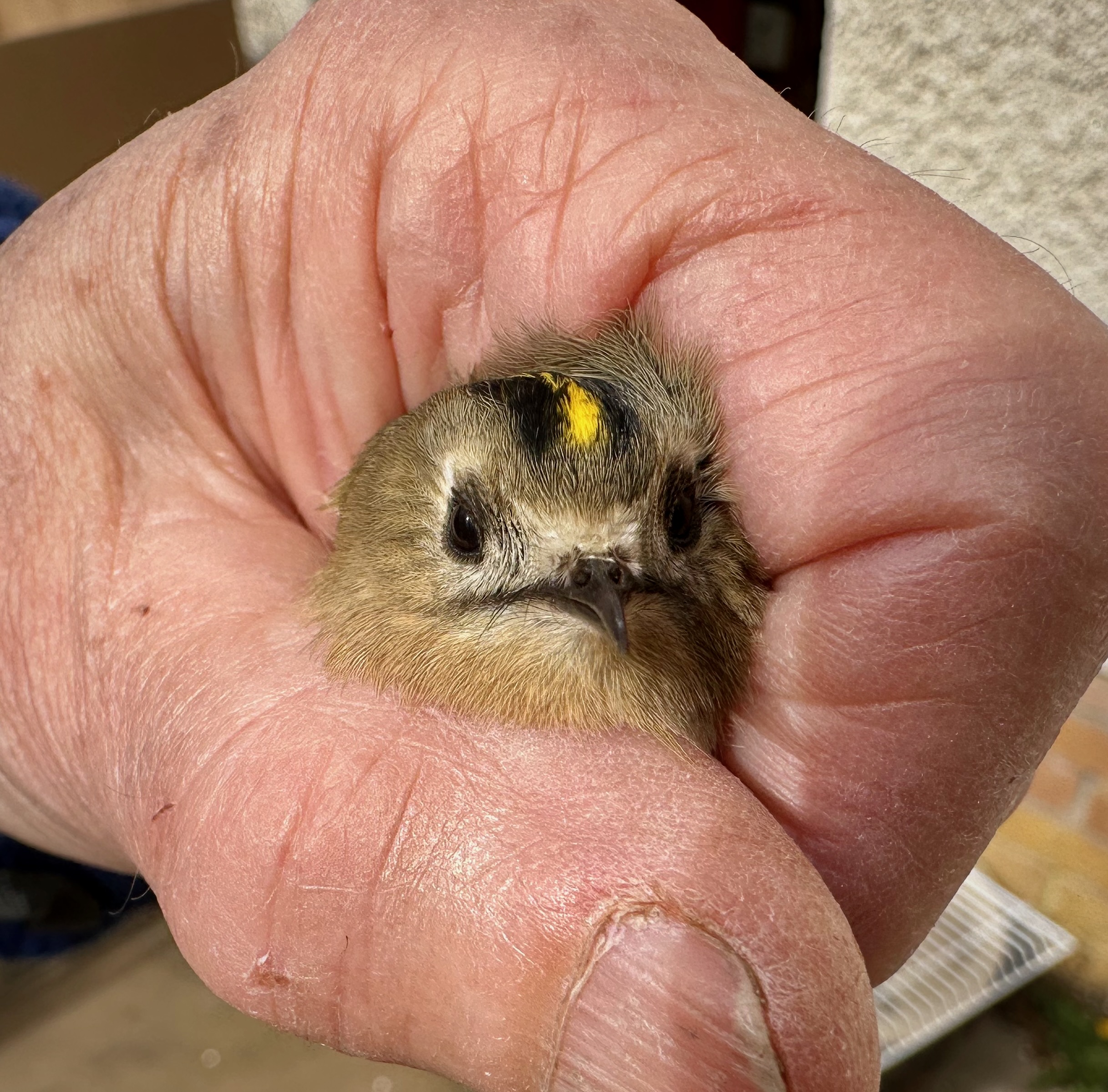
There's a Goldcrest in the garage


This Goldcrest (Regulus regulus) was spotted in the garage last week, trying to leave by flying though the glass and not by the door at either end. It was soon caught and sent on its way. A common breeding bird in these parts we sometimes spot them in the garden searching shrubs, door and window frames for the small invertebrates on which they depend. At their size and relatively large surface area they have to catch prodigious quantitites of small inverrberates just to survive the day. The smallest European bird, averaging around 6 g—less than a two-pence piece—their weight depends on the time of day and the temperature. They lay down fat during the day and then burn if off at night to maintain their body temperature. Unlike some other small birds, they do not, when adequately fed, allow their temperature to fall during the night. 

Sunday, 23 April 2023

John Romer and the new species of amphibians he discovered in Hong Kong

John Romer discovered three new species of amphibian in Hong Kong, and all three still stand as ‘good’ species.

Amolops hongkongensis
From Flickr. Photo by Thomas Brown in 2011

Taking them in order of date of collection the first was described as Staurois hongkongensis. Now known as Amolops hongkongensis, the Hong Kong Cascade Frog or Hong Kong Torrent Frog, lives along mountain streams and lays its eggs on rocks being splashed by the cascading water. Romer found the first specimens in August 1950 on the mountain, Tai Mo Shan. It is known to occur over much of Hong Kong and there are also reports from nearby regions. In Hong Kong it is relatively common but it is classified by IUCN as ‘Endangered’. Given his contacts in London I always found it rather odd that the description of the new species was with Clifford Hillhouse Pope (1899-1974) of the Chicago Natural History Museum as senior author. Pope was well established as an expert on the herpetofauna of China with his book on amphibians, a companion to his The Reptiles of China still unpublished. Pope was also beginning well known for his semi-popular books. His 1955 book The Reptile World appeared in British school and public libraries. The paper by Pope and Romer, 1951, appeared in Fieldiana Zoology, a house journal of the museum.


Boulenophrys brachykolos
From Flickr. Photo by Thomas Brown in 2011

A small frog found on The Peak, Hong Kong Island in August 1952, was next to be described as a new species. Again the specimen was sent to Chicago. Although the frog was found in 1952, the paper did not appear until 1961. The senior author this time was another well-known herpetologist Robert Frederick Inger (1920-2019) who had succeeded Pope in Chicago. Inger wrote the popular Living Reptiles of the World in 1957 with his and Pope’s former boss, Karl Patterson Schmidt (18890-1957). Megophrys (now Boulenophrys) brachykolos or Short-legged Toad also occurs over the border in Guangdong. It is classified as ‘Endangered’.


Romerus romerus
From Flickr. Photo by Thomas Brown in 2011

The third species, the eponymous Romer’s Frog, was also discovered in August 1952—in a cave beside the sea on the island of Lamma. But instead of Chicago he sent specimens to the Natural History Museum in London where in 1953 they were described and named for Romer, Philautus romeri by Malcolm Arthur Smith (1875-1958) who worked in a voluntary capacity at the Museum.

Romer would have known Smith personally because he was a driving force behind the formation of the British Herpetological Society and would have become its first Secretary had he not got a job as pest control officer in the Hong Kong government. Smith was slated as first President. I have written before on Smith who was keen on amphibians and reptiles as a child but knew the only way he could pursue that activity was by earning a living as a doctor. After qualifying at Charing Cross Hospital and practice in London he went off to Bangkok as medical officer to the British Legation. That job was then extended to physician to the royal household of Siam (now Thailand). During his time there he was active in natural history, collecting specimens and writing accounts of the herpetofauna of south-east Asia. In 1925 at the age of 50 he retired to London where he was given space at the Natural History Museum. From there until his death he published extensively particularly on the reptiles of Asia.

Romer’s Frog has carried a succession of generic names. The most recent move has been to put it along with several others species from China into a new genus, Romerus. Thus we have John commemorated by both genus and species, Romerus romerus. I also much prefer the simple common name to others that have come into use like Romer's Treefrog and Romer's Bubble-nest Frog. Romerus romerus is also classified by IUCN as ‘Endangered’.

I do not know why he chose to send specimens where he did. Did he take advice from Smith, for example, on where the most expertise lay? He certainly sent a snake to a leading expert in that particular group of snakes when he found or received the first specimen in 1966 on the side of Tai Mo Shan. The expert was Edmiund Virgil Malnate (1916-2003) an interesting character who by profession was a graphic artist but combined that work with being a volunteer curator at the Academy of Natural Sciences of Philadelphia. The paper by Malnate and Romer on the occurrence of the Mountain Keelback, Amphiesma (now Hebius) atemporalis, in Hong Kong was published in 1969. Until he collaborated with Jean-Paul Risch in debunking the newt that never was, his only co-authors were Pope, Inger and Malnate.


The People


John Romer in Stuttgart, 1977


Clifford H Pope                         Robert F Inger


Anon. 2014. Pope, Clifford H (1899-1974). In Contributions to the History of Herpetology (Volume 1, revised and expanded), Edited by Kraig Adler, p 94. Society for the Study of Reptiles and Amphibians.

Anon. 2007. Romer, J.D. (1920-1982). In Contributions to the History of Herpetology (Volume 2), Edited by Kraig Adler, p 212. Society for the Study of Reptiles and Amphibians.

Inger RF, Romer JD. 1961. A new pelobatid frog of the genus Megophrys from Hong Kong. Fieldiana—Zoology 39, 533-538

Malnate EV, Romer JD. 1969. A snake new to the fauna of Hong Kong and China: Amphiesma atemporalis (Bourret). Notulae naturae of the Academy of Natural Sciences of Philadelphia  No 424, 1–8.

Pope CH, Romer, JD. 1951 A new ranid frog (Staurois) from the Colony of Hongkong. Fieldiana—Zoology 31, 609-6l2.

Smith M. 1953. Description of a new species of frog of the genus Philautus, Annals and Magazine of Natural History 6, 477-478.