Wednesday, 17 May 2023

Ceylon or Sri Lankan Junglefowl: a colour plate from 1959

In the days when colour printing was extremely expensive, the Avicultural Society had special appeals for funds to support the appearance in Avicultural Magazine of the occasional colour plate. A well-known bird artist was then commissioned. Although the whole run of the Society’s magazines can be found online, the plates rarely see the light of day. Therefore I decided to show one, now and again, on this site. This is the 7th in the series.

 – – – – – – – – – –


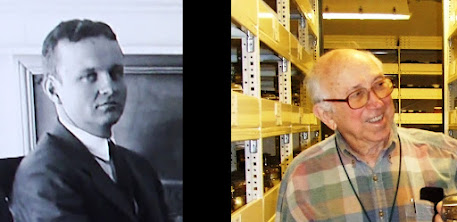
This plate illustrates an article by the artist, George Morrison Reid Henry (1891-1983). He published and signed his work ‘G.M. Henry’. One of eleven children, his father was manager of tea estates in what was then Ceylon. He was educated at home by his older sisters. After working as a laboratory assistant he was taken on as a draughtsman by the Colombo Museum. He worked his way up and in 1913 was appointed to a new post of Assistant in Systematic Entomology. He stayed in in that post until he retired in 1946. His son, David Morrison Reid Henry (1919-1977) was also a bird painter.

The bird, Gallus lafayettii, is endemic to Sri Lanka where it is common. Henry, in the article, descrbed his observations on the birds in the wild.

Avicultural Magazine 65, 1959


Herbert Womersley: from industrial chemistry in Lancashire through amateur entomology to world-class expertise on mites in South Australia

In my recent article on species of mite discovered on rats in Hong Kong by John Romer in the early 1950s I noted that they had been named by Herbert Womersley (1889-1962) at the South Australian Museum in Adelaide.


Herbert Womersley achieved a professional post in descriptive zoology by a route that would be almost impossible today. He trained in England as a works chemist and by dint of his amateur activities in entomology was offered a post in Australia to investigate with some degree of urgency the mite infestations that were devastating crops.

Womersley was born in Warrington, Lancashire. His father, a wire drawer by trade, was a keen amateur lepidopterist. He had always been interested in insects, flies in particular, and while working in industry he attended ‘night school’ under Abraham Flatters at the Manchester Technical School (eventually to become part, after a long series of mergers, part of the University of Manchester).

The First World War changed everything. Womersley’s employment as an industrial chemist was put to use. First he was in the Royal Army Medical Corps but was transferred to the Special Companies of the Royal Engineers to carry out gas attacks on German lines in retaliation for the first use of poison gas (chlorine) by Germany in April 1915. All the men involved appear to have been chemists in civilian life and were given the rank of ‘Chemist Corporal’. In 1917 Womersley was sent to H.M. Factory, Gretna, the huge factory built in 1915-1916 for producing cordite. The site of 9000 acres (3650 hectares) extended for 9 miles to straddle the English-Scottish border near Gretna. At peak production 1,400 tonnes of cordite was being sent to the shell-filling factories each week by a workforce of nearly 17,000 (two-thirds women). Womersley is commemorated on the website of the museum commemorating the factory, The Devil’s Porridge Museum.

From 1920 until 1930 Womersley and his family lived near Bristol. He was Manager of the Fuel and Steamraising Department of Christopher Thomas & Bros Ltd, soap manufacturers. It was during this period that Womersley became well known in entomological circles, becoming a fellow of the Royal Entomological Society in 1926. In Bristol he served as president of Bristol Naturalists’ Society and was one of the promoters and secretary of the South Western Naturalists’ Union. During this time he became the leading authority in Britain on wingless insects, then lumped into a single subclass, the Apterygota. Foreign collections as well as British specimens were sent to him in Bristol for further work.

He started to seek work as a professional entomologist and in 1930 was offered a post in the Division of Economic Entomology of CSIRO in Australia. The head of the division knew of Womersley’s work, was impressed and had him appointed for the study and control of two species of which were important agricultural pests. Before moving to Australia, CSIRO had him work at the Natural History Museum in London in order to learn about collembolans (springtails) and mites (Acarina). It was stressed to him that he must learn as much as possible there and during a visit to South Africa in order that he could hit the ground running when he reached Australia. His boss wrote to him: ‘However you must on no account come out without a full equipment of knowledge of the groups on which you are to work. I would rather you spent a further month or two in England than that you came out without all the information you can possibly gather. Please remember we have no expert on mites or Collembola here (except S. Hirst in Adelaide, whom nobody ever sees)... ". 

After 5 months in London and 7 weeks in South Africa Womersley arrived in Perth on 25 September 1930. He is said to have worked extremely hard at CSIRO both in field studies and on taxonomy. However, he did not stay long because CSIRO was under severe financial constraints as the Australian government tightened its belt. There were no new appointments and rumours began to circulate that the whole division in which Womersley worked was going to be closed down. Not surprisingly, in 1932, he jumped ship. He was appointed as entomologist at the South Australia Museum. He stayed in that post until his retirement in 1954. He was then re-appointed to the museum as acarologist until he retired again in 1959 but still continued work in an honorary capacity.

The mites that were the vectors of scrub-typhus were an important cause of disease in the Western Pacific theatre during the Seconds World War. The U.S.A.’s Typhus Commission sought help from Womersley in the identification of mites. Such work continued in south-east Asia after the war, in collaboration with the U.K.’s Colonial Office and the U.S. Amy medical research unit in Malaya.

Womersley was an active member of the Royal Society of South Australia, serving as secretary, editor, treasurer, vice-president and president. Through that activity he became involved in conservation. He represented the Royal Society of South Australia on the Board of Commissioners of the National Park and Wild Life Reserves of South Australia ex officio as President, He was subsequently appointed a Commissioner in his own right. His obituarist noted that he identified himself closely with the purposes of fauna and flora preservation in South Australia. 

Ronald Vernon Southcott (1918–1998) started to study mites with Womersley at the age of 16. He then qualified in medicine but continued that interest in his medical research in acarology. He wrote Womersley’s obituary for the journal Acarologia. It ends:

His achievements in his chosen fields were considerable. He was undoubtedly at his best in descriptive taxonomy, and it is fortunate that he was able to achieve his ambition and do the work which he loved best… His judgement was sound in coming to Australia, and he was able to do much for acarology. At his death the collection of Acarina at the South Australian Museum must be one of the largest in the world, with many types and much reference material sent in exchange. He gave a good deal of assistance to earnest students of the Acarina… A bond of affection developed naturally with him in the course of work, although at times the air could be a little clouded while a point was in dispute.

Herbert Womersley at his death in 1962 had come some way from the streets of Warrington and a life as an industrial chemist - and he produced two biologists; one son, an algologist, became Professor of Botany in the University of Adelade, the other, an expert on the flora of New Guinea became Director of the National Botanic Garden at Lae.

Southcott RV. 1963. Herbert Womersley (1889 -1962), Acarologia, 5  323-334.

AMENDED 4 June 2023

Thursday, 27 April 2023

John Romer discovered other animals in Hong Kong: his eponymous chiggers, harvest-mites, scrub-typhus or itch mites

From Wikipedia
by Bugboy52.40

Until I received copies of gleanings from the ZSL Library archives by Jack Greatrex I had no knowledge of John Romer’s discovery of other animal species in Hong Kong. A copy of his curriculum vitae prepared about a year before his death in 1982 showed he had discovered what were then three new species of something entirely different from, his interests in amphibians and reptiles but connected with his work first as rodent control officer and then, more widely, as pest control officer for the Hong Kong Government.

Rats have parasites and as well as collecting fleas found on rats, he also collected other possible vectors of human disease, the tiny mites called chiggers or harvest mites—the  Trombiculidae, a family of arachnids. After an encounter with the microscopic chigger larvae in Guyana the very thought of them makes me itch.

Herbert Womersley

Romer sent the mites collected from rats to Herbert Womersley (1889-1962) at the South Australian Museum in Adelaide. Womersley—more on him in a future article—was the established world expert on the Acarina, mites and ticks, and continued to build a major collection at the Museum. He named three species from the specimens Romer supplied: Garhliepia romeri, Helenicula hongkongensis, Acomatacarus romeri.

What has happened more recently? Do they still stand as ‘good’ species or were they synonyms of previously described species? Fortunately I found a recent checklist of world Trombiculids. As a whole they go under a number of common names in addition to chiggers and harvest mites which some reflecting their effect on the human population or as vectors of human diseases: scrub-typhus mites, scrub-itch mites, red mites, sand mites.

The present state of play

The first named, Garhliepia romeri Womersley 1952 is now Gateria romeri and still a recognised species. The larva was collected by Romer from a rat stated to be Rattus rattus* in 1950. 


Womersley's figure showing the scutum of
Gahrliepia romeri

Womersley H. 1952. The scrub-typhus and scrub-itch mites (Trombiculidae, Acarina) of the asiatic-pacific region. Records of the South Australian Museum 10. Adelaide: South Australian Museum.

The second, Helenicula hongkongensis is now regarded as a synonymous with the earlier named Helenicula kohlsi, and therefore invalid. It was collected from Rattus rattus with the location provided by Romer: The Peak, Middle Gap Road. I wonder how the current owners of properties there—some of the most expensive in the world—view their purchases being recorded in perpetuity as the habitat of rats carrying scrub-typhus mite larvae?

Womersley H. 1957. Malaysian Parasites—XXI. A small collection of larval mites (Acarina, Trombiculidae and Leeuwenhoekiidae) from rats in Hong Kong. Studies from the Institute for Medical Research, Federation of Malaya, 28, 105-112.

The third and the other eponymous species, named by Womersley in the same publication, still stands as Odontacarus romeri.

----------------------------------

In summary John Dudley Romer has three currently recognised species named for him, one frog and two mites, all of which he discovered in Hong Kong in the 1950s.

…and I am still itching.

*I have written previously of trying to sort out the rats of Hong Kong. The mite larvae that Romer found were described as from from Rattus rattus. Given the current state of knowledge, it is not possible to state which of the currently recognised species in Hong Kong the mite larvae were obtained from. The choice is between Rattus tanezumi, more likely in the roof of buildings, and Rattus andamanensis, the free-living species on the hillsides.

Nielsen DH, Robbins RG, Rueda LM. 2021. Annotated world checklist of the Trombiculidae and Leeuwenhoekiidae (1758– 2021) (Acari: Trombiculoidea), with notes on nomenclature, taxonomy, and distribution. Zootaxa 4967, 1-243. https://doi.org/10.11646/zootaxa.4967.1.1 


Monday, 24 April 2023

There's a Goldcrest in the garage


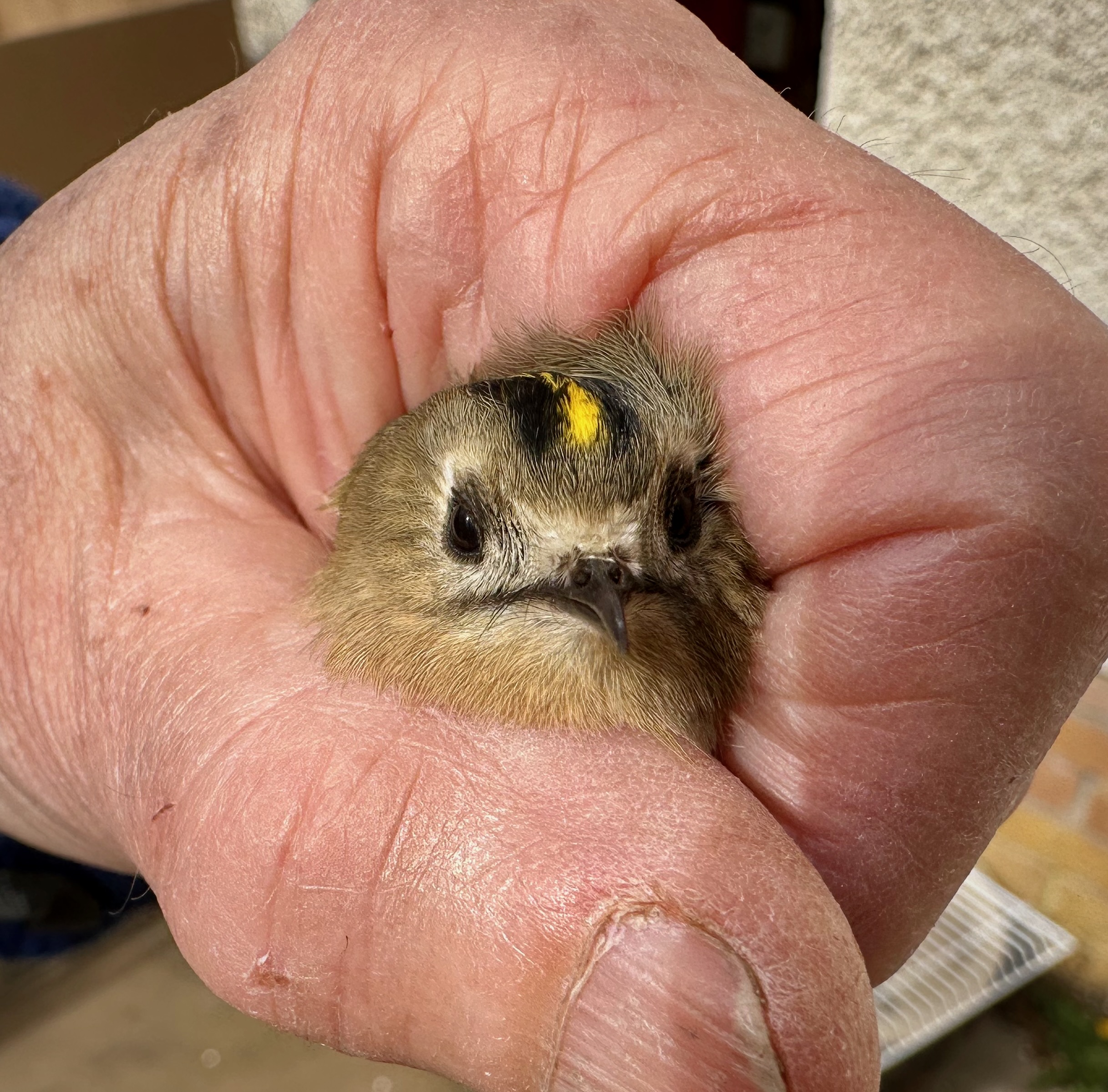
This Goldcrest (Regulus regulus) was spotted in the garage last week, trying to leave by flying though the glass and not by the door at either end. It was soon caught and sent on its way. A common breeding bird in these parts we sometimes spot them in the garden searching shrubs, door and window frames for the small invertebrates on which they depend. At their size and relatively large surface area they have to catch prodigious quantitites of small inverrberates just to survive the day. The smallest European bird, averaging around 6 g—less than a two-pence piece—their weight depends on the time of day and the temperature. They lay down fat during the day and then burn if off at night to maintain their body temperature. Unlike some other small birds, they do not, when adequately fed, allow their temperature to fall during the night. 

Sunday, 23 April 2023

John Romer and the new species of amphibians he discovered in Hong Kong

John Romer discovered three new species of amphibian in Hong Kong, and all three still stand as ‘good’ species.

Amolops hongkongensis
From Flickr. Photo by Thomas Brown in 2011

Taking them in order of date of collection the first was described as Staurois hongkongensis. Now known as Amolops hongkongensis, the Hong Kong Cascade Frog or Hong Kong Torrent Frog, lives along mountain streams and lays its eggs on rocks being splashed by the cascading water. Romer found the first specimens in August 1950 on the mountain, Tai Mo Shan. It is known to occur over much of Hong Kong and there are also reports from nearby regions. In Hong Kong it is relatively common but it is classified by IUCN as ‘Endangered’. Given his contacts in London I always found it rather odd that the description of the new species was with Clifford Hillhouse Pope (1899-1974) of the Chicago Natural History Museum as senior author. Pope was well established as an expert on the herpetofauna of China with his book on amphibians, a companion to his The Reptiles of China still unpublished. Pope was also beginning well known for his semi-popular books. His 1955 book The Reptile World appeared in British school and public libraries. The paper by Pope and Romer, 1951, appeared in Fieldiana Zoology, a house journal of the museum.
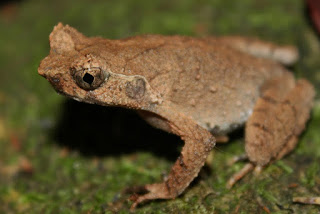

Boulenophrys brachykolos
From Flickr. Photo by Thomas Brown in 2011

A small frog found on The Peak, Hong Kong Island in August 1952, was next to be described as a new species. Again the specimen was sent to Chicago. Although the frog was found in 1952, the paper did not appear until 1961. The senior author this time was another well-known herpetologist Robert Frederick Inger (1920-2019) who had succeeded Pope in Chicago. Inger wrote the popular Living Reptiles of the World in 1957 with his and Pope’s former boss, Karl Patterson Schmidt (18890-1957). Megophrys (now Boulenophrys) brachykolos or Short-legged Toad also occurs over the border in Guangdong. It is classified as ‘Endangered’.

Romerus romerus
From Flickr. Photo by Thomas Brown in 2011

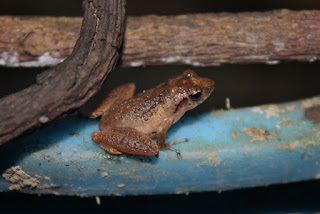
The third species, the eponymous Romer’s Frog, was also discovered in August 1952—in a cave beside the sea on the island of Lamma. But instead of Chicago he sent specimens to the Natural History Museum in London where in 1953 they were described and named for Romer, Philautus romeri by Malcolm Arthur Smith (1875-1958) who worked in a voluntary capacity at the Museum.

Romer would have known Smith personally because he was a driving force behind the formation of the British Herpetological Society and would have become its first Secretary had he not got a job as pest control officer in the Hong Kong government. Smith was slated as first President. I have written before on Smith who was keen on amphibians and reptiles as a child but knew the only way he could pursue that activity was by earning a living as a doctor. After qualifying at Charing Cross Hospital and practice in London he went off to Bangkok as medical officer to the British Legation. That job was then extended to physician to the royal household of Siam (now Thailand). During his time there he was active in natural history, collecting specimens and writing accounts of the herpetofauna of south-east Asia. In 1925 at the age of 50 he retired to London where he was given space at the Natural History Museum. From there until his death he published extensively particularly on the reptiles of Asia.

Romer’s Frog has carried a succession of generic names. The most recent move has been to put it along with several others species from China into a new genus, Romerus. Thus we have John commemorated by both genus and species, Romerus romerus. I also much prefer the simple common name to others that have come into use like Romer's Treefrog and Romer's Bubble-nest Frog. Romerus romerus is also classified by IUCN as ‘Endangered’.

I do not know why he chose to send specimens where he did. Did he take advice from Smith, for example, on where the most expertise lay? He certainly sent a snake to a leading expert in that particular group of snakes when he found or received the first specimen in 1966 on the side of Tai Mo Shan. The expert was Edmiund Virgil Malnate (1916-2003) an interesting character who by profession was a graphic artist but combined that work with being a volunteer curator at the Academy of Natural Sciences of Philadelphia. The paper by Malnate and Romer on the occurrence of the Mountain Keelback, Amphiesma (now Hebius) atemporalis, in Hong Kong was published in 1969. Until he collaborated with Jean-Paul Risch in debunking the newt that never was, his only co-authors were Pope, Inger and Malnate.


The People
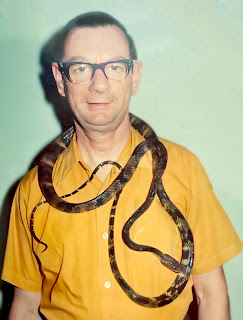

John Romer in Stuttgart, 1977


Clifford H Pope                         Robert F Inger


Anon. 2014. Pope, Clifford H (1899-1974). In Contributions to the History of Herpetology (Volume 1, revised and expanded), Edited by Kraig Adler, p 94. Society for the Study of Reptiles and Amphibians.

Anon. 2007. Romer, J.D. (1920-1982). In Contributions to the History of Herpetology (Volume 2), Edited by Kraig Adler, p 212. Society for the Study of Reptiles and Amphibians.

Inger RF, Romer JD. 1961. A new pelobatid frog of the genus Megophrys from Hong Kong. Fieldiana—Zoology 39, 533-538

Malnate EV, Romer JD. 1969. A snake new to the fauna of Hong Kong and China: Amphiesma atemporalis (Bourret). Notulae naturae of the Academy of Natural Sciences of Philadelphia  No 424, 1–8.

Pope CH, Romer, JD. 1951 A new ranid frog (Staurois) from the Colony of Hongkong. Fieldiana—Zoology 31, 609-6l2.

Smith M. 1953. Description of a new species of frog of the genus Philautus, Annals and Magazine of Natural History 6, 477-478.


Friday, 21 April 2023

The White Scarab Beetle of Hong Kong. All done without pigment


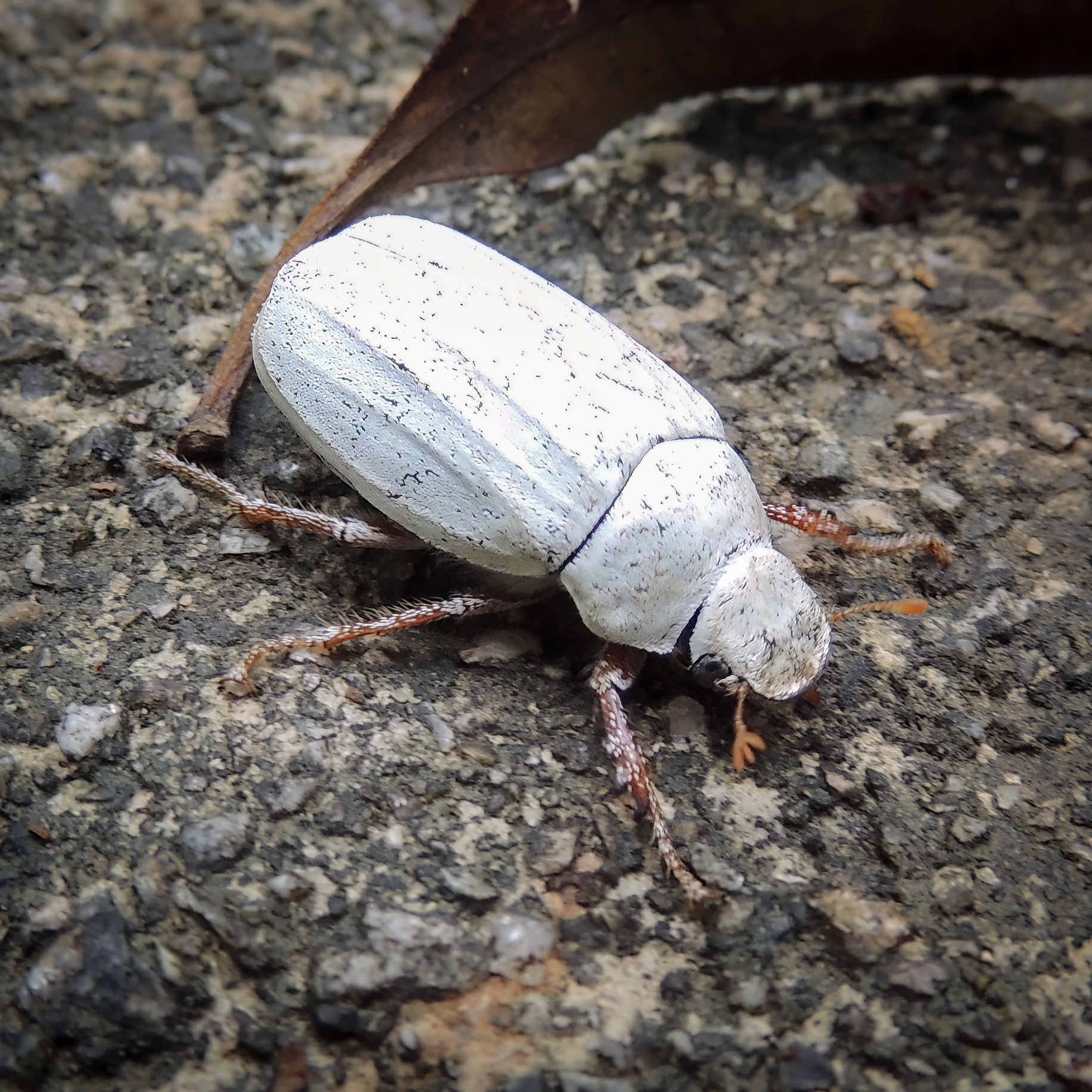
No. This beetle has not found itself too close to a brush full of brilliant white emulsion paint. It is that white or, more precisely, looks that white but, is in fact, black. This was one was photographed recently in Hong Kong by AJP.

Beetles of the genus Cyphochilus occur in south-east Asia. The species that occurs in Hong Kong has been identified as Cyphochilus apicalis. All are white and it is that whiteness that has attracted research by physicists. The whiteness is achieved not by pigment but by the optical properties of a layer of cuticle proteins only around 5 microns or μ (micrometres) thick—less than half the thickness of the finest human hair. The filaments in the layer are arranged in a manner such that they scatter incoming light of all wavelengths equally to produce white light.

Once the mechanism and structural characteristics of the protein filaments had been identified the race was on to mimic the process and produce an extremely thin material with such properties. In short, thin materials with these properties have now been made.

The advantage of appearing white has been attributed to camouflage of the beetles against a background of white fungi.


Monday, 17 April 2023

New Zealand Tomtit: a colour plate from 1961

In the days when colour printing was extremely expensive, the Avicultural Society had special appeals for funds to support the appearance in Avicultural Magazine of the occasional colour plate. A well-known bird artist was then commissioned. Although the whole run of the Society’s magazines can be found online, the plates rarely see the light of day. Therefore I decided to show one, now and again, on this site. This is the 6th in the series.

– – – – – – – – – –


The artist for this plate was Chloe Elizabeth Talbot Kelly (born 1927) who went on to illustrate a number of field guides. Her paintings of birds appear in art sales. She began painting in 1945 at the Natural History Museum in London.

The plate shows the North Island form of the New Zealand Tomtit (Petroica macrocephala). The South Island form has yellow band between the black and white on the breast. The bird has enjoyed a number of common names over the years including Pied Tit as it was described in Avicultural Magazine. The article accompanying the plate was written by Alan Reece Longhurst (born 1925). He is a well-known oceanographer and expert on plankton communities who spent a short time working in fisheries in New Zealand. He was born in Plymouth and after four years in the army he returned to London and university life. He graduated in entomology and then proceeded to a PhD on the ecology of notostracans. Fisheries research in West Africa then followed (with the short period in New Zealand in the middle). Spells in Plymouth and the USA were followed by a career in Canada. He became Director-General of the Bedford Institute of Oceanography in Nova Scotia.

Avicultural Magazine 67, 1961