Tuesday, 18 January 2022

The worm in the toad in the washing machine. Not the usual method of discovering a new species

Don’t leave your clothes on the floor in the tropics is a good maxim. It only takes a few cockroaches or venomous centipedes to run out in order to make the point. A couple returning to UK from Mauritius discovered they had a fellow traveller in their baggage. After emptying the contents of their suitcase into the washing machine and washing the clothes at what must have been a modest temperature, a toad—very much still alive—was found. Local herpetologists identified and housed the accidental migrant. It was a common African species, the Guttural Toad, Sclerophrys gutturalis, introduced into Mauritius in 1922 in an attempt to control the cane beetle.

A few days later, parasitic worms were found dead in the vivarium’s water bath, the ejection of which may have followed the shock of motion in the machine and/or the ingestion of detergent. The worms were preserved and were later identified as a new species of acanthocephalan. Acanthocephalans are gut parasites. They have a spiny proboscis which is used to pierce and hold the gut wall. Their life cycles are complex involving at least two hosts. The new species was named Pseudoacanthocephalus goodmani after one of the authors of the report who collected the toad from its accidental transcontinental carriers.

The toad, incidentally, grew and lived for another four years.

Oh…and tap your shoes or boots out before putting them on. That habit was instilled, as a necessary precaution against scorpions, into my wife as a young girl in Venezuela to the extent she still did it over a decade later in the depths of the 1963 freeze in Sheffield.


Allain SJR, Goodman MJ, Wilkinson JW. 2021. A series of unlikely events: from washing machine to new species. Herpetological Bulletin 156, 47-48 doi.org/10.33256/hb156.4748 


Thursday, 13 January 2022

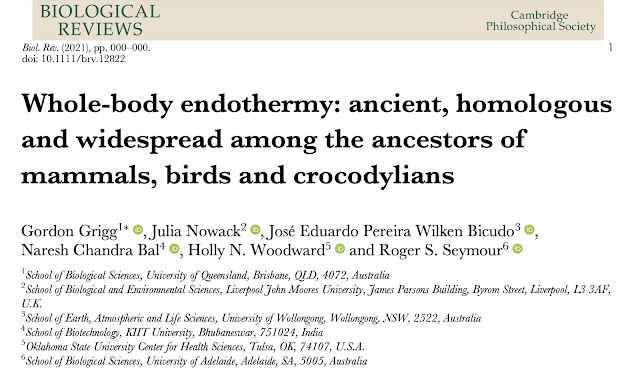
Were the ancestors of mammals, birds and crocodylians warm-blooded? A new paper argues they were

Claud Bernard’s dictum, La fixité du milieu intérieur est la condition de la vie libre et indépendante…, developed in the latter half of the 19th century has dominated thinking on the importance of constancy of the internal environment and of the mechanisms used, homeostasis, to maintain it. The corollary in evolutionary terms is that in terms of temperature regulation mammals and birds are at the peak of physiological efficiency. They generate heat from metabolic processes and keep their body temperature within fine limits.

Anything less than the mammalian and avian perfection of maintaining a stable body temperature has been viewed as a liability. After all it is self evident that at lower temperatures the ‘cold-blooded’ or poikilothermic vertebrates which do not generate sufficient heat internally cannot move so quickly and avoid predation, for example. That is all a simple matter of the effects of temperature on chemical reactions. Therefore, extant reptiles and amphibians have been looked on as relics of an inferior system of temperature generation and control with many of them using behavioural means to garner heat from the sun.

The view that reptiles had never developed the ability to generate heat was challenged fifty years ago by the suggestion that dinosaurs were warm-blooded in that they could generate heat internally (endothermy) rather than rely on heat from the environment (exothermy). Arguments have continued on whether new bits of evidence from the fossil record supports ectothermy, endothermy or something in between.

The generally accepted view of the mechanism of endothermy is that it must have arisen independently in the the evolutionary lines that ended up as mammals and birds and involved different biochemical mechanisms and tissues; indeed it is often referred to as an example of parallel evolution. The new paper turns that view on its head. In their scheme the authors suggest that the precursors of mammals and birds, as well as other reptile groups, had developed endothermy and that mammals and birds generate heat by a similar ancestral mechanism.

I will not go further into the extensive arguments the authors have mustered in support of their hypothesis but it does extend to take into account the structure and function of the circulatory system in mammals, birds and reptiles, for example.

If endothermy was, as the authors suggest, the ancestral condition, the question that arises is why animals like modern crocodilians have become cold-blooded animals more recently. Ectothermy (poikilothermy in old money) is highly efficient in metabolic terms. Reptiles have much lower metabolic rates than mammals of the same size and therefore require much less food. For ambush predators with an intermittent food supply that could be of great selective advantage.


A Mugger (Crocodylus palustris) basking in the sun at Sigiriya, Sri Lanka in 2013


Another Mugger in Yala National Park, Sri Lanka, 2013


Again if the authors are correct, we have to stop thinking of reptiles as losers in the race to develop endothermy and therefore enjoy Claud Bernard’s la vie libre et indépendante. You need a lot of energy from food or fat stores to be an endotherm and when the going is tough, loss of endothermy and la vie libre could well have been the evolutionary trade-off.

The paper by Gordon Grigg, Julia Nowack, José Eduardo Pereira Wilken Bicudo, Naresh Chandra Bal, Holly N. Woodward and Roger S. Seymour from universities in Australia, UK, India and the USA will promote a great deal of discussion across a wide range of disciplines. I think it is a case of watch this space.

Grigg G, Nowack J, Bicudo JEPW, Bal NC, Woodward HN, Seymour RS. 2021. Whole-body endothermy: ancient, homologous and widespread among the ancestors of mammals, birds and crocodylians. Biological Reviews  doi.org/10.1111/brv.12822


Wednesday, 5 January 2022

Joan Procter and Sir Peter Chalmers Mitchell at London Zoo: Barbary Apes and Innuendo

The relationship between Joan Beauchamp Procter, Curator of Reptiles at London Zoo until her death in 1931 and her boss, Sir Peter Chalmers Mitchell has intrigued historians as well as past fellows and employees of the Zoo.  I wrote in a previous article:

Rumours that Mitchell, who was at least distant and perhaps estranged from his wife for a time, and Procter were lovers were rife in the 1920s and 1930s; indeed they persisted at least until the 1990s whenever his name came up in conversation with people to whom the story had been passed down the line from the 1920s. But were the rumours based on fact?

Some have argued that her severe illness and series of operations would have prevented close contact but their travels together and sojourn in Spain certainly had tongues wagging in London. Procter, who was described by Mitchell as his 'dear friend, ward and colleague’, was seen by some (Mitchell and his friends on the Council of the Zoo) as a person who could do no wrong but to others, Solly Zuckerman for example, as a person who had a beguiling influence on some men but could do little right.


In 1950, nearly twenty years after Joan Procter’s death at the age of 34 and five years after the death of Mitchell, an article on Barbary Apes appeared in Zoo Life, the house magazine of the Zoological Society of London. The author, on whom more later, had in 1928 been the British army officer charged with the welfare of the apes on Gibraltar and their feeding from Colonial Office funds of £3 per month; an NCO had the job of recording happenings in the life of the apes on the Rock. These matters were taken seriously given the legend that if the apes die out Britain will lose Gibraltar.

One male ape went ape during the author’s tenure. ‘Jacko’ broke into Government House, broke crockery and removed the Governor’s hair brushes which were never recovered. The order was given for the animal to be shot but the ape avoided that fate by never presenting himself as a clear target. Impasse. The author continued:

It happened just at this time that the lady curator of the Reptile House of the London Zoological Gardens [i.e. Joan Procter] was staying at Malaga in the south of Spain, and was related to a certain Gunner captain then stationed at Gibraltar. The latter, thinking it would be of interest, wrote and told her the story, which she passed on to the Secretary of the Zoological Society [Mitchell]. He immediately wrote to the Governor saying that they had no Barbary Ape in the Society's collection and would be very grateful if the delinquent in question could be caught and sent to them instead of being killed. The Governor therefore caused an amendment to be issued to his first instruction, the gist of which, boiled down, said “for ‘shoot' read ‘catch’”…

After a considerable time of trying to entice Jacko into a trap and then to a cage for transport by sea, involving it would seem just about every member of the Royal Artillery in Gibraltar, the ape eventually arrived in London where he lived to the age of 21.

In the meantime, the author of the article moved on, was captured at the fall of Singapore and decided to write his part in the story of the apes on the Rock while a prisoner-of-war. However, he had to contact the keepers after the war to catch up with the story of Barbary Apes at the Zoo and with what had happened to Jacko:

"Joan" and "Peter," the two present incumbents, arrived at the Gardens from Gibraltar in 1942 and 1944 respectively. "Joan" was then four years old and twice the size of "Peter" who was only two and a half. In due course they were introduced and by virtue of her superior years and size “Joan"' for a time, the dominant female and “Peter” noticeably henpecked. Since then "Peter" has gradually outgrown his partner and is now twice her weight. With vivid recollections of earlier indignities, he has been able to pay back with interest all the chastisement he received until, eventually, the brow-beaten and lacerated "Joan"had, not long ago, to be removed to the sanitorium. While there she succeeded in opening her cage door and can thus claim the distinction of being one of the few animals to escape from the Gardens. She remained at large in the near vicinity for three days, was eventually enveloped in a coat on some scaffolding by a workman, netted and ignominiously returned to convalescence.

The author noted that ‘Joan’ and ‘Peter’ had failed to breed.

I think we can safely assume that the keepers at the Zoo, many of whom served for decades, had made their minds up on the nature of the Procter-Mitchell relationship. It is, therefore, of interest that the author added:

Author’s note.—None of the characters in this story is fictitious.

While the author was pointing out that he was well aware who the apes were named after, was he aware of the more salacious innuendo?

- - - - - - - - - - - - - - - - - - - - - - - - - - - - - - -

Who was Colonel Cecil Hunt, the author of the article and former subaltern i/c apes in Gibraltar?

Cecil Hunt (1899-1985) was a regular army officer, first, as during his time in Gibraltar, in the Royal Artillery and then, from 1934, in the Royal Army Ordnance Corps. He had the misfortune of being posted to Singapore as an Acting Colonel and Deputy Director of Ordnance Supply eleven weeks before the Japanese invasion in February 1942. A prisoner until the end of the war with Japan, his daughter recalled that he reached Southampton on 5 November 1945 on board R.M.S. Queen Elizabeth. In 1955 and by then a Brigadier, Cecil Hunt was ADC to the Queen until his retirement and appointment as CBE in 1956. In retirement he lived with his wife in Camberley, Surrey. In 1966 he is shown as attending the memorial service for Lieutenant-General Percival, the much but possibly unfairly criticised GOC Singapore at the time of its capture. Percival served as president of the Far East Prisoners of War Association and I suspect we can take it that Hunt approved of the actions of his former GOC in both rôles.

The ‘Gunner captain’ in Gibraltar with Hunt must have been Joan Procter’s cousin, John Ralph Willoughby Curtois (1897-1972). Awarded the Military Cross as a Lieutenant in the Royal Filed Artillery in the First World War, by the time he retired from the army in 1944 he had risen to Lieutenant-Colonel. His mother and Joan Procter’s father were siblings.


Hunt C. 1950. A Mediterranean Memory…Barbary Ape. Zoo Life 5 2( Summer 1950), 56-58.


Tuesday, 21 December 2021

A dissenting review of J.Z. Young’s Life of Vertebrates from 1951. Who wrote it?

I had a surprise when I found a book review in Zoo Life, a magazine circulated to fellows of the Zoological Society of London from 1946 until 1957. The review, written for the Spring 1951 issue, was of the first edition of The Life of Vertebrates by J.Z. Young which had been greeted with universal acclaim as ‘a breath of fresh air’.  As a result of its new approach generations of students were brought up with it. As I read the review I realised that the reviewer did not like it one little bit—well perhaps just one little bit since its extensive treatment of birds was praised. All the reviewer had to say on J.Z.’s treatment of fish concerned the fishing industry!


This was the first real statement to catch my eye:

The other chapters are less satisfactory. The fact of evolution being a continuous process and that it is embryologythe evolution of the individual--that alone provides a continuous chain of evidence, while the evidence of comparative anatomy or palaeontology consists of isolated fragmentsis not mentioned.

The reader in 1951 might have been taken aback by the misuse of the word ‘evolution’ as applied to the ontogeny of an individual organism. But I will not go further into questions of phylogeny and ontogeny in this article.

Then came:

Even a single palaeontological specimen may be of extraordinary interest; our knowledge that there once existed poisonous serpents of dimensions rivalling—indeed probably exceeding—those of the anaconda or of the largest pythons of the present day rests entirely on a singe tooth dug up in Gran Chaco!

Who was the reviewer? Did he not know that the identification of the tooth of a supposed giant snake by Sir John Graham Kerr in 1927 had been shot down in flames in 1939. The ‘tooth’ was a broken off projection from a conch shell, as I have explained here. Oh dear. But the review ended with:

It is to be regretted that the author has not acquainted himself with the large amount of information now available regarding the life-history of those archaic and still surviving vertebrates Polypterus, Ceratodus, Protopterus and Lepidosiren. The facts exposed by the study of these creatures have important bearings upon the old fashioned ideas on “The Life of Vertebrates”.

And who did the descriptive studies on lungfish? Sir John Graham Kerr. So it was hardly necessary to see that the reviewer, J.G.K., was no other than the man himself: Sir John Graham Kerr.

How utterly embarrassing. I wonder what J.Z. Young did with Kerr’s review. Frame and hang it in a room thought suitable for the purpose? How much it led to misconceptions of then modern zoology in the minds of the largely amateur readers of Zoo Life is anybody’s guess.

Kerr was 82 when he wrote the review and looking back on it 70 years later, he provided a contemporary demonstration quite like no other of why J.Z.’s new textbook was so welcomed as that  ‘breath of fresh air’. It also adds weight to the comment by Edward Hindle in his biographical memoir on Kerr: ‘Graham Kerr was a man of very vigorous personality and aroused strong opposition in certain individuals’.

It was Hindle who would, as editor, have solicited the review of The Life of Vertebrates in Zoo Life. He left the Zoological Society of London where he was scientific director in the same year. Previously he had succeeded Kerr in the regius chair of zoology in Glasgow and the two were related by marriage. And it was Hindle who perpetuated the mischief of the hypothetical giant snake when writing Kerr’s biographical memoir; nor did he get to grips with Kerr’s overweening views on the value of morphological embryology in matters of phylogeny.

In all, a rather sad but historically informative snapshot. The take-home message that J.Z. put across is as relevant today as it was when he wrote it:

…every biologist must know as much as possible of the life of the whole organism with which he deals…

Sadly, 70 years on that message and the integrative approach has, to a great extent, been forgotten as biological science has been balkanised into narrow fields of research and thought.


Friday, 17 December 2021

Introduced snakes on snake-free islands are bad news. The California Kingsnake on Gran Canaria devastates the local lizard populations

Did you know that an introduced snake is having a devastating effect on the three endemic lizards of Gran Canaria? No, me neither but a paper published this month spells out what has been happening.


The California Kingsnake (
Lampropeltis californiae) became one of the most popular snakes kept and bred in captivity from the 1970s. The story from Gran Canaria, where there are no native snakes, states that they were first found in the wild in 1998 after ‘the release or mass escape of individuals bred in captivity’. Since 2007 it has been found in first one, then two and then three distinct areas and various efforts have been made to control the population.

The research described in the new paper has estimated the effects of the snake’s presence by comparing areas where it is known to occur and those in which it does not (yet). There are three species of reptile on Gran Canaria, all endemic to the island. One, the Gran Canaria Giant Lizard, Gallotia stehlini, was reduced in numbers by 90% in the sites where the snake was present; the second, the Gran Canaria Skink, Chalcides sexlineatus, by 80%; the third, Boettger’s Wall Gecko, Tarentola boettgeri, by 50%.

Lizards are not the only prey. The endemic birds of the Canary Islands are also eaten as are feral mice and rats. Not surprisingly, efforts have been—and continue to be—made to eradicate the snake from the island.


This California Kingsnake I kept in the early 1970s. Kingsnakes are
famous for killing and eating other, often venomous, snakes.
I had to put this one in a vivarium holding a much heftier Royal
Python for a couple of minutes. When I returned I found the
kingsnake trying to constrict the python. Had I not intervened
would it have succeeded?

Gallotia stehlini is a magnificent lizard, reaching 80 cm in length.
I had a pair in the 1980s but passed them on to somebody with
more room. They breed readily in captivity and are omnivorous.
Photo: Juan Emilio from Las Palmas de Gran Canaria - on Wikipedia


Piquet JC, López-Darias M. 2021 Invasive snake causes massive reduction of all endemic herpetofauna on Gran Canaria. Proc. R. Soc. B 288: 20211939. https://doi.org/10.1098/rspb.2021.1939 


Sunday, 12 December 2021

Scientists who kept animals. 1. Parr Tate, Canaries and Antimalarial Drugs

There are those who think people who keep or have kept animals (excluding pet dogs and cats) are strange. On the other hand there are those of us who think that those who do not keep animals are the oddities. It was while writing a Royal Society Biographical Memoir that it struck me that I should start a series on scientists who kept animals as a hobby or professional sideline, the latter activity in many cases not only stimulating an interest in the animal life but also contributing to success in the former. The trail I was following was in a field, parasitology, of which my knowledge is rudimentary. In a biographical memoir on Ann Bishop FRS (1899-1990), Len Goodwin FRS (1915-2008), the subject of the memoir I was co-authoring, and Keith Vickerman FRS (1933-2016) who when we used to meet for lunch in the late 1990s up to his serious accident in 2002 told me about some of his work on how trypanosomes avoid the host’s immune system, wrote:


In 1927…the Medical Research Council joined in the search for new antimalarial drugs. With money from the Council, compounds were synthesized in the chemistry departments of several universities and sent for testing for antimalarial activity at the Molteno Institute. At that time, the only infection available for laboratory tests was Plasmodium relictum in canaries, the vector being Culex pipiens. The uniqueness of the Molteno Institute in the testing of antimalarial drugs was due to Dr Parr Tate, an Irishman with a boyhood interest in breeding canaries and a regular prize winner at local shows in Cork.


Parr Tate (1901-1985) arrived at the Molteno Institute in Cambridge in 1924. After suffering severe asthma as a boy which meant that he could not attend school, instead relying on private tuition,  he had graduated from University College, Cork in 1923 and then completed an M.Sc. He stayed at the Molteno for 44 years, becoming its Director in 1953 until his retirement in 1968. Thereafter he divided his time between Cambridge and Cork with his sister; he died there in 1985.

Tate’s interest and skill in keeping, breeding and exhibiting canaries may not just have contributed to his later scientific career. Canaries and other birds are now well known to be responsible for some cases of asthma (Bird Fancier’s Asthma) in their keepers and others in the household.


Crompton DWT. Parr Tate, 1901-1985. 1986. Parasitology 93, 249-250. https://doi.org/10.1017/S0031182000051416

Goodwin LG, Vickerman K. 1992. Ann Bishop 19 December 1899-7 May 1990. Biographical Memoirs of Fellows of the Royal Society, 38: 28–39.  doi:10.1098/rsbm.1992.0002


Thursday, 9 December 2021

Monkeys and Vitamin D. Pioneering science successfully applied to wild animal husbandry in the 1920s and 30s by Miss Hume, Miss Smith and Dr Lucas

The story of the discovery of Vitamin D in the early decades of the 20th century as part of an effort to cure rickets is well known to historians of endocrinology and nutrition. What I did not know until I looked in some editions of Zoo Life magazine was the rôle that monkeys kept as pets, at London Zoo and at the Lister Institute played in the early days of the story.

The article written in 1951 by Margaret Hume and Hannah Henderson Smith under the title ‘Monkeys and Sunshine’ began:


Twenty-five years ago monkeys in captivity used to suffer from cage paralysis. They lost the use of their limbs, sat about listlessly and gradually faded away. We know now that the disease was really the same as human rickets and that what the monkeys lacked was sunshine.


Eleanor Muriel Margaret Hume (1887-1968) and Hannah Henderson Smith (1885-1972) were nutritionists working at the Lister Institute in London. Hannah Henderson Smith served in Queen Alexandra’s Imperial Military Nursing Service during the 1914-18 War; she became Acting Matron of the military hospital at Fovant in Wiltshire. After the end of the First World War they were sent as half of a team led by Hariette (later Dame Hariette) Chick (1875-1977) to Vienna to investigate nutritional diseases which were then rife in the city. They established in their two-year stay at the children’s hospital that cod liver oil or exposure to ultraviolet light could cure and prevent rickets in children.


The article continued: 


Having seen miracles of healing and of relief from pain achieved in Vienna with the aid of light and cod-liver oil, and being monkey lovers, convinced that monkeys in confinement in Britain were the sun-starved victims of the colder climate which kept them indoors, we decided on our return to England to test our belief.


There was no lack of subjects for experiment. Many people, from publican to peer, were monkey lovers too. They heard about our work from the pet shops and brought their bent and crippled pets to us at the Lister Institute for treatment with ultra-violet light. There was no doubt about its success. The crippled creatures began to walk again, even though on deformed limbs. In spite of difficulty we had X-ray photographs taken of a few and were able to demonstrate the restoration of bone which was the basis of the cure. Our experience in curing these invalids and our success in advising their owners how to keep them in health made it clear to us that, once the supply of vitamin D was in some way assured, the major obstacle to keeping many of these creatures healthy in captivity was removed.


They acquired monkeys for themselves to see if they could get them to breed. The first they chose were a pair of Common Marmosets (Callithrix jacchus but then known as Hapale jacchus). They were commonly available in British pet shops, particularly in London, and had a short lifespan in captivity. Each day the marmosets were exposed to ultraviolet radiation from a mercury-vapour lamp. Not only did that pair breed, the first successful breeding of this species in Britain, but another pair produced 25 young over the years and a number of grandchildren. They then went on to see if they could keep Squirrel Monkeys (Saimiri sciureus, then S. sciurea) since London Zoo failed to keep them successfully. Initially so did Hume and Smith but after one of their’s died, an autopsy revealed rosary of the ribs, a characteristic of rickets. Therefore they upped the length of daily exposure to ultraviolet for the next Squirrel Monkeys they obtained. That pair lived together at the Lister Institute for ten years, every day being exposed to ultraviolet for half an hour. They thrived but did not breed. Then their lab was evacuated to Cambridge (to occupy the house of the Lister’s Director) and the monkeys had to live in a glazed conservatory (glass blocks ultraviolet radiation from the sun) with no means of running the mercury-vapour lamp. The monkeys began to deteriorate and the male died within a couple of months. I have told the story of ‘Vitaglass’ and its pioneering use at London Zoo previously; it did not block the sun’s ultraviolet rays. Two panes were obtained and installed instead of glass in the conservatory. The remaining monkey’s cage was moved close to the panes of Vitaglass. She responded to the winter sun shining directly into her cage: ‘She curled up in it, making a happy noise like sleigh bells with which she ever afterwards welcomed the coming of the sun’.


Photograph from Zoo Life showing 'Olive' on the
shoulder of 'her best friend'. I suspect this is Hannah
Henderson Smith


In 1946, lab and monkey moved back to London but there was no mercury-vapour lamp or Vitaglass. She was therefore given milk containing Vitamin D (the form is not stated, see below). In 1949 at the age of 21 the female Squirrel Monkey (called ‘Olive’) died of old age. Olive had been entertained by the comings and goings of a busy lab; in turn she, and the marmosets, had informed her fellow primates something of the of the habits of New World Monkeys and of the necessity of Vitamin D.


The authors concluded:


In summing up the whole story, one must say that the application to the care of all these monkeys, of scientific knowledge about the supply to them of vitamin D, made it possible to study the domestic habits and life history of the marmosets, and to maintain the squirrel monkey for so long that she developed, in an intimate relationship, a psychology of interest and charm and exhibited an intelligence quite unexpected in these little monkeys.


The link to London Zoo and its experiences and evidence on keeping monkeys was provided by Nathaniel Sampson Lucas (1884-1968). He had qualified in medicine with an Oxford M.B. and was on the Medical Register from 1912. He served in the Royal Army Medical Corps in 1917-19 and then joined London Zoo as pathologist. Chalmers Mitchell in his history of the Zoological Society of London noted that he retired in 1924 (at the age of 40!) but he actually joined the Lister Institute as a voluntary worker. He worked on all sorts of things, from vitamins to trying to isolate oxytocin from the pituitary. His work often involved light, from analytical spectroscopy to the effect of different wavelengths on biological processes. Having examined many dead monkeys at the Zoo and been involved in efforts to prevent vitamin deficiencies he  noted that cod liver oil had been tried but that marmosets found it distasteful and usually rejected it.


The team of Hume, Smith and Lucas was an ideal one to tackle the problem and as the authors of the article in Zoo Life stated, the results of their work were reported in Proceedings of the Zoological Society of London in 1927 and then in 1937 as a ten-year follow-up. There were also papers in Veterinary Journal.


But that was far from the end of the story because what Hume and Smith set off was a continuing interest in Vitamin D and bone metabolism in New World monkeys in particular against a background of a spectacular increase in knowledge of Vitamin D in the following decades of the 20th century and against a continuing debate on the provision of Vitamin D and its physiological rôle in human health and wellbeing. There  have been many bumps in the road to the present state of knowledge. There were, for example, claims that depriving monkeys of Vitamin D had no effect on their bones, without the realisation dawning that animals store the fat-soluble Vitamin D in body fat and signs of deficiency only become evident when the stores are exhausted. 


The biologically active form of Vitamin D acts as a steroid hormone and has effects on a number of tissues and organs. For the purpose of the present discussion I will restrict its function as stimulating the absorption of calcium and phosphorus from the intestine. The chemical precursor of the active form, which is produced by the kidneys, is synthesised in the skin by the action of ultraviolet rays. However, precursors of the biologically active form of Vitamin D are also present in some foods that some animals eat. Plants and fungi produce one form of precursor, ergocalciferol (Vitamin D2), while animals produce and store cholecalciferol (Vitamin D3). In the absence of natural sunlight or ultraviolet rays from an artificial source, an animal becomes entirely dependent on Vitamin D provided in the food. Because Vitamin D given in large amounts is toxic, there has been endless argument on how much should be in the diet of the human population as well as of animals in captivity.


Factors also known to be important in rickets and its adult equivalent are the calcium:phosphorus ratio of the diet and the provision of Vitamin B12. The use of ultraviolet sources fell out of favour when Vitamin D additives became available for fear of damage to the eyes. However, while Old World monkeys responded to the provision of vitamins and the correct Ca:P ratio, there remained a problem with New World Monkeys, both adults and young. First, the seemed to require D3 rather than D2. Even with daily intakes of D3 sufficient for Old World Monkeys serious problems remained. Further research showed that they need Vitamin D3 in far greater quantities. Marmosets and tamarins—the ones that responded to ultraviolet rays in the hands of Hume and Smith—need a specially formulated complete food that if eaten by other mammals would cause Vitamin D toxicity. Even then, animals not kept with access to sunlight run into problems, especially the young since primate milk has low concentrations of Vitamin D even when the mother has an ample sufficiency.


Clearly, just using a mercury-vapour quartz-walled lamp, Hume and Smith did provide sufficient Vitamin D for their marmosets to thrive and breed for several generations. Modern lamps which produce a targeted spectrum are said to be in use for South American monkeys not exposed to sunlight.


The reason why—in the mechanistic sense— most but not all Old World Monkeys need more Vitamin D3, from synthesis in the skin and/or the diet has been studied since the 1980s but are beyond the scope of this article. The reason why—in the evolutionary sense—has not been, to my knowledge, yet considered. 


The need for sunlight or dietary sources of Vitamin D3 of marmosets and tamarins reminded me of our only visit to Jersey Zoo in the mid-1990s (there is still discussion about who forgot the camera). A large troupe of Golden Lion Tamarins was being kept outside and many were congregated on an earth bank. There many of them were clearly sun-bathing, exposing as large a surface area as possible to the sun. On a similar note we saw Guianan Red Howler Monkeys (Alouatta macconnelli) just sitting on the top of the forest canopy in the full sun. The Harpy Eagles that live nearby must sometimes strike lucky. I therefore end with a question: Do New World monkeys get sufficient exposure to sunlight as part of their daily activity or do they need to spend time out of the forest canopy exposing themselves to the sun, and is there a trade-off in a greater exposure to predation?


Margaret Hume
from obituary in British Journal of Nutrition


The article in Zoo Life magazine:


Hume EM, Smith HH. 1951. Monkeys and sunshine. Zoo Life 6 (1, Spring 1951), 3-5.


The original publications:


Hume EM, Smith HH. 1927. The value of ultra-violet rays in the prophylaxis and cure of rickets in

monkeys. Veterinary Journal 83, 368-372.


Hume EM, Lucas NS, Smith HH. 1929. Further Notes on the Prevention and Cure of Rickets in Monkeys. Veterinary Journal 85, 490-492.


Lucas NS, Hume EM, Smith HH. 1927. On the breeding of the Common Marmoset (Hapale jacchus Linn.) in captivity when irradiated with ultra-violet rays. Proceedings of the Zoological Society of London 97, 447-451.


Lucas NS, Hume EM, Smith HH. 1937. On the breeding of the Common Marmoset (Hapale jacchus Linn.) in captivity when irradiated with ultra-violet rays. - Il. A ten years' family history. Proceedings of the Zoological Society of London A107, 205-210.


Other publications:


Copping AM. 1970. Eleanor Margaret Hume (27 May 1887-1 April 1968). British Journal of Nutrition 24, I. 


Power ML, Oftedal OT, Tardif SD, Allen ME. 1995. Vitamin D and primates: recurring problems on a familiar theme. In Proceedings of the First Conference on Zoo and Wildlife Nutrition, AZA Nutrition Advisory Group, Scarborough, OT.